




Build Your Custom Market Intelligence Report
Customize Your ReportUS Pure Nicotine Market Key Takeaways
- Market valued at USD 8.32 billion in 2026, reflecting accelerating smoke-free product investments.
- Industry projected to reach USD 12.87 billion by 2034, expanding at a steady 5.60% CAGR.
- High purity nicotine dominates the purity level segment, driven by pharmaceutical and e-liquid demand.
- Liquid formulation leads the formulation type segment owing to e-vapor and NRT manufacturing needs.
- The Western US region maintains market leadership through advanced vape manufacturing infrastructure.
- The Southeastern US is the fastest-growing region due to expanded pouch production capacity.
- Leading companies include Altria Group, Reynolds American, Philip Morris USA, and Swisher International.
- Rising FDA-authorized smoke-free products and nicotine pouch adoption continue accelerating market expansion.
US Pure Nicotine Market Insights & Analysis
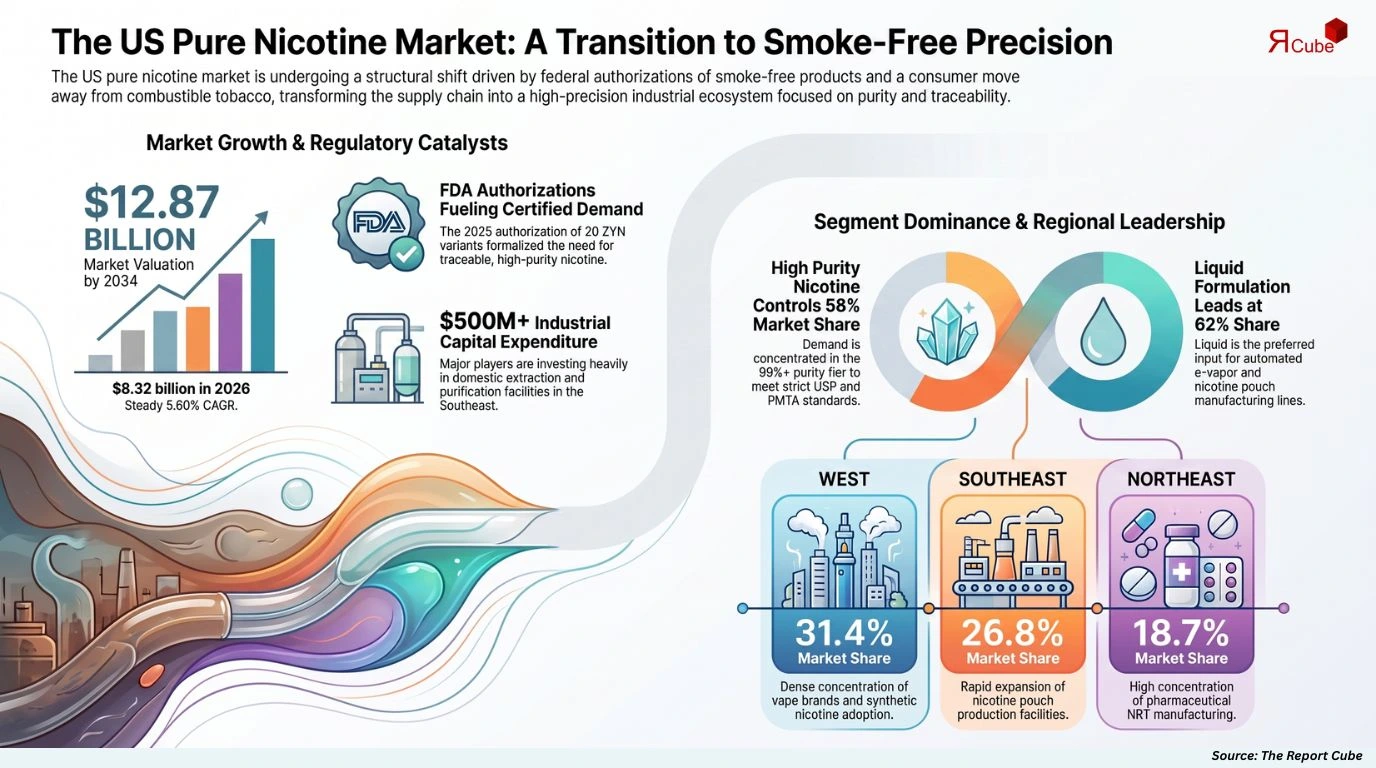
The US Pure Nicotine Market is anticipated to register a 5.60% CAGR during 2026–2034. The market size was valued at USD 8.32 billion in 2026 and is projected to reach USD 12.87 billion by 2034. The industry is benefiting from a structural shift in American nicotine consumption away from combustible tobacco, with federal authorization milestones for next-generation delivery formats fueling consistent upstream demand for pharmaceutical-grade and industrial-grade pure nicotine feedstocks. Investments in domestic nicotine extraction, purification, and synthetic production are reinforcing long-term supply security for e-liquid formulators, pouch manufacturers, and nicotine replacement therapy (NRT) developers alike.
The market's momentum is further reinforced by a combination of private capital inflows and public-sector research backing. Yale University's $20 million federal grant for nicotine cessation research and Sesh's $40 million fundraise for nicotine pouch innovation underscore the breadth of institutional confidence in smoke-free nicotine product development. Regulatory clarity following the FDA's synthetic nicotine authority amendment and the January 2025 authorization of 20 ZYN nicotine pouch variants have formalized demand signals across the supply chain, prompting domestic manufacturers to scale high-purity and ultra-high-purity nicotine output. Industry-wide capital expenditure by major players exceeded $500 million in 2025, with production facilities in Florida, North Carolina, and Virginia anchoring a domestic pure nicotine supply ecosystem.
US Pure Nicotine Market Dynamics
The US pure nicotine industry is expanding across both upstream extraction and downstream formulation segments as consumer preferences shift decisively toward smoke-free delivery formats. Driven by robust demand from e-liquid producers, nicotine pouch manufacturers, pharmaceutical companies, and smoking cessation product developers, the market is transitioning from a commodity supply chain to a precision-grade industrial ecosystem requiring consistent purity certification, traceability standards, and compliance with evolving FDA premarket requirements.
|
Factor |
Type |
Specific Impact on Market |
Magnitude |
|---|---|---|---|
|
FDA premarket authorization of nicotine pouches |
Driver |
Formalizes demand for certified high-purity nicotine inputs |
Very High |
|
Rising nicotine pouch consumption |
Driver |
Accelerates large-scale domestic pure nicotine procurement |
High |
|
Synthetic nicotine patent expansion |
Trend |
Enables tobacco-free formulation across premium product tiers |
High |
|
Regulatory PMTA compliance requirements |
Driver |
Boosts demand for traceable, pharmaceutical-grade nicotine |
High |
|
State-level excise tax increases |
Challenge |
Shifts consumer mix toward premium smokeless formats |
Medium |
Key Market Driver: FDA Authorization Driving Certified Nicotine Demand
The January 2025 FDA authorization of 20 ZYN nicotine pouch products marked a pivotal inflection point for the US pure nicotine supply chain. Manufacturers producing authorized products are legally obligated to source nicotine meeting documented purity standards under premarket tobacco product application (PMTA) specifications. This regulatory threshold has elevated quality assurance requirements for upstream nicotine suppliers, with processors investing in USP-grade distillation, batch-level verification, and certificate-of-analysis protocols. The FDA's September 2025 PMTA pilot program for nicotine pouches, restricted to major players including PMI, Altria, and Reynolds, further concentrates demand toward certified, traceable pure nicotine supply chains for regulated manufacturers.
Major Industry Challenge: Tobacco-Derived Supply Chain Traceability Pressures
Pure nicotine destined for PMTA-authorized products must meet traceability requirements that extend through the extraction and purification supply chain, creating compliance cost pressures for smaller domestic processors. The coexistence of tobacco-derived and synthetic nicotine pathways complicates sourcing decisions, as manufacturers must demonstrate purity lineage to satisfy FDA documentation standards. State-level enforcement actions against illicit nicotine products have further heightened scrutiny of supply chain certifications, compelling processors to invest in third-party quality audits, testing infrastructure, and regulatory documentation systems that add operational complexity without proportionally increasing revenue per unit.
Emerging Trend Shaping Outlook: Synthetic Nicotine Penetrating Premium Formulation Tiers
Next Generation Labs' patented TFN (Tobacco Free Nicotine) platform has catalyzed a broader industry movement toward synthetic pure nicotine as a preferred feedstock for premium e-liquid and pouch formulations. Synthetic nicotine eliminates tobacco-specific nitrosamines and anabasine contaminants inherent in leaf-derived extraction, delivering cleaner sensory profiles that support product differentiation in premium consumer segments. NJOY's patent for synthetic nicotine synthesis and purification signals that major branded players are moving toward synthetic nicotine production for next-generation delivery formats, positioning synthetic nicotine as a long-term structural growth driver within the US market rather than a niche alternative.
Need Specific Data, Let’s Customize the Report for You
Request CustomizationUS Pure Nicotine Market Segment-wise Analysis
The US pure nicotine industry spans a diverse range of processing grades and physical formulations that serve distinct downstream applications across pharmaceutical manufacturing, e-liquid production, nicotine replacement therapy development, and oral pouch processing. Segment dynamics reflect the increasing specialization of nicotine sourcing as end-product categories diversify and regulatory requirements impose stricter purity and traceability standards.
By Purity Level
- High Purity
- Medium Purity
- Low Purity
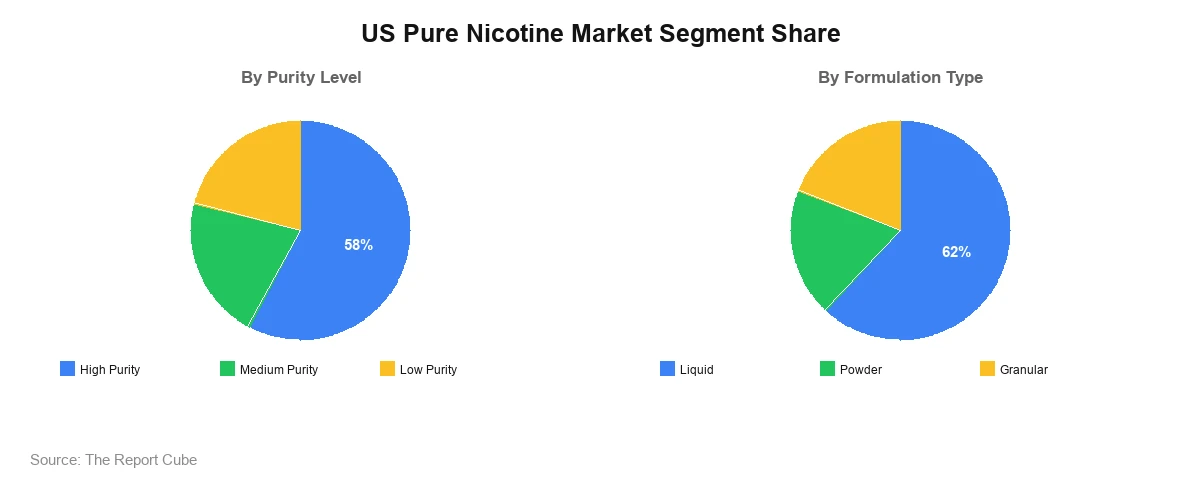
High purity nicotine commands the dominant share of the US purity level segment, accounting for an estimated 58% of total market revenue. This category encompasses nicotine processed to a minimum of 99% concentration, typically verified against United States Pharmacopeia (USP) standards, and serves the pharmaceutical NRT segment, premium e-liquid manufacturers, and FDA-authorized pouch producers. The FDA's PMTA framework has effectively mandated high purity sourcing for any brand pursuing regulatory clearance, concentrating procurement among certified domestic suppliers such as AmeriNic and Next Generation Labs. The purity threshold also aligns with pharmaceutical co-processing agreements, where patch and gum manufacturers require batch-level consistency for clinical-grade input formulations.
Medium purity nicotine, typically ranging between 95% and 98.9% concentration, serves the broader e-liquid manufacturing base, accounting for approximately 31% of segment revenue. This tier balances cost efficiency with functional performance for volume-focused vape liquid producers where PMTA authorization is pending or not pursued. Low purity nicotine, used in biopesticide applications and select industrial processes, constitutes the remaining 11% of segment revenue and represents a structurally mature sub-segment with limited near-term growth upside. The fastest growth trajectory resides firmly in the high purity tier, driven by regulatory formalization, branded product premiumization, and pharmaceutical pipeline expansion linking nicotine-based therapeutic delivery systems to demand for ultra-pure certified inputs.
By Formulation Type
- Liquid
- Powder
- Granular
Liquid nicotine maintains dominant positioning within the US formulation type segment, representing an estimated 62% of market revenue. This formulation encompasses diluted nicotine solutions and nicotine base preparations used directly in e-liquid blending, nicotine salt synthesis, and pharmaceutical liquid manufacturing. The explosive growth of US nicotine pouch production - anchored by Reynolds American's $200 million facility expansion in North Carolina and Swisher's $135 million Jacksonville investment - has significantly elevated domestic demand for liquid nicotine as a primary processing input. Liquid formulations offer superior integration into automated pouch and e-liquid manufacturing lines, enabling precise dosing control, reducing handling complexity, and accelerating production throughput at the scale required by major branded manufacturers.
Powder nicotine captures approximately 24% of formulation type revenue and serves the dry-blended pouch matrix, oral lozenge, and dietary supplement manufacturing segments. Granular nicotine, which accounts for the remaining 14% of revenue, is used in specialty tobacco applications and select industrial blending processes. The powder formulation sub-segment represents the fastest-growing tier within this category, as nicotine pouch manufacturers requiring dry matrix integration increasingly adopt precision-milled pharmaceutical-grade powder over liquid conversion processes. Continued investment in US oral nicotine pouch manufacturing capacity is expected to sustain strong demand growth for both liquid and powder formulations through 2034.
Regional Projection of US Pure Nicotine Market
The US pure nicotine market exhibits meaningful regional variation driven by differences in manufacturing infrastructure, proximity to downstream consumer product producers, regulatory enforcement density, and state-level production incentive frameworks. Production and consumption patterns are clustered across specific geographic corridors linked to established tobacco, pharmaceutical, and e-liquid processing ecosystems.
|
Region |
Estimated Market Share |
Key Growth Factors |
Consumer Trends |
|---|---|---|---|
|
West |
31.4% |
Advanced e-liquid manufacturing base, vape brand concentration |
High adoption of liquid and synthetic nicotine formulations |
|
Southeast |
26.8% |
Major pouch manufacturing expansion, tobacco heritage supply chain |
Surging demand for high purity nicotine in pouch production |
|
Northeast |
18.7% |
Pharmaceutical and NRT manufacturing concentration |
Growing demand for USP-grade pharmaceutical nicotine |
|
Midwest |
13.5% |
Distribution hub infrastructure and emerging vape processing |
Increasing uptake of medium purity liquid nicotine inputs |
|
Southwest |
9.6% |
Emerging vape retail and e-liquid blending activity |
Rising demand for small-batch premium nicotine formulations |
- West: The Western US leads with an estimated 31.4% market share, anchored by California's dense concentration of e-liquid brands, vape product manufacturers, and boutique nicotine formulators requiring high-volume liquid nicotine supply.
- Southeast: The Southeast is the fastest-growing US region, with Reynolds American's North Carolina expansion and Swisher's Jacksonville facility investment collectively adding hundreds of millions in annual nicotine feedstock procurement demand.
- Northeast: The Northeast hosts the largest concentration of pharmaceutical NRT manufacturers, sustaining consistent demand for USP-certified high purity nicotine in patch, gum, and lozenge production.
- Midwest: The Midwest serves primarily as a distribution and blending intermediary, with processors and regional e-liquid producers driving steady demand for medium purity liquid nicotine at competitive volume pricing.
- Southwest: The Southwest represents an emerging production cluster, with small-scale e-liquid blenders and specialty nicotine formulators driving incremental demand growth for premium and synthetic nicotine grades.
US Pure Nicotine Market: Recent Development (2025)
- Reynolds American expanded its Tobaccoville, NC facility with $200 million investment to scale nicotine pouch production capacity.
- Swisher International announced a $135 million Jacksonville expansion adding 240 jobs for nicotine pouch output.
- Altria secured additional FDA clearances for on! and on! PLUS pouches under a streamlined PMTA pilot review.
- Next Generation Labs extended TFN synthetic nicotine distribution partnerships across premium US e-liquid manufacturers.
US Pure Nicotine Market Future Outlook (2034)
The US Pure Nicotine Market is projected to expand at a 5.60% CAGR, reaching approximately USD 12.87 billion by 2034. Growth will be underpinned by the continued proliferation of FDA-authorized smoke-free products requiring certified nicotine inputs, as manufacturers of nicotine pouches, e-liquids, and pharmaceutical NRT products converge on traceable, high-purity domestic supply chains. The accelerating transition of major tobacco companies toward smoke-free portfolios - exemplified by Reynolds American earmarking $3.2 billion in nicotine product spending through 2030 — signals durable structural demand that will sustain upstream pure nicotine procurement at scale.
Technology advancement will play a pivotal role in reshaping production economics across the forecast period. Synthetic nicotine processes are expected to achieve cost parity with tobacco-derived extraction methods as patent portfolios mature and manufacturing scales, enabling a broader adoption of tobacco-free nicotine across consumer product categories. AI-driven quality monitoring systems embedded in nicotine extraction and purification facilities will improve batch consistency, reduce waste, and accelerate compliance documentation, further lowering the per-unit cost of certified high purity nicotine manufacturing for pharmaceutical applications. Long-term market expansion will be anchored by the compounding effect of regulatory formalization, continued investment in end-of-life battery recycling and material recovery, and the entry of wellness and functional nicotine products into mainstream consumer distribution channels.
US Pure Nicotine Market Report Coverage
|
Report Attribute |
Details |
|---|---|
|
Market Name |
US Pure Nicotine Market |
|
Market Size (2026) |
USD 8.32 Billion |
|
Market Size (2034) |
USD 12.87 Billion |
|
Forecast Period |
2026–2034 |
|
CAGR |
5.60% |
|
Base Year |
2026 |
|
Historical Years |
2021–2025 |
|
Forecast Years |
2026–2034 |
|
Segments Covered |
By Purity Level, By Formulation Type, By Application, By End Use |
|
Regions Covered |
West, Southeast, Northeast, Midwest, Southwest |
|
Key Companies |
Altria Group Inc, Reynolds American Inc, Philip Morris USA Inc, Swisher International Inc, Nicotine River LLC, American Vapor Company, Next Generation Labs, Pure Nicotine LLC, Others |
|
Report Format |
PDF, Excel, PPT |
|
Customization |
Available as per client requirements |
Why Choose This Report?
- Comprehensive analysis of purity level and formulation type segmentation across the US market.
- Accurate market sizing anchored at USD 8.32 billion with reliable forecast through 2034.
- In-depth coverage of synthetic nicotine's growing role in premium formulation tiers.
- Regional insights covering five distinct US production and consumption corridors.
- Competitive profiling of leading domestic pure nicotine suppliers and branded manufacturers.
- Analysis of FDA PMTA authorization impact on pure nicotine supply chain requirements.
- Strategic insights supporting sourcing, investment, and market entry planning decisions.
- Data-driven research grounded in verified 2025 industry developments and regulatory activity.
Table of Contents
- Introduction
- Objective of the Study
- Product Definition
- Market Segmentation
- Study Variables
- Research Methodology
- Secondary Data Points
- Companies Interviewed
- Primary Data Points
- Breakdown of Primary Interviews
- Secondary Data Points
- Executive Summary
- Market Dynamics
- Drivers
- Challenges
- Opportunity Assessment
- Recent Trends and Developments
- Policy and Regulatory Landscape
- US Pure Nicotine Market Overview and Forecast Analysis (2021-2034)
- Market Size, By Value, By Growth Rate (CAGR/USD Billions)
- Demand – Supply Trends
- Market Share, By End Use
- Tobacco Industry
- Vaping Industry
- Pharmaceutical Industry
- Agricultural Sector
- Market Share, By Application
- Pharmaceuticals
- E-liquids
- Nicotine Replacement Therapy
- Research
- Pesticides
- Market Share, By Purity Level
- High Purity
- Medium Purity
- Low Purity
- Market Share, By Formulation Type
- Liquid
- Powder
- Granular
- Market Share, By Region
- West
- Southeast
- Northeast
- Midwest
- Southwest
- Market Share, By Competitors
- Competition Characteristics
- Revenue Shares
- Tobacco Industry US Pure Nicotine Market Overview, 2021-2034F
- By Value (USD Million)
- By Application – Market Size & Forecast 2021-2034, USD Million
- Pharmaceuticals
- E-liquids
- Nicotine Replacement Therapy
- Research
- Pesticides
- Vaping Industry US Pure Nicotine Market Overview, 2021-2034F
- By Value (USD Million)
- By Application – Market Size & Forecast 2021-2034, USD Million
- Pharmaceuticals
- E-liquids
- Nicotine Replacement Therapy
- Research
- Pesticides
- Pharmaceutical Industry US Pure Nicotine Market Overview, 2021-2034F
- By Value (USD Million)
- By Application – Market Size & Forecast 2021-2034, USD Million
- Pharmaceuticals
- E-liquids
- Nicotine Replacement Therapy
- Research
- Pesticides
- Agricultural Sector US Pure Nicotine Market Overview, 2021-2034F
- By Value (USD Million)
- By Application – Market Size & Forecast 2021-2034, USD Million
- Pharmaceuticals
- E-liquids
- Nicotine Replacement Therapy
- Research
- Pesticides
- Competitive Outlook (Company Profile – Partial List)
- Altria Group Inc
- Company Overview
- Business Segments
- Strategic Alliances/Partnerships
- Recent Developments
- Reynolds American Inc
- Company Overview
- Business Segments
- Strategic Alliances/Partnerships
- Recent Developments
- Philip Morris USA Inc
- Company Overview
- Business Segments
- Strategic Alliances/Partnerships
- Recent Developments
- Swisher International Inc
- Company Overview
- Business Segments
- Strategic Alliances/Partnerships
- Recent Developments
- Nicotine River LLC
- Company Overview
- Business Segments
- Strategic Alliances/Partnerships
- Recent Developments
- American Vapor Company
- Company Overview
- Business Segments
- Strategic Alliances/Partnerships
- Recent Developments
- Next Generation Labs
- Company Overview
- Business Segments
- Strategic Alliances/Partnerships
- Recent Developments
- Pure Nicotine LLC
- Company Overview
- Business Segments
- Strategic Alliances/Partnerships
- Recent Developments
- Others
- Altria Group Inc
- Contact Us & Disclaimer
Top Key Players & Market Share Outlook
- Altria Group Inc
- Reynolds American Inc
- Philip Morris USA Inc
- Swisher International Inc
- Nicotine River LLC
- American Vapor Company
- Next Generation Labs
- Pure Nicotine LLC
- Others
Frequently Asked Questions






