



Build Your Custom Market Intelligence Report
Customize Your ReportUSA Quantum Computing as a Service (QCaaS) Market Key Takeaways
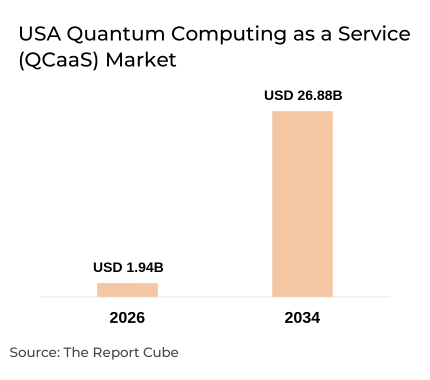
- USA Quantum Computing as a Service (QCaaS) Market was valued at USD 1.94 billion in 2026.
- The market is projected to reach USD 26.88 billion by 2034, expanding significantly.
- A robust 38.90% CAGR is forecast for the 2026–2034 period across the USA.
- Subscription-Based pricing leads revenue, driven by enterprise adoption and platform commitments.
- Finance & Banking remains the dominant end-user segment due to optimization workload demand.
- The Northeast United States leads regional revenue through financial and research hub density.
- The West United States is the fastest-growing region driven by tech cluster investments.
- AI-quantum hybrid computing is rapidly reshaping enterprise service delivery and adoption models.
- Key players include Amazon Web Services, Microsoft, Google Cloud, IBM, D-Wave, IonQ, and Quantinuum.
USA Quantum Computing as a Service (QCaaS) Market Insights & Analysis
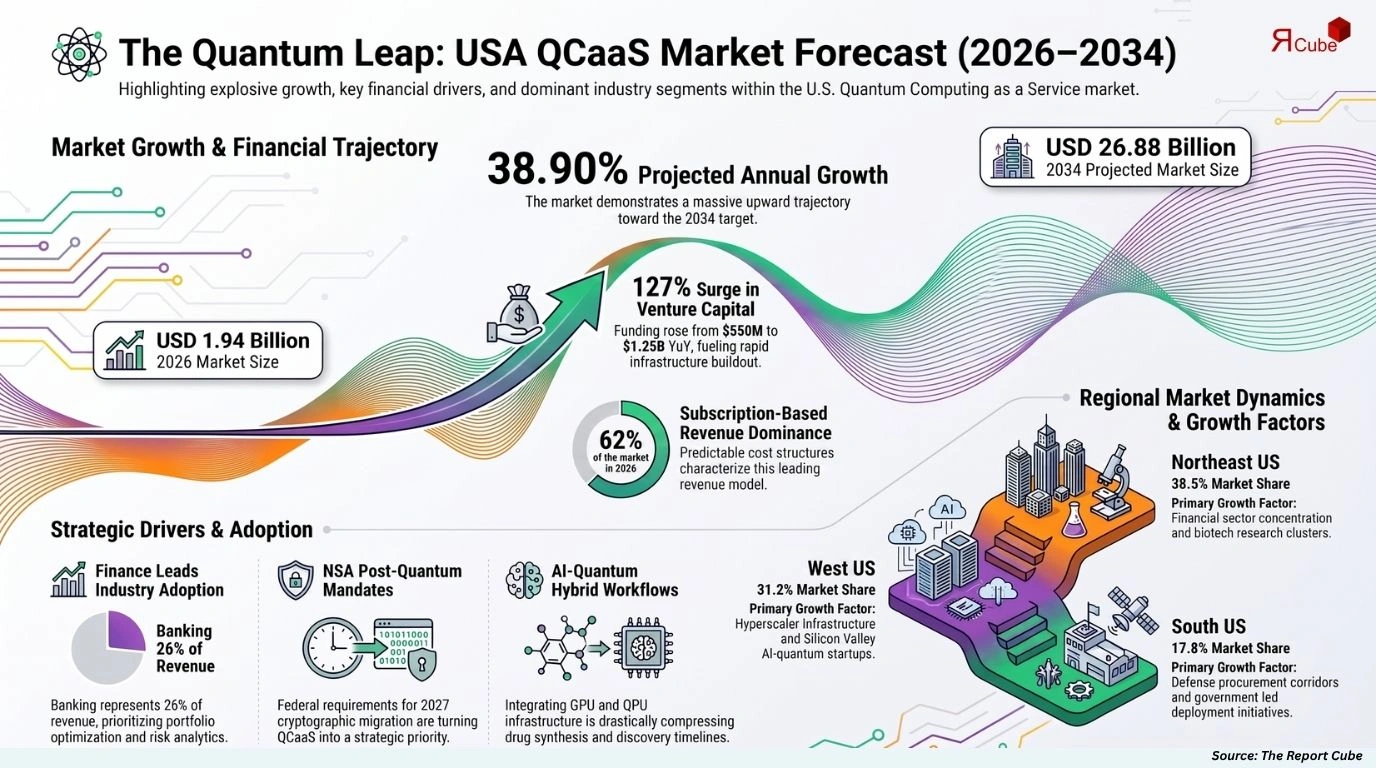
The USA Quantum Computing as a Service (QCaaS) Market is anticipated to register a 38.90% CAGR during 2026–2034. The market size was valued at USD 1.94 billion in 2026 and is projected to reach USD 26.88 billion by 2034. The United States accounts for approximately 82.55% of North America's total QCaaS revenue, driven by the world's densest concentration of quantum hardware vendors, cloud platforms, and enterprise adopters. The National Quantum Initiative Act has channeled over USD 1.8 billion in federal funding toward quantum research, commercialization, and workforce development, creating structural tailwinds across every end-user vertical.
Enterprise demand across finance, pharmaceuticals, defense, and telecommunications is accelerating as organizations recognize that classical computing architectures cannot solve certain categories of optimization and simulation problems at scale. IBM's Quantum Network now exceeds 400 institutional members, while Amazon Braket's 2025 Emerald processor launch extended cloud quantum capabilities for enterprise customers. Venture capital investment in quantum computing climbed from USD 550 million in Q1 2024 to USD 1.25 billion in Q1 2025, a year-over-year rise of approximately 127%. This funding surge is directly reinforcing QCaaS infrastructure buildout and application development across the quantum software and algorithms development ecosystem.
USA Quantum Computing as a Service (QCaaS) Market Dynamics
The USA QCaaS market is expanding as cloud-delivered quantum access becomes the practical entry point for enterprises across banking, life sciences, defense, and energy. Growing national security mandates, post-quantum cryptography adoption timelines set by the NSA, and accelerating qubit fidelity improvements are transforming QCaaS from an experimental tool into a mission-critical platform. Federal agencies, Fortune 500 enterprises, and research universities are all increasing quantum cloud commitments.
|
Factor |
Type |
Specific Impact on Market |
Magnitude |
|---|---|---|---|
|
NSA post-quantum cryptography mandates |
Driver |
Accelerates QCaaS adoption for cryptographic migration pilots |
Very High |
|
Subscription and pay-per-use models |
Opportunity |
Lowers enterprise entry barriers and boosts recurring revenue |
High |
|
NISQ-to-fault-tolerant hardware transition |
Driver |
Expands deployable workload categories for QCaaS platforms |
High |
|
Quantum algorithm scarcity |
Challenge |
Limits practical application depth across non-specialist enterprises |
Medium |
|
AI-quantum hybrid workflows |
Trend |
Creates new hybrid computing demand across cloud QCaaS providers |
Very High |
Key Market Driver: Federal Mandates Accelerating Enterprise Quantum Adoption
The NSA's directive requiring federal agencies and contractors to migrate to post-quantum cryptographic algorithms by 2027 has elevated QCaaS from a research curiosity to a strategic enterprise priority. Financial institutions, defense contractors, and telecommunications providers are actively using QCaaS platforms to simulate quantum attack scenarios against RSA-2048 and ECC-256 encryption schemes, test NIST-approved post-quantum algorithms, and develop quantum key distribution integration strategies. DARPA's Quantum Benchmarking Initiative, which selected IonQ for its first stage in 2025, further reinforces the federal quantum computing procurement pipeline as a durable commercial driver for QCaaS vendors.
Major Industry Challenge: Practical Algorithm Development Remains Constrained
Despite hardware progress, the availability of enterprise-ready quantum algorithms that demonstrate clear computational advantages over classical systems remains limited across most verticals. Building in-house quantum algorithm expertise requires specialized talent that remains scarce across financial, pharmaceutical, and industrial organizations. Most enterprise QCaaS users currently operate in hybrid classical-quantum workflows where quantum handles specific subroutines rather than full-stack problem solving. Bridging this gap requires sustained investment in quantum software development kits, professional services, and algorithm libraries - areas where IBM Quantum, Quantinuum, and Google Cloud have begun differentiating their QCaaS platforms.
Emerging Trend Shaping Outlook: AI-Quantum Hybrid Computing Workflows
A defining shift in the USA QCaaS market is the convergence of large-scale AI infrastructure with quantum processing. In June 2025, IonQ partnered with AstraZeneca, AWS, and NVIDIA to deliver over 20x speedup in simulating Suzuki-Miyaura drug synthesis reactions using IonQ Forte with NVIDIA CUDA-Q on Amazon Braket - compressing months of computation into days. IBM and AMD announced a partnership in August 2025 to develop quantum-centric supercomputing architectures combining quantum processors with high-performance computing. These AI-quantum hybrid platforms are creating demand for quantum-classical hybrid computing infrastructure that supports both near-term NISQ workloads and longer-term fault-tolerant deployments.
Need Specific Data, Let’s Customize the Report for You
Request CustomizationUSA Quantum Computing as a Service (QCaaS) Market Segment-wise Analysis
The USA QCaaS market spans multiple revenue and pricing structures alongside a diverse set of enterprise end-users. Segmenting by revenue and pricing model reveals how demand for accessible, usage-flexible quantum access is reshaping commercial structures, while end-user segmentation highlights which industries are driving the deepest quantum integration and the highest per-account revenue contribution.
By Revenue & Pricing Model
- Subscription-Based
- Pay-Per-Use / On-Demand
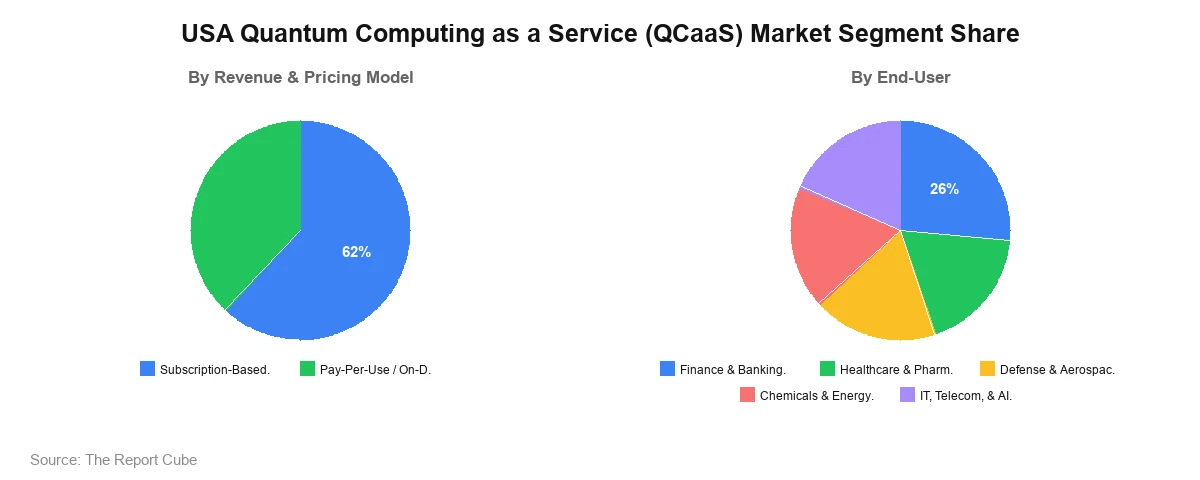
Subscription-Based pricing commands an estimated 62% of the USA QCaaS market in 2026, reflecting strong enterprise preference for predictable cost structures and guaranteed platform access. Large financial institutions, defense contractors, and pharmaceutical research teams adopt subscription models to secure priority queuing on high-demand quantum backends, access proprietary algorithm libraries, and maintain dedicated technical support relationships. IBM Quantum's premium-tier subscriptions and Microsoft Azure Quantum's enterprise agreements exemplify how tier-based pricing is locking in high-value, long-duration customer relationships across the most compute-intensive use cases.
Pay-Per-Use / On-Demand access accounts for the remaining 38% of market revenue but is the fastest-growing pricing model as startups, academic institutions, and small and mid-sized enterprises accelerate quantum experimentation. Amazon Braket pioneered this model through per-task pricing structures that allow organizations to pay cents per quantum circuit shot without infrastructure commitments. The accessibility of on-demand pricing is enabling quantum algorithm prototyping across SME and research sectors, broadening the customer base well beyond Fortune 500 enterprises and government agencies that historically dominated early adoption.
By End-User
- Finance & Banking
- Healthcare & Pharmaceuticals
- Defense & Aerospace
- Chemicals & Energy
- IT, Telecom, & AI
Finance & Banking is the dominant end-user segment, accounting for approximately 26% of total USA QCaaS revenue in 2026, driven by the sector's demanding requirements for portfolio optimization, derivatives pricing, Monte Carlo simulation acceleration, fraud detection, and real-time risk analytics. JPMorgan Chase, Goldman Sachs, and Citigroup have all maintained active quantum computing research units engaged with IBM Quantum and Google Cloud QCaaS platforms. The need to model complex correlations across millions of financial instruments simultaneously makes quantum optimization a high-priority investment even before full quantum advantage is commercially demonstrated.
Healthcare & Pharmaceuticals and Defense & Aerospace each represent substantial and rapidly growing end-user segments within the USA QCaaS landscape. Pharmaceutical companies are applying QCaaS to molecular simulation, protein folding computation, and drug-target interaction modeling - use cases that strain classical high-performance computing architectures. Defense and aerospace organizations represent the second-largest revenue segment by contract value, with the U.S. Air Force Research Lab holding a USD 54.5 million quantum networking hardware contract with IonQ and DARPA's Quantum Benchmarking Initiative expanding federal QCaaS procurement. Chemicals & Energy and IT, Telecom, & AI sectors are registering accelerating adoption as quantum optimization improves materials discovery workflows and network routing efficiency across large-scale infrastructure operators.
Regional Projection of USA Quantum Computing as a Service (QCaaS) Market
The USA QCaaS market exhibits distinct regional variation driven by the concentration of quantum hardware vendors, cloud infrastructure providers, research universities, financial institutions, and federal government facilities. The Northeast leads on revenue concentration, while the West delivers the fastest hardware innovation activity and the South is emerging as a significant government-led quantum deployment corridor.
|
Region |
Estimated Market Share |
Key Growth Factors |
Consumer Trends |
|---|---|---|---|
|
Northeast United States |
38.5% |
Financial sector concentration, Ivy League research partnerships, IBM and IonQ proximity |
High subscription-tier adoption across banking and pharma |
|
West United States |
31.2% |
Silicon Valley hyperscaler infrastructure, Google and AWS QCaaS platform leadership |
Rapid pay-per-use growth among startups and AI-quantum developers |
|
South United States |
17.8% |
Defense procurement corridors, IonQ's Maryland headquarters expansion, DARPA initiatives |
Growing government contract-driven enterprise QCaaS deployments |
|
Midwest United States |
12.5% |
University of Chicago quantum research, energy sector optimization pilots, IBM Poughkeepsie facility |
Increasing chemical and energy sector QCaaS adoption |
- Northeast United States: The Northeast holds approximately 38.5% of total USA QCaaS revenue, anchored by Wall Street financial institutions, biotechnology research clusters in Boston, and proximity to IBM and IonQ's primary development centers driving deep enterprise adoption.
- West United States: The West is the fastest-growing region, powered by Google Cloud, Amazon Braket, and Microsoft Azure Quantum's hyperscaler infrastructure in California and Washington, alongside a dense startup ecosystem pursuing AI-quantum hybrid applications across Silicon Valley.
- South United States: The South is rapidly gaining share through defense-focused deployments anchored by IonQ Federal's government procurement unit, DARPA's quantum benchmarking programs, and IonQ's expanding Maryland headquarters at the University of Maryland's College Park campus.
- Midwest United States: The Midwest is accelerating through the University of Chicago's Pritzker School of Molecular Engineering, IBM's Poughkeepsie quantum facility, and growing chemical and energy industry adoption of QCaaS for materials simulation and grid optimization workloads.
USA Quantum Computing as a Service (QCaaS) Market: Recent Development (2025)
- Amazon Web Services launched its 54-qubit Emerald quantum processor on Braket, enhancing enterprise QCaaS fidelity capabilities.
- IonQ secured DARPA's Quantum Benchmarking Initiative selection, validating its enterprise-grade QCaaS platform viability.
- IBM unveiled plans to build a large-scale fault-tolerant quantum computer at its Poughkeepsie, New York data center.
- D-Wave completed its USD 550 million acquisition of Quantum Circuits Inc., expanding its USA QCaaS portfolio.
USA Quantum Computing as a Service (QCaaS) Market Future Outlook (2034)
The USA Quantum Computing as a Service (QCaaS) Market is projected to expand at a 38.90% CAGR, reaching approximately USD 26.88 billion by 2034. The transition from noisy intermediate-scale quantum (NISQ) devices toward fault-tolerant quantum computers will fundamentally expand the range of commercially viable workloads available through QCaaS platforms. IBM's roadmap targeting quantum circuits with up to 7,500 gates by 2026 and quantum-centric supercomputers capable of running 1 billion gates by 2033 signals the hardware trajectory that will drive QCaaS service expansion across finance, pharmaceuticals, defense, and energy. Demand for post-quantum cryptography migration services will remain a structural growth driver as NSA compliance deadlines approach.
AI-quantum hybrid computing will emerge as the defining growth category within the USA QCaaS market through 2034 as enterprises deploy integrated NVIDIA GPU-QPU workflows, quantum-accelerated machine learning, and autonomous optimization systems across logistics, financial modeling, and drug discovery. Continued federal investment through the National Quantum Initiative, expanding university-industry research partnerships, and the proliferation of quantum application development platforms will collectively sustain long-term market expansion. Enterprises that build QCaaS capabilities today are positioning themselves for quantum advantage demonstrations expected in the late 2020s that will unlock entirely new categories of commercially transformative computation.
USA Quantum Computing as a Service (QCaaS) Market Report Coverage
|
Report Attribute |
Details |
|---|---|
|
Market Name |
USA Quantum Computing as a Service (QCaaS) Market |
|
Market Size (2026) |
USD 1.94 Billion |
|
Market Size (2034) |
USD 26.88 Billion |
|
Forecast Period |
2026–2034 |
|
CAGR |
38.90% |
|
Base Year |
2026 |
|
Historical Years |
2021–2025 |
|
Forecast Years |
2026–2034 |
|
Segments Covered |
By Revenue & Pricing Model, By End-User, By Cloud Deployment Model, By Hardware Modality, By Component |
|
Regions Covered |
West United States, Midwest United States, Northeast United States, South United States |
|
Key Companies |
Amazon Web Services, Microsoft, Google Cloud, IBM, D-Wave Quantum Inc., IonQ, Quantinuum, Others |
|
Report Format |
PDF, Excel, PPT |
|
Customization |
Available as per client requirements |
Why Choose This Report?
- Comprehensive analysis of USA QCaaS market across pricing, end-user, and regional segments.
- Accurate market sizing from USD 1.94 billion to USD 26.88 billion through 2034.
- Detailed coverage of subscription and pay-per-use pricing model revenue dynamics.
- Regional insights across all four major US corridors with market share data.
- Profiling of key quantum cloud vendors including AWS, IBM, Google, and IonQ.
- Analysis of AI-quantum hybrid computing trends shaping enterprise platform demand.
- Federal procurement and NSA compliance dynamics informing long-term investment positioning.
- Data-driven research following EEAT standards and current industry best practices.
Table of Contents
- Introduction
- Objective of the Study
- Product Definition
- Market Segmentation
- Study Variables
- Research Methodology
- Secondary Data Points
- Companies Interviewed
- Primary Data Points
- Breakdown of Primary Interviews
- Secondary Data Points
- Executive Summary
- Market Dynamics
- Drivers
- Challenges
- Opportunity Assessment
- Recent Trends and Developments
- Policy and Regulatory Landscape
- USA Quantum Computing as a Service (QCaaS) Market Overview and Forecast Analysis (2021-2034)
- Market Size, By Value, By Growth Rate (CAGR/USD Billions)
- Demand – Supply Trends
- Market Share, By Component
- Hardware Access
- Quantum Simulators
- Software & Middleware
- Professional & Consulting Services
- Market Share, By Hardware Modality
- Superconducting Circuits
- Trapped Ions
- Neutral Atoms
- Photonic (Light-based)
- Quantum Annealing
- Market Share, By Cloud Deployment Model
- Public Cloud Platforms
- Private Cloud Platforms
- Hybrid Classical-Quantum Cloud
- Market Share, By Revenue & Pricing Model
- Subscription-Based
- Pay-Per-Use / On-Demand
- Market Share, By End-User
- Finance & Banking
- Healthcare & Pharmaceuticals
- Defense & Aerospace
- Chemicals & Energy
- IT, Telecom, & AI
- Market Share, By Region
- West United States
- Midwest United States
- Northeast United States
- South United States
- Market Share, By Competitors
- Competition Characteristics
- Revenue Shares
- Hardware Access USA Quantum Computing as a Service (QCaaS) Market Overview, 2021-2034F
- By Value (USD Million)
- By Hardware Modality – Market Size & Forecast 2021-2034, USD Million
- Superconducting Circuits
- Trapped Ions
- Neutral Atoms
- Photonic (Light-based)
- Quantum Annealing
- Quantum Simulators USA Quantum Computing as a Service (QCaaS) Market Overview, 2021-2034F
- By Value (USD Million)
- By Hardware Modality – Market Size & Forecast 2021-2034, USD Million
- Superconducting Circuits
- Trapped Ions
- Neutral Atoms
- Photonic (Light-based)
- Quantum Annealing
- Software & Middleware USA Quantum Computing as a Service (QCaaS) Market Overview, 2021-2034F
- By Value (USD Million)
- By Hardware Modality – Market Size & Forecast 2021-2034, USD Million
- Superconducting Circuits
- Trapped Ions
- Neutral Atoms
- Photonic (Light-based)
- Quantum Annealing
- Professional & Consulting Services USA Quantum Computing as a Service (QCaaS) Market Overview, 2021-2034F
- By Value (USD Million)
- By Hardware Modality – Market Size & Forecast 2021-2034, USD Million
- Superconducting Circuits
- Trapped Ions
- Neutral Atoms
- Photonic (Light-based)
- Quantum Annealing
- Competitive Outlook (Company Profile – Partial List)
- Amazon Web Services
- Company Overview
- Business Segments
- Strategic Alliances/Partnerships
- Recent Developments
- Microsoft
- Company Overview
- Business Segments
- Strategic Alliances/Partnerships
- Recent Developments
- Google Cloud
- Company Overview
- Business Segments
- Strategic Alliances/Partnerships
- Recent Developments
- IBM
- Company Overview
- Business Segments
- Strategic Alliances/Partnerships
- Recent Developments
- D-Wave Quantum Inc.
- Company Overview
- Business Segments
- Strategic Alliances/Partnerships
- Recent Developments
- IonQ
- Company Overview
- Business Segments
- Strategic Alliances/Partnerships
- Recent Developments
- Quantinuum
- Company Overview
- Business Segments
- Strategic Alliances/Partnerships
- Recent Developments
- Others
- Amazon Web Services
- Contact Us & Disclaimer
Top Key Players & Market Share Outlook
- Amazon Web Services
- Microsoft
- Google Cloud
- IBM
- D-Wave Quantum Inc.
- IonQ
- Quantinuum
- Others
Frequently Asked Questions






