



Build Your Custom Market Intelligence Report
Customize Your ReportBrazil Racing Games Market Key Takeaways
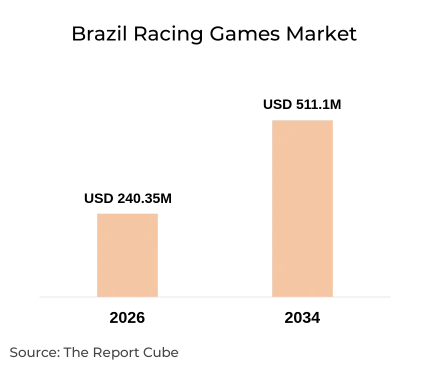
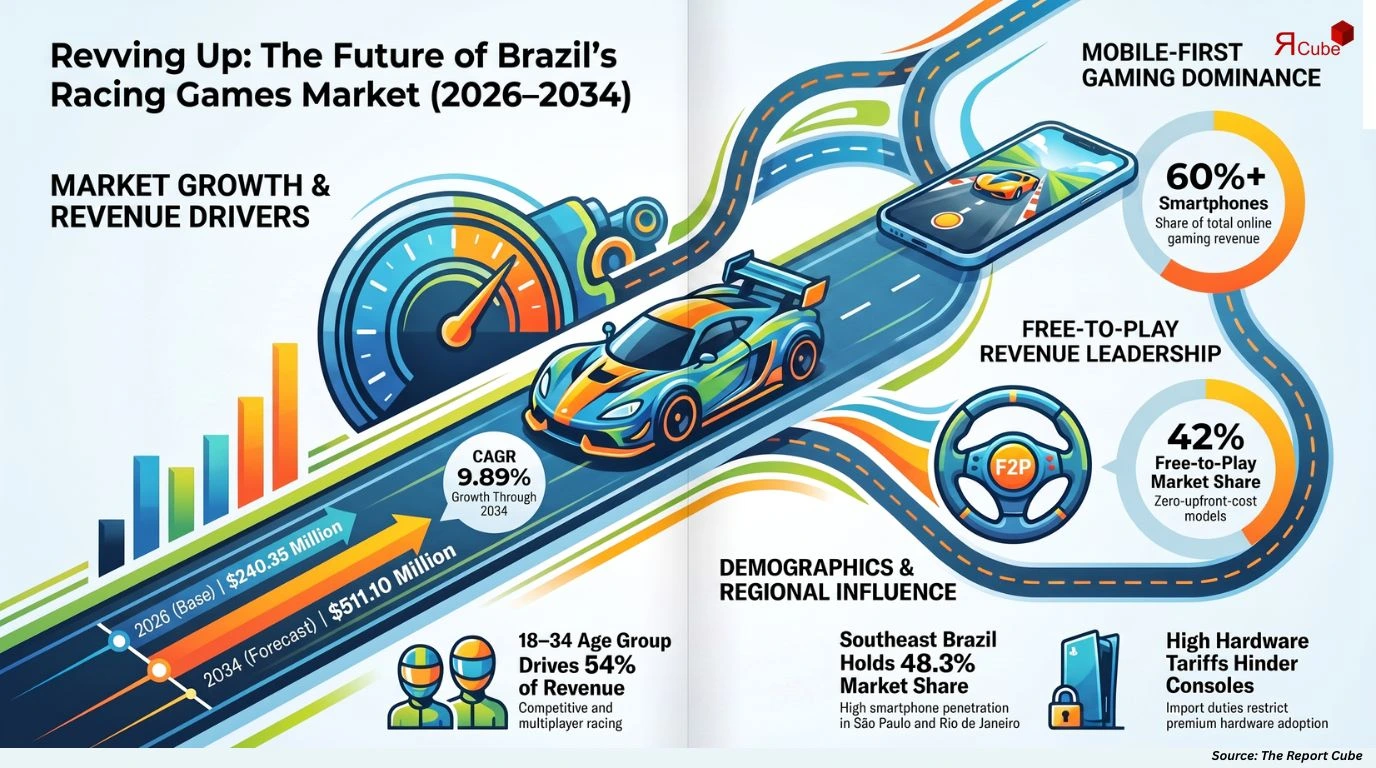
- Brazil Racing Games Market valued at USD 240.35 million in 2026, reflecting strong digital entertainment growth.
- Industry projected to reach USD 511.10 million by 2034, expanding at a 9.89% CAGR.
- Free-to-play monetization dominates revenue generation owing to widespread mobile gaming adoption.
- Male gamers aged 18 to 34 represent the largest and most commercially active user demographic.
- Brazil emerges as Latin America's leading racing games market, contributing over 10% regional revenue uplift.
- Mobile-first gaming platforms and 5G infrastructure expansion accelerate player engagement nationwide.
- Leading companies include Electronic Arts, Activision Blizzard, Ubisoft, Codemasters, Turn 10 Studios, and Milestone Srl.
- Rising esports visibility, in-game purchase innovation, and localized content strategies fuel long-term market expansion.
Brazil Racing Games Market Insights & Analysis
The Brazil Racing Games Market is anticipated to register a 9.89% CAGR during 2026–2034. The market size was valued at USD 240.35 million in 2026 and is projected to reach USD 511.10 million by 2034. Brazil's gaming ecosystem has undergone rapid transformation, driven by expanding smartphone penetration surpassing 82% of the adult population, affordable mobile data access, and a youthful demographic base with strong discretionary spending on digital entertainment. Government-backed initiatives including the Brazil Games export program - a strategic partnership between Abragames and ApexBrasil - have provided critical infrastructure and international visibility, reinforcing investor confidence and stimulating game developer activity across the country.
Increasing investment from global publishers seeking to localize racing titles with Portuguese language support, Brazilian track environments, and culturally resonant automotive themes continues differentiating the domestic market. Brazil's esports sector, projected to grow from USD 52.6 million in 2025 to USD 202.9 million by 2034 at a 15.69% CAGR, has elevated competitive racing gaming as a legitimate spectator sport, attracting sponsorship revenue from automotive and consumer electronics brands. The Brazil International Games (BIG) Festival - the largest gaming conference in Latin America - continues drawing global publishers, further accelerating content investment and distribution partnerships that sustain Brazil Racing Games Market momentum through the forecast period.
Brazil Racing Games Market Dynamics
Brazil's racing games sector continues attracting significant commercial attention as mobile-first consumption patterns, growing middle-class disposable incomes, and a deeply embedded automotive culture converge to create favorable market conditions. Major international publishers are actively prioritizing Brazilian content localization and regional monetization strategies while domestic developers gain international recognition, collectively reinforcing a competitive and rapidly maturing racing games ecosystem.
|
Factor |
Type |
Specific Impact on Market |
Magnitude |
|---|---|---|---|
|
Mobile gaming penetration |
Driver |
Accelerates free-to-play racing game downloads across income segments |
Very High |
|
Esports ecosystem expansion |
Opportunity |
Increases sponsorship and competitive racing game engagement |
High |
|
Portuguese content localization |
Driver |
Strengthens player retention and premium title conversion rates |
High |
|
5G infrastructure rollout |
Driver |
Enhances multiplayer racing game performance and streaming quality |
High |
|
In-game purchase innovation |
Trend |
Drives incremental monetization across free-to-play user base |
Very High |
Key Market Driver: Mobile Penetration Accelerating Free-to-Play Adoption
Brazil's mobile gaming infrastructure represents the most powerful demand driver for the racing games segment, with smartphones accounting for approximately 60.8% of total online gaming revenue in 2025. Affordable device availability, expanding 4G and 5G network coverage across urban and semi-urban areas, and the proliferation of competitively priced data plans have lowered participation barriers significantly. Free-to-play racing titles, including those optimized for lower-specification handsets, have enabled publishers such as Electronic Arts - through Real Racing and Need for Speed Mobile - to capture demographically diverse player segments, particularly among younger consumers with limited but growing racing simulation and mobile monetization spending power.
Major Industry Challenge: High Import Tariffs on Gaming Hardware
Brazil's protectionist trade framework imposes significant import duties on gaming hardware, including consoles, graphics cards, and high-performance peripherals essential for premium racing simulation experiences. These tariffs substantially increase the retail price of PlayStation and Xbox consoles, restricting console-based racing game adoption among lower- and middle-income segments that constitute the majority of Brazil's gaming population. As a result, publishers developing premium console-optimized racing titles face compressed addressable markets and must strategically invest in mobile-compatible versions or cross-platform adaptations to maintain competitive Latin American racing games distribution revenue positioning.
Emerging Trend Shaping Outlook: Automotive Brand Partnerships Reshaping Monetization
Global automotive manufacturers including Ferrari, Lamborghini, and domestic brands with strong Brazilian market recognition are increasingly partnering with racing game publishers to integrate official vehicle licenses, branded liveries, and sponsored in-game events. These collaborations deliver authenticity-driven engagement, elevate average revenue per user through premium cosmetic purchases, and create co-marketing channels that amplify organic user acquisition. Milestone Srl's official motorsport licensing strategy and Electronic Arts' multi-franchise automotive partnerships exemplify this trend, which is reshaping Brazilian motorsport gaming and automotive brand co-investment models well beyond traditional advertising formats.
Need Specific Data, Let’s Customize the Report for You
Request CustomizationBrazil Racing Games Market Segment-wise Analysis
Brazil's racing games landscape demonstrates nuanced consumption patterns shaped by demographic diversity, digital infrastructure variation, and evolving monetization preferences. Publishers targeting the domestic market are deploying differentiated strategies across user segments and revenue models to maximize engagement and commercial returns across Brazil's heterogeneous gamer base.
By User Demographics
- Age Group
- Gender
- Income Level
- Gaming Experience
- Geographic Distribution
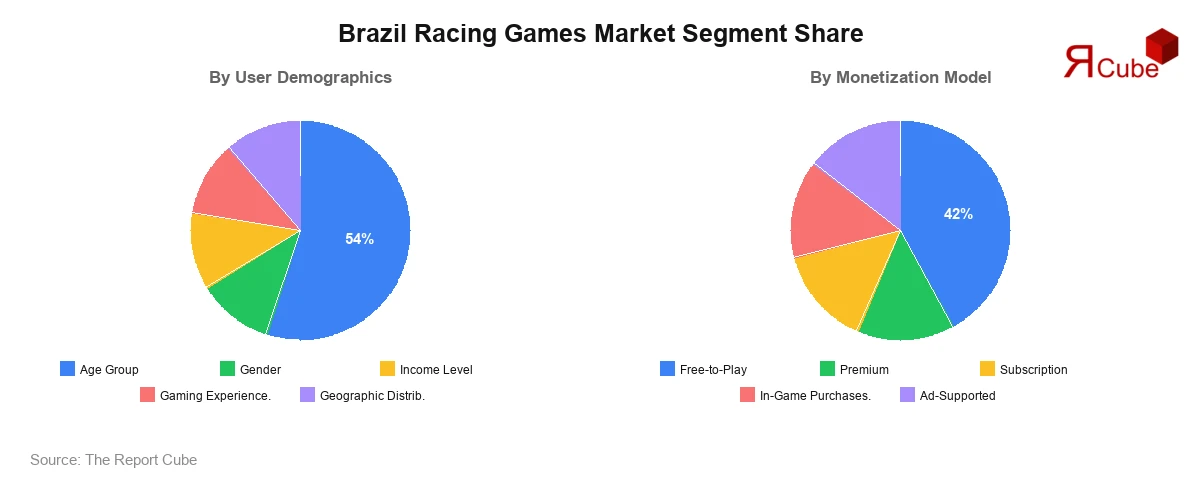
Brazil's 18-to-34 age cohort represents the dominant demographic segment, accounting for approximately 54% of total racing game revenue in 2026, driven by strong affinity for competitive multiplayer formats, esports consumption, and discretionary spending on in-game content. This group demonstrates the highest average session duration and conversion rates from free-to-play to premium content, making them the primary monetization target for major publishers deploying live-service racing models. Male gamers within this cohort drive outsized engagement, supported by Brazil's well-documented automotive culture and the rising influence of international motorsport events — particularly Formula 1, whose São Paulo Grand Prix consistently ranks among the most-watched sporting events in the country.
The female gamer segment represents a strategically significant and rapidly expanding sub-demographic, with survey data from Pesquisa Game Brasil indicating that women now constitute over 50% of Brazil's total gaming population. While casual and arcade-style racing formats attract stronger female engagement relative to simulation-heavy titles, publishers are increasingly tailoring accessible onboarding mechanics, social features, and customization tools to broaden cross-gender appeal. Middle-income urban gamers and experienced players seeking realistic driving simulation and competitive esports formats are emerging as the fastest-growing sub-segments, particularly as 5G availability improves game performance and online racing accessibility across Brazil's metropolitan regions.
By Monetization Model
- Free-to-Play
- Premium
- Subscription
- In-Game Purchases
- Ad-Supported
Free-to-play monetization commands an estimated 42% revenue share within Brazil's racing games market, underpinned by the dominant role of smartphone gaming among middle- and lower-income consumers who prioritize zero-upfront-cost entry points. Publishers including Electronic Arts leverage free-to-play mechanics across mobile racing franchises to build large active user bases in Brazil, subsequently monetizing through cosmetic items, vehicle upgrades, and event passes that align with local spending behavior. The free-to-play framework has proven particularly effective in Tier 2 and Tier 3 Brazilian cities where console ownership remains limited but mobile connectivity continues improving.
In-game purchases represent the fastest-growing monetization sub-segment, with Brazilian players demonstrating increasing willingness to spend on limited-edition vehicle skins, racing circuits, and performance enhancements that deliver competitive advantages within multiplayer environments. Subscription-based access through platforms such as Xbox Game Pass — which includes Turn 10 Studios' Forza titles — is gaining measured traction among higher-income Brazilian gamers seeking premium content libraries at predictable monthly costs. The ad-supported model maintains relevance among casual mobile racing audiences, while premium one-time purchase titles from publishers such as Codemasters and Milestone Srl serve dedicated simulation racing game enthusiasts and motorsport licensing collectors willing to invest in high-fidelity racing experiences.
Regional Projection of Brazil Racing Games Market
Brazil's racing games market exhibits distinct geographic variation in adoption, spending power, and platform preference across its five major regions, reflecting pronounced differences in digital infrastructure maturity, income distribution, and cultural engagement with motorsport and gaming entertainment.
|
Region |
Estimated Market Share |
Key Growth Factors |
Consumer Trends |
|---|---|---|---|
|
Southeast Brazil |
48.3% |
Highest smartphone penetration, São Paulo and Rio tech ecosystems |
Strong premium and subscription adoption |
|
South Brazil |
17.9% |
Higher income levels, console gaming culture |
Growing simulation and esports engagement |
|
Northeast Brazil |
16.4% |
Rapid 4G/5G rollout, young demographic base |
Free-to-play and ad-supported model dominance |
|
Central-West Brazil |
10.1% |
Expanding urban connectivity and gaming café culture |
Mobile gaming and in-game purchase growth |
|
North Brazil |
7.3% |
Increasing mobile internet penetration |
Entry-level free-to-play racing adoption |
- Southeast Brazil: Southeast Brazil leads the domestic market with approximately 48.3% share, anchored by São Paulo and Rio de Janeiro's dense urban populations, high smartphone ownership, and robust digital payment infrastructure enabling seamless in-game transactions and subscription services.
- South Brazil: South Brazil demonstrates the highest console gaming penetration nationally, supporting stronger adoption of premium racing simulation titles and competitive multiplayer formats, particularly among higher-income adult gamers in Porto Alegre and Curitiba.
- Northeast Brazil: Northeast Brazil represents the most demographically youthful region and is experiencing accelerating mobile internet adoption, making it the fastest-growing sub-regional market for free-to-play and ad-monetized racing game formats.
- Central-West Brazil: Central-West Brazil's expanding urban centers and growing gaming café infrastructure are supporting gradual transition from mobile-only to cross-platform racing game engagement, particularly among mid-income millennial consumers.
- North Brazil: North Brazil remains an emerging sub-market characterized by primary mobile gaming adoption, with free-to-play racing titles serving as the dominant entry point as regional broadband connectivity continues improving.
Brazil Racing Games Market: Recent Development (2025)
- Electronic Arts launched Need for Speed Mobile with dedicated Brazilian Portuguese localization and regional multiplayer servers.
- Milestone Srl partnered with Brazilian motorsport federation to integrate authentic local racing circuits into MotoGP titles.
- Kylotonn Racing Games announced WRC reboot development targeting expanded Latin American market localization and accessibility.
- Turn 10 Studios shifted focus to Forza Horizon 6, incorporating Brazilian-inspired open-world environments for 2026 release.
Brazil Racing Games Market Future Outlook (2034)
The Brazil Racing Games Market is projected to expand at a 9.89% CAGR, reaching approximately USD 511.10 million by 2034. Continued 5G network densification across Brazilian metropolitan and secondary cities will unlock immersive multiplayer racing experiences, cloud-streamed high-fidelity simulation, and real-time competitive esports formats that deepen player engagement and increase monetization per user. Artificial intelligence-driven adaptive gameplay mechanics, procedurally generated racing environments, and AI-powered opponent personalization will differentiate premium offerings and sustain long-term player retention as the competitive landscape intensifies across mobile, console, and PC platforms.
Brazil's deepening integration into the global gaming economy - supported by the government-backed Brazil Games export initiative, increasing venture capital inflows into domestic studios, and the growing international recognition of Brazilian esports talent - will continue attracting major publisher investment and content localization commitments through 2034. Rising female gamer participation, expanding middle-class consumer spending, and the mainstreaming of end-of-life battery recycling and material recovery augmented reality and virtual reality racing formats will collectively broaden the addressable audience beyond traditionally male-dominated demographics. Subscription gaming platforms and creator-economy integrations through streaming services will further diversify revenue streams, ensuring that the Brazil Racing Games Market remains among Latin America's most strategically significant digital entertainment verticals across the entire forecast horizon.
Brazil Racing Games Market Report Coverage
|
Report Attribute |
Details |
|---|---|
|
Market Name |
Brazil Racing Games Market |
|
Market Size (2026) |
USD 240.35 Million |
|
Market Size (2034) |
USD 511.10 Million |
|
Forecast Period |
2026–2034 |
|
CAGR |
9.89% |
|
Base Year |
2026 |
|
Historical Years |
2021–2025 |
|
Forecast Years |
2026–2034 |
|
Segments Covered |
By Platform, By Game Type, By Graphics Quality, By User Demographics, By Monetization Model |
|
Regions Covered |
Southeast Brazil, South Brazil, Northeast Brazil, Central-West Brazil, North Brazil |
|
Key Companies |
Electronic Arts, Activision Blizzard, Ubisoft, Codemasters, Turn 10 Studios, Slightly Mad Studios, Kylotonn Racing Games, Milestone Srl, Others |
|
Report Format |
PDF, Excel, PPT |
|
Customization |
Available as per client requirements |
Why Choose This Report?
- Comprehensive analysis of Brazil's rapidly evolving racing games ecosystem and trends.
- Accurate market sizing with reliable 9.89% CAGR forecast through 2034.
- Detailed segmentation covering user demographics and monetization models.
- Regional sub-market insights reflecting Brazil's geographic income and connectivity variation.
- Competitive profiling of nine global and independent racing game publishers.
- Analysis of free-to-play, subscription, and in-game purchase monetization dynamics.
- Strategic insights on automotive brand partnerships and esports-driven engagement.
- Data-driven research aligned with Brazil Games export initiative and government policy.
Table of Contents
- Introduction
- Objective of the Study
- Product Definition
- Market Segmentation
- Study Variables
- Research Methodology
- Secondary Data Points
- Companies Interviewed
- Primary Data Points
- Breakdown of Primary Interviews
- Secondary Data Points
- Executive Summary
- Market Dynamics
- Drivers
- Challenges
- Opportunity Assessment
- Recent Trends and Developments
- Policy and Regulatory Landscape
- Brazil Racing Games Market Overview and Forecast Analysis (2021-2034)
- Market Size, By Value, By Growth Rate (CAGR/USD Millions)
- Demand – Supply Trends
- Market Share, By Platform
- PC
- Console
- Mobile
- Virtual Reality
- Cloud Gaming
- Market Share, By Game Type
- Simulation
- Arcade
- Rally
- Street Racing
- Kart Racing
- Market Share, By Graphics Quality
- 2D
- 3D
- Realistic
- Cartoonish
- Stylized
- Market Share, By User Demographics
- Age Group
- Gender
- Income Level
- Gaming Experience
- Geographic Distribution
- Market Share, By Monetization Model
- Free-to-Play
- Premium
- Subscription
- In-Game Purchases
- Ad-Supported
- Market Share, By Region
- Southeast Brazil
- South Brazil
- Northeast Brazil
- Central-West Brazil
- North Brazil
- Market Share, By Competitors
- Competition Characteristics
- Revenue Shares
- PC Brazil Racing Games Market Overview, 2021-2034F
- By Value (USD Million)
- By Game Type – Market Size & Forecast 2021-2034, USD Million
- Simulation
- Arcade
- Rally
- Street Racing
- Kart Racing
- Console Brazil Racing Games Market Overview, 2021-2034F
- By Value (USD Million)
- By Game Type – Market Size & Forecast 2021-2034, USD Million
- Simulation
- Arcade
- Rally
- Street Racing
- Kart Racing
- Mobile Brazil Racing Games Market Overview, 2021-2034F
- By Value (USD Million)
- By Game Type – Market Size & Forecast 2021-2034, USD Million
- Simulation
- Arcade
- Rally
- Street Racing
- Kart Racing
- Virtual Reality Brazil Racing Games Market Overview, 2021-2034F
- By Value (USD Million)
- By Game Type – Market Size & Forecast 2021-2034, USD Million
- Simulation
- Arcade
- Rally
- Street Racing
- Kart Racing
- Cloud Gaming Brazil Racing Games Market Overview, 2021-2034F
- By Value (USD Million)
- By Game Type – Market Size & Forecast 2021-2034, USD Million
- Simulation
- Arcade
- Rally
- Street Racing
- Kart Racing
- Competitive Outlook (Company Profile – Partial List)
- Electronic Arts
- Company Overview
- Business Segments
- Strategic Alliances/Partnerships
- Recent Developments
- Activision Blizzard
- Company Overview
- Business Segments
- Strategic Alliances/Partnerships
- Recent Developments
- Ubisoft
- Company Overview
- Business Segments
- Strategic Alliances/Partnerships
- Recent Developments
- Codemasters
- Company Overview
- Business Segments
- Strategic Alliances/Partnerships
- Recent Developments
- Turn 10 Studios
- Company Overview
- Business Segments
- Strategic Alliances/Partnerships
- Recent Developments
- Slightly Mad Studios
- Company Overview
- Business Segments
- Strategic Alliances/Partnerships
- Recent Developments
- Kylotonn Racing Games
- Company Overview
- Business Segments
- Strategic Alliances/Partnerships
- Recent Developments
- Milestone Srl
- Company Overview
- Business Segments
- Strategic Alliances/Partnerships
- Recent Developments
- Others
- Electronic Arts
- Contact Us & Disclaimer
Top Key Players & Market Share Outlook
- Electronic Arts
- Activision Blizzard
- Ubisoft
- Codemasters
- Turn 10 Studios
- Slightly Mad Studios
- Kylotonn Racing Games
- Milestone Srl
- Others
Frequently Asked Questions