



Build Your Custom Market Intelligence Report
Customize Your ReportCanada Real Estate Market Insights & Analysis
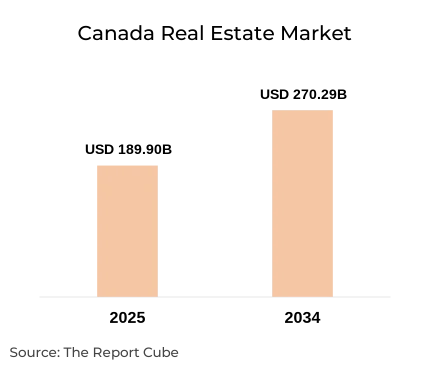
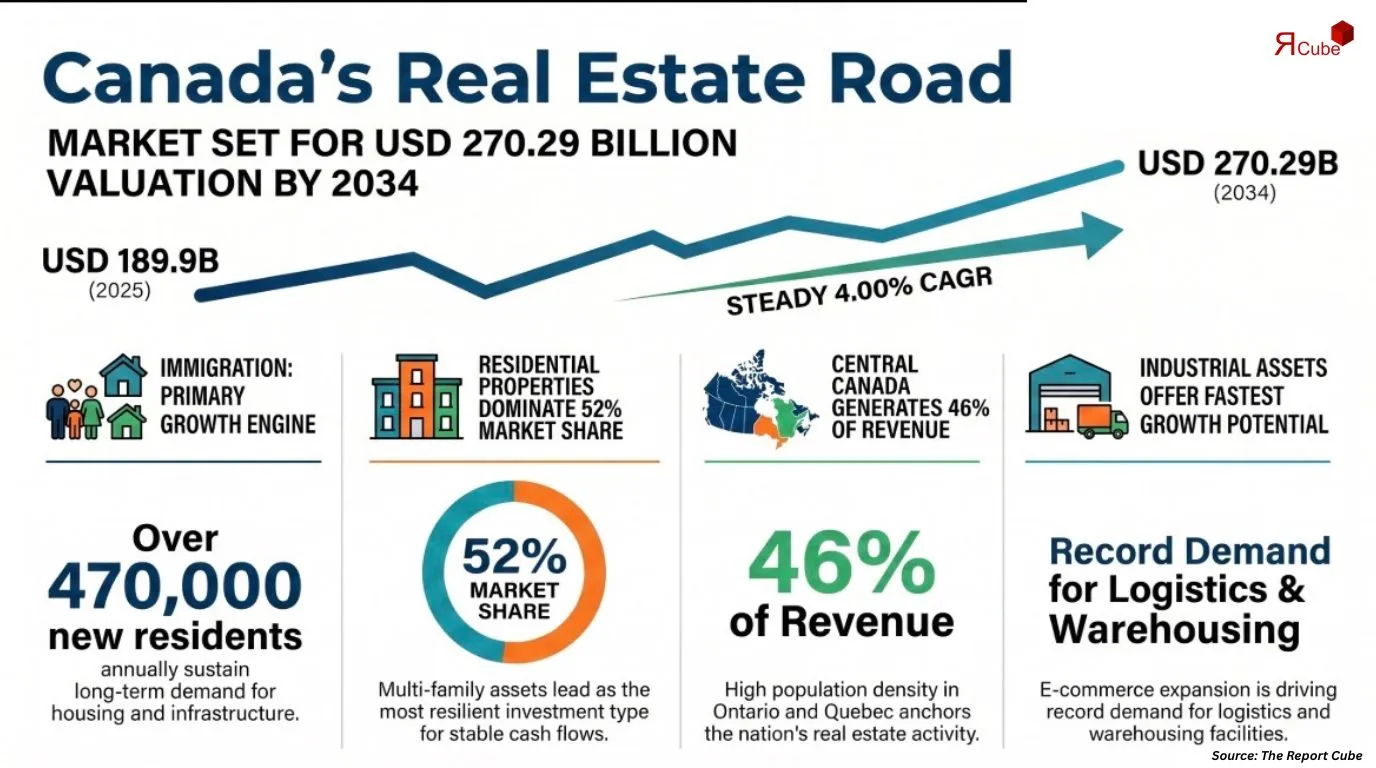
The Canada Real Estate Market is anticipated to register a CAGR of 4.00% during 2026-2034. The market size was valued at USD 189.9 billion in 2025 and is projected to reach USD 270.29 billion by 2034. The market continues to demonstrate structural resilience, supported by strong population growth, steady immigration inflows, and long-term demand for residential and commercial spaces. Despite short-term interest rate fluctuations, real estate remains a preferred asset class due to its inflation-hedging characteristics and stable income generation.
Urbanization trends across major metropolitan areas such as Toronto, Vancouver, Calgary, and Montreal are sustaining demand across residential and mixed-use developments. At the same time, suburban and secondary markets are gaining traction as remote and hybrid work models reshape location preferences. Industrial and logistics assets are experiencing heightened interest due to e-commerce expansion, while institutional investors continue to favor income-generating commercial properties.
Furthermore, sustainability-focused developments, green building standards, and technology-driven property management solutions are increasingly influencing investment decisions. These interconnected drivers collectively position the Canada Real Estate Market for steady and diversified growth through 2034.
Canada Real Estate Market Recent Developments
- 2025: Brookfield Properties expanded its mixed-use redevelopment portfolio across Ontario and British Columbia.
- 2025: Choice Properties REIT announced new logistics-focused acquisitions to strengthen its industrial asset base.
Government Initiatives & Policies
- National Housing Strategy: Federal program supporting affordable housing supply and rental market stability.
- Canada Infrastructure Bank Housing Initiative: Financing program accelerating large-scale housing developments.
Canada Real Estate Market Dynamics
Key Driver: Strong Population Growth and Immigration Demand
Population growth, driven largely by sustained immigration, remains the most influential driver of the Canada Real Estate Market. Canada welcomed over 470,000 new permanent residents in 2024, significantly boosting demand for housing across urban and suburban regions. This influx supports both rental and ownership markets, particularly in multi-family residential and mixed-use developments. As housing demand continues to outpace new supply in key cities, property values and rental rates remain structurally supported. Additionally, commercial real estate benefits indirectly from population growth through higher demand for retail, office, healthcare, and community infrastructure.
Book your FREE 30-minute expert consultation today
Contact UsIndustry Trends: Rising Institutional Investment and Asset Diversification
The market is witnessing a clear trend toward increased institutional participation and portfolio diversification. Pension funds, insurance firms, and REITs are actively reallocating capital toward resilient asset classes such as multi-family residential, logistics, and necessity-based retail. Office assets are undergoing repositioning rather than abandonment, with a growing focus on high-quality, transit-oriented buildings. Meanwhile, hospitality and mixed-use developments are rebounding alongside tourism recovery. This trend reflects a shift toward long-term income stability and risk-adjusted returns rather than speculative appreciation.
Major Challenge: Affordability Constraints and Regulatory Pressures
Housing affordability remains a critical challenge for the Canada Real Estate Market. Rising construction costs, limited land availability, and zoning restrictions continue to constrain supply, particularly in high-demand urban centers. At the same time, higher interest rates have reduced purchasing power for first-time buyers, slowing transaction volumes. Regulatory measures aimed at cooling housing prices, including foreign buyer restrictions and vacancy taxes, add complexity for investors and developers. These factors collectively moderate short-term growth momentum despite strong underlying demand.
Opportunity: Expansion of Purpose-Built Rental and Industrial Assets
Significant opportunities exist in purpose-built rental housing and industrial real estate segments. Government incentives and financing programs are encouraging developers to increase rental supply, addressing chronic housing shortages. Industrial properties, particularly logistics and distribution centers, continue to attract capital due to low vacancy rates and long-term lease structures. As e-commerce penetration deepens and supply chains localize, demand for modern logistics facilities is expected to remain robust, offering attractive returns for investors.
Canada Real Estate Market Segment-wise Analysis
By Property:
- Residential
- Commercial
- Industrial
- Land
Residential real estate leads the market by property type, accounting for approximately 52% of total market value in 2025. Strong demand for single-family and multi-family housing, supported by immigration and household formation, underpins this dominance. Commercial properties remain stable contributors, while industrial assets are the fastest-growing segment due to logistics and warehousing demand. Land assets continue to attract long-term investors focused on future development potential.
By Asset Type:
- Single-Family
- Multi-Family
- Office
- Logistics
Multi-family assets represent the leading asset type, holding nearly 34% market share in 2025. This leadership reflects strong rental demand, lower volatility, and consistent cash flows. Logistics assets are rapidly gaining share, driven by e-commerce growth and supply chain optimization. Office assets are stabilizing through adaptive reuse and premium-grade developments, while single-family homes remain a cornerstone of residential investment.
Regional Projection of Canada Real Estate Industry
- Eastern
- Central
- Western
- Northern
The Central region dominates the Canada Real Estate Market, contributing approximately 46% of total market revenue in 2025. Ontario and Quebec anchor this leadership due to high population density, diversified economies, and significant commercial activity. Major urban centers within this region attract both domestic and international investment, supporting residential, office, and industrial development. While the Central region leads, Western Canada is emerging as a high-growth area, driven by affordability advantages and increased interprovincial migration.
Need insights for a specific region within this market?
Request Regional DataWhy Choose This Report?
- Provides a comprehensive overview of the overall market analysis, encompassing key trends, consumer behavior analysis, and risk assessment to support strategic decision-making.
- Provides accurate, up-to-date insights into market size, segmentation, and emerging opportunities, helping to minimize risk & capitalizing on growth.
- Gives deep understanding of target audience preferences, investment habits, and communication channels for enhanced product development & marketing effectiveness.
- Delivers competitive analysis & benchmarking, uncovering the strengths & weaknesses of market competitors to guide strategies.
- Consolidate comprehensive market intelligence, reducing reasoning & streamlining research efforts.
- Facilitates customized market segmentation & risk mitigation strategies, fine-tuned to the business objectives.
- Aids in identifying both market challenges & untapped opportunities within the industry to drive long-term business growth.
- Provides valuable information based on actual customer data & search trends.
Table of Contents
- Introduction
- Objective of the Study
- Product and Category Definition
- Market Segmentation
- Study Variables
- Research Methodology
- Secondary Data Points
- Breakdown of Secondary Sources
- Primary Data Points
- Breakdown of Primary Interviews
- Secondary Data Points
- Executive Summary
- Market Dynamics
- Drivers
- Challenges
- Opportunity Assessment
- Recent Trends and Developments
- Regulatory and Policy Landscape
- Canada Real Estate Market Overview (2021-2034)
- Market Size, By Value (USD Billion)
- Market Share, By Property
- Residential
- Commercial
- Industrial
- Land
- Government
- Market Share, By Asset Type
- Single-Family
- Multi-Family
- Office
- Retail
- Logistics
- Hospitality
- Market Share, By Buyer Type
- Owner-Occupier
- Institutional
- Private Investor
- Foreign Investor
- Market Share, By Tenure
- Freehold
- Leasehold
- Market Share, By Region
- Eastern
- Central
- Western
- Northern
- Market Share, By Company
- Market Share, By Company
- Competition Characteristics
- Revenue Shares & Analysis
- Eastern Canada Real Estate Market
- Market Size, By Value (USD Billion)
- Market Share, By Property Segment
- Market Share, By Asset Type
- Market Share, By Buyer Type
- Market Share, By Tenure
- Market Share, By Province Group
- Market Share, By Province
- Quebec
- Atlantic Provinces
- Rest of East
- Central Canada Real Estate Market
- Market Size, By Value (USD Billion)
- Market Share, By Property Segment
- Market Share, By Asset Type
- Market Share, By Buyer Type
- Market Share, By Tenure
- Market Share, By Province Group
- Market Share, By Province
- Ontario
- Rest of Central
- Western Canada Real Estate Market
- Market Size, By Value (USD Billion)
- Market Share, By Property Segment
- Market Share, By Asset Type
- Market Share, By Buyer Type
- Market Share, By Tenure
- Market Share, By Province Group
- Market Share, By Province
- British Columbia
- Alberta
- Prairie Provinces
- Northern Canada Real Estate Market
- Market Size, By Value (USD Billion)
- Market Share, By Property Segment
- Market Share, By Asset Type
- Market Share, By Buyer Type
- Market Share, By Tenure
- Market Share, By Territory Group
- Market Share, By Territory
- Yukon
- Northwest Territories
- Nunavut
- Competitive Outlook and Company Profiles
- Royal LePage
- Company Overview
- Service Portfolio
- Strategic Alliances/Partnerships
- Recent Developments
- RE/MAX Canada
- Company Overview
- Service Portfolio
- Strategic Alliances/Partnerships
- Recent Developments
- CBRE Group
- Company Overview
- Service Portfolio
- Strategic Alliances/Partnerships
- Recent Developments
- Colliers International
- Company Overview
- Service Portfolio
- Strategic Alliances/Partnerships
- Recent Developments
- Brookfield Properties
- Company Overview
- Asset Portfolio
- Strategic Alliances/Partnerships
- Recent Developments
- Cushman & Wakefield
- Company Overview
- Service Portfolio
- Strategic Alliances/Partnerships
- Recent Developments
- Savills Canada
- Company Overview
- Service Portfolio
- Strategic Alliances/Partnerships
- Recent Developments
- FirstService Residential
- Company Overview
- Service Portfolio
- Strategic Alliances/Partnerships
- Recent Developments
- Choice Properties REIT
- Company Overview
- Asset Portfolio
- Strategic Alliances/Partnerships
- Recent Developments
- Manulife Real Estate
- Company Overview
- Asset Portfolio
- Strategic Alliances/Partnerships
- Recent Developments
- Others
- Royal LePage
- Contact Us and Disclaimer
Top Key Players & Market Share Outlook
- Royal LePage
- RE/MAX Canada
- CBRE Group
- Colliers International
- Brookfield Properties
- Cushman & Wakefield
- Savills Canada
- FirstService Residential
- Choice Properties REIT
- Manulife Real Estate
- Others
Frequently Asked Questions






