



Build Your Custom Market Intelligence Report
Customize Your ReportUAE Real Estate Market Insights & Analysis
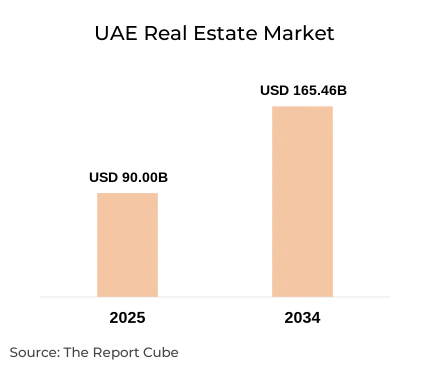
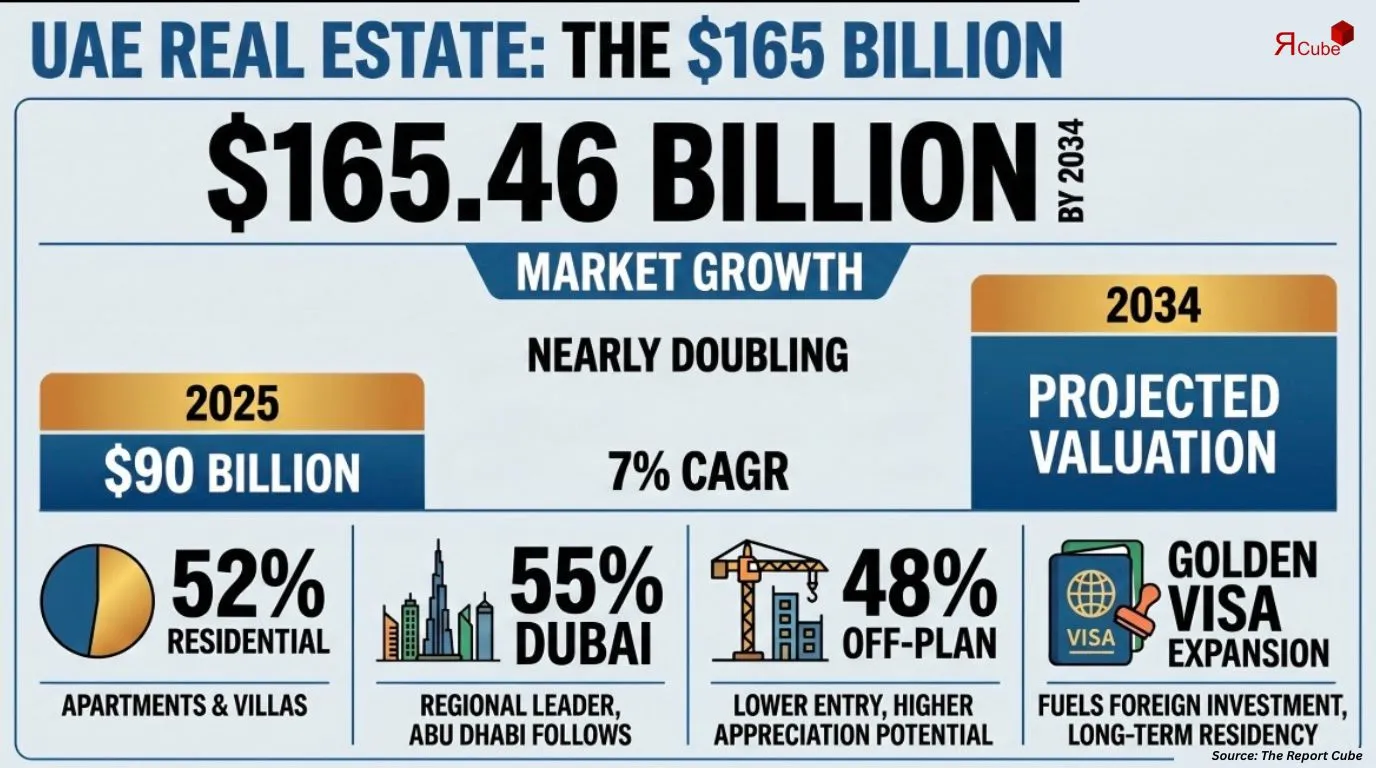
The UAE Real Estate Market is anticipated to register a CAGR of 7.00% during 2026-2034. The market size was valued at USD 90 billion in 2025 and is projected to reach USD 165.46 billion by 2034. The market continues to demonstrate strong structural resilience, supported by sustained population growth, rising foreign direct investment, and the UAE’s positioning as a global business, tourism, and lifestyle destination. Favorable ownership regulations for expatriates and long-term residency programs have further strengthened investor confidence across residential, commercial, and mixed-use developments.
Real estate demand in the UAE is increasingly diversified, moving beyond traditional luxury housing toward affordable, mid-income, and purpose-built communities. Large-scale master-planned developments integrating residential, retail, hospitality, and leisure components are reshaping urban landscapes, particularly in Dubai and Abu Dhabi. These projects are designed to enhance liveability while generating long-term rental yields, appealing to both end-users and institutional investors.
Additionally, infrastructure investments, including transport connectivity, smart city initiatives, and tourism-led developments, are reinforcing market fundamentals. Digital platforms, transparent regulatory frameworks, and flexible financing options have improved transaction efficiency and buyer accessibility. As a result, the UAE Real Estate Market is positioned for steady, demand-led expansion through 2034, supported by strong economic diversification and investor-friendly policies.
UAE Real Estate Market Recent Developments
- 2025: Emaar Properties announced a new mixed-use waterfront project in Dubai integrating residential, retail, and hospitality assets.
- 2025: DAMAC Properties launched an off-plan luxury residential tower targeting international investors.
Government Initiatives & Policies
- UAE Golden Visa Expansion: Long-term residency program supporting real estate investment and foreign ownership.
- Dubai 2040 Urban Master Plan: Strategic framework for sustainable urban development and real estate growth.
UAE Real Estate Market Dynamics
Key Driver: Strong Foreign Investment and Population Influx
One of the primary drivers of the UAE Real Estate Market is the sustained inflow of foreign investment and skilled expatriates. The UAE remains a preferred destination for global professionals, entrepreneurs, and high-net-worth individuals due to political stability, tax advantages, and world-class infrastructure. Net population growth continues to support housing demand, particularly in Dubai and Abu Dhabi, where rental occupancy rates exceed 80% in key districts. Additionally, relaxed foreign ownership laws and long-term residency options have encouraged non-residents to purchase property for both residential use and capital appreciation, strengthening transaction volumes across asset classes.
Book your FREE 30-minute expert consultation today
Contact UsIndustry Trends: Shift Toward Mixed-Use and Master-Planned Communities
The market is witnessing a clear trend toward integrated mixed-use developments that combine residential, retail, office, and leisure spaces. These projects align with changing lifestyle preferences favoring walkable, community-centric environments. Developers are prioritizing sustainability, smart building technologies, and wellness-oriented designs to enhance long-term value. Approximately 40% of new large-scale launches in 2025 included mixed-use components, reflecting this structural shift. This trend is improving asset utilization while stabilizing rental income streams, making such developments attractive to institutional and long-term investors.
Major Challenge: Market Cyclicality and Price Sensitivity
Despite strong fundamentals, the UAE Real Estate Market remains exposed to cyclical fluctuations influenced by global economic conditions, interest rate movements, and oil price volatility. Periodic oversupply in certain residential segments can lead to short-term price corrections and rental yield compression. Additionally, buyers remain price-sensitive, particularly in the mid-income segment, limiting rapid price escalation. Developers must balance new supply with demand dynamics to avoid inventory build-up, making market timing and phased project execution critical for sustained profitability.
Opportunity: Growth of Affordable and Mid-Income Housing
The rising demand for affordable and mid-income housing presents a significant growth opportunity. As the workforce population expands, demand for reasonably priced, well-connected residential units is increasing. Developers focusing on efficient layouts, suburban locations, and flexible payment plans are capturing this underserved segment. Affordable housing projects offer stable occupancy rates and long-term rental income, reducing exposure to luxury market volatility. Government support for inclusive urban development further enhances growth prospects within this segment.
UAE Real Estate Market Segment-wise Analysis
By Property:
- Residential
- Commercial Offices
- Retail
- Industrial & Logistics
The Residential segment leads the UAE Real Estate Market, accounting for approximately 52% of total market value in 2025. Strong demand from expatriates, investors, and end-users continues to drive residential sales and leasing activity. Apartments dominate transaction volumes due to affordability and rental yield stability, while villas attract premium buyers seeking long-term residence. Commercial offices and logistics assets are gaining momentum, supported by business expansion and e-commerce growth, but residential properties remain the market’s primary revenue contributor.
By Asset Class:
- Ready Properties
- Off-Plan Properties
- Luxury & Prime
- Affordable & Mid
Off-plan properties hold a leading position, representing nearly 48% of total transactions in 2025. Flexible payment plans, lower entry prices, and strong capital appreciation potential make off-plan assets attractive to investors. Luxury and prime properties continue to perform well in premium locations, while affordable and mid-income assets deliver volume-driven growth. This balanced asset mix enhances overall market resilience.
Regional Projection of UAE Real Estate Industry
- Dubai
- Abu Dhabi
- Sharjah
- Ras Al Khaimah
Dubai leads the UAE Real Estate Market, contributing approximately 55% of total market value in 2025. The emirate benefits from strong international demand, diversified economic activity, and continuous infrastructure development. Iconic projects, tourism growth, and favorable investor regulations sustain high transaction volumes. Abu Dhabi follows as a stable, institutionally driven market, while Sharjah and Ras Al Khaimah are emerging as cost-effective alternatives with growing residential demand and infrastructure investments.
Need insights for a specific region within this market?
Request Regional DataWhy Choose This Report?
- Provides a comprehensive overview of the overall market analysis, encompassing key trends, consumer behavior analysis, and risk assessment to support strategic decision-making.
- Provides accurate, up-to-date insights into market size, segmentation, and emerging opportunities, helping to minimize risk & capitalizing on growth.
- Gives deep understanding of target audience preferences, investment habits, and communication channels for enhanced product development & marketing effectiveness.
- Delivers competitive analysis & benchmarking, uncovering the strengths & weaknesses of market competitors to guide strategies.
- Consolidate comprehensive market intelligence, reducing reasoning & streamlining research efforts.
- Facilitates customized market segmentation & risk mitigation strategies, fine-tuned to the business objectives.
- Aids in identifying both market challenges & untapped opportunities within the industry to drive long-term business growth.
- Provides valuable information based on actual customer data & search trends.
Table of Contents
- Introduction
- Objective of the Study
- Product and Category Definition
- Market Segmentation
- Study Variables
- Research Methodology
- Secondary Data Points
- Breakdown of Secondary Sources
- Primary Data Points
- Breakdown of Primary Interviews
- Secondary Data Points
- Executive Summary
- Market Dynamics
- Drivers
- Challenges
- Opportunity Assessment
- Recent Trends and Developments
- Regulatory and Policy Landscape
- UAE Real Estate Market Overview (2021-2034)
- Market Size, By Value (AED/USD Billion)
- Market Share, By Segment
- Residential
- Commercial Offices
- Retail
- Industrial & Logistics
- Hospitality
- Mixed-Use
- Market Share, By Asset Class
- Ready Properties
- Off-Plan Properties
- Luxury & Prime
- Affordable & Mid
- Market Share, By Buyer Type
- End Users
- Domestic Investors
- Foreign Investors
- Institutional Investors
- Market Share, By Region
- Dubai
- Abu Dhabi
- Sharjah
- Ras Al Khaimah
- Other Emirates
- Market Share, By Company
- Market Share, By Company
- Competition Characteristics
- Revenue Shares & Analysis
- Dubai Real Estate Market
- Market Size, By Value (AED/USD Billion)
- Market Share, By Segment
- Market Share, By Asset Class
- Market Share, By Buyer Type
- Abu Dhabi Real Estate Market
- Market Size, By Value (AED/USD Billion)
- Market Share, By Segment
- Market Share, By Asset Class
- Market Share, By Buyer Type
- Sharjah & Northern Emirates Market
- Market Size, By Value (AED/USD Billion)
- Market Share, By Segment
- Market Share, By Asset Class
- Market Share, By Buyer Type
- Market Share, By Emirate
- Sharjah
- Ras Al Khaimah
- Ajman
- Fujairah & Umm Al Quwain
- Others
- Segment Deep Dives
- Residential Segment Analysis
- Commercial Offices Analysis
- Retail Segment Analysis
- Industrial & Logistics Analysis
- Hospitality Segment Analysis
- Mixed-Use Developments
- Competitive Outlook and Company Profiles
- Emaar Properties
- Company Overview
- Key Projects and Communities
- Strategic Initiatives
- Recent Developments
- DAMAC Properties
- Company Overview
- Key Projects and Communities
- Strategic Initiatives
- Recent Developments
- Nakheel
- Company Overview
- Key Projects and Communities
- Strategic Initiatives
- Recent Developments
- Sobha Realty
- Company Overview
- Key Projects and Communities
- Strategic Initiatives
- Recent Developments
- Dubai Properties
- Company Overview
- Key Projects and Communities
- Strategic Initiatives
- Recent Developments
- Aldar Properties
- Company Overview
- Key Projects and Communities
- Strategic Initiatives
- Recent Developments
- Majid Al Futtaim
- Company Overview
- Key Projects and Communities
- Strategic Initiatives
- Recent Developments
- Danube Properties
- Company Overview
- Key Projects and Communities
- Strategic Initiatives
- Recent Developments
- Meraas
- Company Overview
- Key Projects and Communities
- Strategic Initiatives
- Recent Developments
- Ellington Properties
- Company Overview
- Key Projects and Communities
- Strategic Initiatives
- Recent Developments
- Others
- Emaar Properties
- Contact Us and Disclaimer
Top Key Players & Market Share Outlook
- Emaar Properties
- DAMAC Properties
- Nakheel
- Sobha Realty
- Dubai Properties
- Aldar Properties
- Majid Al Futtaim
- Danube Properties
- Meraas
- Ellington Properties
- Others
Frequently Asked Questions






