



Build Your Custom Market Intelligence Report
Customize Your ReportJapan Real-Time Location System Market Key Highlights
By Offering:
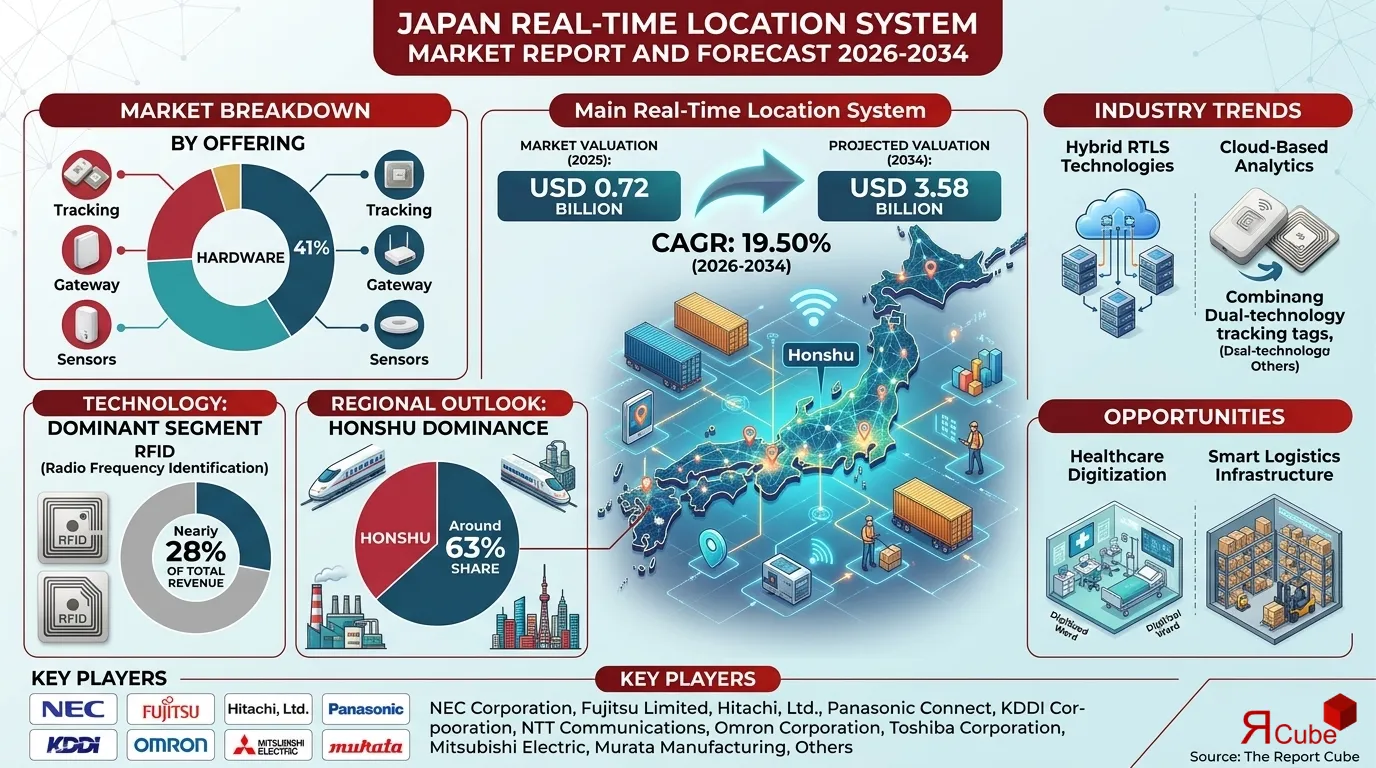
Hardware segment leads the market, with around 41% share.
By Technology:
Radio Frequency Identification (RFID) segment dominates the market, accounting for nearly 28% of total revenue.
Regional Outlook:
Honshu region dominates the japan real-time location system market, with around 63% share.
Government Initiatives & Policies
- Society 5.0 Initiative (Cabinet Office, Japan - Updated 2025 Smart Infrastructure Roadmap): Promotes IoT, AI, and cyber-physical systems integration across manufacturing and healthcare, accelerating RTLS deployment.
- MIC Local 5G Promotion Policy (Ministry of Internal Affairs and Communications, 2025 Update): Supports enterprise-grade local 5G networks for factories, hospitals, and logistics hubs, enabling low-latency RTLS infrastructure.
Japan Real-Time Location System Market Insights & Analysis
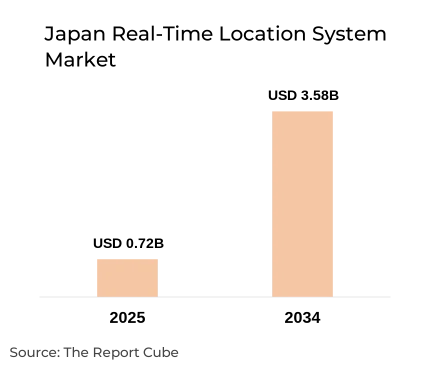
The Japan Real-Time Location System Market is anticipated to register a CAGR of 19.50% during 2026-34. The market size was valued at USD 0.72 billion in 2025 and is projected to reach USD 3.58 billion by 2034. Rapid digital transformation across manufacturing, healthcare, and logistics sectors is accelerating real-time asset and personnel visibility across Japan.
Japan’s advanced industrial base and aging workforce are central to RTLS demand expansion. Manufacturing accounts for nearly 20% of Japan’s GDP, and factories are increasingly deploying RFID, BLE, and UWB-based tracking to optimize work-in-process monitoring and reduce downtime. Smart factory initiatives supported by local 5G networks are reducing latency below 10 milliseconds, enabling real-time analytics for robotics and automated guided vehicles (AGVs). By 2025, over 35% of large-scale manufacturing plants in Honshu had integrated some form of digital asset tracking solution.
Healthcare is another high-growth domain. With more than 28% of Japan’s population aged 65 or older, hospitals are investing in patient tracking and equipment monitoring systems to enhance operational efficiency. RTLS deployment in major urban hospitals has shown reductions of up to 18% in equipment search times and 12% improvements in patient throughput efficiency. Additionally, logistics and retail sectors are responding to labor shortages by automating inventory visibility using RFID and cloud-based analytics platforms.
Investment momentum is supported by strong domestic technology players including NEC Corporation, Fujitsu Limited, Hitachi, Ltd., Panasonic Connect, KDDI Corporation, and NTT Communications. The integration of RTLS with AI analytics dashboards and hybrid cloud platforms is reshaping enterprise mobility strategies. As enterprises seek real-time operational intelligence, Japan is positioned as one of Asia-Pacific’s fastest-growing RTLS markets.
Japan Real-Time Location System Market Dynamics
Key Driver: Smart Factory Expansion and Industrial Automation
Japan’s manufacturing modernization drive is a primary growth catalyst. Government-backed digitalization programs are accelerating Industry 4.0 adoption, where RTLS enables machine-to-machine communication and predictive maintenance. UWB and RFID technologies are widely deployed for tracking raw materials, tools, and robotic fleets. Studies indicate that factories implementing RTLS-based workflow optimization report productivity gains between 15-22%. Workforce tracking also enhances safety compliance, particularly in heavy industrial zones. Integration with MES (Manufacturing Execution Systems) ensures seamless production visibility. As manufacturers aim to offset workforce shortages through automation, RTLS infrastructure becomes foundational for data-driven plant management.
Book your FREE 30-minute expert consultation today
Contact UsIndustry Trends: Hybrid RTLS Technologies and Cloud-Based Analytics
Hybrid RTLS technologies combining RFID, BLE, Wi-Fi, and UWB are gaining traction to improve accuracy within complex indoor environments. Sub-meter accuracy, particularly with UWB, is becoming standard in automotive and semiconductor manufacturing. Cloud-based deployment models are expanding rapidly, accounting for nearly 38% of new installations in 2025. Enterprises prefer cloud-hosted dashboards for centralized monitoring across multi-site operations. AI-driven analytics tools are enhancing predictive insights, enabling anomaly detection in supply chains. Furthermore, integration with private and local 5G networks is reducing infrastructure barriers and supporting high-density device connectivity within factories and campuses.
Major Challenge: High Initial Deployment Costs and System Integration Complexity
RTLS implementation requires significant upfront investment in tags, readers, antennas, and network infrastructure. UWB systems, while highly accurate, involve higher capital expenditure compared to Wi-Fi or BLE alternatives. Integration with legacy enterprise systems can also be technically complex. Many SMEs face budget constraints when deploying enterprise-grade tracking platforms. Data security and compliance concerns add another layer of operational complexity. Although cloud adoption is increasing, enterprises remain cautious about sensitive location data management. These factors can slow deployment cycles, particularly outside major industrial hubs.
Opportunity: Healthcare Digitization and Smart Logistics Infrastructure
Healthcare modernization presents a strong growth opportunity. RTLS solutions for patient monitoring, infant protection, and asset management are expanding across university hospitals in Tokyo and Osaka. Logistics hubs are also leveraging RFID-based pallet tracking to reduce inventory discrepancies by up to 30%. Fleet and vehicle tracking integrated with GPS systems supports real-time route optimization in urban centers. As Japan continues to invest in digital public safety infrastructure, RTLS adoption in government facilities and smart campuses is expected to rise steadily through 2034.
Japan Real-Time Location System Market Segment-wise Analysis
By Offering:
- Hardware
- Tags and Badges
- Readers and Antennas
- Gateways and Hubs
- Location Sensors
- Other Hardware
- Software
- Location Engine Platforms
- Asset Tracking Software
- Workforce Management Software
- Analytics and Dashboard Software
- Other RTLS Software
- Services
- Consulting Services
- Integration and Deployment Services
- Support and Maintenance Services
- Managed RTLS Services
Hardware accounts for approximately 41% of total revenue in 2025, driven by demand for RFID tags, BLE beacons, and UWB anchors across industrial and healthcare settings. Large-scale manufacturing facilities require thousands of tags per site, creating recurring hardware demand. Readers and antennas remain critical infrastructure components, particularly in logistics warehouses exceeding 50,000 square meters. Japanese firms such as Murata Manufacturing and Advantech Japan support localized hardware innovation. Although software and managed services are expanding rapidly, hardware retains a leading position due to initial deployment scale requirements.
By Technology:
- Radio Frequency Identification (RFID)
- Wi-Fi
- Bluetooth Low Energy (BLE)
- Ultra-Wideband (UWB)
- Global Positioning System (GPS)
- Ultrasound
- Infrared
- Hybrid RTLS Technologies
RFID leads with nearly 28% share due to its cost efficiency and scalability in retail and logistics. Japanese retailers deploy passive RFID tags to maintain real-time inventory accuracy above 95%. Manufacturing plants integrate active RFID for tool and component tracking. While UWB adoption is accelerating in high-precision applications, RFID remains dominant for large-scale deployments requiring economical tagging. Continuous innovation in battery-free and energy-harvesting RFID solutions is further strengthening its adoption across apparel and consumer goods industries.
Regional Projection of Japan Real-Time Location System Industry
- Hokkaido
- Honshu
- Shikoku
- Kyushu
Honshu dominates the market with around 63% share, supported by industrial clusters in Tokyo, Osaka, Nagoya, and Yokohama. The region hosts the majority of Japan’s manufacturing plants, healthcare institutions, and technology enterprises. Advanced 5G network infrastructure accelerates RTLS deployment across smart factories and logistics hubs. Kyushu is emerging as a semiconductor manufacturing hub, increasing demand for precise asset tracking systems. Hokkaido and Shikoku show moderate growth driven by regional healthcare digitization initiatives and public safety infrastructure modernization.
Japan Real-Time Location System Market Recent Developments
- 2025: Panasonic Connect launched a camera-based real-time location system in Japan designed for warehouse worker analysis, identifying bottlenecks and unsafe behavior patterns to enhance productivity and operational safety.
- 2025: Sato Holdings Corp. introduced a battery-free RFID apparel tag enabling continuous real-time inventory visibility, supporting Japanese retailers in addressing labor shortages through automated stock monitoring.
- 2025: NTT Communications launched Local 5G Service Type D, leveraging NTT DOCOMO’s public 5G network to provide carrier-grade low-latency connectivity, enabling enterprise-scale RTLS deployments across factories and campuses.
Need insights for a specific region within this market?
Request Regional DataWhy Choose This Report?
- Provides a comprehensive overview of the overall market analysis, encompassing key trends, consumer behavior analysis, and risk assessment to support strategic decision-making.
- Provides accurate, up-to-date insights into market size, segmentation, and emerging opportunities, helping to minimize risk & capitalizing on growth.
- Gives deep understanding of target audience preferences, investment habits, and communication channels for enhanced product development & marketing effectiveness.
- Delivers competitive analysis & benchmarking, uncovering the strengths & weaknesses of market competitors to guide strategies.
- Consolidate comprehensive market intelligence, reducing reasoning & streamlining research efforts.
- Facilitates customized market segmentation & risk mitigation strategies, fine-tuned to the business objectives.
- Aids in identifying both market challenges & untapped opportunities within the industry to drive long-term business growth.
- Provides valuable information based on actual customer data & search trends.
Table of Contents
- Introduction
- Objective of the Study
- Product and Category Definition
- Market Segmentation
- Study Variables and Assumptions
- Research Methodology
- Secondary Data Points
- Breakdown of Secondary Sources
- Primary Data Points
- Breakdown of Primary Interviews
- Secondary Data Points
- Executive Summary
- Market Dynamics
- Drivers
- Challenges
- Opportunity Assessment
- Recent Trends and Developments
- Regulatory and Policy Landscape
- Japan Real-Time Location System Market Overview (2021-2034)
- Market Size, By Value (USD Billion)
- Market Share, By Offering
- Hardware
- Tags and Badges
- Readers and Antennas
- Gateways and Hubs
- Location Sensors
- Other Hardware
- Software
- Location Engine Platforms
- Asset Tracking Software
- Workforce Management Software
- Analytics and Dashboard Software
- Other RTLS Software
- Services
- Consulting Services
- Integration and Deployment Services
- Support and Maintenance Services
- Managed RTLS Services
- Hardware
- Market Share, By Technology
- Radio Frequency Identification (RFID)
- Wi-Fi
- Bluetooth Low Energy (BLE)
- Ultra-Wideband (UWB)
- Global Positioning System (GPS)
- Ultrasound
- Infrared
- Hybrid RTLS Technologies
- Market Share, By Deployment Mode
- On-Premises
- Cloud-Based
- Hybrid Deployment
- Market Share, By Application
- Asset Tracking
- Personnel Tracking
- Work-in-Process Tracking
- Inventory and Material Flow Tracking
- Safety and Security Management
- Fleet and Vehicle Tracking
- Others
- Market Share, By Industry Vertical
- Healthcare
- Manufacturing
- Logistics and Transportation
- Retail
- Government and Public Safety
- Hospitality and Entertainment
- Education
- Others
- Market Share, By Region
- Hokkaido
- Honshu
- Shikoku
- Kyushu
- Market Share, By Company
- Revenue Shares and Analysis
- Competitive Landscape
- Hokkaido Real-Time Location System Market
- Market Size, By Value (USD Billion/Million)
- Market Share, By Offering
- Market Share, By Technology
- Market Share, By Deployment Mode
- Market Share, By Application
- Market Share, By Industry Vertical
- Honshu Real-Time Location System Market
- Market Size, By Value (USD Billion/Million)
- Market Share, By Offering
- Market Share, By Technology
- Market Share, By Deployment Mode
- Market Share, By Application
- Market Share, By Industry Vertical
- Shikoku Real-Time Location System Market
- Market Size, By Value (USD Billion/Million)
- Market Share, By Offering
- Market Share, By Technology
- Market Share, By Deployment Mode
- Market Share, By Application
- Market Share, By Industry Vertical
- Kyushu Real-Time Location System Market
- Market Size, By Value (USD Billion/Million)
- Market Share, By Offering
- Market Share, By Technology
- Market Share, By Deployment Mode
- Market Share, By Application
- Market Share, By Industry Vertical
- Competitive Outlook and Company Profiles
- NEC Corporation
- Company Overview
- Product Portfolio
- Strategic Alliances/Partnerships
- Recent Developments
- Fujitsu Limited
- Company Overview
- Product Portfolio
- Strategic Alliances/Partnerships
- Recent Developments
- Hitachi, Ltd.
- Company Overview
- Product Portfolio
- Strategic Alliances/Partnerships
- Recent Developments
- Panasonic Connect
- Company Overview
- Product Portfolio
- Strategic Alliances/Partnerships
- Recent Developments
- KDDI Corporation
- Company Overview
- Product Portfolio
- Strategic Alliances/Partnerships
- Recent Developments
- NTT Communications
- Company Overview
- Product Portfolio
- Strategic Alliances/Partnerships
- Recent Developments
- Omron Corporation
- Company Overview
- Product Portfolio
- Strategic Alliances/Partnerships
- Recent Developments
- Toshiba Corporation
- Company Overview
- Product Portfolio
- Strategic Alliances/Partnerships
- Recent Developments
- Mitsubishi Electric
- Company Overview
- Product Portfolio
- Strategic Alliances/Partnerships
- Recent Developments
- Murata Manufacturing
- Company Overview
- Product Portfolio
- Strategic Alliances/Partnerships
- Recent Developments
- Sony Group
- Company Overview
- Product Portfolio
- Strategic Alliances/Partnerships
- Recent Developments
- Zebra Technologies
- Company Overview
- Product Portfolio
- Strategic Alliances/Partnerships
- Recent Developments
- Cisco Systems G.K.
- Company Overview
- Product Portfolio
- Strategic Alliances/Partnerships
- Recent Developments
- LSI Japan Co., Ltd.
- Company Overview
- Product Portfolio
- Strategic Alliances/Partnerships
- Recent Developments
- Sato Holdings Corp.
- Company Overview
- Product Portfolio
- Strategic Alliances/Partnerships
- Recent Developments
- Furuno Electric Co.
- Company Overview
- Product Portfolio
- Strategic Alliances/Partnerships
- Recent Developments
- Advantech Japan
- Company Overview
- Product Portfolio
- Strategic Alliances/Partnerships
- Recent Developments
- Others
- NEC Corporation
- Contact Us and Disclaimer
Top Key Players & Market Share Outlook
- NEC Corporation
- Fujitsu Limited
- Hitachi, Ltd.
- Panasonic Connect
- KDDI Corporation
- NTT Communications
- Omron Corporation
- Toshiba Corporation
- Mitsubishi Electric
- Murata Manufacturing
- Sony Group
- Zebra Technologies
- Cisco Systems G.K.
- LSI Japan Co., Ltd.
- Sato Holdings Corp.
- Furuno Electric Co.
- Advantech Japan
Frequently Asked Questions






