




Build Your Custom Market Intelligence Report
Customize Your ReportSouth Africa Remittance Market Insights & Analysis
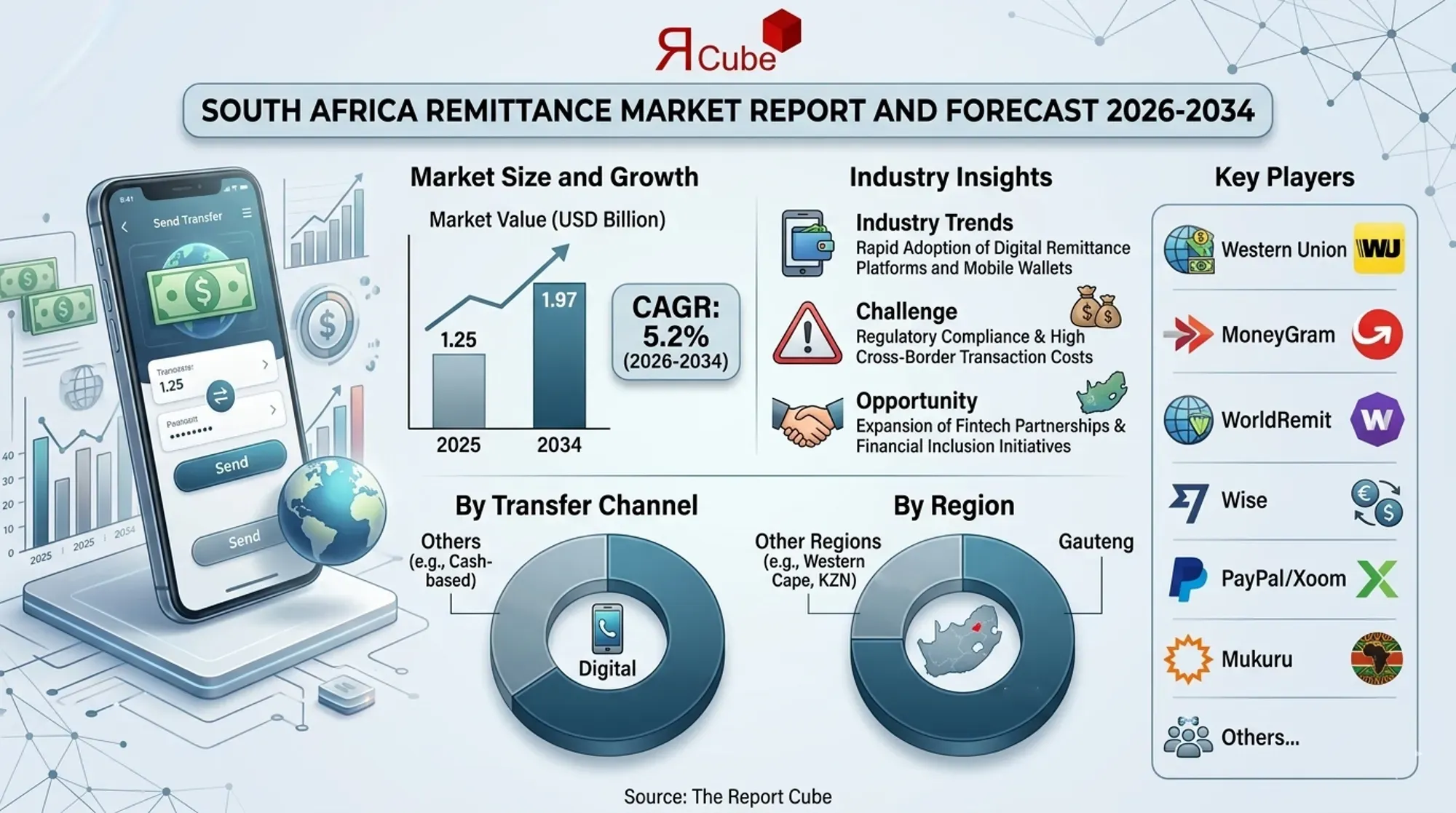
The South Africa Remittance Market is anticipated to register a CAGR of 5.2% during 2026-2034. The market size was valued at USD 1.25 Billion in 2025 and is projected to reach USD 1.97 Billion by 2034.
The South Africa remittance ecosystem has experienced steady growth over the past decade due to rising cross-border labor mobility, a growing diaspora population, and the increasing reliance of households on international money transfers. Remittances play a crucial role in supporting family consumption, education funding, and healthcare expenses across several African nations connected to South Africa. In addition, migrant workers from neighboring countries such as Zimbabwe, Mozambique, Lesotho, and Malawi rely heavily on remittance services to send money back home, creating consistent demand for transfer platforms and financial intermediaries.
The increasing digitalization of financial services has significantly reshaped the remittance landscape across South Africa. Mobile banking, fintech platforms, and digital wallets are simplifying cross-border transfers by offering faster processing times and reduced transaction costs compared with traditional channels. Additionally, fintech companies are integrating blockchain technology and advanced payment infrastructure to enhance transparency and reduce settlement delays. As digital financial inclusion expands across Southern Africa, remittance platforms are improving accessibility for unbanked populations through mobile-based transfers and agent networks. These factors are expected to strengthen the market outlook and encourage new fintech entrants, strategic partnerships, and service innovations through 2034.
South Africa Remittance Market Recent Developments
- 2025: Mukuru Financial Services expanded digital wallet transfers across Southern Africa, enabling faster cross-border payments for migrant workers.
- 2025: Wise Plc enhanced its low-cost transfer infrastructure in South Africa, reducing transaction fees for regional remittances.
Government Initiatives & Policies
- National Payment System Framework and Strategy: South African Reserve Bank initiative strengthening digital payment infrastructure and financial inclusion.
- Financial Sector Development Strategy: Program improving access to financial services and supporting fintech innovation in cross-border payments.
South Africa Remittance Market Dynamics
Key Driver: Growing Migrant Workforce and Rising Cross-Border Money Transfers
The steady growth of migrant labor across Southern Africa has become a significant driver of the South Africa Remittance Market. South Africa remains one of the largest economic hubs in the region, attracting millions of migrant workers seeking employment in sectors such as mining, construction, agriculture, and domestic services. According to regional migration estimates, more than 3 million migrant workers currently reside in South Africa, with a large proportion regularly sending funds back to their home countries. These remittances support household spending on essential needs including food, education, housing, and healthcare.
In addition, remittance flows to neighboring economies have grown steadily as economic migration continues across the Southern African Development Community (SADC). Countries like Zimbabwe, Mozambique, and Lesotho rely significantly on inflows from workers based in South Africa. For instance, remittances account for nearly 9% of GDP in Lesotho and approximately 7% in Zimbabwe, highlighting their macroeconomic importance. These consistent transfers generate sustained demand for reliable, cost-efficient remittance services.
Financial service providers have responded by expanding agent networks and digital platforms to improve access and affordability. Fintech companies and global remittance providers are partnering with mobile operators, banks, and microfinance institutions to broaden their reach across rural communities. With continued regional migration and improved financial inclusion initiatives, cross-border transfers are expected to remain a major growth driver for the South Africa Remittance Market through the forecast period.
Industry Trends: Rapid Adoption of Digital Remittance Platforms and Mobile Wallets
One of the most prominent trends shaping the South Africa Remittance Market is the increasing adoption of digital remittance services and mobile-based financial platforms. Traditional remittance channels such as bank transfers and physical money transfer operators have historically dominated the market. However, the rapid growth of fintech companies and digital payment technologies is transforming how money is transferred across borders. Consumers increasingly prefer mobile wallets, app-based transfers, and online remittance platforms due to their convenience, lower fees, and faster settlement times.
Mobile connectivity has played a key role in accelerating this transition. South Africa currently has mobile penetration exceeding 95%, enabling a large portion of the population to access mobile financial services. Fintech companies such as digital remittance platforms are leveraging this infrastructure to offer seamless cross-border payment solutions that reduce the need for physical branch visits. Digital transfers can be completed within minutes, compared with traditional bank transfers that often take several days.
Another notable trend is the integration of advanced technologies such as blockchain, artificial intelligence, and automated compliance tools. These innovations improve fraud detection, enhance transaction monitoring, and reduce operational costs for remittance providers. Furthermore, digital remittance services are increasingly incorporating multi-currency wallets and transparent fee structures, making cross-border transfers more efficient. As fintech innovation continues to accelerate, digital remittance channels are expected to capture a significant share of the market over the coming decade.
Major Challenge: Regulatory Compliance and High Cross-Border Transaction Costs
Despite its strong growth potential, the South Africa Remittance Market faces several challenges related to regulatory complexity and transaction costs. Cross-border remittance services are subject to strict financial regulations designed to prevent money laundering, terrorist financing, and fraud. Compliance with these regulations often requires extensive customer verification processes, reporting requirements, and operational monitoring. For remittance providers, particularly smaller fintech companies, these regulatory obligations can increase operational costs and create barriers to entry.
Transaction fees remain another significant challenge affecting both consumers and service providers. In some corridors within Southern Africa, remittance costs can reach between 7% and 10% of the transferred amount, exceeding the global target of 3% established by international financial inclusion initiatives. High costs discourage frequent transfers and can push consumers toward informal remittance channels that operate outside regulated financial systems.
Currency volatility also presents a challenge for cross-border transactions. Fluctuations in exchange rates can reduce the final amount received by beneficiaries, particularly in economies with unstable currencies. These risks create uncertainty for both senders and recipients. Addressing these challenges requires coordinated regulatory reforms, enhanced payment infrastructure, and improved interoperability between financial institutions. As policymakers and fintech firms collaborate to reduce remittance costs and streamline compliance processes, the market is expected to gradually overcome these structural barriers.
Opportunity: Expansion of Fintech Partnerships and Financial Inclusion Initiatives
Growing fintech innovation and financial inclusion initiatives present significant opportunities for the South Africa Remittance Market. Financial technology companies are actively partnering with banks, mobile network operators, and payment processors to develop integrated cross-border payment ecosystems. These partnerships enable remittance providers to reach underserved populations and expand services across rural communities where traditional banking infrastructure remains limited.
Mobile money platforms are particularly important in bridging the financial inclusion gap. By enabling users to send and receive money directly through their mobile phones, these services eliminate the need for formal bank accounts. This approach is especially beneficial for migrant workers and low-income households that previously relied on informal transfer methods. As digital financial services become more accessible, millions of previously unbanked individuals are entering the formal remittance ecosystem.
Another opportunity lies in the development of regional payment corridors across Southern Africa. Cross-border payment systems supported by regional financial institutions aim to reduce settlement times and transaction costs for remittances between neighboring countries. These initiatives are expected to encourage formal remittance flows and improve economic connectivity within the region. With strong fintech investment and supportive policy frameworks, the South Africa Remittance Market is positioned to unlock substantial growth opportunities during the forecast period.
South Africa Remittance Market Segment-wise Analysis
By Type:
- Inward Remittances
- Outward Remittances
- Domestic Transfers
- Cross-Border Transfers
Inward remittances are projected to account for the largest share of the South Africa Remittance Market due to the strong flow of funds from South African migrants working abroad and the regional transfer ecosystem. In 2025, inward remittances represented nearly 58% of total remittance transactions within the country. These transfers are primarily directed toward household consumption, education fees, and healthcare expenses. The demand for inward remittances has grown steadily as South African expatriates living in Europe, North America, and the Middle East continue to support families back home.
Additionally, regional remittance corridors across Southern Africa contribute significantly to inward transfers. Migrants working in South Africa often receive funds from relatives in other African countries for shared household responsibilities or small-scale business investments. Financial service providers are strengthening their remittance infrastructure by integrating digital wallets and mobile payment platforms to facilitate these inflows. As digital remittance adoption expands, inward remittance services are expected to maintain their dominant market position.
By Transfer Channel:
- Digital Remittance
- Mobile Wallets
- Online Money Transfer Platforms
- Traditional Remittance
Digital remittance services are expected to dominate the South Africa Remittance Market during the forecast period due to their convenience, lower fees, and faster transaction processing. In 2025, digital remittance channels accounted for approximately 62% of total transactions, driven largely by the rapid expansion of mobile banking and fintech platforms. Mobile wallets and online money transfer platforms enable users to initiate cross-border payments instantly through mobile applications, significantly reducing reliance on physical remittance agents.
Mobile wallet services have emerged as the leading sub-segment within digital remittances. Their popularity is largely attributed to the widespread use of smartphones and mobile payment solutions across South Africa and neighboring countries. Consumers prefer mobile wallets due to their ease of use, transparent pricing, and ability to store multiple currencies. Additionally, fintech companies are integrating artificial intelligence-based fraud detection and real-time transaction monitoring to enhance security and reliability.
Traditional remittance channels such as banks and money transfer operators still maintain a presence in the market, particularly for high-value transfers and corporate transactions. However, their share is gradually declining as digital platforms offer more affordable alternatives. With increasing digital financial literacy and improved mobile connectivity, digital remittance channels are expected to strengthen their leadership in the South Africa Remittance Market through 2034.
Regional Projection of South Africa Remittance Industry
- Gauteng
- Western Cape
- KwaZulu-Natal
- Eastern Cape
Gauteng is projected to dominate the South Africa Remittance Market throughout the forecast period due to its position as the country’s primary economic and financial hub. In 2025, Gauteng accounted for nearly 38% of the national remittance market share. The province hosts major metropolitan cities such as Johannesburg and Pretoria, which attract a large population of migrant workers employed in industries including finance, construction, mining, and manufacturing. These workers frequently send money to their families in neighboring countries, creating strong demand for remittance services.
The presence of numerous financial institutions, fintech startups, and international money transfer providers further strengthens Gauteng’s market position. Banks and remittance companies in the region continue to expand their digital payment infrastructure and agent networks to serve the growing migrant population. Additionally, Johannesburg’s status as a major financial center in Africa encourages the development of cross-border payment corridors and fintech innovation.
Western Cape and KwaZulu-Natal also represent significant regional markets due to their large urban populations and international trade connections. Meanwhile, Eastern Cape has witnessed rising remittance activity driven by internal migration and diaspora transfers. As economic opportunities continue to attract migrant workers to South Africa’s urban centers, Gauteng is expected to maintain its leadership in the remittance industry through 2034.
Why Choose This Report?
- Provides a comprehensive overview of the overall market analysis, encompassing key trends, consumer behavior analysis, and risk assessment to support strategic decision-making.
- Provides accurate, up-to-date insights into market size, segmentation, and emerging opportunities, helping to minimize risk & capitalizing on growth.
- Gives deep understanding of target audience preferences, investment habits, and communication channels for enhanced product development & marketing effectiveness.
- Delivers competitive analysis & benchmarking, uncovering the strengths & weaknesses of market competitors to guide strategies.
- Consolidate comprehensive market intelligence, reducing reasoning & streamlining research efforts.
- Facilitates customized market segmentation & risk mitigation strategies, fine-tuned to the business objectives.
- Aids in identifying both market challenges & untapped opportunities within the industry to drive long-term business growth.
- Provides valuable information based on actual customer data & search trends.
Table of Contents
- Introduction
- Objective of the Study
- Product and Category Definition
- Market Segmentation
- Study Variables
- Research Methodology
- Secondary Data Points
- Breakdown of Secondary Sources
- Primary Data Points
- Breakdown of Primary Interviews
- Secondary Data Points
- Executive Summary
- Market Dynamics
- Drivers
- Challenges
- Opportunity Assessment
- Recent Trends and Developments
- Regulatory and Policy Landscape
- South Africa Remittance Market Overview (2026-2034)
- Market Size, By Value (USD Billion)
- Market Share, By Type
- Inward Remittances
- Outward Remittances
- Market Share, By Transfer Channel
- Digital Remittance
- Mobile Wallets
- Online Money Transfer Platforms
- Traditional Remittance
- Banks
- Money Transfer Operators
- Exchange Houses
- Digital Remittance
- Market Share, By End User
- Personal Remittances
- Business Remittances
- Market Share, By Transfer Purpose
- Family Maintenance
- Education Payments
- Medical Expenses
- Investment Transfers
- Others
- Market Share, By Region
- Gauteng
- Western Cape
- KwaZulu‑Natal
- Eastern Cape
- Rest of South Africa
- Market Share, By Company
- Revenue Shares and Analysis
- Competitive Landscape
- Gauteng Remittance Market
- Market Size, By Value (USD Billion/Million)
- Market Share, By Type
- Market Share, By Transfer Channel
- Market Share, By End User
- Market Share, By Transfer Purpose
- Western Cape Remittance Market
- Market Size, By Value (USD Billion/Million)
- Market Share, By Type
- Market Share, By Transfer Channel
- Market Share, By End User
- Market Share, By Transfer Purpose
- KwaZulu‑Natal Remittance Market
- Market Size, By Value (USD Billion/Million)
- Market Share, By Type
- Market Share, By Transfer Channel
- Market Share, By End User
- Market Share, By Transfer Purpose
- Eastern Cape Remittance Market
- Market Size, By Value (USD Billion/Million)
- Market Share, By Type
- Market Share, By Transfer Channel
- Market Share, By End User
- Market Share, By Transfer Purpose
- Rest of South Africa Remittance Market
- Market Size, By Value (USD Billion/Million)
- Market Share, By Type
- Market Share, By Transfer Channel
- Market Share, By End User
- Market Share, By Transfer Purpose
- Competitive Outlook and Company Profiles
- Western Union Company
- Company Overview
- Product Portfolio
- Strategic Alliances/Partnerships
- Recent Developments
- MoneyGram International Inc.
- Company Overview
- Product Portfolio
- Strategic Alliances/Partnerships
- Recent Developments
- WorldRemit Ltd.
- Company Overview
- Product Portfolio
- Strategic Alliances/Partnerships
- Recent Developments
- Wise Plc
- Company Overview
- Product Portfolio
- Strategic Alliances/Partnerships
- Recent Developments
- PayPal Holdings Inc. (Xoom)
- Company Overview
- Product Portfolio
- Strategic Alliances/Partnerships
- Recent Developments
- Mukuru Financial Services
- Company Overview
- Product Portfolio
- Strategic Alliances/Partnerships
- Recent Developments
- Western Union Company
- Contact Us and Disclaimer
Top Key Players & Market Share Outlook
-
Western Union Company
-
MoneyGram International Inc.
-
WorldRemit Ltd.
-
Wise Plc
-
PayPal Holdings Inc. (Xoom)
-
Mukuru Financial Services
-
Others
Frequently Asked Questions






