




Build Your Custom Market Intelligence Report
Customize Your ReportIndonesia Semiconductor Talent & Training Market Key Highlights
By Training Type:
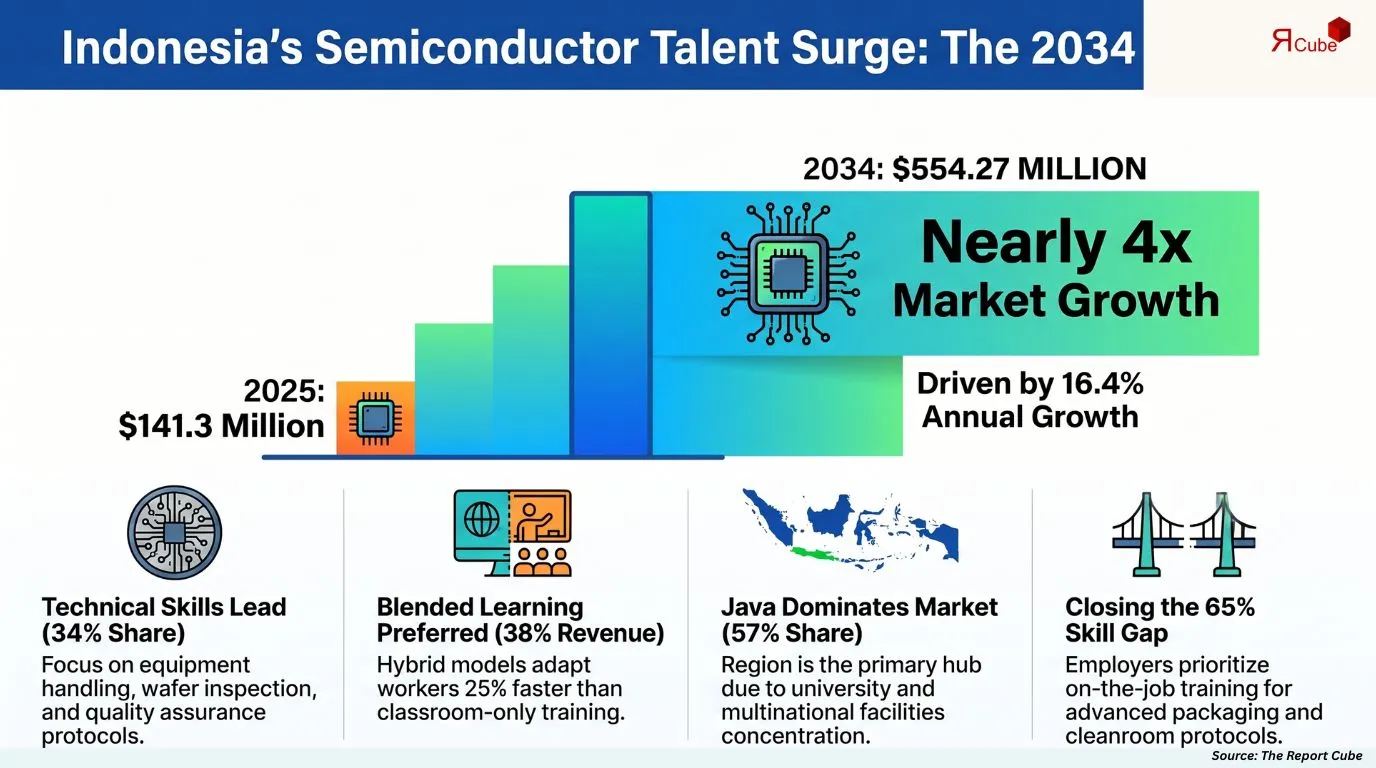
Technical Skills segment leads the market, with around 34% share.
By Delivery Mode:
Blended Training segment dominates the market, accounting for nearly 38% of total revenue.
Regional Outlook:
Java region dominates the indonesia semiconductor talent & training market, with around 57% share.
Government Initiatives & Policies
- Making Indonesia 4.0 (Updated Semiconductor Focus 2025 Roadmap): Strengthens semiconductor manufacturing, vocational alignment, and advanced electronics workforce development.
- National Semiconductor Industry Development Initiative (BKPM & Kemenperin 2025-2029 Plan): Incentivizes ATP expansion, IC design capability, and industry-academia semiconductor training partnerships.
Indonesia Semiconductor Talent & Training Market Insights & Analysis
The Indonesia Semiconductor Talent & Training Market is anticipated to register a CAGR: 16.4% during 2026-34. The market size was valued at USD 141.3 million in 2025 and is projected to reach USD 554.27 million by 2034. Indonesia’s ambition to become a key node in Southeast Asia’s semiconductor value chain is driving structured investments in talent, technical certification, and industry-linked training programs.
Indonesia’s semiconductor ecosystem is evolving beyond electronics assembly into advanced packaging, testing, and early-stage design collaboration. Batam, positioned as a core assembly and test (ATP) hub, hosts global manufacturers such as PT Infineon Technologies Batam and PT Unisem. As ATP expansion plans accelerate between 2025 and 2029, workforce demand for packaging engineers, equipment technicians, and quality control specialists is projected to rise by over 12% annually. This surge is fueling structured technical training partnerships between chipmakers, vocational institutions, and polytechnics.
IC design capability development is gaining traction through regional collaboration frameworks. ASEM (formerly AI Nusantara) expanded semiconductor IC design training initiatives in 2025, reinforcing Southeast Asia’s integrated talent mobility. Indonesian engineers are increasingly participating in cross-border design certification programs, particularly in AI-enabled chip design and embedded systems. Demand for Electronic Design Automation (EDA) tool proficiency has grown sharply, with universities integrating practical lab modules aligned with global foundry standards.
Government-backed programs under the Ministry of Industry are aligning vocational schools with semiconductor curriculum standards, emphasizing microelectronics, wafer fabrication basics, automation control systems, and reliability testing. Industry surveys indicate that nearly 65% of semiconductor employers in Indonesia report skill gaps in advanced packaging, cleanroom protocol compliance, and semiconductor equipment calibration. This gap is pushing companies to invest directly in on-the-job training and blended learning formats, accelerating the formalization of Indonesia’s semiconductor workforce pipeline.
Private investment and foreign direct investment (FDI) commitments are strengthening the talent infrastructure. Semiconductor-linked FDI approvals in Indonesia rose significantly in 2025, with Batam and West Java emerging as preferred zones. These investments are directly linked to workforce training obligations, often requiring local hiring ratios exceeding 70%. As global supply chains diversify beyond traditional hubs, Indonesia’s training ecosystem is evolving from foundational electronics instruction to specialized semiconductor skill development, supporting the projected multi-fold market expansion by 2034.
Indonesia Semiconductor Talent & Training Market Dynamics
Key Driver: Rapid Expansion of Assembly, Test, and Advanced Packaging Operations
Indonesia’s ATP segment is expanding in response to global semiconductor supply chain diversification. PT Infineon Technologies Batam remains the country’s primary ATP anchor, and national capacity expansion strategies between 2025 and 2029 are creating direct demand for trained technicians and packaging engineers. Advanced packaging technologies such as flip-chip and system-in-package (SiP) require specialized handling skills, cleanroom discipline, and automated inspection expertise. Industry projections suggest ATP workforce demand could increase by 1.8x by 2030. Companies are increasingly embedding structured certification modules into onboarding processes. This operational scaling directly fuels demand for technical, manufacturing, and maintenance-focused training programs across Indonesia.
Book your FREE 30-minute expert consultation today
Contact UsIndustry Trends: Rise of Blended and Industry-Embedded Learning Models
Blended training models combining classroom instruction with on-the-job immersion are becoming the dominant format, accounting for nearly 38% of market revenue in 2025. Semiconductor training increasingly integrates simulation software, remote labs, and live production floor mentoring. Partnerships between universities in Java and semiconductor firms enable final-year students to undergo six-month industry residencies. Online modules focused on IC layout design, VLSI fundamentals, and EDA tool usage are expanding access to advanced skillsets beyond major cities. Certification-linked programs, often co-developed with equipment vendors, ensure alignment with real production requirements. This hybrid approach improves employability and reduces onboarding costs for semiconductor employers.
Major Challenge: Shortage of Advanced IC Design and Process Engineering Expertise
While Indonesia has a strong electronics assembly base, advanced IC design capability remains limited. Industry data suggests that fewer than 15% of engineering graduates possess practical semiconductor design exposure. High-end process engineering roles, particularly those related to wafer-level packaging and reliability stress testing, face talent shortages. Competition from regional hubs such as Malaysia and Singapore increases retention challenges for experienced engineers. Universities are expanding microelectronics labs; however, capital-intensive infrastructure requirements slow deployment. Addressing this gap requires sustained collaboration between global chipmakers, government agencies, and local academic institutions to elevate Indonesia’s design-level competency.
Opportunity: Development of National Semiconductor Certification and Regional Talent Export
Indonesia has the potential to become a regional semiconductor talent exporter. Structured national certification aligned with global semiconductor competency frameworks could improve cross-border employability. With Southeast Asia facing an estimated shortage of over 60,000 semiconductor engineers by 2030, Indonesia’s demographic advantage offers strong growth prospects. Government-sponsored scholarship programs targeting microelectronics and AI chip design can expand the advanced talent pool. Furthermore, collaborations with equipment vendors such as PT Schneider Electric and PT Omron Manufacturing support automation and factory digitization training. A standardized certification framework would enhance credibility and attract additional semiconductor FDI into Indonesia.
Indonesia Semiconductor Talent & Training Market Segment-wise Analysis
By Training Type:
- Technical Skills
- Design Skills
- Manufacturing Skills
- Maintenance Skills
- Management Skills
Technical Skills training leads with approximately 34% market share in 2025. These programs focus on semiconductor fundamentals, equipment handling, wafer inspection, ESD control, and quality assurance protocols. Vocational institutions and polytechnics are prioritizing lab-based training modules tailored to ATP operations. Industry surveys reveal that over 60% of entry-level semiconductor roles require technical certification in equipment operation and cleanroom standards. As ATP capacity expands, demand for certified technicians is expected to grow at double-digit rates annually. Technical skills remain foundational, supporting both manufacturing efficiency and production yield optimization.
By Delivery Mode:
- Classroom Training
- Online Training
- Blended Training
- On-the-Job Training
Blended Training accounts for nearly 38% of total revenue, reflecting the industry’s need for theoretical grounding combined with real production exposure. Semiconductor employers prefer candidates who have completed simulation-based modules followed by supervised floor assignments. Online platforms provide flexible access to IC design and automation theory, while hands-on factory immersion reinforces applied learning. Employers report that blended trainees demonstrate 25% faster adaptation to operational environments compared to purely classroom-trained counterparts. This format reduces retraining costs and improves early-stage productivity.
Regional Projection of Indonesia Semiconductor Talent & Training Industry
- Java
- Sumatra
- Kalimantan
- Sulawesi
- Nusa Tenggara
- Maluku
- Papua
Java dominates with around 57% market share due to concentration of universities, industrial estates, and multinational semiconductor facilities. West Java and Jakarta host leading engineering institutions and vocational centers aligned with semiconductor curricula. Batam in Sumatra remains a strategic ATP hub, contributing significantly to regional training demand. Kalimantan and Sulawesi are gradually expanding technical education infrastructure, primarily focused on electronics assembly and automation skills. Regional distribution closely follows industrial cluster density and FDI inflow patterns.
Indonesia Semiconductor Talent & Training Market Recent Developments
- 2025: ASEM (formerly AI Nusantara) expanded IC design and AI semiconductor training programs under the Malaysia IC Design Park collaboration, strengthening Southeast Asia’s design engineer pipeline and supporting Indonesian talent mobility in advanced chip development.
- 2025: PT Infineon Technologies Batam was highlighted in industry analysis as Indonesia’s primary ATP anchor, with national plans for capacity expansion linked to workforce development initiatives between 2025 and 2029.
- 2025: PT Sat Nusapersada Tbk was profiled among top global hardware development firms, reinforcing its scalable PCB assembly and manufacturing capabilities that support semiconductor-related electronics growth and local technical workforce demand.
- 2026: PT Renesas Electronics Indonesia was identified as a key participant in Indonesia’s emerging flip-chip and advanced packaging ecosystem, emphasizing the strategic importance of advanced semiconductor training and engineering skill development.
Need insights for a specific region within this market?
Request Regional DataWhy Choose This Report?
- Provides a comprehensive overview of the overall market analysis, encompassing key trends, consumer behavior analysis, and risk assessment to support strategic decision-making.
- Provides accurate, up-to-date insights into market size, segmentation, and emerging opportunities, helping to minimize risk & capitalizing on growth.
- Gives deep understanding of target audience preferences, investment habits, and communication channels for enhanced product development & marketing effectiveness.
- Delivers competitive analysis & benchmarking, uncovering the strengths & weaknesses of market competitors to guide strategies.
- Consolidate comprehensive market intelligence, reducing reasoning & streamlining research efforts.
- Facilitates customized market segmentation & risk mitigation strategies, fine-tuned to the business objectives.
- Aids in identifying both market challenges & untapped opportunities within the industry to drive long-term business growth.
- Provides valuable information based on actual customer data & search trends.
Table of Contents
- Introduction
- Objective of the Study
- Product and Category Definition
- Market Segmentation
- Study Variables
- Research Methodology
- Secondary Data Points
- Breakdown of Secondary Sources
- Primary Data Points
- Breakdown of Primary Interviews
- Secondary Data Points
- Executive Summary
- Market Dynamics
- Drivers
- Challenges
- Opportunity Assessment
- Recent Trends and Developments
- Regulatory and Policy Landscape
- Indonesia Semiconductor Talent & Training Market Overview (2021-2034)
- Market Size, By Value (USD Million)
- Market Share, By Training Type
- Technical Skills
- Design Skills
- Manufacturing Skills
- Maintenance Skills
- Management Skills
- Market Share, By Delivery Mode
- Classroom Training
- Online Training
- Blended Training
- On-the-Job Training
- Market Share, By Provider
- Chipmakers
- Equipment Vendors
- Training Institutes
- Universities
- Government Programs
- Market Share, By Learner Level
- Vocational Students
- Undergraduate Students
- Graduate Engineers
- Experienced Professionals
- Market Share, By Region
- Sumatra
- Java
- Kalimantan
- Sulawesi
- Nusa Tenggara
- Maluku
- Papua
- Market Share, By Company
- Revenue Shares & Analysis
- Competitive Landscape
- Sumatra Semiconductor Talent & Training Market
- Market Size, By Value (USD Million)
- Market Share, By Training Type
- Market Share, By Delivery Mode
- Market Share, By Provider
- Market Share, By Learner Level
- Java Semiconductor Talent & Training Market
- Market Size, By Value (USD Million)
- Market Share, By Training Type
- Market Share, By Delivery Mode
- Market Share, By Provider
- Market Share, By Learner Level
- Kalimantan Semiconductor Talent & Training Market
- Market Size, By Value (USD Million)
- Market Share, By Training Type
- Market Share, By Delivery Mode
- Market Share, By Provider
- Market Share, By Learner Level
- Sulawesi Semiconductor Talent & Training Market
- Market Size, By Value (USD Million)
- Market Share, By Training Type
- Market Share, By Delivery Mode
- Market Share, By Provider
- Market Share, By Learner Level
- Nusa Tenggara Semiconductor Talent & Training Market
- Market Size, By Value (USD Million)
- Market Share, By Training Type
- Market Share, By Delivery Mode
- Market Share, By Provider
- Market Share, By Learner Level
- Maluku Semiconductor Talent & Training Market
- Market Size, By Value (USD Million)
- Market Share, By Training Type
- Market Share, By Delivery Mode
- Market Share, By Provider
- Market Share, By Learner Level
- Papua Semiconductor Talent & Training Market
- Market Size, By Value (USD Million)
- Market Share, By Training Type
- Market Share, By Delivery Mode
- Market Share, By Provider
- Market Share, By Learner Level
- Competitive Outlook and Company Profiles
- PT Infineon Technologies
- Company Overview
- Product Portfolio
- Strategic Alliances/Partnerships
- Recent Developments
- PT Yokogawa Indonesia
- Company Overview
- Product Portfolio
- Strategic Alliances/Partnerships
- Recent Developments
- PT Sharp Semiconductor
- Company Overview
- Product Portfolio
- Strategic Alliances/Partnerships
- Recent Developments
- PT Xirka Silicon Tech
- Company Overview
- Product Portfolio
- Strategic Alliances/Partnerships
- Recent Developments
- PT TSM Technologies
- Company Overview
- Product Portfolio
- Strategic Alliances/Partnerships
- Recent Developments
- PT Sat Nusapersada
- Company Overview
- Product Portfolio
- Strategic Alliances/Partnerships
- Recent Developments
- PT Schneider Electric
- Company Overview
- Product Portfolio
- Strategic Alliances/Partnerships
- Recent Developments
- PT Unisem
- Company Overview
- Product Portfolio
- Strategic Alliances/Partnerships
- Recent Developments
- PT Renesas Technology
- Company Overview
- Product Portfolio
- Strategic Alliances/Partnerships
- Recent Developments
- PT Omron Manufacturing
- Company Overview
- Product Portfolio
- Strategic Alliances/Partnerships
- Recent Developments
- PT Banti Tekno Investama
- Company Overview
- Product Portfolio
- Strategic Alliances/Partnerships
- Recent Developments
- PT SFE Electronics
- Company Overview
- Product Portfolio
- Strategic Alliances/Partnerships
- Recent Developments
- ASEM (via AI Nusantara)
- Company Overview
- Product Portfolio
- Strategic Alliances/Partnerships
- Recent Developments
- PT Versatile Silicon
- Company Overview
- Product Portfolio
- Strategic Alliances/Partnerships
- Recent Developments
- PT Panasonic Industrial
- Company Overview
- Product Portfolio
- Strategic Alliances/Partnerships
- Recent Developments
- PT Teknologi Sistem Nusantara
- Company Overview
- Product Portfolio
- Strategic Alliances/Partnerships
- Recent Developments
- Others
- PT Infineon Technologies
- Contact Us and Disclaimer
Top Key Players & Market Share Outlook
- PT Infineon Technologies
- PT Yokogawa Indonesia
- PT Sharp Semiconductor
- PT Xirka Silicon Tech
- PT TSM Technologies
- PT Sat Nusapersada
- PT Schneider Electric
- PT Unisem
- PT Renesas Technology
- PT Omron Manufacturing
- PT Banti Tekno Investama
- PT SFE Electronics
- ASEM (via AI Nusantara)
- PT Versatile Silicon
- PT Panasonic Industrial
- PT Teknologi Sistem Nusantara
- Others
Frequently Asked Questions






