



Build Your Custom Market Intelligence Report
Customize Your ReportIndia Senior Living Market Key Highlights
By Property Type:
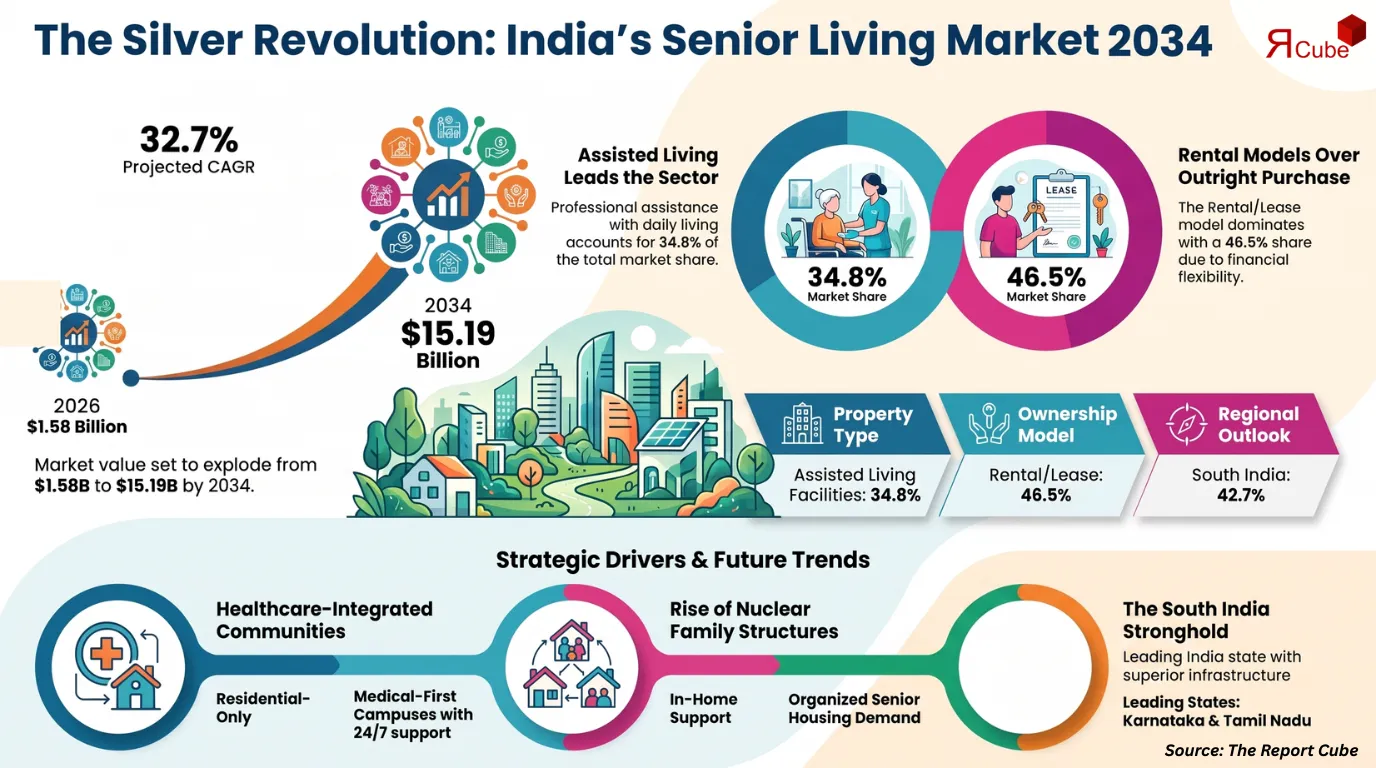
Assisted Living Facilities segment leads the market with approximately 34.8% share.
By Ownership Model:
Rental/Lease segment dominates the market with nearly 46.5% of total revenue.
Regional Outlook:
South India dominates the India Senior Living Market with around 42.7% share.
India Senior Living Market Insights & Analysis
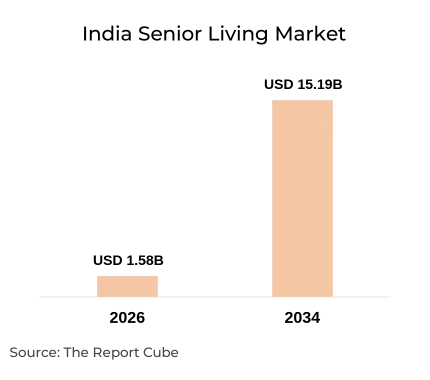
The India Senior Living Market is anticipated to register a CAGR of around 32.7% during the forecast period of 2026-2034. The market size is valued at USD 1.58 billion in 2026 and is projected to reach USD 15.19 billion by 2034. The market is entering a transformational phase as India's elderly population expands rapidly alongside rising life expectancy, changing family structures, and increasing urban migration. Traditional joint families are gradually giving way to nuclear households, creating greater demand for organized senior housing, assisted living facilities, retirement communities, and healthcare-integrated residential projects. Developers are increasingly introducing age-friendly housing equipped with emergency response systems, wellness centers, rehabilitation services, recreational amenities, and digital healthcare platforms. The market also benefits from rising disposable incomes among retirees and growing financial planning for post-retirement lifestyles, encouraging demand for premium and mid-income senior living communities across metropolitan as well as Tier II cities.
Capital inflows from real estate developers, healthcare providers, private investors, and senior care operators are accelerating the development of integrated retirement communities across India. Developers are increasingly collaborating with hospitals, rehabilitation providers, home healthcare companies, and digital health platforms to offer continuous medical support alongside residential services. Modern projects now feature emergency response systems, physiotherapy centers, dementia care units, pharmacy services, wellness clubs, teleconsultation facilities, and smart health monitoring technologies that improve residents' quality of life. At the same time, government initiatives promoting healthy ageing, digital healthcare infrastructure, and elderly welfare continue to strengthen the operating environment for organized senior living providers. As consumer preferences shift from institutional elderly care toward lifestyle-oriented retirement communities, the India Senior Living Market is expected to witness substantial investment, higher occupancy rates, and broader geographic expansion throughout the forecast period.
India Senior Living Market Impact Analysis
| Factor | Type | Specific Impact on Market | Magnitude | Business Implication |
|---|---|---|---|---|
| Rapidly Aging Population Base | Market | More elders seek organized housing and care solutions | High | Supports long term demand growth for senior communities |
| Rise of Nuclear Family Structures | Consumer | Reduced in home support increases appeal of senior living | High | Drives occupancy in independent and assisted living projects |
| Growing Middle Class Affordability | Market | Higher incomes allow spending on lifestyle retirement homes | Medium | Enables development of premium amenity rich senior housing |
| Healthcare Integration and Telemedicine | Technological | On site medical and remote care raise project attractiveness | Medium | Creates scope for health operator tie ups within communities |
| Cultural Preference for Family Care | Consumer | Social norms slow acceptance of institutional senior living | Medium | Requires strong awareness work to reposition senior projects |
| High Development and Operating Costs | Environmental | Specialized design and staffing raise unit price points | Medium | Needs scale, partnerships and mixed pricing to protect margin |
| Increasing Private and NRI Investment | Competitive | More branded players expand supply across major regions | High | Intensifies competition yet deepens market reach and product variety |
India Senior Living Market Dynamics
Key Driver: Demographic Ageing and Changing Household Structure Driving Demand for Organized Senior Living
India's demographic transition has become the primary growth engine for the organized senior living industry. Improvements in healthcare access, disease management, and overall living standards have steadily increased life expectancy, resulting in a rapidly expanding population aged 60 years and above. Simultaneously, urbanization, overseas migration, and the widespread adoption of nuclear family structures have reduced the availability of full-time family caregivers. These structural changes are encouraging elderly individuals and their families to consider professionally managed retirement communities, assisted living facilities, and healthcare-enabled old age homes that provide safety, independence, and continuous medical support. The shift reflects changing lifestyle expectations rather than solely a requirement for institutional care.
Financial preparedness among retirees has also improved over the past decade, supported by pension income, retirement savings, insurance products, and higher disposable incomes among middle and upper-income households. Families increasingly recognize the benefits of communities that offer medication management, emergency healthcare access, wellness activities, housekeeping, nutrition planning, and social engagement under one roof. Demand is particularly strong in metropolitan regions where working professionals often reside away from ageing parents. These long-term demographic and socioeconomic factors continue to strengthen the growth outlook for the India Senior Living Market while encouraging developers to expand organized retirement housing across multiple price segments.
Industry Trends: Healthcare-Integrated Communities Becoming the Preferred Senior Housing Model
Healthcare is becoming the defining feature of India's organized senior living industry, with developers increasingly designing communities around integrated medical support rather than residential infrastructure alone. Leading operators are establishing partnerships with multispecialty hospitals, diagnostic laboratories, rehabilitation centers, physiotherapy providers, and home healthcare companies to deliver comprehensive geriatric care within residential campuses. Residents benefit from regular health assessments, chronic disease management, memory care, pharmacy access, emergency medical response, and preventive wellness programs without depending on external healthcare facilities. This integrated approach improves resident confidence while enhancing operational value for developers.
Technology is also strengthening service delivery across modern retirement communities. Wearable health monitoring devices, digital nurse call systems, AI-enabled fall detection, electronic medical records, telemedicine consultations, and smart home automation are increasingly incorporated into premium senior housing projects. Mobile applications allow family members, particularly Non-Resident Indians, to remain connected with residents through real-time health updates and service monitoring. Developers are complementing healthcare with wellness centers, yoga studios, hobby clubs, community dining, and lifelong learning activities that encourage active ageing. These innovations continue to differentiate organized senior living communities from conventional Vridh Ashrams while supporting higher occupancy and resident retention.
Book your FREE 30-minute expert consultation today
Contact UsMajor Challenge: Affordability Constraints and Social Perception Continue to Limit Wider Adoption
The organized senior living industry continues to face affordability challenges, particularly among middle-income and lower-income households. Professionally managed retirement communities often involve substantial entry costs, monthly maintenance charges, healthcare fees, and personalized care expenses that exceed the financial capacity of many retirees. Consequently, conventional family-based caregiving and charitable old age homes remain the primary option for a large segment of India's elderly population. The absence of standardized financing models for senior housing further limits broader market penetration outside affluent urban centers.
Social attitudes also influence purchasing decisions across several parts of the country. Many families continue to associate senior living communities with traditional old age homes rather than viewing them as lifestyle-oriented retirement residences designed to promote healthy and independent ageing. This perception reduces acceptance despite the significant improvement in service quality offered by organized operators. Variations in regulatory standards, caregiver training, and healthcare integration across different projects also create uncertainty among prospective residents. Improving awareness, strengthening quality standards, and expanding affordable housing options will remain important priorities for sustaining long-term growth in the India Senior Living Market.
Opportunity: Expansion Across Tier II Cities and Integrated Township Developments Creating Long-Term Growth Potential
Rapid urban development across Tier II cities is opening new avenues for organized senior housing developers. Locations such as Coimbatore, Mysuru, Kochi, Ahmedabad, Jaipur, Chandigarh, Bhubaneswar, Indore, Nagpur, and Pune are emerging as preferred retirement destinations due to improving healthcare infrastructure, lower living costs, cleaner environments, and better quality of life. Compared with metropolitan cities, these locations provide developers with access to larger land parcels, enabling the construction of spacious communities featuring landscaped open areas, wellness centers, rehabilitation facilities, assisted living services, and recreational amenities at comparatively affordable prices.
Integrated township developments are also reshaping the future of India's senior housing industry. Rather than developing isolated retirement campuses, leading real estate companies are incorporating senior living residences within mixed-use townships that include hospitals, retail outlets, parks, sports facilities, hospitality services, and public transportation. This approach encourages intergenerational interaction while allowing elderly residents to remain socially connected without compromising access to specialized healthcare. Strategic partnerships between healthcare providers, retirement housing operators, insurance companies, and technology firms are expected to strengthen this business model, creating significant opportunities for investment and innovation throughout the forecast period.
India Senior Living Market Segment-wise Analysis
By Property Type:
- Memory Care Facilities
- Independent Living Communities
- Continuing Care Retirement Communities
- Skilled Nursing Facilities
- Assisted Living Facilities
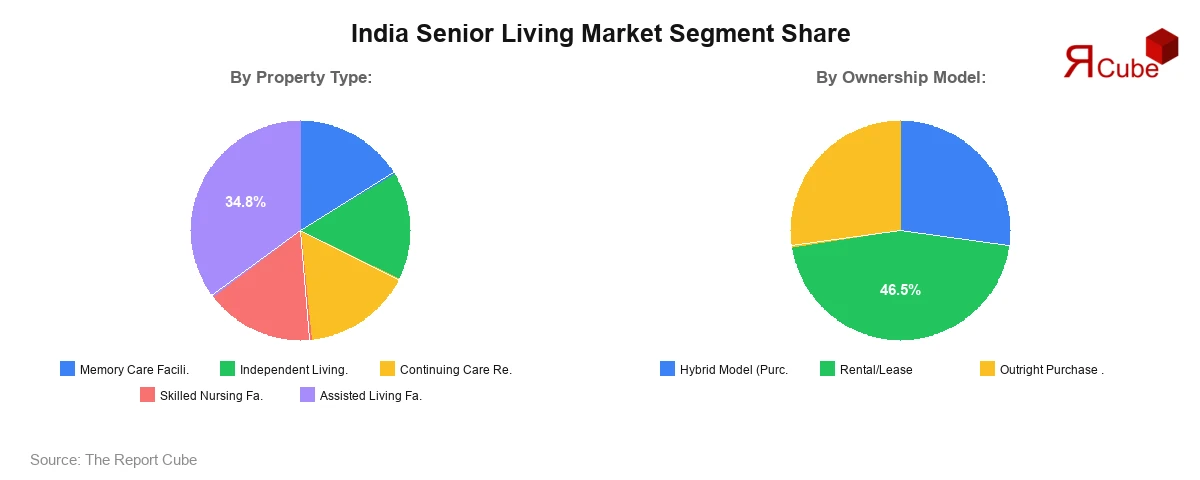
Among all property types, Assisted Living Facilities account for the largest share of the India Senior Living Market, representing approximately 34.8% of total revenue in 2026. The segment has gained significant momentum as elderly individuals increasingly require professional assistance with daily activities while maintaining an independent lifestyle. Unlike traditional old age homes or Vridh Ashrams, assisted living communities provide structured care through medication management, physiotherapy, nursing support, emergency medical response, housekeeping, nutritious dining, and recreational engagement. The rising prevalence of chronic diseases such as diabetes, cardiovascular disorders, arthritis, and mobility-related conditions among India's ageing population continues to support demand for professionally managed assisted living facilities across metropolitan and emerging urban centers.
Leading developers are expanding assisted living projects by integrating healthcare partnerships, smart monitoring technologies, rehabilitation centers, dementia care services, and wellness-focused infrastructure to improve resident outcomes. Families, particularly those with working professionals or Non-Resident Indians, increasingly prefer organized assisted living communities that ensure continuous medical supervision and social interaction for ageing parents. Premium operators are also introducing personalized care plans, digital health monitoring, and age-friendly residential designs that improve safety and quality of life. As organized elderly care becomes more widely accepted, assisted living facilities are expected to remain the preferred property type, supported by rising investments from both healthcare providers and real estate developers.
By Ownership Model:
- Hybrid Model (Purchase + Service Fee)
- Rental/Lease
- Outright Purchase (Freehold)
The Rental/Lease ownership model dominates the India Senior Living Market with nearly 46.5% of total revenue. This model has witnessed strong acceptance because it offers financial flexibility without requiring retirees to invest substantial capital in property ownership. Residents receive accommodation together with housekeeping, maintenance, security, healthcare coordination, dining services, wellness activities, and community facilities through predictable monthly payments. The model is particularly attractive for senior citizens seeking hassle-free living arrangements while allowing families to avoid long-term property management responsibilities. Rental communities also enable residents to transition between independent living and assisted care as healthcare requirements evolve over time.
Senior housing operators increasingly favor the rental model because it generates recurring revenue, supports higher occupancy rates, and allows continuous investment in resident services and healthcare infrastructure. Demand is especially strong among urban retirees, expatriate families, and children residing overseas who prioritize professionally managed accommodation for ageing parents. Developers are further strengthening the rental proposition by incorporating telemedicine, emergency healthcare services, wellness centers, concierge support, and recreational programs within residential campuses. As India's organized retirement housing industry expands into Tier II cities and integrated township developments, rental and lease-based communities are expected to maintain their market leadership owing to their affordability, operational flexibility, and comprehensive service offerings.
Regional Projection of India Senior Living Industry
- North India
- South India
- West India
- East India
- Central India
South India holds the leading position in the India Senior Living Market, accounting for nearly 42.7% of the overall market in 2026. The region benefits from a well-established healthcare ecosystem, higher retirement planning awareness, and greater acceptance of organized senior housing compared to many other parts of the country. Karnataka, Tamil Nadu, Kerala, Telangana, and Andhra Pradesh have emerged as prominent destinations for retirement communities because of their strong hospital networks, favorable climate, skilled healthcare workforce, and comparatively better quality of life. Cities including Bengaluru, Chennai, Coimbatore, Kochi, and Hyderabad continue attracting retirees, including Non-Resident Indians, who seek professionally managed communities offering healthcare support, wellness services, and age-friendly residential environments.
Several of India's leading senior living developers have established a significant presence across South India by introducing healthcare-integrated retirement communities, assisted living facilities, memory care centers, and independent living residences within large residential townships. Continuous investment in healthcare infrastructure, digital medical services, and geriatric care further strengthens the region's competitive position. State governments have also focused on expanding healthcare accessibility and improving elderly welfare programs, creating a favorable environment for organized senior housing. Growing demand from affluent retirees, increasing life expectancy, and rising awareness of active ageing continue to support strong occupancy levels, reinforcing South India's position as the country's largest and most mature senior living market throughout the forecast period.
Need insights for a specific region within this market?
Request Regional DataRegional Analysis of India Senior Living Market
India’s senior living demand varies by region, driven by income, urbanisation, healthcare access and family structure shifts.
| Cluster | Demand Level | Key Areas | System Dominance | Core Demand Logic | Growth Nature |
|---|---|---|---|---|---|
| North India | High | Delhi NCR, Chandigarh, Dehradun | Independent & Assisted living | Rising nuclear families, premium housing | Metro-led, fast formalisation |
| South India | Very High | Bengaluru, Chennai, Hyderabad, Kochi | Organised communities, care homes | Early adopter region with strong healthcare | Supply-led, most mature |
| West India | Very High | Mumbai MMR, Pune, Ahmedabad, Goa | Premium senior housing & rentals | High property prices, space constraints | Rapid expansion in tier 1–2 |
| East India | Medium | Kolkata, Bhubaneswar, Guwahati | Independent living, hybrid models | Urban ageing, limited organised stock | Emerging, policy-sensitive |
| Central India | Low to Medium | Indore, Bhopal, Nagpur, Raipur | Smaller projects, rental focus | Lower incomes, growing awareness | Gradual, developer driven |
Government Initiatives & Policies
- Atal Vayo Abhyuday Yojana (AVYAY) 2025: The Ministry of Social Justice and Empowerment continues expanding financial assistance for Integrated Programme for Senior Citizens, elder care services, helplines, and senior care institutions, improving welfare support and strengthening organized elderly care across India.
- Ayushman Bharat Digital Mission (2025-2026 Expansion): The Government of India continues expanding digital health records, telemedicine, and interoperable healthcare services, enabling senior living operators to deliver connected healthcare and better chronic disease management for elderly residents.
India Senior Living Industry Recent Developments
- 2026: Age Care Labs raised USD 9.9 million in a Series B1 funding round with participation from Rain Matter, Pegasus Finvest, Shrem Group, and several family offices. As part of the investment, the company partnered with Shrem Group to launch Shremoha, a premium independent senior living platform. The investment will support nationwide expansion of home-care services, assisted living operations, digital healthcare capabilities, and technology-enabled elderly care while strengthening its integrated senior living ecosystem.
- 2026: Primus Senior Living partnered with Gopalan Enterprises to develop Primus Olympia, a USD 52.3 million senior living project within the 16-acre Gopalan Olympia Sports City in Bengaluru. The development combines senior-friendly residential infrastructure, Intelligent Home Design standards for fall prevention, healthcare services, and lifestyle amenities within an integrated township, reflecting the growing preference for mixed-use senior living developments over standalone retirement communities.
Why Choose This Report?
- Provides a comprehensive overview of the overall market analysis, encompassing key trends, consumer behavior analysis, and risk assessment to support strategic decision-making.
- Provides accurate, up-to-date insights into market size, segmentation, and emerging opportunities, helping to minimize risk while capitalizing on growth.
- Gives deep understanding of target audience preferences, investment habits, and communication channels for enhanced product development and marketing effectiveness.
- Delivers competitive analysis and benchmarking, uncovering the strengths and weaknesses of market competitors to guide business strategies.
- Consolidates comprehensive market intelligence, reducing research effort and streamlining strategic planning.
- Facilitates customized market segmentation and risk mitigation strategies, fine-tuned to specific business objectives.
- Aids in identifying both market challenges and untapped opportunities within the industry to drive long-term business growth.
- Provides valuable information based on actual customer data, industry developments, and search trends.
Table of Contents
- Introduction
- Objective of the Study
- Product and Category Definition
- Market Segmentation
- Study Variables
- Research Methodology
- Secondary Data Points
- Breakdown of Secondary Sources
- Primary Data Points
- Breakdown of Primary Interviews
- Secondary Data Points
- Executive Summary
- Market Dynamics
- Emerging Opportunities
- Adoption Trends
- Demand Drivers
- Disruption Analysis (Challenges)
- Industry Analysis & Strategic Insights
- Supply/Value Chain Analysis
- Pricing Analysis
- Go-To-Market (GTM) Strategy
- BCG Matrix
- Recent Trends and Developments
- Import and Export Analysis
- Regulatory and Policy Landscape
- Region-wise Policies
- Government Initiatives
- India Senior Living Market Overview and Forecast Analysis (2021-2034)
- Market Size, By Value, By Growth Rate (CAGR/USD Billion)
- Market Share, By Property Type
- Memory Care Facilities
- Independent Living Communities
- Continuing Care Retirement Communities
- Skilled Nursing Facilities
- Assisted Living Facilities
- Market Share, By Ownership Model
- Hybrid Model (Purchase + Service Fee)
- Rental/Lease
- Outright Purchase (Freehold)
- Market Share, By Community Type
- Healthcare-Integrated Senior Living Communities
- Senior Living within Integrated Townships
- Standalone Senior Living Communities
- Others
- Market Share, By Region
- North
- South
- West
- East
- Central
- Market Share, By Company
- Revenue Shares and Analysis
- Competitive Landscape
- North India Senior Living Market Overview and Forecast Analysis (2021-2034)
- Market Size, By Value, By Growth Rate (CAGR/USD Billion/Million)
- Market Share, By Property Type
- Market Share, By Ownership Model
- Market Share, By Community Type
- South India Senior Living Market Overview and Forecast Analysis (2021-2034)
- Market Size, By Value, By Growth Rate (CAGR/USD Billion/Million)
- Market Share, By Property Type
- Market Share, By Ownership Model
- Market Share, By Community Type
- West India Senior Living Market Overview and Forecast Analysis (2021-2034)
- Market Size, By Value, By Growth Rate (CAGR/USD Billion/Million)
- Market Share, By Property Type
- Market Share, By Ownership Model
- Market Share, By Community Type
- East India Senior Living Market Overview and Forecast Analysis (2021-2034)
- Market Size, By Value, By Growth Rate (CAGR/USD Billion/Million)
- Market Share, By Property Type
- Market Share, By Ownership Model
- Market Share, By Community Type
- Central India Senior Living Market Overview and Forecast Analysis (2021-2034)
- Market Size, By Value, By Growth Rate (CAGR/USD Billion/Million)
- Market Share, By Property Type
- Market Share, By Ownership Model
- Market Share, By Community Type
- Competitive Analysis, 2026
- Market Share of Key Players
- Competitive Mapping for Each Segment and Companies Operating Regionally
- North India Senior Living Companies Share and Competitive Analysis, 2026
- South India Senior Living Companies Share and Competitive Analysis, 2026
- West India Senior Living Companies Share and Competitive Analysis, 2026
- East India Senior Living Companies Share and Competitive Analysis, 2026
- Central India Senior Living Companies Share and Competitive Analysis, 2026
- Company Profile (Partial List)
- Casagrand Communities
- Company Overview
- Product Portfolio
- Strategic Alliances/Partnerships
- Recent Developments
- Oasis Senior Living
- Company Overview
- Product Portfolio
- Strategic Alliances/Partnerships
- Recent Developments
- Primus Lifestyle Pvt. Ltd.
- Company Overview
- Product Portfolio
- Strategic Alliances/Partnerships
- Recent Developments
- Bahri Realty Management Services Pvt. Ltd.
- Company Overview
- Product Portfolio
- Strategic Alliances/Partnerships
- Recent Developments
- Ananya's Nana Nani Homes
- Company Overview
- Product Portfolio
- Strategic Alliances/Partnerships
- Recent Developments
- Antara Senior Care
- Company Overview
- Product Portfolio
- Strategic Alliances/Partnerships
- Recent Developments
- The Golden Estate
- Company Overview
- Product Portfolio
- Strategic Alliances/Partnerships
- Recent Developments
- Covai Property Center (CovaiCare)
- Company Overview
- Product Portfolio
- Strategic Alliances/Partnerships
- Recent Developments
- Ashiana Housing Ltd.
- Company Overview
- Product Portfolio
- Strategic Alliances/Partnerships
- Recent Developments
- Columbia Pacific Communities
- Company Overview
- Product Portfolio
- Strategic Alliances/Partnerships
- Recent Developments
- Vedaanta Senior Living
- Company Overview
- Product Portfolio
- Strategic Alliances/Partnerships
- Recent Developments
- Others (Partial List)
- Casagrand Communities
- Contact Us and Disclaimer
Top Key Players & Market Share Outlook
- Casagrand Communities
- Oasis Senior Living
- Primus Lifestyle Pvt. Ltd.
- Bahri Realty Management Services Pvt. Ltd.
- Ananya's Nana Nani Homes
- Antara Senior Care
- The Golden Estate
- Covai Property Center (CovaiCare)
- Ashiana Housing Ltd.
- Columbia Pacific Communities
- Vedaanta Senior Living
- Others
Frequently Asked Questions






