



Build Your Custom Market Intelligence Report
Customize Your ReportGermany Smart Home Security Market Key Highlights
By Component:
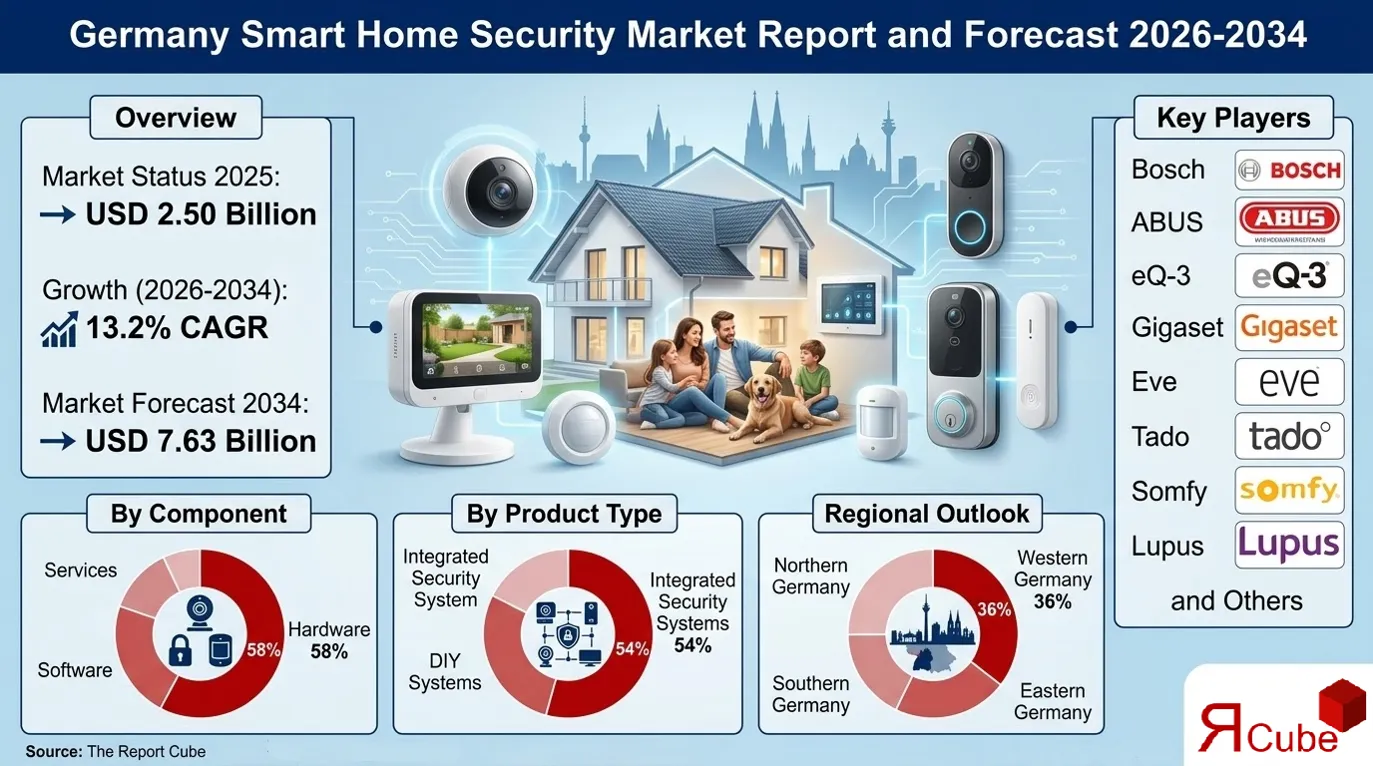
Hardware segment leads the market, with around 58% market share.
By Product Type:
Integrated Security Systems segment dominates the market, accounting for nearly 54% of total revenue.
Regional Outlook:
Western Germany dominates the Germany smart home security market, with around 36% market share.
Germany Smart Home Security Market Insights & Analysis
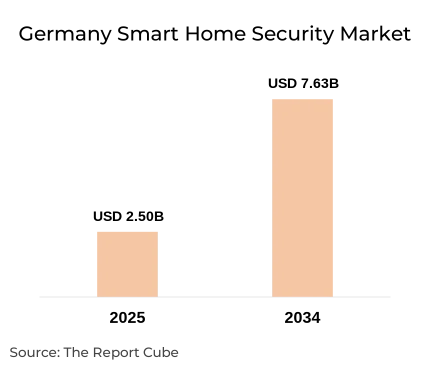
The Germany Smart Home Security Market is anticipated to register a 13.2% during 2026-2034. the market size was valued at USD 2.50 billion in 2025 and is projected to reach USD 7.63 billion by 2034. Germany has emerged as one of Europe’s most technologically advanced residential security ecosystems, supported by strong consumer awareness, robust digital infrastructure, and a growing emphasis on connected home safety. Smart security technologies are increasingly integrated into everyday living environments, offering homeowners real-time visibility and remote monitoring capabilities that traditional security systems cannot deliver.
In recent years, Germany’s residential construction sector has increasingly incorporated smart infrastructure during the design stage. According to data from the German Federal Statistical Office, more than 295,000 new residential units were completed in 2024, many of which integrated smart home automation frameworks including surveillance cameras, door sensors, and intelligent alarm systems. This trend is reshaping security adoption patterns. Rather than installing stand-alone alarm systems after construction, homeowners and property developers are embedding security networks directly into the digital architecture of homes.
Technology partnerships between telecom providers and security solution manufacturers are also accelerating market momentum. Companies such as Deutsche Telekom have expanded smart home ecosystems that combine broadband connectivity, mobile applications, and integrated security hardware into unified platforms. Meanwhile, growing consumer concerns regarding residential burglary—Germany recorded over 77,000 residential break-ins in 2023 according to the Federal Criminal Police Office—have further strengthened demand for proactive home monitoring solutions. As households increasingly prioritize safety and convenience, smart security systems are becoming a central component of the connected home environment across Germany.
Germany Smart Home Security Market Dynamics
Key Driver: Rising Residential Security Concerns and Smart Home Adoption
Germany has experienced a steady increase in demand for intelligent residential protection solutions as homeowners seek more responsive and automated security systems. Data from the German Federal Criminal Police Office indicates that burglary incidents remain a significant concern in urban residential areas such as Berlin, Hamburg, and Cologne. While traditional alarm systems were once the primary protection tool, modern households are shifting toward connected security ecosystems that provide real-time alerts, remote monitoring, and automated threat detection.
Smart cameras, doorbell surveillance systems, and motion sensors connected through mobile applications have transformed how homeowners interact with security technologies. Instead of reacting after an incident occurs, users now receive instant notifications, live video feeds, and AI-based threat alerts directly on smartphones. German households increasingly value this level of control. Surveys conducted by Bitkom Research show that nearly 41% of German consumers expressed interest in installing smart home security devices by 2025. This growing awareness of digital safety solutions is pushing demand for connected cameras, smart locks, and sensor-based monitoring systems across the country.
Book your FREE 30-minute expert consultation today
Contact UsIndustry Trends: Integration of AI, Edge Computing, and Interoperable Smart Home Platforms
The Germany smart home security market is rapidly evolving toward intelligent ecosystems where multiple devices operate seamlessly through unified platforms. One major trend involves the adoption of AI-enabled video analytics capable of distinguishing between routine movement and suspicious activity. These systems reduce false alarms while delivering faster security responses. For example, advanced camera systems can differentiate between pets, delivery personnel, and unauthorized individuals, improving both security accuracy and user convenience.
Another notable trend is the increasing adoption of interoperability standards such as Matter and Thread. These protocols enable smart home devices from different manufacturers to communicate through a single ecosystem, removing compatibility barriers that previously limited adoption. German consumers increasingly prefer devices that can integrate security cameras, smart locks, thermostats, and lighting controls within one mobile application. As this ecosystem expands, security solutions are becoming a core layer of the broader smart home environment rather than isolated hardware installations.
Major Challenge: Data Privacy Concerns and Regulatory Compliance
Data protection regulations remain one of the most important challenges shaping the smart home security landscape in Germany. The country maintains strict digital privacy standards under the General Data Protection Regulation (GDPR), which places limitations on the collection, storage, and processing of video surveillance data. Smart security devices often capture continuous footage and behavioral patterns inside residential environments, raising concerns among consumers about personal data security.
Manufacturers operating in Germany must invest heavily in encrypted cloud storage, secure device authentication, and transparent data management policies. These requirements increase product development complexity and regulatory compliance costs. In addition, some homeowners remain hesitant about installing internet-connected cameras due to fears of hacking or unauthorized access. As the market continues to expand, companies must balance innovation with robust cybersecurity protections to maintain consumer trust in connected security technologies.
Opportunity: Growth of DIY Smart Security Systems and Telecom-Driven Ecosystems
The growing popularity of do-it-yourself smart home devices presents a significant growth opportunity for the Germany smart home security market. Modern consumers prefer easy-to-install security products that can be configured through smartphone applications without professional assistance. Devices such as wireless cameras, smart doorbells, and sensor kits have become highly accessible through online retail platforms, allowing homeowners to build customized security systems at lower costs.
Telecommunications providers are also playing a crucial role in expanding smart security adoption. Companies such as Deutsche Telekom offer bundled services that combine broadband connectivity, home automation platforms, and security devices within subscription-based ecosystems. These integrated services simplify installation and provide centralized control of connected home technologies. As telecom networks expand high-speed fiber and 5G connectivity across Germany, the reliability and responsiveness of smart home security systems will continue improving, encouraging wider household adoption.
Germany Smart Home Security Market Segment-wise Analysis
By Component:
- Hardware
- Software
- Services
The hardware segment dominates the Germany smart home security market, accounting for nearly 58% of total revenue in 2025. Hardware components represent the physical backbone of security systems, including cameras, doorbells, motion sensors, and control hubs that enable real-time monitoring. Among these devices, smart security cameras have experienced particularly strong adoption as they provide visual verification of security events and remote surveillance capabilities.
German homeowners increasingly favor high-resolution cameras equipped with night vision, AI-based motion detection, and cloud video storage. Indoor and outdoor camera installations have grown rapidly as property owners seek full perimeter monitoring. In addition, video doorbells have become one of the fastest-growing hardware devices, enabling residents to interact with visitors remotely and verify deliveries through mobile applications. This combination of advanced features and improved affordability continues to reinforce hardware as the largest revenue-generating segment in the market.
By Product Type:
- Standalone Security Devices
- Integrated Security Systems
Integrated security systems hold the largest share in the Germany smart home security market, capturing around 54% of total revenue. These systems combine multiple security components—such as alarm systems, surveillance cameras, sensors, and control panels—into unified platforms that provide comprehensive home protection. Consumers increasingly prefer bundled security kits because they deliver broader coverage and simplified device management.
Integrated systems also align with the growing demand for connected home ecosystems. Rather than managing separate devices individually, homeowners can monitor all security elements through a single mobile interface. This approach enhances convenience and ensures faster response to potential security threats. As technology continues evolving, integrated platforms are incorporating automation features such as automatic alarm activation, remote lock control, and emergency notifications, making them a preferred solution for modern households.
Regional Projection of Germany Smart Home Security Industry
- Northern Germany
- Western Germany
- Eastern Germany
- Southern Germany
- Others
Western Germany represents the largest regional market for smart home security solutions, accounting for nearly 36% of total installations. Cities such as Cologne, Düsseldorf, Frankfurt, and Dortmund have experienced significant adoption of connected home technologies due to high population density and strong digital infrastructure. Many residential developments in these regions incorporate smart automation frameworks during construction, enabling seamless integration of security devices.
The region also hosts a large concentration of technology companies and telecom operators that promote smart home ecosystems. Consumers in Western Germany tend to adopt connected technologies earlier compared to other regions, influenced by higher disposable incomes and strong broadband penetration. As urban housing developments continue expanding and security awareness rises, the region is expected to maintain its leading position in the Germany smart home security market.
Government Initiatives & Policies
- Germany Smart Living Initiative: The German Federal Ministry for Economic Affairs supports the Smart Living program to accelerate smart home technologies, digital infrastructure, and security automation adoption across residential buildings.
- Digital Strategy Germany 2025: The federal government’s digitalization roadmap includes funding for smart infrastructure, cybersecurity innovation, and connected home technologies supporting residential automation ecosystems.
Germany Smart Home Security Market Recent Developments
- 2025: tado GmbH announced an AI-powered heating optimization feature called “AI Assist,” leveraging deep neural networks trained on over 15 years of anonymized data from more than one million connected homes. The system proactively manages heating patterns and energy consumption, strengthening smart home ecosystem integration across German households.
- 2025: Eve Systems GmbH, now part of ABB, launched the fifth generation of its Eve Thermo smart radiator valve featuring Matter and Thread connectivity. The new design improves interoperability with other smart home devices, supporting secure and standardized connected home ecosystems widely adopted in Germany.
- 2025: Deutsche Telekom AG expanded its Magenta SmartHome ecosystem with enhanced AI-based device management and improved compatibility with third-party security devices, enabling German households to integrate cameras, sensors, and alarms into a unified home automation platform.
- 2025: Robert Bosch GmbH introduced upgraded Bosch Smart Home cameras featuring AI-driven motion detection and encrypted cloud storage, strengthening residential security capabilities and ensuring compliance with Germany’s strict data protection regulations.
Need insights for a specific region within this market?
Request Regional DataWhy Choose This Report?
- Provides a comprehensive overview of the overall market analysis, encompassing key trends, consumer behavior analysis, and risk assessment to support strategic decision-making.
- Provides accurate, up-to-date insights into market size, segmentation, and emerging opportunities, helping to minimize risk & capitalizing on growth.
- Gives deep understanding of target audience preferences, investment habits, and communication channels for enhanced product development & marketing effectiveness.
- Delivers competitive analysis & benchmarking, uncovering the strengths & weaknesses of market competitors to guide strategies.
- Consolidate comprehensive market intelligence, reducing reasoning & streamlining research efforts.
- Facilitates customized market segmentation & risk mitigation strategies, fine-tuned to the business objectives.
- Aids in identifying both market challenges & untapped opportunities within the industry to drive long-term business growth.
- Provides valuable information based on actual customer data & search trends.
Table of Contents
- Introduction
- Objective of the Study
- Product and Category Definition
- Market Segmentation
- Study Variables
- Research Methodology
- Secondary Data Points
- Breakdown of Secondary Sources
- Primary Data Points
- Breakdown of Primary Interviews
- Secondary Data Points
- Executive Summary
- Market Dynamics
- Drivers
- Challenges
- Opportunity Assessment
- Recent Trends and Developments
- Regulatory and Policy Landscape
- Germany Smart Home Security Market Overview (2021-2034)
- Market Size, By Value (USD Billion)
- Market Share, By Component
- Hardware
- Security Cameras
- Video Doorbells
- Smart Door Locks
- Entry Sensors
- Motion Sensors
- Glass Break Sensors
- Sirens and Alarms
- Control Panels and Hubs
- Software
- Mobile Applications
- Video Management Software
- Home Automation Platforms
- Cloud Management Platforms
- Services
- Professional Monitoring
- Installation Services
- Maintenance Services
- Managed Security Services
- Hardware
- Market Share, By Product Type
- Standalone Security Devices
- Indoor Cameras
- Outdoor Cameras
- Smart Doorbells
- Smart Locks
- Security Sensors
- Integrated Security Systems
- All-in-One Security Kits
- Alarm Systems
- Video Surveillance Systems
- Standalone Security Devices
- Market Share, By Connectivity
- Wi-Fi
- Zigbee
- Z-Wave
- Bluetooth
- Proprietary Protocols
- Others
- Market Share, By Installation Type
- Do-It-Yourself
- Professionally Installed
- Market Share, By End User
- Single-Family Homes
- Multi-Family Apartments
- Luxury Residences
- Others
- Market Share, By Distribution Channel
- Online Retail
- Consumer Electronics Retail
- Telecom Operator Channels
- Security Specialist Dealers
- DIY Home Improvement Stores
- Others
- Market Share, By Region
- Northern
- Western
- Eastern
- Southern
- Others
- Market Share, By Company
- Revenue Shares and Analysis
- Competitive Landscape
- Northern Germany Smart Home Security Market
- Market Size, By Value (USD Billion/Million)
- Market Share, By Component
- Market Share, By Product Type
- Market Share, By Connectivity
- Market Share, By Installation Type
- Market Share, By End User
- Market Share, By Distribution Channel
- Western Germany Smart Home Security Market
- Market Size, By Value (USD Billion/Million)
- Market Share, By Component
- Market Share, By Product Type
- Market Share, By Connectivity
- Market Share, By Installation Type
- Market Share, By End User
- Market Share, By Distribution Channel
- Eastern Germany Smart Home Security Market
- Market Size, By Value (USD Billion/Million)
- Market Share, By Component
- Market Share, By Product Type
- Market Share, By Connectivity
- Market Share, By Installation Type
- Market Share, By End User
- Market Share, By Distribution Channel
- Southern Germany Smart Home Security Market
- Market Size, By Value (USD Billion/Million)
- Market Share, By Component
- Market Share, By Product Type
- Market Share, By Connectivity
- Market Share, By Installation Type
- Market Share, By End User
- Market Share, By Distribution Channel
- Competitive Outlook and Company Profiles
- Robert Bosch GmbH
- Company Overview
- Product Portfolio
- Strategic Alliances/Partnerships
- Recent Developments
- ABUS Security Center
- Company Overview
- Product Portfolio
- Strategic Alliances/Partnerships
- Recent Developments
- eQ-3 AG
- Company Overview
- Product Portfolio
- Strategic Alliances/Partnerships
- Recent Developments
- Gigaset Technologies
- Company Overview
- Product Portfolio
- Strategic Alliances/Partnerships
- Recent Developments
- Eve Systems GmbH
- Company Overview
- Product Portfolio
- Strategic Alliances/Partnerships
- Recent Developments
- Tado GmbH
- Company Overview
- Product Portfolio
- Strategic Alliances/Partnerships
- Recent Developments
- Somfy GmbH
- Company Overview
- Product Portfolio
- Strategic Alliances/Partnerships
- Recent Developments
- Lupus Electronics
- Company Overview
- Product Portfolio
- Strategic Alliances/Partnerships
- Recent Developments
- Deutsche Telekom AG
- Company Overview
- Product Portfolio
- Strategic Alliances/Partnerships
- Recent Developments
- Devolo Solutions GmbH
- Company Overview
- Product Portfolio
- Strategic Alliances/Partnerships
- Recent Developments
- Brennenstuhl GmbH
- Company Overview
- Product Portfolio
- Strategic Alliances/Partnerships
- Recent Developments
- Ring (Amazon)
- Company Overview
- Product Portfolio
- Strategic Alliances/Partnerships
- Recent Developments
- Arlo
- Company Overview
- Product Portfolio
- Strategic Alliances/Partnerships
- Recent Developments
- Blaupunkt Competence
- Company Overview
- Product Portfolio
- Strategic Alliances/Partnerships
- Recent Developments
- Nuki Home Solutions
- Company Overview
- Product Portfolio
- Strategic Alliances/Partnerships
- Recent Developments
- Shelly (Allterco Robotics)
- Company Overview
- Product Portfolio
- Strategic Alliances/Partnerships
- Recent Developments
- Others
- Robert Bosch GmbH
- Contact Us and Disclaimer
Top Key Players & Market Share Outlook
- Robert Bosch GmbH
- ABUS Security Center
- eQ-3 AG
- Gigaset Technologies
- Eve Systems GmbH
- Tado GmbH
- Somfy GmbH
- Lupus Electronics
- Deutsche Telekom AG
- Devolo Solutions GmbH
- Brennenstuhl GmbH
- Ring (Amazon)
- Arlo
- Blaupunkt Competence
- Nuki Home Solutions
- Shelly (Allterco Robotics)
Frequently Asked Questions






