




Build Your Custom Market Intelligence Report
Customize Your ReportAsia-Pacific Smart Thermostat Market Key Highlights
By Product Type:
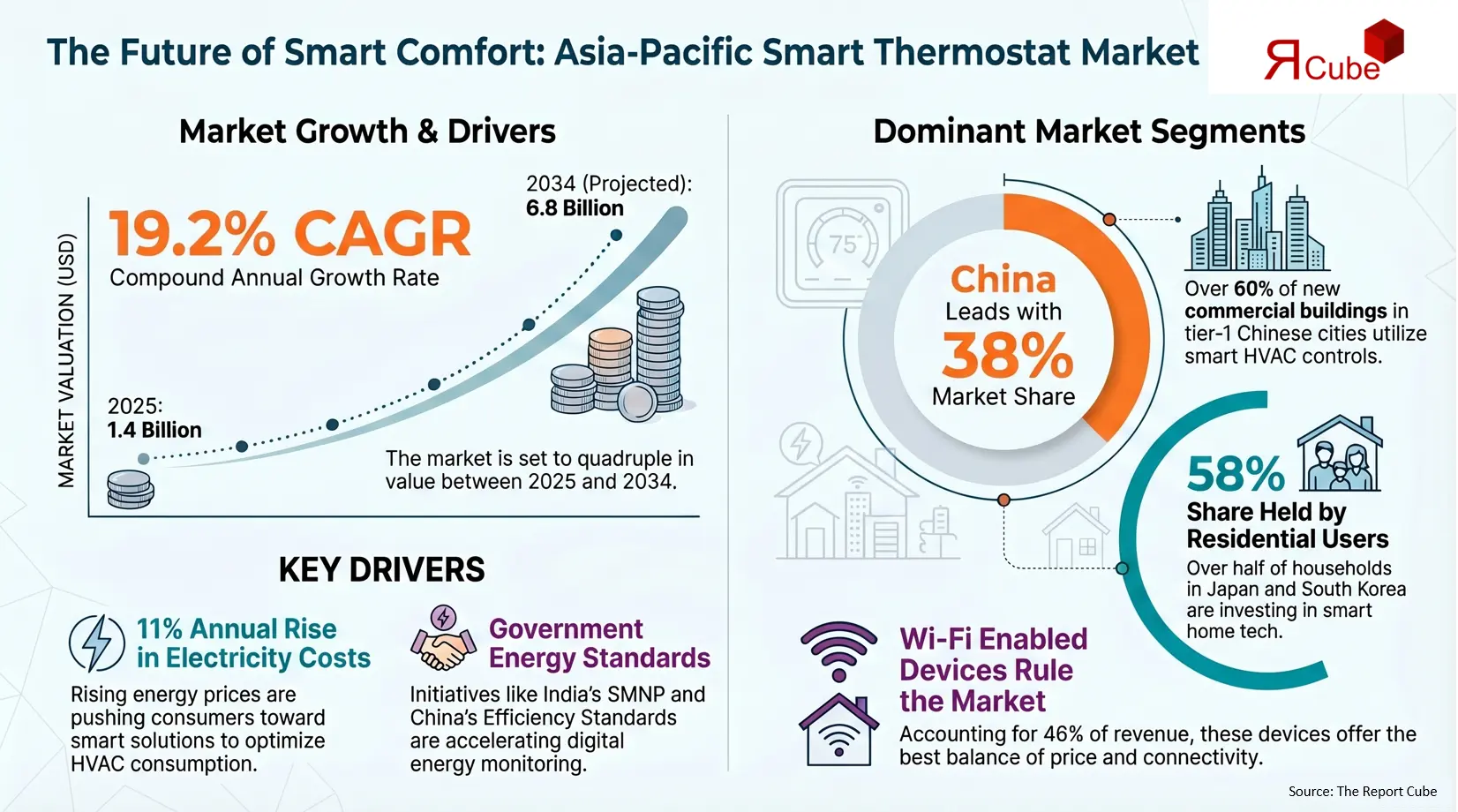
Wi-Fi Enabled Thermostats segment lead the market, with around 46% share.
By Application:
Residential segment dominate the market, accounting for nearly 58% of total revenue.
Regional Outlook:
China region dominates the market, with around 38% share.
Government Initiatives & Policies
- China Energy Efficiency Standards Program: Focuses on smart home energy optimization and appliance efficiency standards.
- India Smart Meter National Programme (SMNP): Promotes digital energy monitoring and smart home integrations.
Asia-Pacific Smart Thermostat Market Insights & Analysis
The Asia-Pacific Smart Thermostat Market is anticipated to register a 19.2% during 2026-2034. the market size was valued at USD 1.4 Billion and is projected to reach USD 6.80 Billion by 2034.
The Asia-Pacific smart thermostat market is witnessing strong expansion driven by rapid urbanization, increasing adoption of smart home ecosystems, and rising energy efficiency awareness. Countries such as China, Japan, South Korea, and India are investing heavily in intelligent infrastructure, which is accelerating the demand for connected HVAC control systems. Recent estimates suggest that over 42% of newly constructed residential units in urban China are integrating at least one smart energy device, including thermostats, highlighting a significant shift toward automated climate control solutions.
Government-backed energy-saving programs across the region are playing a crucial role in shaping market growth. For instance, policies promoting green buildings and energy-efficient appliances have led to a 28% increase in adoption of connected thermostats in commercial spaces between 2022 and 2025. Additionally, rising electricity costs across Asia-Pacific, which increased by nearly 11% annually in major economies, are pushing consumers and businesses toward smart solutions that optimize energy consumption.
Asia-Pacific Smart Thermostat Market Dynamics
Key Driver:
- Rising demand for energy-efficient HVAC systems across residential and commercial sectors
- Increasing adoption of smart home ecosystems and IoT-enabled devices
- Government regulations promoting energy conservation and green buildings
Industry Trends:
- Integration of AI-based learning and predictive temperature control systems
- Growth of wireless connectivity technologies such as Wi-Fi and Zigbee
- Expansion of e-commerce platforms boosting product accessibility
Book your FREE 30-minute expert consultation today
Contact UsMajor Challenge:
- High initial installation and device costs limiting adoption in developing economies
- Interoperability issues between smart home devices and platforms
- Limited consumer awareness in rural and semi-urban regions
Opportunity:
- Growing smart city projects across Asia-Pacific economies
- Expansion of retrofit solutions for existing buildings
- Rising demand for energy analytics and consumption monitoring systems
Asia-Pacific Smart Thermostat Market Segment-wise Analysis
By Product Type:
- Programmable Thermostats
- Wi-Fi Enabled Thermostats
- Learning Thermostats
Out of all sub-segments, Wi-Fi enabled thermostats dominate the Asia-Pacific market, accounting for approximately 46% of total revenue share in 2025. The widespread availability of internet infrastructure and increasing smartphone penetration, which surpassed 78% across urban Asia-Pacific regions, are key contributors to this dominance. These devices offer remote control, scheduling, and integration with mobile apps, making them highly attractive to tech-savvy consumers. Additionally, Wi-Fi enabled thermostats are often priced 15–20% lower than advanced learning models, making them more accessible to middle-income households. The segment is also benefiting from rising adoption in small commercial establishments, where energy savings of up to 18% annually have been recorded through remote HVAC optimization.

By Application:
- Residential
- Commercial
- Industrial
The residential segment leads the market with nearly 58% share, driven by increasing smart home adoption and rising disposable income across key economies. In countries like Japan and South Korea, over 52% of households are actively investing in smart home technologies, including climate control systems. Residential users are increasingly adopting smart thermostats to reduce electricity bills, which have seen consistent growth of 9–12% annually. Additionally, government incentives for energy-efficient homes have encouraged installation rates. The integration of voice assistants and home automation platforms has further boosted demand, making smart thermostats a central component of modern connected living environments.
Regional Projection of Asia-Pacific Smart Thermostat Industry
- China
- Japan
- India
- South Korea
- Australia
- Rest of Asia-Pacific
China dominates the Asia-Pacific smart thermostat market, contributing approximately 38% of the overall regional revenue. The country’s rapid urban development and strong focus on energy efficiency have accelerated adoption rates significantly. Over 60% of new commercial buildings in tier-1 cities are equipped with smart HVAC control systems, including thermostats. Government initiatives promoting smart cities and sustainable construction have further strengthened market demand. Additionally, domestic manufacturers are offering competitively priced products, reducing average device costs by nearly 25% compared to imported alternatives. The presence of large-scale infrastructure projects and growing middle-class population continue to drive sustained growth in the Chinese market.
Asia-Pacific Smart Thermostat Market Recent Developments
-
- 2025: Google Nest introduced advanced AI-powered learning thermostats tailored for Asia-Pacific climates, improving energy efficiency by over 25% and expanding compatibility with regional smart home ecosystems.
- 2025: Honeywell launched a new range of Wi-Fi enabled thermostats with enhanced mobile app integration and real-time energy analytics targeting commercial buildings across Southeast Asia.
- 2025: Schneider Electric expanded its smart building solutions portfolio by integrating smart thermostats with building management systems, enhancing automation capabilities in large commercial facilities.
- 2025: Siemens introduced upgraded IoT-enabled thermostats designed for industrial applications, offering predictive maintenance features and improved energy consumption monitoring.
- 2025: Ecobee expanded its distribution network across India and Australia, focusing on residential markets with affordable smart thermostat models and localized product features.
Build Your Custom Market Intelligence Report
Customized Your ReportWhy Choose This Report?
- Provides a comprehensive overview of the overall market analysis, encompassing key trends, consumer behavior analysis, and risk assessment to support strategic decision-making.
- Provides accurate, up-to-date insights into market size, segmentation, and emerging opportunities, helping to minimize risk & capitalizing on growth.
- Gives deep understanding of target audience preferences, investment habits, and communication channels for enhanced product development & marketing effectiveness.
- Delivers competitive analysis & benchmarking, uncovering the strengths & weaknesses of market competitors to guide strategies.
- Consolidate comprehensive market intelligence, reducing reasoning & streamlining research efforts.
- Facilitates customized market segmentation & risk mitigation strategies, fine-tuned to the business objectives.
- Aids in identifying both market challenges & untapped opportunities within the industry to drive long-term business growth.
- Provides valuable information based on actual customer data & search trends.
Table of Contents
- Introduction
- Objective of the Study
- Product and Category Definition
- Market Segmentation
- Study Variables
- Research Methodology
- Secondary Data Points
- Breakdown of Secondary Sources
- Primary Data Points
- Breakdown of Primary Interviews
- Secondary Data Points
- Executive Summary
- Market Dynamics
- Drivers
- Challenges
- Opportunity Assessment
- Recent Trends and Developments
- Regulatory and Policy Landscape
- Asia-Pacific Smart Thermostat Market Overview (2026-2034)
- Market Size, By Value (USD Billion)
- Market Share, By Product Type
- Programmable Thermostats
- Wi-Fi Enabled Thermostats
- Learning Thermostats
- Market Share, By Component
- Display
- Sensors
- Connectivity Modules
- Others
- Market Share, By Technology
- Zigbee
- Z-Wave
- Wi-Fi
- Bluetooth
- Market Share, By Application
- Residential
- Commercial
- Industrial
- Market Share, By Distribution Channel
- Online Retail
- Offline Retail
- Market Share, By End User
- Homeowners
- Businesses
- Facility Managers
- Market Share, By Country
- China
- Japan
- India
- South Korea
- Australia
- Rest of Asia-Pacific
- Market Share, By Company
- Revenue Shares and Analysis
- Competitive Landscape
- China Smart Thermostat Market
- Market Size, By Value (USD Billion/Million)
- Market Share, By Product Type
- Market Share, By Technology
- Market Share, By Application
- Market Share, By Distribution Channel
- Japan Smart Thermostat Market
- Market Size, By Value (USD Billion/Million)
- Market Share, By Product Type
- Market Share, By Technology
- Market Share, By Application
- Market Share, By Distribution Channel
- India Smart Thermostat Market
- Market Size, By Value (USD Billion/Million)
- Market Share, By Product Type
- Market Share, By Technology
- Market Share, By Application
- Market Share, By Distribution Channel
- South Korea Smart Thermostat Market
- Market Size, By Value (USD Billion/Million)
- Market Share, By Product Type
- Market Share, By Technology
- Market Share, By Application
- Market Share, By Distribution Channel
- Australia Smart Thermostat Market
- Market Size, By Value (USD Billion/Million)
- Market Share, By Product Type
- Market Share, By Technology
- Market Share, By Application
- Market Share, By Distribution Channel
- Rest of Asia-Pacific Smart Thermostat Market
- Market Size, By Value (USD Billion/Million)
- Market Share, By Product Type
- Market Share, By Technology
- Market Share, By Application
- Market Share, By Distribution Channel
- Competitive Outlook and Company Profiles
- Google Nest (Alphabet Inc.)
- Company Overview
- Product Portfolio
- Strategic Alliances/Partnerships
- Recent Developments
- Honeywell International Inc.
- Company Overview
- Product Portfolio
- Strategic Alliances/Partnerships
- Recent Developments
- Johnson Controls International plc
- Company Overview
- Product Portfolio
- Strategic Alliances/Partnerships
- Recent Developments
- Schneider Electric SE
- Company Overview
- Product Portfolio
- Strategic Alliances/Partnerships
- Recent Developments
- Siemens AG
- Company Overview
- Product Portfolio
- Strategic Alliances/Partnerships
- Recent Developments
- Ecobee Inc.
- Company Overview
- Product Portfolio
- Strategic Alliances/Partnerships
- Recent Developments
- Google Nest (Alphabet Inc.)
- Contact Us and Disclaimer
Top Key Players & Market Share Outlook
- Google Nest (Alphabet Inc.)
- Honeywell International Inc.
- Johnson Controls International plc
- Schneider Electric SE
- Siemens AG
- Ecobee Inc. &
- Others
Frequently Asked Questions






