




Build Your Custom Market Intelligence Report
Customize Your ReportUS Software Market Key Highlights
By Type:
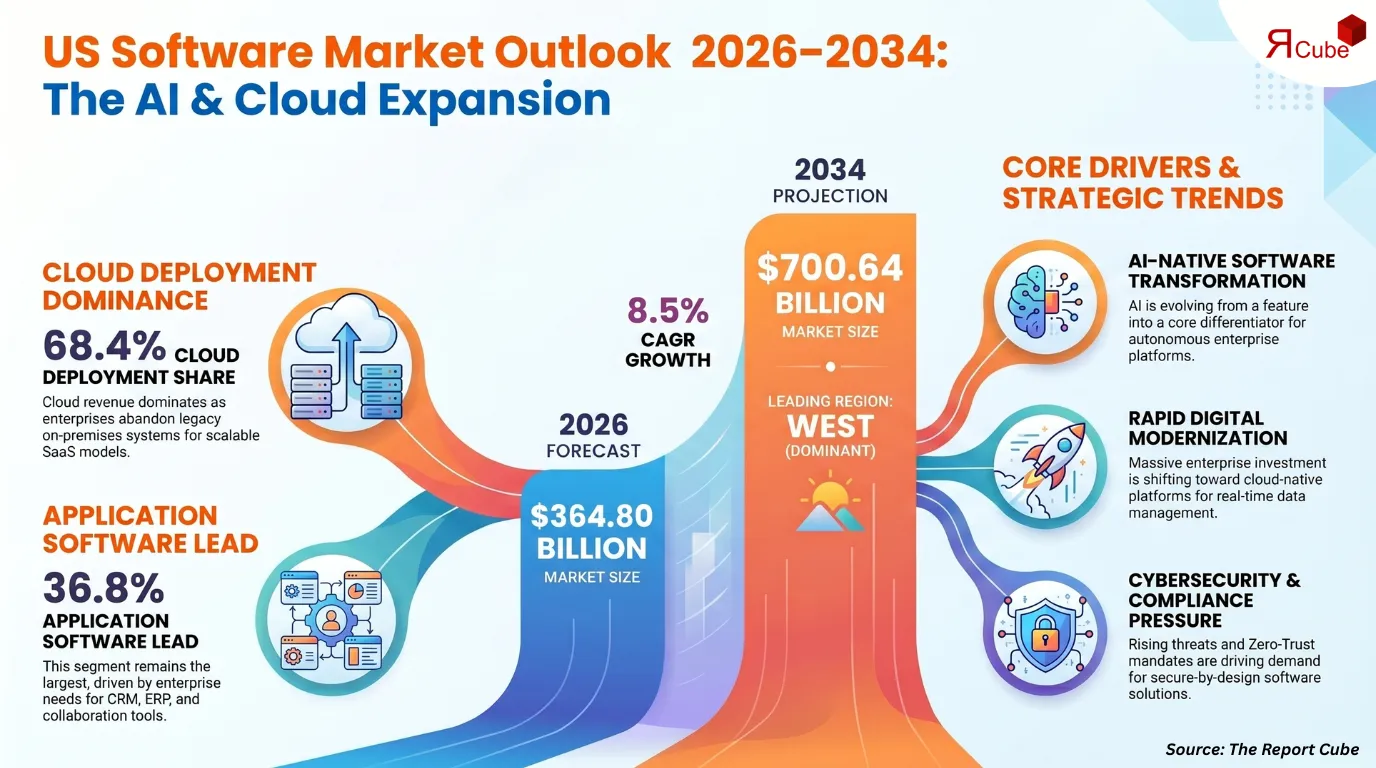
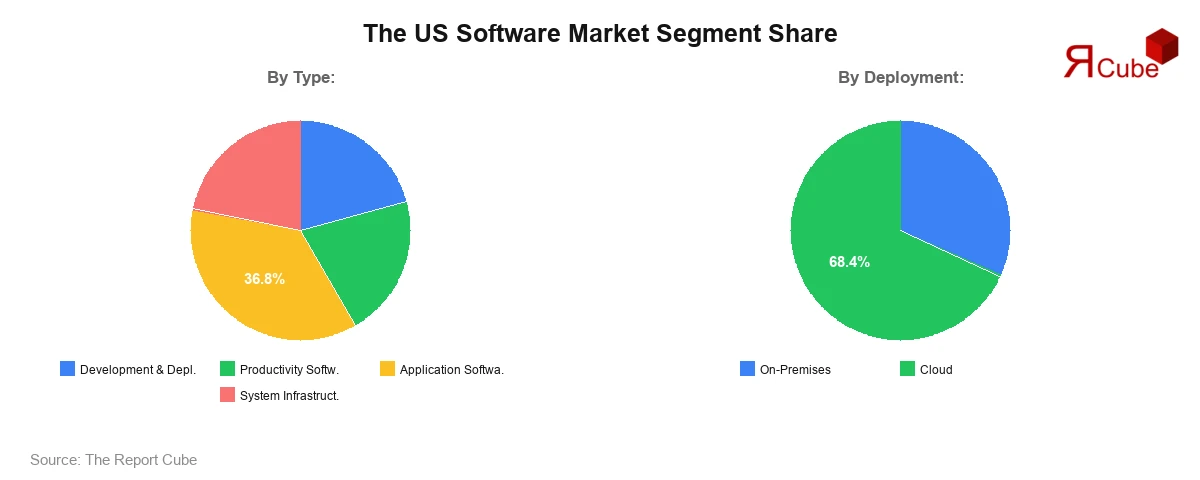
Application Software segment leads the market with approximately 36.8% share.
By Deployment:
Cloud segment dominates the market with nearly 68.4% of revenue.
Regional Outlook:
West region dominates the US Software market with around 38.7% share.
US Software Market Insights & Analysis
The US Software Market is anticipated to register a CAGR of around 8.5% during the forecast period 2026-2034. The market size is valued at USD 364.80 billion in 2026 and is projected to reach USD 700.64 billion by 2034. The United States remains the global center of software innovation, supported by a mature technology ecosystem, deep venture capital networks, and continuous enterprise investment in digital infrastructure. Organizations across finance, healthcare, retail, manufacturing, and government sectors are increasing software expenditures to modernize operations, improve workforce productivity, and strengthen business resilience. Enterprise software spending has accelerated as companies replace legacy systems with cloud-native platforms capable of supporting large-scale data management, automation, and real-time decision-making. This transition is creating sustained demand for business applications, productivity tools, cybersecurity software, and system infrastructure solutions throughout the country.
The software development industry in United States is undergoing a significant transformation as autonomous systems, intelligent workflows, and advanced analytics become embedded within enterprise environments. Major technology companies are expanding investments in AI-enabled software architectures, cybersecurity platforms, and cloud ecosystems to meet evolving enterprise requirements. Recent developments from Nvidia, Adobe, Cisco, and ServiceNow demonstrate how software vendors are moving beyond traditional application delivery toward integrated platforms that combine automation, governance, security, and operational intelligence. In addition, federal digital modernization initiatives and growing enterprise adoption of hybrid cloud environments continue to create favorable conditions for long-term market expansion.
US Software Market Impact Analysis
| Factor | Type | Specific Impact on Market | Magnitude | Business Implication |
|---|---|---|---|---|
| Strong Digital Transformation Spend | Market | Enterprise cloud and SaaS budgets continue rising rapidly | High | Supports premium pricing and recurring subscription growth |
| Rapid AI and Automation Adoption | Technological | AI features become core differentiators across software suites | High | Requires sustained R&D to bundle AI into mainstream products |
| Intense Competition and Consolidation | Competitive | Large incumbents and startups drive pricing and M&A pressure | High | Pushes firms to specialize in niches or scale via acquisitions |
| Evolving Data Privacy Regulations | Regulatory | Stricter rules increase compliance costs and design complexity | Medium | Creates demand for secure, compliant, audit ready software tools |
| Cloud Infrastructure Maturity | Technological | Reliable hyperscale clouds lower entry barriers for new vendors | Medium | Enables asset light models but heightens platform dependency risk |
| Macroeconomic Spending Cycles | Environmental | Downturns delay new deals but protect mission critical renewals | Medium | Drives focus on value messaging and multi year contract locking |
| Chronic Digital Skills Shortage | Consumer | Enterprises seek tools that simplify workflows for lean teams | Medium | Favours intuitive, low code and automation first product design |
US Software Market Dynamics
Key Driver: Enterprise Digital Transformation Accelerating Software Investments
Digital transformation remains one of the strongest growth engines for the US Software Market. Enterprises are increasingly adopting software platforms to improve operational efficiency, reduce manual workloads, enhance customer experiences, and optimize resource utilization. Across industries, organizations are integrating enterprise resource planning systems, business analytics platforms, collaboration software, and cloud-based applications to create more agile operating models. As business environments become increasingly data-driven, software solutions capable of delivering real-time insights and automation are becoming essential components of corporate strategy.
The software development industry in United States is benefiting from rising enterprise demand for scalable and interoperable software ecosystems. Large organizations are investing heavily in software modernization projects to support distributed workforces, digital commerce, cybersecurity readiness, and data governance requirements. Small and medium enterprises are also expanding software adoption as subscription-based cloud models reduce upfront infrastructure costs. This broad-based investment environment continues to strengthen software market growth while creating opportunities across application software, productivity software, and system infrastructure segments.
Industry Trends: Expansion of Autonomous Enterprise Platforms and AI-Native Software
A defining trend reshaping the US Software Market is the emergence of intelligent enterprise platforms capable of automating increasingly complex business functions. Organizations are moving beyond basic workflow automation and deploying software solutions that support predictive decision-making, autonomous operations, and continuous process optimization. Software vendors are embedding advanced intelligence across customer engagement, financial management, cybersecurity, software development, and enterprise collaboration platforms to improve performance and reduce operational friction.
The introduction of enterprise AI agent platforms by leading technology providers reflects a broader shift within the software development industry in United States. Businesses are seeking software environments that can execute tasks, analyze data, generate recommendations, and coordinate workflows with limited human intervention. At the same time, growing emphasis on governance, transparency, and accountability is driving demand for platforms that manage and monitor intelligent systems. These developments are accelerating innovation across the software market while redefining how enterprises deploy and utilize business applications.
Book your FREE 30-minute expert consultation today
Contact UsMajor Challenge: Escalating Cybersecurity Threats and Software Complexity
As software ecosystems become more interconnected, organizations face increasing challenges related to cybersecurity, compliance, and operational complexity. The expansion of cloud environments, remote work infrastructures, and digital business models has created new vulnerabilities that require continuous monitoring and protection. Cyberattacks targeting enterprise applications, customer databases, and cloud platforms have become more sophisticated, increasing pressure on organizations to strengthen security investments and software governance practices.
Another challenge stems from the growing complexity of modern enterprise software environments. Businesses often operate across multiple cloud platforms, legacy systems, and third-party applications, making integration and management more difficult. Regulatory requirements related to data privacy, cybersecurity, and digital compliance further increase implementation costs and operational responsibilities. These factors can slow deployment timelines and create barriers for organizations with limited technical resources, particularly within small and medium-sized business segments.
Opportunity: Industry-Specific Software Solutions Creating New Revenue Streams
Demand for specialized software solutions tailored to industry-specific requirements is creating substantial growth opportunities across the US Software Market. Sectors such as healthcare, financial services, manufacturing, education, logistics, and energy increasingly require software platforms designed to address unique regulatory, operational, and customer-facing challenges. Vendors that offer industry-focused functionality, compliance capabilities, and integrated analytics are gaining competitive advantages in an increasingly specialized software landscape.
The software development industry in United States is also witnessing growing demand for governance, orchestration, and lifecycle management platforms that support enterprise deployment of intelligent systems. As organizations adopt advanced automation technologies, the need for software solutions that ensure visibility, compliance, accountability, and operational consistency continues to increase. This emerging segment presents significant opportunities for software providers seeking to expand beyond traditional application delivery models and establish long-term enterprise relationships.
US Software Market Segment-wise Analysis
By Type:
- Development & Deployment Software
- Business Analytics & Reporting Tools
- Application Services
- Enterprise Data Management
- Data Quality Tools
- Productivity Software
- Creative Software
- Office Software
- Application Software
- Customer Resource Planning
- Enterprise Content Management (ECM) Software
- Supply Chain Management (SCM)
- Enterprise Resource Planning
- Others (Education Software, Enterprise Collaboration Software, etc.)
- System Infrastructure Software
- Storage Software
- Security Software
- Network Management Software
Application Software holds the largest share of the US Software Market, accounting for approximately 36.8% of total industry revenue. The segment's leadership reflects the growing importance of enterprise applications in managing business operations, customer engagement, workforce collaboration, and supply chain activities. Organizations increasingly rely on enterprise resource planning, customer resource planning, enterprise content management, and collaboration platforms to improve efficiency and support data-driven decision-making. Continuous digital transformation initiatives across both private and public sectors are further strengthening adoption levels.
Growth within the segment is also being supported by the integration of advanced analytics, automation capabilities, and intelligent workflow management features. Businesses are seeking software solutions that can centralize information, improve visibility across operations, and reduce administrative burdens. As organizations continue investing in modernization programs, application software remains positioned as a critical technology foundation supporting productivity, scalability, and long-term business performance across the United States.
By Deployment:
- On-Premises
- Cloud
Cloud deployment remains the dominant segment within the US Software Market, capturing nearly 68.4% of total revenue. Enterprises continue migrating workloads from traditional on-premises environments to cloud-based platforms to improve flexibility, scalability, and operational efficiency. Cloud software enables organizations to deploy applications faster, support remote and hybrid work models, and reduce infrastructure maintenance costs. These advantages have accelerated adoption across businesses of all sizes.
Cloud leadership is further reinforced by the growing popularity of subscription-based software delivery models and hybrid cloud strategies. Organizations increasingly prefer cloud platforms because they provide continuous updates, enhanced collaboration capabilities, and seamless integration with emerging technologies. As cybersecurity, data management, and performance capabilities continue to improve, cloud deployment is expected to remain the preferred software delivery model throughout the forecast period, supporting sustained software market growth.
Regional Projection of US Software Industry
- West
- East
- South
- Midwest
- Others
The West region maintains its position as the largest contributor to the US Software Market, accounting for approximately 38.7% of overall revenue. The region benefits from a highly concentrated technology ecosystem that includes leading software developers, cloud providers, semiconductor companies, venture capital firms, and research institutions. California and Washington continue to serve as major centers for software innovation, attracting significant investments in cloud computing, cybersecurity, enterprise applications, and intelligent software technologies.
The region's leadership is further supported by strong technology talent availability, high levels of research and development activity, and close collaboration between enterprises, universities, and startup communities. Many of the nation's largest software companies maintain substantial operations within the region, enabling continuous innovation and commercialization of emerging technologies. As enterprise demand for advanced software solutions continues to expand, the West is expected to remain a primary driver of software market size, growth, and technological advancement across the United States.
Need insights for a specific region within this market?
Request Regional DataUS Software Market Regional Analysis
The US software market in 2026 shows strong but uneven growth, shaped by tech hubs, cloud and AI adoption, and industry-specific digitalization across regions [web:1892][web:1899].
| Cluster | Demand Level | Key Areas | System Dominance | Core Demand Logic | Growth Nature |
|---|---|---|---|---|---|
| West (Silicon Valley & West Coast) | Extremely High | SF Bay Area, Seattle, LA | Cloud, AI, dev tools | Big tech, startups, VC capital | Innovation-led, fastest |
| East (Northeast tech corridor) | Very High | NYC, Boston, DC | Fintech, SaaS, security | Finance, healthcare, public | Enterprise upgrade cycle |
| South (Sun Belt & Texas) | High | Austin, Atlanta, Miami | Cloud, SaaS, nearshore | Relocation, cost & talent | Fast, business-friendly |
| Midwest (Industrial cloud) | Medium | Chicago, Detroit, Columbus | ERP, industrial, cloud | Manufacturing digital shift | Steady, vertical focus |
| Others (Secondary tech nodes) | Emerging | Raleigh, Denver, Phoenix | Vertical SaaS, AI, dev | Remote work & cost appeal | High-potential, niche |
Government Initiatives & Policies
- Federal Zero Trust Cybersecurity Strategy: The U.S. government continues implementing zero-trust cybersecurity frameworks across federal agencies to strengthen software security, identity management, and cloud infrastructure resilience.
- National Artificial Intelligence Initiative: Ongoing federal investments support AI research, commercialization, workforce development, and responsible AI deployment, creating growth opportunities for software developers and enterprise software providers.
US Software Industry Recent Developments
- 2026: NVIDIA Corporation launched an enterprise AI agent platform enabling organizations to build and deploy autonomous software agents across engineering, analytics, and operational workflows. The platform enhances enterprise automation capabilities while accelerating adoption of AI-driven software ecosystems across the United States.
- 2026: Cisco Systems, Inc. expanded its AI-driven cybersecurity software portfolio with advanced threat detection, automated incident response, and AI workload protection capabilities. The development strengthens enterprise security operations and supports increasing adoption of AI-native cybersecurity platforms.
- 2026: ServiceNow enhanced its AI governance and workflow orchestration platform to help enterprises manage, monitor, and optimize autonomous AI agents. The solution strengthens compliance, governance, and operational control across AI-powered business environments.
- 2025: Adobe Inc. introduced Firefly Image Model 5 and expanded AI-powered creative capabilities including image generation, video editing, voiceover creation, and custom AI models. The development strengthens Adobe's competitive position within the rapidly expanding generative AI software market.
Why Choose This Report?
- Provides a comprehensive overview of the overall market analysis, encompassing key trends, consumer behavior analysis, and risk assessment to support strategic decision-making.
- Provides accurate, up-to-date insights into market size, segmentation, and emerging opportunities, helping to minimize risk & capitalizing on growth.
- Gives deep understanding of target audience preferences, investment habits, and communication channels for enhanced product development & marketing effectiveness.
- Delivers competitive analysis & benchmarking, uncovering the strengths & weaknesses of market competitors to guide strategies.
- Consolidate comprehensive market intelligence, reducing reasoning & streamlining research efforts.
- Facilitates customized market segmentation & risk mitigation strategies, fine-tuned to the business objectives.
- Aids in identifying both market challenges & untapped opportunities within the industry to drive long-term business growth.
- Provides valuable information based on actual customer data & search trends.
Table of Contents
- Introduction
- Objective of the Study
- Product and Category Definition
- Market Segmentation
- Study Variables
- Research Methodology
- Secondary Data Points
- Breakdown of Secondary Sources
- Primary Data Points
- Breakdown of Primary Interviews
- Secondary Data Points
- Executive Summary
- Market Dynamics
- Emerging Opportunities
- Adoption Trends
- Demand Drivers
- Disruption Analysis (Challenges)
- Industry Analysis & Strategic Insights
- Supply/Value Chain Analysis
- Pricing Analysis
- Go-To-Market (GTM) Strategy
- BCG Matrix
- Recent Trends and Developments
- Regulatory and Policy Landscape
- Region-wise Policies
- Government Initiatives
- US Software Market Overview and Forecast Analysis (2021-2034)
- Market Size, By Value, By Growth Rate (CAGR/USD Billion)
- Market Share, By Type
- Development & Deployment Software
- Business Analytics & Reporting Tools
- Application Services
- Enterprise Data Management
- Data Quality Tools
- Productivity Software
- Creative Software
- Office Software
- Application Software
- Customer Resource Planning
- Enterprise Content Management (ECM) Software
- Supply Chain Management (SCM)
- Enterprise Resource Planning
- Others (Education Software, Enterprise Collaboration Software, etc.)
- System Infrastructure Software
- Storage Software
- Security Software
- Network Management Software
- Development & Deployment Software
- Market Share, By Deployment
- On-Premises
- Cloud
- Market Share, By Enterprise Size
- Large Enterprises
- Small & Medium Enterprises
- Market Share, By End User
- Retail
- BFSI
- Government/ Public Sector
- IT & Telecom
- Others (Healthcare, Energy & Utilities, etc.)
- Market Share, By Region
- West
- East
- South
- Midwest
- Others
- Market Share, By Company
- Revenue Shares & Analysis
- Competitive Landscape
- West US Software Market Overview and Forecast Analysis (2021-2034)
- Market Size, By Value, By Growth Rate (CAGR/USD Billion/Million)
- Market Share, By Type
- Market Share, By Deployment
- Market Share, By Enterprise Size
- Market Share, By End User
- East US Software Market Overview and Forecast Analysis (2021-2034)
- Market Size, By Value, By Growth Rate (CAGR/USD Billion/Million)
- Market Share, By Type
- Market Share, By Deployment
- Market Share, By Enterprise Size
- Market Share, By End User
- South US Software Market Overview and Forecast Analysis (2021-2034)
- Market Size, By Value, By Growth Rate (CAGR/USD Billion/Million)
- Market Share, By Type
- Market Share, By Deployment
- Market Share, By Enterprise Size
- Market Share, By End User
- Midwest US Software Market Overview and Forecast Analysis (2021-2034)
- Market Size, By Value, By Growth Rate (CAGR/USD Billion/Million)
- Market Share, By Type
- Market Share, By Deployment
- Market Share, By Enterprise Size
- Market Share, By End User
- Competitive Analysis, 2026
- Market Share of Key Players
- Competitive Mapping for Each Segment and Companies Operating Regionally
- West US Software Companies Share & Competitive Analysis, 2026
- East US Software Companies Share & Competitive Analysis, 2026
- South US Software Companies Share & Competitive Analysis, 2026
- Midwest US Software Companies Share & Competitive Analysis, 2026
- Company Profile (Partial List)
- Adobe Inc.
- Company Overview
- Product Portfolio
- Strategic Alliances/Partnerships
- Recent Developments
- Microsoft Corporation
- Company Overview
- Product Portfolio
- Strategic Alliances/Partnerships
- Recent Developments
- Oracle Corporation
- Company Overview
- Product Portfolio
- Strategic Alliances/Partnerships
- Recent Developments
- NVIDIA Corporation
- Company Overview
- Product Portfolio
- Strategic Alliances/Partnerships
- Recent Developments
- Cisco Systems, Inc.
- Company Overview
- Product Portfolio
- Strategic Alliances/Partnerships
- Recent Developments
- Alphabet Inc.
- Company Overview
- Product Portfolio
- Strategic Alliances/Partnerships
- Recent Developments
- VMware Inc.
- Company Overview
- Product Portfolio
- Strategic Alliances/Partnerships
- Recent Developments
- NortonLifeLock Inc.
- Company Overview
- Product Portfolio
- Strategic Alliances/Partnerships
- Recent Developments
- McAfee Corporation
- Company Overview
- Product Portfolio
- Strategic Alliances/Partnerships
- Recent Developments
- Splunk, Inc.
- Company Overview
- Product Portfolio
- Strategic Alliances/Partnerships
- Recent Developments
- Others (Partial List)
- Adobe Inc.
- Contact Us and Disclaimer
Top Key Players & Market Share Outlook
- Adobe Inc.
- Microsoft Corporation
- Oracle Corporation
- NVIDIA Corporation
- Cisco Systems, Inc.
- Alphabet Inc.
- VMware Inc.
- NortonLifeLock Inc.
- McAfee Corporation
- Splunk, Inc.
- Others
Frequently Asked Questions






