



Build Your Custom Market Intelligence Report
Customize Your ReportGermany Automotive Software Market Key Highlights
By Software Type:
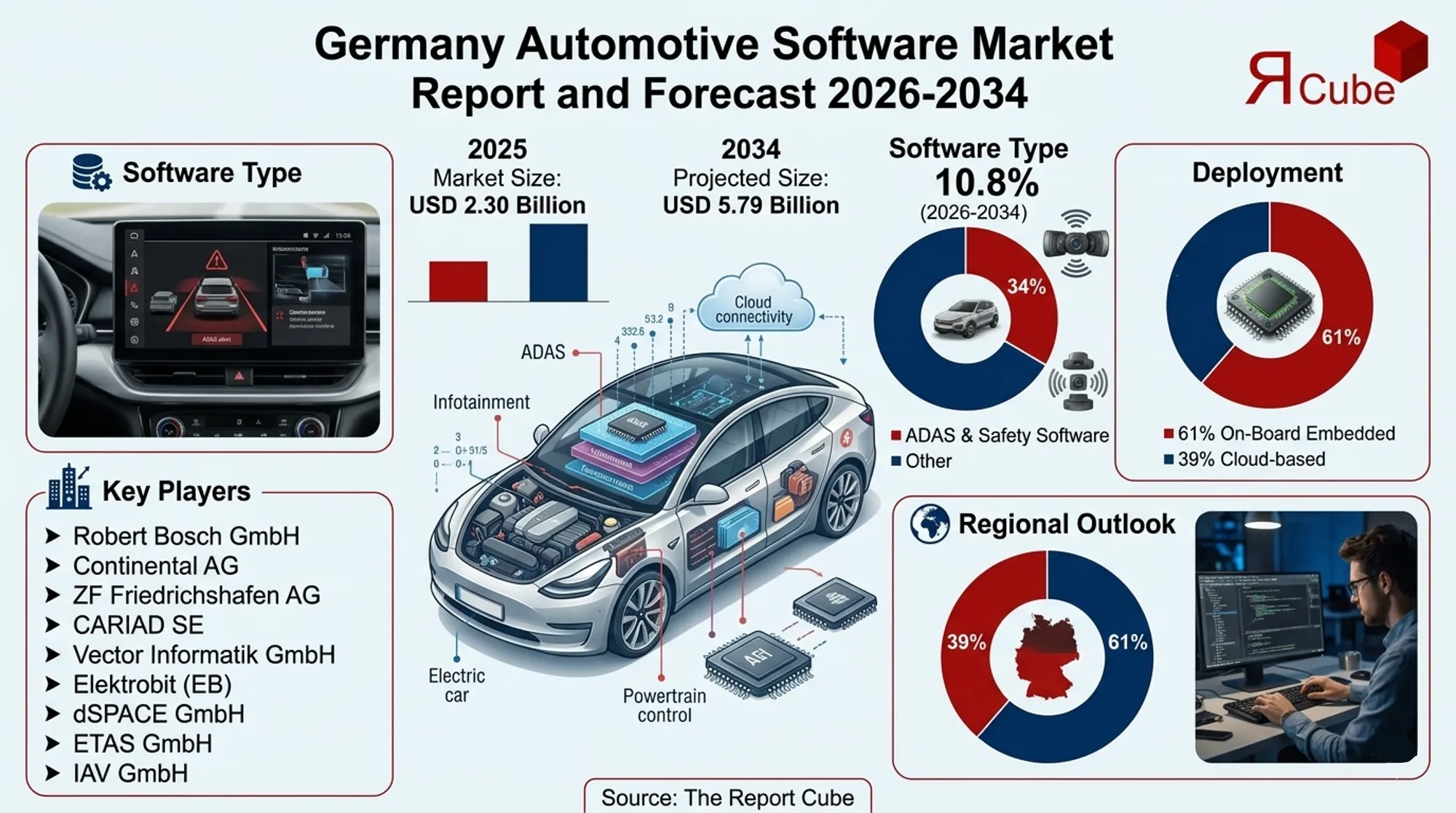
Advanced Driver Assistance Systems (ADAS) and Safety Software segment lead the market, with around 34% share.
By Deployment:
On-Board Embedded Software segment dominate the market, accounting for nearly 61% of total revenue.
Regional Outlook:
Western region dominates the Germany automotive software market, with around 39% share.
Germany Automotive Software Market Insights & Analysis
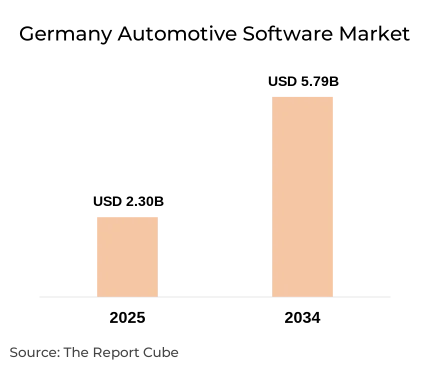
The Germany Automotive Software Market is anticipated to register a CAGR of around 10.8% during the forecast period 2026-2034. the market size was valued at USD 2.30 billion in 2025 and is projected to reach USD 5.79 billion by 2034. Germany continues to anchor Europe’s transition toward software-defined vehicles, where code increasingly determines vehicle performance, safety, and user experience. As OEMs shift from hardware-centric engineering to software-driven architectures, the demand for scalable automotive software platforms has intensified across passenger and commercial vehicle segments.
Investment activity across Germany reflects this transformation clearly. In 2025 alone, German automakers and suppliers allocated over USD 8.5 billion toward automotive software R&D, with a large portion directed toward ADAS, AI-enabled driving systems, and vehicle connectivity platforms. Volkswagen’s software arm CARIAD expanded its engineering workforce by over 20% to accelerate platform development, while Bosch reported that software and electronics now contribute nearly 30% of its mobility division revenue. These developments highlight how software is no longer a supporting function but a primary value driver.
Germany Automotive Software Market Dynamics
Key Driver: Rising Demand for Software-Defined Vehicles and Intelligent Mobility
The rapid transition toward software-defined vehicles is a primary force driving the Germany automotive software market. Automakers are embedding millions of lines of code into vehicles, with modern premium vehicles containing over 150 million lines of software code in 2025. This shift is driven by the growing need for enhanced safety, connectivity, and autonomous capabilities. Consumers now expect vehicles to function more like digital devices, offering continuous updates, personalized interfaces, and intelligent driving assistance. German OEMs are responding by investing heavily in proprietary software stacks, enabling control over vehicle performance and data ecosystems.
Additionally, regulatory push for advanced safety features such as mandatory ADAS systems across Europe has significantly boosted software adoption. This convergence of regulatory requirements, consumer expectations, and technological advancement is accelerating the integration of software across all vehicle domains.
Book your FREE 30-minute expert consultation today
Contact UsIndustry Trends: Integration of AI, Cloud, and Real-Time Data Platforms
The integration of artificial intelligence and cloud-based platforms is reshaping the automotive software landscape in Germany. Automakers are adopting centralized computing systems that enable real-time data processing and seamless communication between vehicle components. By 2025, over 60% of new vehicles in Germany are expected to support over-the-air updates, allowing continuous feature enhancements without physical servicing. AI-driven analytics is also enabling predictive maintenance, reducing unexpected vehicle failures by nearly 25%.
Furthermore, partnerships between automotive companies and tech firms are increasing, leading to the development of unified software ecosystems. This trend supports faster deployment of features such as autonomous driving algorithms, voice assistants, and advanced infotainment systems. As vehicles become more connected, software platforms are evolving into critical infrastructure supporting mobility services.
Major Challenge: Complexity in Software Integration and Cybersecurity Risks
The growing complexity of automotive software systems presents a significant challenge for the Germany automotive software market. Modern vehicles rely on multiple software layers operating across different domains, including powertrain, safety, and infotainment. Ensuring seamless integration across these systems requires advanced engineering capabilities and standardized architectures.
Additionally, cybersecurity concerns have intensified as connected vehicles become vulnerable to data breaches and system hacking. Reports indicate that automotive cyberattacks increased by over 40% between 2023 and 2025, raising concerns among manufacturers and regulators. Compliance with stringent European cybersecurity regulations further adds to development complexity. Addressing these challenges requires continuous investment in secure software frameworks, testing environments, and cross-industry collaboration, which can slow down deployment timelines and increase development costs.
Opportunity: Expansion of Electric Vehicles and Smart Mobility Ecosystems
The rapid growth of electric vehicles presents a strong opportunity for the Germany automotive software market. EVs rely heavily on software for battery management, energy optimization, and charging infrastructure integration. By 2030, electric vehicles are expected to account for over 55% of new vehicle sales in Germany, significantly increasing demand for energy management software solutions. Additionally, smart mobility initiatives such as connected infrastructure and vehicle-to-everything communication are opening new revenue streams for software providers.
Automotive companies are also exploring subscription-based software services, enabling recurring revenue models. These developments create opportunities for innovation in areas such as autonomous driving, digital cockpit systems, and cloud-based mobility platforms, positioning Germany as a hub for next-generation automotive software solutions.
Germany Automotive Software Market Segment-wise Analysis
By Software Type:
- Advanced Driver Assistance Systems (ADAS) and Safety Software
- Infotainment and Connectivity Software
- Navigation and Mapping Software
- Autonomous Driving and AD Software
- Powertrain and Engine Control Software
- Smart Diagnostics and Predictive Maintenance Software
- In-Car Voice Assistance Software
- Energy Management and Battery Management Software
- Vehicle-to-Everything (V2X) and Remote Monitoring Software
Advanced Driver Assistance Systems and safety software hold the leading position, contributing nearly 34% of the Germany automotive software market in 2025. This dominance stems from regulatory mandates and rising consumer demand for enhanced safety features. Technologies such as adaptive cruise control, lane-keeping assistance, and collision avoidance systems rely heavily on real-time data processing and advanced algorithms. German automakers have significantly expanded their ADAS capabilities, integrating sensor fusion technologies combining radar, LiDAR, and cameras.
By 2025, more than 70% of newly produced vehicles in Germany are equipped with Level 2 or higher automation features. The increasing push toward autonomous driving further strengthens this segment, as safety software forms the foundation for higher levels of automation. Continuous updates through over-the-air systems also ensure performance improvements, making ADAS software a central component of modern vehicle architecture.
By Deployment:
- On-Board Embedded Software
- Cloud-Based Software
On-board embedded software dominates the deployment segment, accounting for approximately 61% of total market revenue. This dominance is driven by the need for real-time processing, low latency, and high reliability in critical vehicle functions such as braking, steering, and powertrain control. Embedded systems enable immediate response without dependence on external networks, which is essential for safety-critical operations. German automotive manufacturers continue to invest in high-performance computing units integrated within vehicles, supporting complex software applications.
However, cloud-based software is rapidly gaining traction, particularly for non-critical functions such as infotainment, remote diagnostics, and data analytics. The hybrid model combining embedded and cloud systems is emerging as the preferred architecture, offering both performance and scalability.
Regional Projection of Germany Automotive Software Industry
- Northern
- Western
- Eastern
- Southern
- Others
Western Germany leads the automotive software market, capturing nearly 39% of the overall share. This region hosts major automotive clusters, including leading OEMs, Tier-1 suppliers, and technology firms. Cities such as Stuttgart, Munich, and Frankfurt serve as innovation hubs, driving software development and testing activities. The presence of research institutions and strong collaboration between academia and industry further supports technological advancement.
Additionally, Western Germany benefits from robust infrastructure and access to skilled talent, enabling faster adoption of advanced automotive technologies. Investment in smart mobility projects and digital infrastructure continues to strengthen the region’s position as the core of Germany’s automotive software ecosystem.
Government Initiatives & Policies
- Germany Autonomous Driving Act (Updated Framework 2025): The German government expanded Level 4 autonomous vehicle deployment regulations, enabling commercial mobility services and accelerating software-defined vehicle ecosystems.
- EU Software Defined Vehicle Initiative (SDV Program 2026): European Commission-backed program supporting AI-driven automotive software innovation and cross-border mobility platforms.
Germany Automotive Software Market Recent Developments
- 2025: ZF Friedrichshafen AG showcased production-ready by-wire systems and software-defined chassis technologies at IAA Mobility 2025, integrating its SELECT e-mobility platform with advanced thermal management systems to support next-generation connected electric vehicles.
- 2025: CARIAD SE introduced a unified event-driven data platform connecting millions of vehicles through real-time data streaming, enabling scalable deployment of software-defined vehicle functions across Volkswagen Group brands.
- 2025: Robert Bosch GmbH expanded its automotive software division by launching AI-powered vehicle control units, enhancing predictive diagnostics and enabling seamless integration of cloud-based automotive services.
- 2025: Continental AG unveiled a high-performance computing platform designed to centralize vehicle software architecture, reducing system complexity while improving real-time processing capabilities for autonomous driving.
- 2025: Mercedes-Benz accelerated the rollout of its MB.OS operating system, enabling continuous over-the-air updates and enhancing in-car digital experiences with advanced AI-driven personalization features.
Need insights for a specific region within this market?
Request Regional DataWhy Choose This Report?
- Provides a comprehensive overview of the overall market analysis, encompassing key trends, consumer behavior analysis, and risk assessment to support strategic decision-making.
- Provides accurate, up-to-date insights into market size, segmentation, and emerging opportunities, helping to minimize risk & capitalizing on growth.
- Gives deep understanding of target audience preferences, investment habits, and communication channels for enhanced product development & marketing effectiveness.
- Delivers competitive analysis & benchmarking, uncovering the strengths & weaknesses of market competitors to guide strategies.
- Consolidate comprehensive market intelligence, reducing reasoning & streamlining research efforts.
- Facilitates customized market segmentation & risk mitigation strategies, fine-tuned to the business objectives.
- Aids in identifying both market challenges & untapped opportunities within the industry to drive long-term business growth.
- Provides valuable information based on actual customer data & search trends.
Table of Contents
- Introduction
- Objective of the Study
- Product and Category Definition
- Market Segmentation
- Study Variables
- Research Methodology
- Secondary Data Points
- Breakdown of Secondary Sources
- Primary Data Points
- Breakdown of Primary Interviews
- Secondary Data Points
- Executive Summary
- Market Dynamics
- Drivers
- Challenges
- Opportunity Assessment
- Recent Trends and Developments
- Regulatory and Policy Landscape
- Germany Automotive Software Market Overview (2021-2034)
- Market Size, By Value (USD Billion)
- Market Share, By Software Type
- Advanced Driver Assistance Systems (ADAS) and Safety Software
- Infotainment and Connectivity Software
- Navigation and Mapping Software
- Autonomous Driving and AD Software
- Powertrain and Engine Control Software
- Smart Diagnostics and Predictive Maintenance Software
- In-Car Voice Assistance Software
- Energy Management and Battery Management Software
- Vehicle-to-Everything (V2X) and Remote Monitoring Software
- Market Share, By Deployment
- On-Board Embedded Software
- Cloud-Based Software
- Market Share, By Vehicle Type
- Passenger Cars
- Light Commercial Vehicles
- Heavy Commercial Vehicles
- Off-Highway Vehicles
- Market Share, By Application Domain
- Body and Comfort Systems
- Chassis and Safety Systems
- Powertrain and Drivetrain Systems
- Telematics and Connectivity Systems
- Market Share, By Region
- Northern
- Western
- Eastern
- Southern
- Others
- Market Share, By Company
- Revenue Shares and Analysis
- Competitive Landscape
- Northern Germany Automotive Software Market
- Market Size, By Value (USD Billion/Million)
- Market Share, By Software Type
- Market Share, By Deployment
- Market Share, By Vehicle Type
- Market Share, By Application Domain
- Western Germany Automotive Software Market
- Market Size, By Value (USD Billion/Million)
- Market Share, By Software Type
- Market Share, By Deployment
- Market Share, By Vehicle Type
- Market Share, By Application Domain
- Eastern Germany Automotive Software Market
- Market Size, By Value (USD Billion/Million)
- Market Share, By Software Type
- Market Share, By Deployment
- Market Share, By Vehicle Type
- Market Share, By Application Domain
- Southern Germany Automotive Software Market
- Market Size, By Value (USD Billion/Million)
- Market Share, By Software Type
- Market Share, By Deployment
- Market Share, By Vehicle Type
- Market Share, By Application Domain
- Competitive Outlook and Company Profiles
- Robert Bosch GmbH
- Company Overview
- Product Portfolio
- Strategic Alliances/Partnerships
- Recent Developments
- Continental AG
- Company Overview
- Product Portfolio
- Strategic Alliances/Partnerships
- Recent Developments
- ZF Friedrichshafen AG
- Company Overview
- Product Portfolio
- Strategic Alliances/Partnerships
- Recent Developments
- CARIAD SE
- Company Overview
- Product Portfolio
- Strategic Alliances/Partnerships
- Recent Developments
- Vector Informatik GmbH
- Company Overview
- Product Portfolio
- Strategic Alliances/Partnerships
- Recent Developments
- Elektrobit (EB)
- Company Overview
- Product Portfolio
- Strategic Alliances/Partnerships
- Recent Developments
- dSPACE GmbH
- Company Overview
- Product Portfolio
- Strategic Alliances/Partnerships
- Recent Developments
- ETAS GmbH
- Company Overview
- Product Portfolio
- Strategic Alliances/Partnerships
- Recent Developments
- IAV GmbH
- Company Overview
- Product Portfolio
- Strategic Alliances/Partnerships
- Recent Developments
- Bertrandt AG
- Company Overview
- Product Portfolio
- Strategic Alliances/Partnerships
- Recent Developments
- Hella (FORVIA HELLA)
- Company Overview
- Product Portfolio
- Strategic Alliances/Partnerships
- Recent Developments
- BMW Group (IT/SW)
- Company Overview
- Product Portfolio
- Strategic Alliances/Partnerships
- Recent Developments
- Mercedes-Benz (MB.OS)
- Company Overview
- Product Portfolio
- Strategic Alliances/Partnerships
- Recent Developments
- FEV.io
- Company Overview
- Product Portfolio
- Strategic Alliances/Partnerships
- Recent Developments
- Draxlmaier Group
- Company Overview
- Product Portfolio
- Strategic Alliances/Partnerships
- Recent Developments
- Knorr-Bremse AG
- Company Overview
- Product Portfolio
- Strategic Alliances/Partnerships
- Recent Developments
- Valeo
- Company Overview
- Product Portfolio
- Strategic Alliances/Partnerships
- Recent Developments
- Others
- Robert Bosch GmbH
- Contact Us and Disclaimer
Top Key Players & Market Share Outlook
- Robert Bosch GmbH
- Continental AG
- ZF Friedrichshafen AG
- CARIAD SE
- Vector Informatik GmbH
- Elektrobit (EB)
- dSPACE GmbH
- ETAS GmbH
- IAV GmbH
- Bertrandt AG
- Hella (FORVIA HELLA)
- BMW Group (IT/SW)
- Mercedes-Benz (MB.OS)
- FEV.io
- Draxlmaier Group
- Knorr-Bremse AG
- Valeo (Germany)
Frequently Asked Questions






