


Build Your Custom Market Intelligence Report
Customize Your ReportKey Highlights
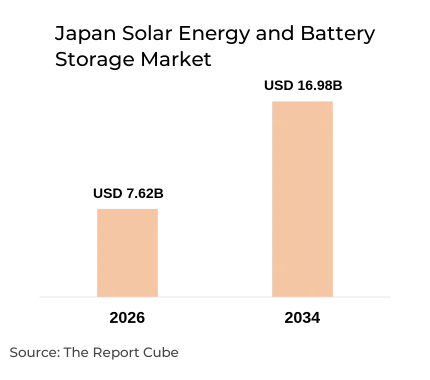
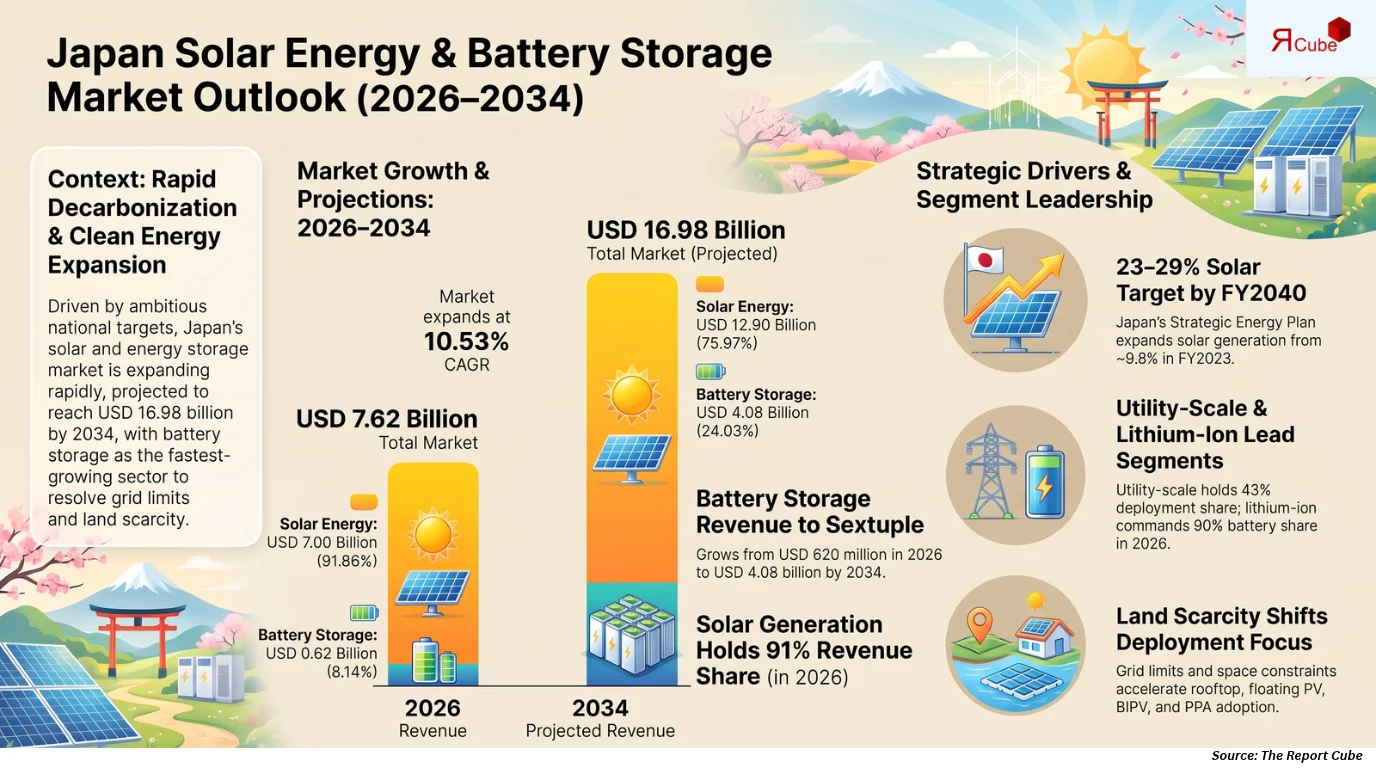
- The Japan Solar Energy and Battery Storage Market was valued at USD 7.62 billion in 2026.
- Market size is forecast to reach USD 16.98 billion by 2034.
- The market is expected to expand at a CAGR of 10.53% during 2026-2034.
- Solar energy leads the market with a 91% share of combined revenue in 2026, while battery storage is the fastest-growing component, rising from USD 620 million in 2026 to USD 4.08 billion in 2034.
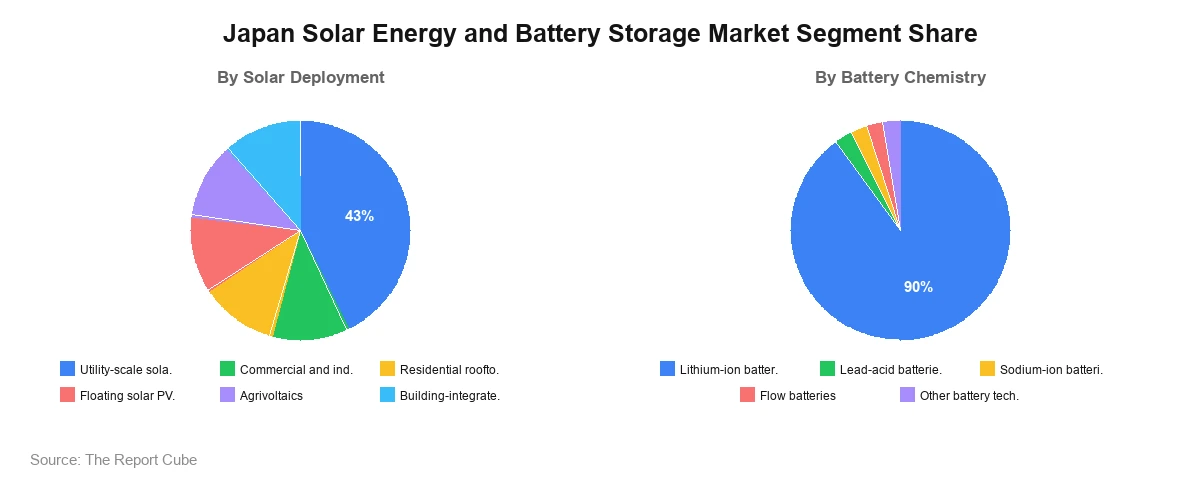
- By solar deployment, utility-scale solar leads with a 43% share in 2026; by battery chemistry, lithium-ion leads with a 90% share in 2026.
- Japan’s Seventh Strategic Energy Plan, approved in February 2025, targets a 23-29% solar share in electricity generation by FY2040, up from about 9.8% in FY2023, supporting long-term demand.
- The competitive landscape includes Kyocera, Sharp, GS Yuasa, Sumitomo Electric, Panasonic, Toshiba, Canadian Solar, JinkoSolar and CATL, with grid-scale storage collaborations gaining momentum.
Market Outlook
The Japan Solar Energy and Battery Storage Market covers photovoltaic modules, inverters, solar power systems, project development, stationary battery energy storage systems and energy management technologies. The industry supports Japan’s energy transition by expanding renewable generation, reducing dependence on conventional energy sources and improving grid flexibility across utility, commercial and residential users.
Japan built its solar base through the Feed-in Tariff programme, spanning utility-scale plants, residential rooftops and commercial and industrial installations. Limited land, declining FIT incentives and grid connection constraints are pushing developers towards rooftop, self-consumption and corporate PPA models. Battery storage is developing alongside solar, helping manage generation variability, peak load and grid stability.
The Japan Solar Energy and Battery Storage Market is projected to grow from USD 7.62 billion in 2026 to USD 16.98 billion by 2034, at a CAGR of 10.53%. Solar remains the larger component, while battery storage grows faster. Competition favours firms offering integrated solar, storage and energy management solutions, with grid-scale storage and next-generation photovoltaics shaping future opportunities.
Government Regulations
The Ministry of Economy, Trade and Industry (METI) and its Agency for Natural Resources and Energy (ANRE) oversee renewable energy policy and electricity market rules in Japan. The Seventh Strategic Energy Plan sets the long-term direction, targeting a 23-29% solar share of generation by FY2040. The Feed-in Tariff and Feed-in Premium frameworks govern renewable electricity remuneration, with FIP linking support to market prices. METI’s Battery Industry Strategy supports the domestic battery supply chain, and its FY2025 budget documentation included funding for grid-scale and household, commercial and industrial storage. Green Transformation initiatives add decarbonisation investment support. Developers must meet grid connection, permitting and safety requirements, which can lengthen project timelines. Well-capitalised participants with grid access, certified products and integrated solar-plus-storage capabilities are best placed to benefit from these frameworks.
Japan Solar Energy and Battery Storage Market Dynamics
Demand in the Japan Solar Energy and Battery Storage Market is shaped by renewable energy targets, corporate electricity procurement and the need for grid flexibility. Land scarcity, grid connection limits, high upfront investment and project economics moderate deployment, while storage integration and new photovoltaic technologies widen the opportunity set for developers and suppliers.
|
Factor |
Type |
Specific Impact on Market |
Magnitude |
|---|---|---|---|
|
Government renewable energy targets |
Driver |
FY2040 solar target of 23-29% supports sustained solar investment |
High |
|
Grid-scale storage requirements |
Driver |
Rising renewable penetration increases demand for balancing capacity |
High |
|
Corporate PPAs and self-consumption |
Trend |
Expands commercial and industrial rooftop deployment |
Medium-High |
|
Next-generation solar technologies |
Opportunity |
Perovskite and flexible modules can address land constraints |
Medium |
|
Land and grid connection limits |
Challenge |
Delays commissioning and raises development costs |
Medium-High |
|
High upfront investment |
Challenge |
Capital intensity affects project returns, especially for storage |
Medium |
Growth Drivers: Government Renewable Energy Targets and Decarbonisation
The Seventh Strategic Energy Plan targets a 23-29% solar share of generation by FY2040, compared with about 9.8% in FY2023, according to METI. This gap points to substantial additional photovoltaic capacity across utility-scale, rooftop and next-generation applications. Policy support for renewable procurement and decarbonisation encourages developers, module suppliers and installers to expand their Japan activities and supports multi-year investment planning across the value chain.
Market Opportunities: Grid-Scale Battery Storage and Energy Trading
Grid-scale storage offers openings for battery manufacturers, developers, engineering contractors and energy management software providers. Battery systems can support frequency regulation, balancing and renewable integration, and may participate in electricity markets subject to applicable rules. Government financial support and infrastructure investment are expected to encourage further stationary storage projects. Operators combining hardware with optimisation software can capture value as storage shifts from a supporting asset to a core grid resource.
Industry Challenges: Limited Land Availability and Grid Connection Constraints
Japan’s geography limits suitable flatland for ground-mounted solar, and competing land uses and permitting procedures raise development costs. Grid connection and transmission requirements can delay both solar and battery projects, affecting commissioning schedules and investment returns. These constraints push developers towards rooftops, floating solar, agrivoltaics and building-integrated systems, while raising the importance of grid-side flexibility and early engagement with network operators.
Need Specific Data, Let’s Customize the Report for You
Request CustomizationMarket Trends: Integration of Solar Generation with Battery Storage
Pairing photovoltaic generation with battery storage is becoming central to improving renewable electricity utilisation. Solar-plus-storage systems help businesses manage peak demand, reduce procurement exposure and raise the availability of renewable power, while grid-connected storage supports balancing and system flexibility. Growth in corporate PPAs and commercial and industrial rooftop projects reinforces this shift towards integrated energy infrastructure combining generation, storage, power conversion and intelligent energy management.
Japan Solar Energy and Battery Storage Market Segment Analysis
The market is segmented across solar deployment, technology and application, and across battery chemistry, system type, component and application. This structure reflects the distinct economics of photovoltaic generation and stationary storage. Leading-segment shares shown are the supplied 2026 figures.
By Solar Deployment
- Utility-scale solar
- Commercial and industrial rooftop solar
- Residential rooftop solar
- Floating solar PV
- Agrivoltaics
- Building-integrated photovoltaics (BIPV)
Utility-scale solar leads deployment with a 43% share in 2026, supported by large-scale generation for grid supply and established project development capability. Commercial and industrial rooftop solar is the second major segment, driven by corporate PPAs, self-consumption and proximity to demand. Residential rooftop solar, floating solar PV, agrivoltaics and BIPV serve distributed and land-constrained applications, with floating, agrivoltaic and building-integrated formats offering routes around Japan’s land limits.
By Battery Chemistry
- Lithium-ion batteries
- Lead-acid batteries
- Sodium-ion batteries
- Flow batteries
- Other battery technologies
Lithium-ion leads battery chemistry with a 90% share in 2026, reflecting an established manufacturing ecosystem, energy density and commercial availability. Flow batteries are the second area of note, with Sumitomo Electric active in grid-scale flow storage where long duration and safety matter. Sodium-ion may find roles where cost and material availability influence purchasing. Lead-acid and other technologies serve established or specialised uses.
Competitive Landscape
The market includes domestic manufacturers, international photovoltaic suppliers, battery technology developers, project developers, engineering firms and energy management providers. Competition rests on product efficiency, system cost, manufacturing scale, safety performance, project financing and the ability to deliver integrated solar, storage and energy management solutions. The table summarises companies by general capability and does not represent market share or ranking.
|
Company |
Competitive Strength |
Primary Segment Served |
|---|---|---|
|
Kyocera Corporation |
Solar modules, residential PV systems and energy solutions |
Solar deployment (residential and commercial) |
|
Sharp Corporation |
Photovoltaic systems and residential energy solutions |
Solar deployment (residential) |
|
Canadian Solar |
Solar modules, project development and energy storage |
Solar and solar-plus-storage |
|
JinkoSolar |
Photovoltaic modules and solar cell technologies |
Solar technology |
|
Trina Solar |
Solar modules, utility-scale systems and storage solutions |
Utility-scale solar and storage |
|
Panasonic / Panasonic Energy |
Energy technologies, battery cells and storage technologies |
Battery cells and storage |
|
GS Yuasa |
Lithium-ion batteries and stationary energy storage |
Grid-scale and stationary storage |
|
Toshiba |
Battery technologies and energy systems |
Battery storage |
|
Sumitomo Electric |
Flow batteries and grid storage technologies |
Grid-scale storage |
|
CATL |
Lithium-ion batteries and storage systems |
Battery chemistry and cells |
|
Tesla |
Megapack and integrated battery storage |
Grid-scale storage |
|
Sungrow |
Battery storage systems and power conversion |
Power conversion systems |
|
Nidec |
Power conversion and energy storage systems |
Power conversion systems |
GS Yuasa: GS Yuasa is a Japanese battery manufacturer producing lithium-ion batteries and stationary energy storage systems. In January 2026 it announced, with Sustech, a joint grid-scale battery energy storage project in Maibara City, Shiga Prefecture, combining battery technology with an AI-based energy management platform. Its strength lies in domestic manufacturing capability and growing involvement in grid-scale storage development.
Sumitomo Electric: Sumitomo Electric is a Japanese industrial group participating in flow battery and grid-scale energy storage technologies. Flow batteries suit long-duration stationary applications where safety and cycle life matter. The company’s strength lies in grid storage engineering and its position as a domestic alternative to lithium-ion-focused suppliers. Detailed project and capacity figures should be confirmed against company disclosures before publication.
Recent Developments and Updates
- January 2026: GS Yuasa and Sustech announced a joint grid-scale battery energy storage development project in Maibara City, Shiga Prefecture, combining battery technology with an AI-based energy management platform, reflecting growing collaboration in grid storage.
- FY2025 (METI budget): METI’s FY2025 budget documentation included substantial funding for grid-scale battery and electricity storage support, alongside separate programmes for household, commercial and industrial storage, strengthening policy backing for stationary storage.
- February 2025: Japan approved the Seventh Strategic Energy Plan, targeting a 23-29% solar share of generation by FY2040, which anchors long-term renewable and storage investment planning.
Japan Solar Energy and Battery Storage Market Future Outlook
The Japan Solar Energy and Battery Storage Market is expected to grow from USD 7.62 billion in 2026 to USD 16.98 billion by 2034, at a CAGR of 10.53%. Solar will remain the largest revenue contributor, while battery storage rises from 8.14% to 24.03% of combined revenue. Commercial and industrial rooftop solar, solar-plus-storage projects, advanced chemistries and perovskite photovoltaics are likely to shape demand.
Competition is expected to centre on integrated offerings that combine generation, storage, power conversion and energy management software. Investment in grid-scale batteries and partnerships between manufacturers, developers and technology providers should intensify. Land scarcity, grid connection limits, financing costs and project economics remain the main challenges, and long-term direction will depend on policy continuity, grid modernisation and cost trends.
Japan Solar Energy and Battery Storage Market Report Coverage
This report covers market size, forecast, segmentation, competitive landscape and policy context for the Japan Solar Energy and Battery Storage Market.
|
Parameter |
Details |
|---|---|
|
Market Name |
Japan Solar Energy and Battery Storage Market |
|
Market Size (Base Year) |
USD 7.62 billion (2026) |
|
Market Size (Forecast Year) |
USD 16.98 billion (2034) |
|
CAGR |
10.53% |
|
Base Year |
2026 |
|
Historical Period |
2021-2025 |
|
Forecast Period |
2026-2034 |
|
Geographic Scope |
Japan |
|
Segmentation |
By Solar Deployment; By Solar Technology; By Solar Application; By Battery Chemistry; By Battery System Type; By Battery Component; By Battery Application |
|
Key Companies |
Kyocera; Sharp; Canadian Solar; JinkoSolar; Trina Solar; Panasonic; GS Yuasa; Toshiba; Sumitomo Electric; CATL; Tesla; Sungrow; Nidec |
|
Customization |
Available as per requirement |
Why Choose This Japan Solar Energy and Battery Storage Market Report?
- Presents the 2026 market size of USD 7.62 billion, the 2034 forecast of USD 16.98 billion and the 10.53% CAGR.
- Segments the market across seven solar and battery categories to support product and investment planning.
- Reviews drivers, challenges, trends and opportunities shaped by METI and ANRE policy.
- Provides a national regional assessment and identifies where regional data is unavailable.
- Profiles solar, battery and power conversion companies by capability and segment served.
- Highlights emerging opportunities in grid-scale storage, solar-plus-storage and perovskite technology.
- Supports strategic decisions on investment, partnerships and market entry.
Table of Contents
- Introduction
- Objective of the Study
- Product Definition
- Market Segmentation
- Study Variables
- Research Methodology
- Secondary Data Points
- Companies Interviewed
- Primary Data Points
- Breakdown of Primary Interviews
- Secondary Data Points
- Executive Summary
- Market Dynamics
- Drivers
- Challenges
- Opportunity Assessment
- Recent Trends and Developments
- Policy and Regulatory Landscape
- Japan Solar Energy and Battery Storage Market Overview and Forecast Analysis (2021-2034)
- Market Size, By Value, By Growth Rate (CAGR/USD Billions)
- Demand – Supply Trends
- Market Share, By Solar Deployment
- Utility-scale Solar
- Commercial and Industrial Rooftop Solar
- Residential Rooftop Solar
- Floating Solar PV
- Agrivoltaics
- Building-integrated Photovoltaics (BIPV)
- Market Share, By Solar Technology
- Monocrystalline Silicon
- Polycrystalline Silicon
- Thin-film Solar
- Perovskite Solar Cells
- Tandem Solar Cells
- Market Share, By Solar Application
- Electricity Generation and Grid Supply
- Residential Self-consumption
- Commercial and Industrial Self-consumption
- 4. Off-grid and Remote Applications
- Market Share, By Battery Chemistry
- Lithium-ion Batteries
- Lead-acid Batteries
- Sodium-ion Batteries
- Flow Batteries
- Other Battery Technologies
- Market Share, By Battery System Type
- Standalone Battery Energy Storage Systems
- Solar PV-plus-BESS Systems
- Wind-plus-BESS Systems
- Hybrid Renewable Energy Storage Systems
- Microgrid Battery Storage Systems
- Behind-the-meter Battery Storage Systems
- Market Share, By Battery Component
- Battery Cells
- Battery Modules and Packs
- Battery Management Systems (BMS)
- Power Conversion Systems (PCS)
- Energy Management Systems (EMS)
- Thermal Management and Safety Systems
- Market Share, By Battery Application
- Grid Balancing and Frequency Regulation
- Renewable Energy Integration
- Peak Shaving and Load Shifting
- Data-centre Backup
- Residential Energy Management
- Industrial Power Backup
- Market Share, By Competitors
- Competition Characteristics
- Revenue Shares
- Utility-scale Solar Japan Solar Energy and Battery Storage Market Overview, 2021-2034F
- By Value (USD Million)
- By Solar Technology – Market Size & Forecast 2021-2034, USD Million
- Monocrystalline Silicon
- Polycrystalline Silicon
- Thin-film Solar
- Perovskite Solar Cells
- Tandem Solar Cells
- Commercial and Industrial Rooftop Solar Japan Solar Energy and Battery Storage Market Overview, 2021-2034F
- By Value (USD Million)
- By Solar Technology – Market Size & Forecast 2021-2034, USD Million
- Monocrystalline Silicon
- Polycrystalline Silicon
- Thin-film Solar
- Perovskite Solar Cells
- Tandem Solar Cells
- Residential Rooftop Solar Japan Solar Energy and Battery Storage Market Overview, 2021-2034F
- By Value (USD Million)
- By Solar Technology – Market Size & Forecast 2021-2034, USD Million
- Monocrystalline Silicon
- Polycrystalline Silicon
- Thin-film Solar
- Perovskite Solar Cells
- Tandem Solar Cells
- Floating Solar PV Japan Solar Energy and Battery Storage Market Overview, 2021-2034F
- By Value (USD Million)
- By Solar Technology – Market Size & Forecast 2021-2034, USD Million
- Monocrystalline Silicon
- Polycrystalline Silicon
- Thin-film Solar
- Perovskite Solar Cells
- Tandem Solar Cells
- Agrivoltaics Japan Solar Energy and Battery Storage Market Overview, 2021-2034F
- By Value (USD Million)
- By Solar Technology – Market Size & Forecast 2021-2034, USD Million
- Monocrystalline Silicon
- Polycrystalline Silicon
- Thin-film Solar
- Perovskite Solar Cells
- Tandem Solar Cells
- Building-integrated Photovoltaics (BIPV) Japan Solar Energy and Battery Storage Market Overview, 2021-2034F
- By Value (USD Million)
- By Solar Technology – Market Size & Forecast 2021-2034, USD Million
- Monocrystalline Silicon
- Polycrystalline Silicon
- Thin-film Solar
- Perovskite Solar Cells
- Tandem Solar Cells
- Competitive Outlook (Company Profile – Partial List)
- Kyocera Corporation
- Company Overview
- Business Segments
- Strategic Alliances/Partnerships
- Recent Developments
- Sharp Corporation
- Company Overview
- Business Segments
- Strategic Alliances/Partnerships
- Recent Developments
- Canadian Solar
- Company Overview
- Business Segments
- Strategic Alliances/Partnerships
- Recent Developments
- JinkoSolar
- Company Overview
- Business Segments
- Strategic Alliances/Partnerships
- Recent Developments
- Trina Solar
- Company Overview
- Business Segments
- Strategic Alliances/Partnerships
- Recent Developments
- Panasonic / Panasonic Energy
- Company Overview
- Business Segments
- Strategic Alliances/Partnerships
- Recent Developments
- GS Yuasa
- Company Overview
- Business Segments
- Strategic Alliances/Partnerships
- Recent Developments
- Toshiba
- Company Overview
- Business Segments
- Strategic Alliances/Partnerships
- Recent Developments
- Sumitomo Electric
- Company Overview
- Business Segments
- Strategic Alliances/Partnerships
- Recent Developments
- Others
- Kyocera Corporation
- Contact Us & Disclaimer
Top Key Players & Market Share Outlook
- Kyocera Corporation
- Sharp Corporation
- Canadian Solar
- JinkoSolar
- Trina Solar
- Panasonic / Panasonic Energy
- GS Yuasa
- Toshiba
- Sumitomo Electric
- Others
Frequently Asked Questions