



Build Your Custom Market Intelligence Report
Customize Your ReportChina Solar-Powered Vehicle Market Insights & Analysis
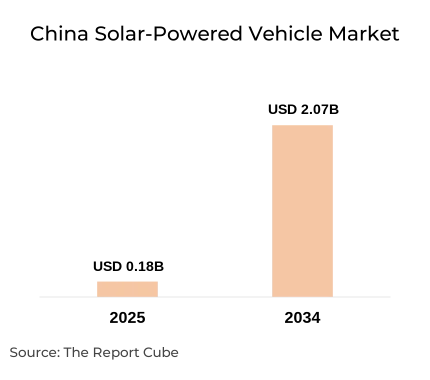
The China Solar-Powered Vehicle Market is anticipated to register a robust CAGR of 31.2% during the forecast period 2026-2034. The market size was valued at USD 0.18 billion in 2025 and is projected to reach USD 2.07 billion by 2034. This rapid expansion reflects China’s accelerating transition toward clean mobility, supported by aggressive decarbonization goals, technological progress in photovoltaic integration, and rising consumer acceptance of alternative energy vehicles.
Solar-powered vehicles, once considered niche, are increasingly gaining commercial relevance as improvements in solar cell efficiency and battery management systems enhance vehicle range and usability. In China, the world’s largest electric vehicle market, solar integration is emerging as a complementary solution to reduce grid dependency and extend driving range. This trend aligns strongly with national energy security objectives and urban emission reduction mandates. Furthermore, strong policy backing for renewable energy adoption, coupled with investments by leading automotive manufacturers, is accelerating pilot deployments and early commercialization. While the market remains at a formative stage, its long-term growth potential is substantial, particularly across urban passenger mobility, public transport fleets, and last-mile delivery solutions.
China Solar-Powered Vehicle Market Recent Developments
- 2025: BYD expanded solar-assisted electric vehicle trials to improve auxiliary energy efficiency.
- 2025: GAC Aion advanced integrated solar roof technology for next-generation electric models.
Government Initiatives & Policies
- New Energy Vehicle Industry Development Plan: Supports renewable energy integration in electric vehicles.
- China Carbon Neutrality Action Plan: Promotes solar and clean-energy mobility solutions nationwide.
China Solar-Powered Vehicle Market Dynamics
Key Driver: Strong Government Support for Renewable Mobility
Government policy support is the most significant driver of the China Solar-Powered Vehicle Market. China’s commitment to achieving carbon neutrality before 2060 has translated into extensive subsidies, pilot programs, and regulatory incentives for renewable-powered transportation. Solar-powered vehicles directly align with these priorities by reducing dependence on fossil fuels and easing pressure on charging infrastructure. Several municipal governments have introduced preferential registration, parking benefits, and research funding for solar-integrated vehicles. In addition, public transport authorities are testing solar-powered buses and service vehicles to lower operating emissions. These initiatives not only stimulate early demand but also encourage manufacturers to accelerate innovation and commercialization efforts.
Book your FREE 30-minute expert consultation today
Contact UsIndustry Trends: Integration of Solar Technology with Electric Platforms
A key trend shaping the market is the integration of solar panels with existing electric vehicle platforms rather than standalone solar-only designs. Solar hybrid vehicles, which combine battery-electric drivetrains with onboard solar generation, are gaining traction due to their practical efficiency advantages. These systems can extend vehicle range by 5-15% under favorable conditions, particularly in urban driving cycles. Automakers are increasingly collaborating with solar technology firms to develop lightweight, high-efficiency photovoltaic materials suitable for vehicle rooftops and body panels. This trend is improving the commercial viability of solar-powered vehicles while maintaining performance, safety, and design standards expected by Chinese consumers.
Major Challenge: Limited Energy Generation and High Initial Costs
Despite strong growth prospects, the China Solar-Powered Vehicle Market faces challenges related to limited onboard energy generation capacity. Current solar panel surface areas restrict the amount of power that can be generated, making full reliance on solar energy impractical for most vehicles. As a result, consumer expectations regarding range and performance must be carefully managed. Additionally, high initial costs associated with advanced solar materials and integration technologies increase vehicle prices. This cost barrier limits mass-market adoption, particularly outside premium and pilot segments. Overcoming these challenges will depend on continued cost reductions, efficiency improvements, and economies of scale.
Opportunity: Expansion in Public Transport and Commercial Fleets
Public transport and commercial fleet applications present a significant growth opportunity for the China Solar-Powered Vehicle Market. Buses, delivery vans, and special-purpose vehicles operate on fixed routes and predictable schedules, making them ideal candidates for solar-assisted energy systems. Even modest solar contributions can translate into substantial fuel and electricity savings over time. Municipal governments and logistics providers are increasingly prioritizing green fleets to meet sustainability targets. This creates strong demand potential for solar hybrid buses and light commercial vehicles, positioning fleet adoption as a key catalyst for market scale-up during the forecast period.
China Solar-Powered Vehicle Market Segment-wise Analysis
By Vehicle Type:
- Passenger Cars
- Light Commercial Vehicles
- Buses & Coaches
- Two/Three Wheelers
- Special Purpose Vehicles
Passenger cars dominate the China Solar-Powered Vehicle Market, accounting for an estimated 41% market share in 2025. This leadership is driven by consumer interest in innovative, eco-friendly mobility solutions and strong OEM focus on passenger vehicle electrification. Solar integration is primarily used to power auxiliary systems and extend driving range. Buses and light commercial vehicles are emerging as high-growth segments due to fleet electrification initiatives. Two- and three-wheelers also present long-term potential, particularly for urban mobility and shared transportation models.
By Energy Source:
- Fully Solar
- Solar Hybrid
Solar hybrid vehicles hold a dominant share of approximately 78%, as they offer a practical balance between reliability and renewable energy usage. These vehicles leverage solar power as a supplementary energy source, enhancing efficiency without compromising performance. Fully solar vehicles remain limited to experimental and niche applications, but ongoing advances in photovoltaic efficiency could gradually expand their role over the long term.
Regional Projection of China Solar-Powered Vehicle Industry
- East China
- North China
- South China
- Central China
- West China
- Others
East China leads the China Solar-Powered Vehicle Market with an estimated 36% market share, driven by strong industrial infrastructure, high EV penetration, and supportive regional policies. Provinces in this region actively promote renewable mobility pilot projects and advanced vehicle manufacturing.
South China follows closely, supported by favorable solar irradiation conditions and strong innovation ecosystems. Other regions are gradually adopting solar-powered vehicles as infrastructure and policy support expand nationwide.
Need insights for a specific region within this market?
Request Regional DataWhy Choose This Report?
- Provides a comprehensive overview of the overall market analysis, encompassing key trends, consumer behavior analysis, and risk assessment to support strategic decision-making.
- Provides accurate, up-to-date insights into market size, segmentation, and emerging opportunities, helping to minimize risk & capitalizing on growth.
- Gives deep understanding of target audience preferences, investment habits, and communication channels for enhanced product development & marketing effectiveness.
- Delivers competitive analysis & benchmarking, uncovering the strengths & weaknesses of market competitors to guide strategies.
- Consolidate comprehensive market intelligence, reducing reasoning & streamlining research efforts.
- Facilitates customized market segmentation & risk mitigation strategies, fine-tuned to the business objectives.
- Aids in identifying both market challenges & untapped opportunities within the industry to drive long-term business growth.
- Provides valuable information based on actual customer data & search trends.
Table of Contents
- Introduction
- Objective of the Study
- Product and Category Definition
- Market Segmentation
- Study Variables
- Research Methodology
- Secondary Data Points
- Breakdown of Secondary Sources
- Primary Data Points
- Breakdown of Primary Interviews
- Secondary Data Points
- Executive Summary
- Market Dynamics
- Drivers
- Challenges
- Opportunity Assessment
- Recent Trends and Developments
- Regulatory and Policy Landscape
- China Solar-Powered Vehicle Market Overview (2020-2034)
- Market Size, By Value (USD Billion)
- Market Share, By Vehicle Type
- Passenger Cars
- Light Commercial
- Buses & Coaches
- Two/Three Wheelers
- Special Purpose
- Market Share, By Energy Source
- Fully Solar
- Solar Hybrid
- Market Share, By Propulsion
- Battery Electric
- Plug‑In Hybrid
- Market Share, By Solar Panel
- Monocrystalline
- Polycrystalline
- Thin‑Film
- Market Share, By Component
- Solar Panels
- Battery System
- Electric Motor
- Controller
- Market Share, By Charging Type
- On‑Grid Charging
- Off‑Grid Charging
- Market Share, By Region
- East
- North
- South
- Central
- West
- Market Share, By Company
- Market Share, By Company
- Competition Characteristics
- Revenue Shares & Analysis
- East China Solar-Powered Vehicle Market
- Market Size, By Value (USD Billion)
- Market Share, By Vehicle Type
- Market Share, By Energy Source
- Market Share, By Propulsion
- Market Share, By Solar Panel
- Market Share, By Component
- Market Share, By Charging Type
- West China Solar-Powered Vehicle Market
- Market Size, By Value (USD Billion)
- Market Share, By Vehicle Type
- Market Share, By Energy Source
- Market Share, By Propulsion
- Market Share, By Solar Panel
- Market Share, By Component
- Market Share, By Charging Type
- North China Solar-Powered Vehicle Market
- Market Size, By Value (USD Billion)
- Market Share, By Vehicle Type
- Market Share, By Energy Source
- Market Share, By Propulsion
- Market Share, By Solar Panel
- Market Share, By Component
- Market Share, By Charging Type
- South China Solar-Powered Vehicle Market
- Market Size, By Value (USD Billion)
- Market Share, By Vehicle Type
- Market Share, By Energy Source
- Market Share, By Propulsion
- Market Share, By Solar Panel
- Market Share, By Component
- Market Share, By Charging Type
- Central China Solar-Powered Vehicle Market
- Market Size, By Value (USD Billion)
- Market Share, By Vehicle Type
- Market Share, By Energy Source
- Market Share, By Propulsion
- Market Share, By Solar Panel
- Market Share, By Component
- Market Share, By Charging Type
- Competitive Outlook and Company Profiles
- BYD Company Ltd.
- Company Overview
- Solar EV Portfolio
- Strategic Alliances/Partnerships
- Recent Developments
- SAIC Motor Corporation
- Company Overview
- Solar EV Portfolio
- Strategic Alliances/Partnerships
- Recent Developments
- Geely Auto Group
- Company Overview
- Solar EV Portfolio
- Strategic Alliances/Partnerships
- Recent Developments
- GAC Aion New Energy
- Company Overview
- Solar EV Portfolio
- Strategic Alliances/Partnerships
- Recent Developments
- NIO Inc.
- Company Overview
- Solar EV Integration
- Strategic Alliances/Partnerships
- Recent Developments
- Li Auto Inc.
- Company Overview
- Solar EV Integration
- Strategic Alliances/Partnerships
- Recent Developments
- Xpeng Inc.
- Company Overview
- Solar EV Integration
- Strategic Alliances/Partnerships
- Recent Developments
- Great Wall Motor
- Company Overview
- Solar EV Portfolio
- Strategic Alliances/Partnerships
- Recent Developments
- Changan Automobile
- Company Overview
- Solar EV Integration
- Strategic Alliances/Partnerships
- Recent Developments
- Honda China Joint Ventures
- Company Overview
- Solar EV Demonstrators
- Strategic Alliances/Partnerships
- Recent Developments
- Others
- BYD Company Ltd.
- Contact Us and Disclaimer
Top Key Players & Market Share Outlook
- BYD Company Ltd.
- SAIC Motor Corporation
- Geely Auto Group
- GAC Aion New Energy
- NIO Inc.
- Li Auto Inc.
- Xpeng Inc.
- Great Wall Motor
- Changan Automobile
- Honda China Joint Ventures
- Others
Frequently Asked Questions