



Build Your Custom Market Intelligence Report
Customize Your ReportAsia Pacific Spin-on Carbon Market Key Highlights
By Carbon Credit Type:
Compliance credits segment leads the market, accounting for nearly 64% of total revenue.
By Market Participant:
Foundries segment dominate the market with around 38% share.
Regional Outlook:
China leads the market with approximately 42% share, backed by strong semiconductor capacity expansion and carbon compliance enforcement.
Government Initiatives & Policies
- China National Carbon Emissions Trading Scheme (ETS): Expands compliance coverage for energy-intensive industries including semiconductor manufacturing.
- Japan Green Growth Strategy under Carbon Neutrality 2050: Promotes low-carbon semiconductor materials and process optimization initiatives.
Asia Pacific Spin-on Carbon Market Insights & Analysis
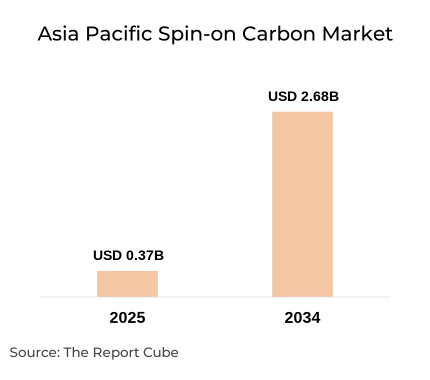
The Asia Pacific Spin-on Carbon Market is anticipated to register a CAGR of 24.60% during 2026-2034. The market size was valued at USD 0.37 billion in 2025 and is projected to reach USD 2.68 billion by 2034. Spin-on carbon (SOC) materials play a vital role in advanced semiconductor lithography processes, particularly as hardmask layers in multi-patterning and extreme ultraviolet (EUV) fabrication nodes.
The region dominates global semiconductor production, accounting for more than 70% of global wafer output, creating strong downstream demand for SOC materials. Expansion of logic and memory fabs across China, Taiwan, South Korea, and Japan is accelerating material consumption. Advanced nodes below 7nm increasingly require carbon-based hardmask layers to maintain pattern fidelity and etch resistance. Investments exceeding USD 150 billion across Asia Pacific semiconductor manufacturing facilities between 2023 and 2025 further reinforce material demand. In parallel, carbon reduction frameworks and sustainability mandates are reshaping production processes, encouraging suppliers to integrate low-emission manufacturing practices within SOC supply chains. These interconnected technological and environmental drivers position the market for rapid long-term growth.
Asia Pacific Spin-on Carbon Market Dynamics
Key Driver: Rapid Expansion of Advanced Semiconductor Fabrication Nodes
Accelerating adoption of advanced logic and memory nodes across Asia Pacific remains the primary growth engine for spin-on carbon materials. Foundries and integrated device manufacturers are transitioning toward 5nm, 3nm, and pilot 2nm processes, which require high-performance hardmask materials for multi-layer pattern transfer. SOC materials provide superior planarization and etch resistance compared to traditional silicon-based layers. With semiconductor capital expenditure in the region surpassing USD 120 billion annually, wafer starts are rising steadily. SOC consumption per wafer has increased by nearly 18% in advanced nodes due to complex patterning cycles. This direct correlation between node miniaturization and SOC usage creates sustained material demand.
Book your FREE 30-minute expert consultation today
Contact UsIndustry Trends: Integration of Sustainability and Low-Carbon Manufacturing Practices
A major trend shaping the market is the integration of sustainability within semiconductor material production. Manufacturers are aligning SOC development with carbon neutrality strategies and renewable energy adoption. Biomass cogeneration systems, energy-efficient solvent recycling, and lower-VOC formulations are becoming common across production facilities. Carbon accounting transparency is increasingly required by leading foundries, influencing supplier selection. Exhibitions such as SEMICON Korea and INTERNEPCON JAPAN highlight advanced lithography materials integrated with AI-based process optimization. These trends reinforce SOC’s role within environmentally responsible semiconductor ecosystems while maintaining performance integrity.
Major Challenge: High Technical Barriers and Process Compatibility Constraints
Developing SOC materials compatible with extreme ultraviolet lithography presents significant technical challenges. Material stability, film thickness uniformity, and plasma etch selectivity require precise formulation control. Minor deviations in carbon composition can impact critical dimension uniformity, affecting chip yields. Manufacturers invest heavily in R&D, with development cycles extending beyond three years for next-generation materials. Additionally, integration with diverse fab equipment platforms across China, Taiwan, and South Korea increases validation complexity. These technical barriers limit rapid market entry for smaller players and concentrate competition among established chemical manufacturers.
Opportunity: Expansion of Regional Emission Trading and Green Semiconductor Policies
Regional emissions trading schemes and sustainability mandates create new opportunities for SOC suppliers focused on low-carbon production. Semiconductor companies increasingly demand materials with reduced life-cycle emissions to align with Scope 3 carbon targets. Renewable-powered fabs in Taiwan and Singapore are prioritizing environmentally optimized material inputs. As compliance frameworks expand, voluntary and regulated carbon credits associated with manufacturing operations can influence procurement decisions. Suppliers that integrate energy-efficient processes and transparent sustainability reporting are well positioned to capture premium contracts across advanced manufacturing hubs.
Asia Pacific Spin-on Carbon Market Segment-wise Analysis
By Carbon Credit Type:
- Compliance Credits
- Voluntary Credits
Compliance credits dominate the segment with nearly 64% market share, reflecting stricter national emission frameworks across China, Japan, and South Korea. Semiconductor fabs classified as energy-intensive facilities must meet emission thresholds, encouraging procurement of lower-carbon materials and offset mechanisms. SOC suppliers aligning with regulated compliance frameworks gain preferential access to large-scale fabrication contracts. Increasing carbon pricing visibility further strengthens compliance-driven procurement strategies.
By Market Participant:
- Integrated Device Manufacturers
- Foundries
- OSAT Providers
- Memory Manufacturers
- IDM-Foundry Hybrids
Foundries lead the market with approximately 38% share due to high wafer throughput and continuous node advancement. Taiwan and South Korea host some of the world’s most advanced fabrication facilities, requiring significant volumes of SOC materials per production cycle. Multi-patterning processes in logic and DRAM manufacturing drive repeated application layers, increasing material intensity. Strong capital investments and long-term supplier contracts reinforce foundries’ dominant consumption position.
Regional Projection of Asia Pacific Spin-on Carbon Industry
- China
- Japan
- India
- South Korea
- Taiwan
- Singapore
- Rest of Asia Pacific
China leads the regional market with around 42% share, supported by aggressive domestic semiconductor expansion and carbon trading enforcement. Taiwan follows closely due to advanced foundry leadership and high EUV penetration rates. South Korea’s strong memory manufacturing ecosystem further accelerates SOC demand. Japan contributes through advanced material innovation and specialty chemical expertise. India and Singapore are emerging contributors supported by new fab investments and sustainability-driven manufacturing initiatives.
Asia Pacific Spin-on Carbon Market Recent Developments
- 2025: JSR launched its “JSR Group Sustainability Site 2025,” reinforcing commitment to advanced lithography materials including spin-on hardmasks widely adopted across Asia-Pacific semiconductor fabrication plants.
- 2025: Shin-Etsu Chemical introduced a biomass cogeneration system at its Thailand facilities, reducing greenhouse-gas emissions while supporting sustainable production of advanced lithography and spin-on carbon materials.
- 2025: Tokyo Ohka Kogyo showcased advanced neo functional materials at SEMICON Korea 2025 and INTERNEPCON JAPAN 2025, emphasizing SOC-compatible patterning technologies for high-density semiconductor devices.
- 2025: Fujifilm Electronic Materials presented its “one stop solution” strategy at SEMICON JAPAN 2025, integrating advanced patterning materials and AI co-creation for SOC-enabled next-generation chip manufacturing.
- 2025: Sumitomo Chemical highlighted progress under its carbon neutrality grand design, focusing on low-carbon semiconductor materials complementing spin-on carbon hardmask processes in Asia Pacific.
Need insights for a specific region within this market?
Request Regional DataWhy Choose This Report?
- Provides a comprehensive overview of the overall market analysis, encompassing key trends, consumer behavior analysis, and risk assessment to support strategic decision-making.
- Provides accurate, up-to-date insights into market size, segmentation, and emerging opportunities, helping to minimize risk & capitalizing on growth.
- Gives deep understanding of target audience preferences, investment habits, and communication channels for enhanced product development & marketing effectiveness.
- Delivers competitive analysis & benchmarking, uncovering the strengths & weaknesses of market competitors to guide strategies.
- Consolidate comprehensive market intelligence, reducing reasoning & streamlining research efforts.
- Facilitates customized market segmentation & risk mitigation strategies, fine-tuned to the business objectives.
- Aids in identifying both market challenges & untapped opportunities within the industry to drive long-term business growth.
- Provides valuable information based on actual customer data & search trends.
Table of Contents
- Introduction
- Objective of the Study
- Product and Category Definition
- Market Segmentation
- Study Variables
- Research Methodology
- Secondary Data Points
- Breakdown of Secondary Sources
- Primary Data Points
- Breakdown of Primary Interviews
- Secondary Data Points
- Executive Summary
- Market Dynamics
- Drivers
- Challenges
- Opportunity Assessment
- Recent Trends and Developments
- Regulatory and Policy Landscape
- Asia Pacific Spin-on Carbon Market Overview (2021-2034)
- Market Size, By Value (USD Billion)
- Market Share, By Carbon Credit Type
- Compliance Credits
- Voluntary Credits
- Market Share, By Market Participant
- Integrated Device Manufacturers
- Foundries
- OSAT Providers
- Memory Manufacturers
- IDM-Foundry Hybrids
- Market Share, By Carbon Offset Activity
- Renewable Energy
- Energy Efficiency
- Process Optimization
- Waste Heat Recovery
- Other Offset Projects
- Market Share, By Compliance Framework
- Kyoto Mechanisms
- Paris Agreement
- Regional Emissions Trading
- National Compliance Schemes
- Voluntary Standards
- Market Share, By Country
- China
- Japan
- India
- South Korea
- Taiwan
- Singapore
- Rest of Asia Pacific
- Market Share, By Company
- Revenue Shares & Analysis
- Competitive Landscape
- China Spin-on Carbon Market
- Market Size, By Value (USD Billion/Million)
- Market Share, By Carbon Credit Type
- Market Share, By Market Participant
- Market Share, By Carbon Offset Activity
- Market Share, By Compliance Framework
- Japan Spin-on Carbon Market
- Market Size, By Value (USD Billion/Million)
- Market Share, By Carbon Credit Type
- Market Share, By Market Participant
- Market Share, By Carbon Offset Activity
- Market Share, By Compliance Framework
- India Spin-on Carbon Market
- Market Size, By Value (USD Billion/Million)
- Market Share, By Carbon Credit Type
- Market Share, By Market Participant
- Market Share, By Carbon Offset Activity
- Market Share, By Compliance Framework
- South Korea Spin-on Carbon Market
- Market Size, By Value (USD Billion/Million)
- Market Share, By Carbon Credit Type
- Market Share, By Market Participant
- Market Share, By Carbon Offset Activity
- Market Share, By Compliance Framework
- Taiwan Spin-on Carbon Market
- Market Size, By Value (USD Billion/Million)
- Market Share, By Carbon Credit Type
- Market Share, By Market Participant
- Market Share, By Carbon Offset Activity
- Market Share, By Compliance Framework
- Singapore Spin-on Carbon Market
- Market Size, By Value (USD Billion/Million)
- Market Share, By Carbon Credit Type
- Market Share, By Market Participant
- Market Share, By Carbon Offset Activity
- Market Share, By Compliance Framework
- Competitive Outlook and Company Profiles
- JSR Corporation
- Company Overview
- Product Portfolio
- Strategic Alliances/Partnerships
- Recent Developments
- Shin-Etsu Chemical
- Company Overview
- Product Portfolio
- Strategic Alliances/Partnerships
- Recent Developments
- Tokyo Ohka Kogyo (TOK)
- Company Overview
- Product Portfolio
- Strategic Alliances/Partnerships
- Recent Developments
- Sumitomo Chemical
- Company Overview
- Product Portfolio
- Strategic Alliances/Partnerships
- Recent Developments
- Resonac
- Company Overview
- Product Portfolio
- Strategic Alliances/Partnerships
- Recent Developments
- Samsung SDI
- Company Overview
- Product Portfolio
- Strategic Alliances/Partnerships
- Recent Developments
- Dongjin Semichem
- Company Overview
- Product Portfolio
- Strategic Alliances/Partnerships
- Recent Developments
- SK Enpulse
- Company Overview
- Product Portfolio
- Strategic Alliances/Partnerships
- Recent Developments
- Soulbrain
- Company Overview
- Product Portfolio
- Strategic Alliances/Partnerships
- Recent Developments
- Merck Performance Materials
- Company Overview
- Product Portfolio
- Strategic Alliances/Partnerships
- Recent Developments
- Brewer Science (Taiwan)
- Company Overview
- Product Portfolio
- Strategic Alliances/Partnerships
- Recent Developments
- Jiangsu Yoke Technology
- Company Overview
- Product Portfolio
- Strategic Alliances/Partnerships
- Recent Developments
- Nata Opto-electronic
- Company Overview
- Product Portfolio
- Strategic Alliances/Partnerships
- Recent Developments
- Fujifilm Electronic Materials
- Company Overview
- Product Portfolio
- Strategic Alliances/Partnerships
- Recent Developments
- Adeka Corporation
- Company Overview
- Product Portfolio
- Strategic Alliances/Partnerships
- Recent Developments
- Nissan Chemical
- Company Overview
- Product Portfolio
- Strategic Alliances/Partnerships
- Recent Developments
- Others
- JSR Corporation
- Contact Us and Disclaimer
Top Key Players & Market Share Outlook
- JSR Corporation
- Shin-Etsu Chemical
- Tokyo Ohka Kogyo (TOK)
- Sumitomo Chemical
- Resonac
- Samsung SDI
- Dongjin Semichem
- SK Enpulse
- Soulbrain
- Merck Performance Materials
- Brewer Science (Taiwan)
- Jiangsu Yoke Technology
- Nata Opto-electronic
- Fujifilm Electronic Materials
- Adeka Corporation
- Nissan Chemical
- Others
Frequently Asked Questions






