



Build Your Custom Market Intelligence Report
Customize Your ReportBrazil Stool Antigen Testing Market Key Takeaways
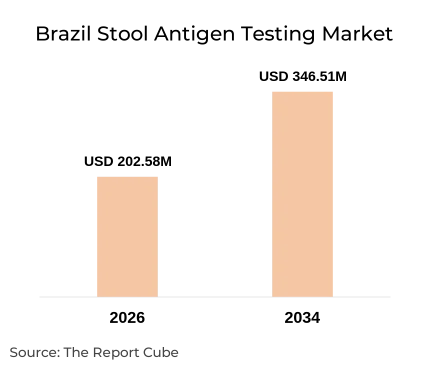
- Market reaches USD 202.58 million during 2026.
- Market is projected to reach USD 346.51 million.
- Growth reflects a 6.94% CAGR through 2034.
- Abbott, bioMérieux, Thermo Fisher, and Roche remain prominent.
- Helicobacter pylori detection represents the dominant application segment.
- Southeast Brazil leads demand across major healthcare centers.
- Northeast Brazil records comparatively faster diagnostic adoption.
- Multiplex and rapid stool diagnostics increasingly influence testing workflows.
Brazil Stool Antigen Testing Market Insights & Analysis
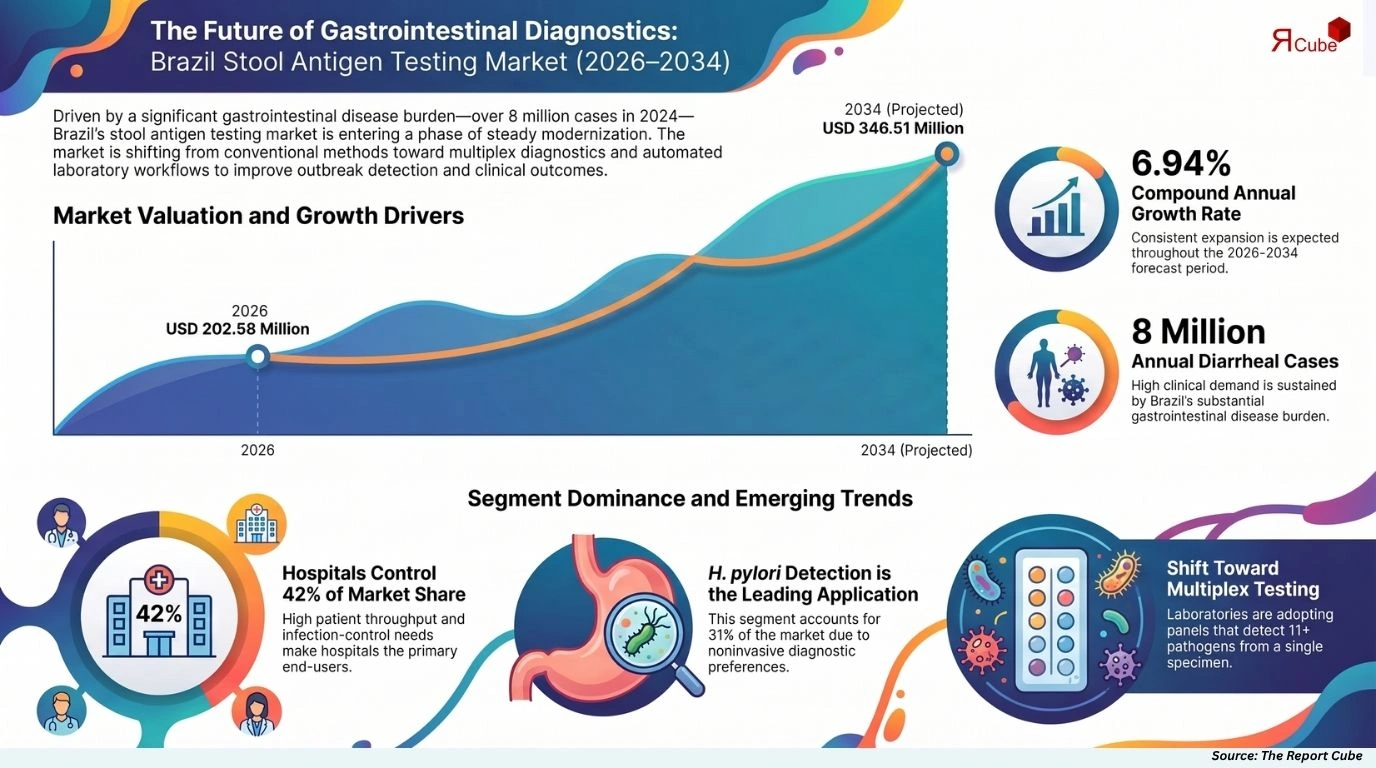
The Brazil Stool Antigen Testing Market is anticipated to register a 6.94% CAGR during 2026-2034. The market size was valued at USD 202.58 million in 2026 and is projected to reach USD 346.51 million by 2034. Demand is supported by Brazil’s substantial gastrointestinal disease burden and continued expansion of laboratory-based surveillance. The Ministry of Health reported more than 8 million acute diarrheal disease cases in 2024, while its surveillance framework emphasizes early outbreak detection through sentinel units and SIVEP-DDA reporting. In 2025, the Ministry also issued guidance supporting decentralized molecular diagnosis of gastrointestinal viruses and laboratory workflows for bacterial enteric infections, reinforcing diagnostic infrastructure and testing capacity.
The competitive environment is increasingly shaped by investments in multiplex diagnostics, automated laboratory workflows, and broader pathogen coverage. bioMérieux’s 2025 FDA clearance for its BIOFIRE FILMARRAY Gastrointestinal Panel Mid demonstrated continued commercial investment in rapid multi-pathogen testing, covering 11 bacterial, viral, and parasitic targets with approximately one-hour results. Thermo Fisher similarly continues expanding gastrointestinal molecular workflows, while Roche reported 75 new diagnostic partnership agreements during 2025, highlighting the sector’s emphasis on external innovation and commercialization.
Brazil Stool Antigen Testing Market Dynamics
The market is gaining momentum as hospitals, diagnostic laboratories, and outpatient providers prioritize faster identification of gastrointestinal pathogens. Brazil’s surveillance infrastructure, geographic disease variability, and persistent diarrheal disease burden support recurring demand for stool-based diagnostics. Testing is also moving toward broader pathogen coverage, automated workflows, and complementary molecular methods, particularly where conventional culture or microscopy cannot deliver sufficiently rapid differential diagnosis.
|
Factor |
Type |
Specific Impact on Market |
Magnitude |
|---|---|---|---|
|
Gastrointestinal disease burden |
Driver |
Sustains recurring demand for pathogen-specific stool testing |
High |
|
Public laboratory surveillance |
Driver |
Expands testing requirements across monitored infectious diseases |
High |
|
Multiplex diagnostics |
Opportunity |
Increases testing breadth from a single stool specimen |
High |
|
Regional healthcare disparities |
Challenge |
Creates uneven access to advanced diagnostic services |
Moderate |
|
Molecular workflow adoption |
Trend |
Encourages complementary movement beyond conventional antigen testing |
High |
Key Market Driver: Expanding Gastrointestinal Disease Surveillance
Brazil’s structured surveillance of acute diarrheal diseases creates recurring diagnostic demand across healthcare settings. The Ministry of Health uses sentinel units and SIVEP-DDA to monitor epidemiological patterns and identify outbreaks, particularly among vulnerable populations and during environmental disruptions. More than 8 million acute diarrheal disease cases were recorded nationally in 2024, demonstrating the scale of the clinical testing environment. These conditions support continued utilization of stool-based antigen assays for rapid pathogen identification, treatment guidance, and follow-up testing across hospitals and diagnostic laboratories.
Major Industry Challenge: Uneven Diagnostic Infrastructure Across Regions
Diagnostic access remains uneven because healthcare infrastructure, laboratory capabilities, and specialist availability differ considerably across Brazilian regions. The Ministry of Health recognizes socioeconomic disparities, sanitation deficiencies, climate-related events, and natural disasters as contributors to acute diarrheal disease variation. Consequently, sophisticated testing capabilities are concentrated more heavily in major metropolitan healthcare networks, while remote areas may depend on centralized laboratories or conventional methods. This geographic imbalance can limit consistent adoption of advanced stool diagnostics and create differences in turnaround times, testing availability, and laboratory utilization between urban and underserved populations.
Emerging Trend Shaping Outlook: Multiplex Testing Expands Diagnostic Breadth
Multiplex testing is reshaping gastrointestinal diagnostics by allowing laboratories to evaluate multiple bacterial, viral, and parasitic targets from one specimen. bioMérieux’s 2025 FDA-cleared BIOFIRE FILMARRAY Gastrointestinal Panel Mid illustrates this direction, simultaneously assessing 11 common gastroenteritis-associated pathogens with approximately one-hour results. Thermo Fisher likewise offers enteric pathogen panels spanning bacterial, viral, and parasitic targets. This trend supports faster differential diagnosis, particularly where symptoms overlap substantially between pathogen classes and sequential testing would otherwise delay clinical decision-making.
Need Specific Data, Let’s Customize the Report for You
Request CustomizationBrazil Stool Antigen Testing Market Segment-wise Analysis
Application patterns are influenced by pathogen prevalence, clinical urgency, diagnostic availability, and institutional testing protocols. End-user demand varies according to laboratory infrastructure, patient volumes, and the need for rapid infectious disease differentiation.
By Application
- Helicobacter pylori Detection
- Bacterial Gastrointestinal Infection Diagnosis
- Viral Gastrointestinal Infection Diagnosis
- Parasitic Infection Diagnosis
- Hospital-Acquired Infection Monitoring
- Others
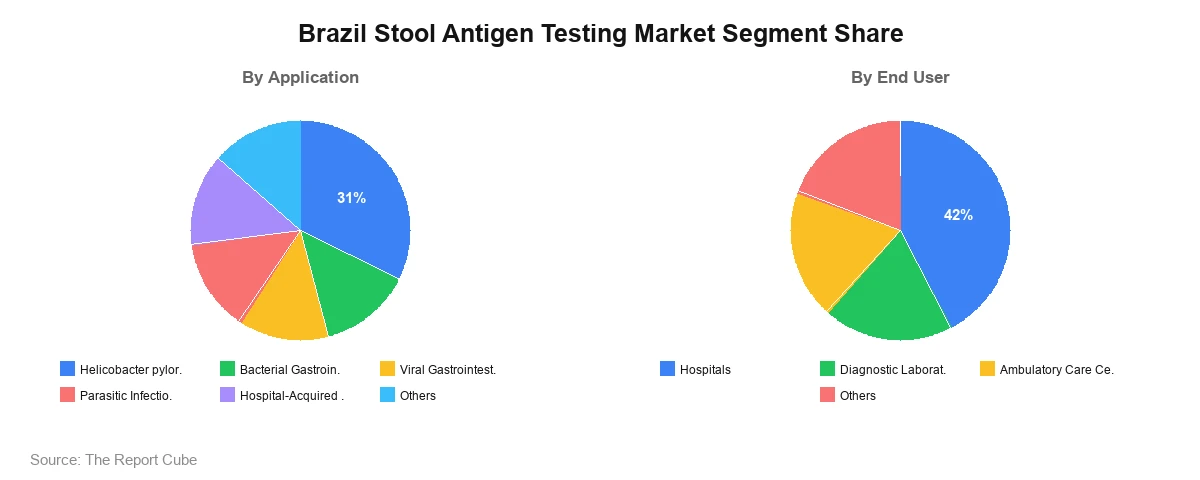
Helicobacter pylori Detection is expected to remain the dominant application, accounting for an estimated 31% share in 2026. Stool antigen testing provides a noninvasive approach for identifying active H. pylori infection and is also suitable for confirming eradication after therapy. TECHLAB notes that stool antigen assays detect active infection and can support both initial diagnosis and post-treatment monitoring. The segment benefits from physician familiarity, noninvasive sample collection, and increasing preference for testing approaches that avoid endoscopic procedures when clinically appropriate.
Bacterial Gastrointestinal Infection Diagnosis remains another substantial contributor because Salmonella, Shigella, Campylobacter, and other enteric pathogens require timely differentiation. Viral and parasitic infection diagnosis is gaining relevance as multiplex technologies expand the number of detectable targets. Hospital-Acquired Infection Monitoring benefits from structured infection-control programs, while Others includes broader gastrointestinal diagnostic applications. Molecular testing increasingly complements antigen methods because multiplex panels can simultaneously assess numerous pathogen classes from one stool specimen.
By End User
- Hospitals
- Diagnostic Laboratories
- Ambulatory Care Centers
- Others
Hospitals represent the dominant end-user segment, estimated at approximately 42% of 2026 demand. High patient throughput, emergency presentations, inpatient infection-control requirements, and gastrointestinal disease complexity support extensive testing utilization. Hospitals also require rapid diagnostic information for differentiating infectious causes of diarrhea and managing patients requiring isolation or targeted treatment. The concentration of advanced laboratory infrastructure within large healthcare networks further strengthens hospital utilization, particularly in metropolitan areas where specialized diagnostic services and clinical microbiology capabilities are more developed.
Diagnostic Laboratories represent the fastest-expanding end-user category as centralized testing and high-throughput workflows gain importance. Ambulatory Care Centers are increasingly adopting rapid diagnostic approaches for outpatient gastrointestinal complaints, while Others includes specialty clinics and public-health facilities. Meridian Bioscience provides stool-focused antigen and molecular reagent capabilities spanning pathogens such as Giardia, Cryptosporidium, H. pylori, Salmonella, and Shigella, supporting the broadening laboratory ecosystem around gastrointestinal testing.
Brazil Stool Antigen Testing Market: Recent Development (2025)
- bioMérieux received FDA clearance for BIOFIRE Gastrointestinal Panel Mid, expanding rapid multi-pathogen testing capabilities.
- Roche showcased expanded diagnostic partnerships and innovative laboratory solutions at ADLM 2025.
- Thermo Fisher presented gastrointestinal pathogen research findings at ESCMID Global 2025.
- Meridian expanded stool-focused molecular testing reagents supporting gastrointestinal pathogen detection workflows.
Brazil Stool Antigen Testing Market Future Outlook
The market is projected to reach USD 346.51 million by 2034 while maintaining a 6.94% CAGR during 2026-2034. Growth opportunities will center on expanded laboratory coverage, hospital-based infection management, H. pylori testing, and improved access to gastrointestinal diagnostics outside major metropolitan centers. Multiplex platforms are expected to increasingly complement targeted antigen assays by providing broader pathogen differentiation from individual stool specimens. Government surveillance programs and continued strengthening of laboratory networks should further support demand, particularly where diarrheal disease monitoring requires timely identification of etiological patterns.
Technology advancement will increasingly integrate automated sample processing, multiplex molecular workflows, digital result interpretation, and AI-driven decision support into gastrointestinal diagnostics. These capabilities can help laboratories manage complex pathogen panels, identify co-detections, prioritize confirmatory testing, and standardize interpretation across higher-volume facilities. Over the longer term, market expansion will depend on broader access to diagnostic infrastructure, improved regional laboratory connectivity, and continued innovation from major diagnostics companies. Antigen testing should retain relevance where targeted, rapid, noninvasive testing provides practical clinical value alongside expanding molecular alternatives.
Brazil Stool Antigen Testing Market Report Coverage
|
Report Attribute |
Details |
|---|---|
|
Market Name |
Brazil Stool Antigen Testing Market |
|
Market Size (2026) |
USD 202.58 million |
|
Market Size (2034) |
USD 346.51 million |
|
Forecast Period |
2026-2034 |
|
CAGR |
6.94% |
|
Base Year |
2025 |
|
Historical Years |
2021-2025 |
|
Forecast Years |
2026-2034 |
|
Segments Covered |
By Application, By End User, By Technology, By Test Type |
|
Regions Covered |
Brazil; Southeast, South, Northeast, Midwest, North |
|
Key Companies |
Abbott Laboratories; BioMérieux S.A.; Thermo Fisher Scientific Inc.; F. Hoffmann-La Roche AG; Meridian Bioscience Inc.; Beckman Coulter Inc.; TECHLAB Inc.; Others |
|
Report Format |
Market Research Report |
|
Customization |
Available according to client requirements |
Why Choose This Report?
- Provides Brazil-specific market sizing and forward-looking growth analysis.
- Evaluates application segments using clinically relevant demand indicators.
- Assesses end-user adoption across major healthcare delivery settings.
- Highlights regional differences influencing diagnostic market development.
- Profiles competitive developments among established diagnostic companies.
- Incorporates government surveillance initiatives affecting diagnostic demand.
- Examines technology trends shaping gastrointestinal testing workflows.
- Supports strategic planning through evidence-led market interpretation.
Table of Contents
- Introduction
- Objective of the Study
- Product Definition
- Market Segmentation
- Study Variables
- Research Methodology
- Secondary Data Points
- Companies Interviewed
- Primary Data Points
- Breakdown of Primary Interviews
- Secondary Data Points
- Executive Summary
- Market Dynamics
- Drivers
- Challenges
- Opportunity Assessment
- Recent Trends and Developments
- Policy and Regulatory Landscape
- Brazil Stool Antigen Testing Market Overview and Forecast Analysis (2021-2034)
- Market Size, By Value, By Growth Rate (CAGR/USD Millions)
- Demand – Supply Trends
- Market Share, By Test Type
- Bacterial Antigen Test
- Viral Antigen Test
- Parasitic Antigen Test
- Multiplex/Combination Stool Test
- Market Share, By Technology
- Enzyme-Linked Immunosorbent Assay (ELISA)
- Lateral Flow Immunoassays
- Fluorescent Immunoassays
- Others
- Market Share, By Application
- Helicobacter pylori Detection
- Bacterial Gastrointestinal Infection Diagnosis
- Viral Gastrointestinal Infection Diagnosis
- Parasitic Infection Diagnosis
- Hospital-Acquired Infection Monitoring
- Others
- Market Share, By End User
- Hospitals
- Diagnostic Laboratories
- Ambulatory Care Centers
- Others
- Market Share, By Competitors
- Competition Characteristics
- Revenue Shares
- Bacterial Antigen Test Brazil Stool Antigen Testing Market Overview, 2021-2034F
- By Value (USD Million)
- By Technology – Market Size & Forecast 2021-2034, USD Million
- Enzyme-Linked Immunosorbent Assay (ELISA)
- Lateral Flow Immunoassays
- Fluorescent Immunoassays
- Others
- Viral Antigen Test Brazil Stool Antigen Testing Market Overview, 2021-2034F
- By Value (USD Million)
- By Technology – Market Size & Forecast 2021-2034, USD Million
- Enzyme-Linked Immunosorbent Assay (ELISA)
- Lateral Flow Immunoassays
- Fluorescent Immunoassays
- Others
- Parasitic Antigen Test Brazil Stool Antigen Testing Market Overview, 2021-2034F
- By Value (USD Million)
- By Technology – Market Size & Forecast 2021-2034, USD Million
- Enzyme-Linked Immunosorbent Assay (ELISA)
- Lateral Flow Immunoassays
- Fluorescent Immunoassays
- Others
- Multiplex/Combination Stool Test Brazil Stool Antigen Testing Market Overview, 2021-2034F
- By Value (USD Million)
- By Technology – Market Size & Forecast 2021-2034, USD Million
- Enzyme-Linked Immunosorbent Assay (ELISA)
- Lateral Flow Immunoassays
- Fluorescent Immunoassays
- Others
- Competitive Outlook (Company Profile - Partial List)
- Abbott Laboratories
- Company Overview
- Business Segments
- Strategic Alliances/Partnerships
- Recent Developments
- BioMérieux S.A.
- Company Overview
- Business Segments
- Strategic Alliances/Partnerships
- Recent Developments
- Thermo Fisher Scientific Inc.
- Company Overview
- Business Segments
- Strategic Alliances/Partnerships
- Recent Developments
- F. Hoffmann-La Roche AG
- Company Overview
- Business Segments
- Strategic Alliances/Partnerships
- Recent Developments
- Meridian Bioscience Inc.
- Company Overview
- Business Segments
- Strategic Alliances/Partnerships
- Recent Developments
- Beckman Coulter Inc.
- Company Overview
- Business Segments
- Strategic Alliances/Partnerships
- Recent Developments
- TECHLAB Inc.
- Company Overview
- Business Segments
- Strategic Alliances/Partnerships
- Recent Developments
- Others
- Abbott Laboratories
- Contact Us & Disclaimer
Top Key Players & Market Share Outlook
- Abbott Laboratories
- BioMérieux S.A.
- Thermo Fisher Scientific Inc.
- F. Hoffmann-La Roche AG
- Meridian Bioscience Inc.
- Beckman Coulter Inc.
- TECHLAB Inc.
- Others
Frequently Asked Questions






