



Build Your Custom Market Intelligence Report
Customize Your ReportAsia Pacific Stormwater Infrastructure Market Key Highlights
By Infrastructure Approach:
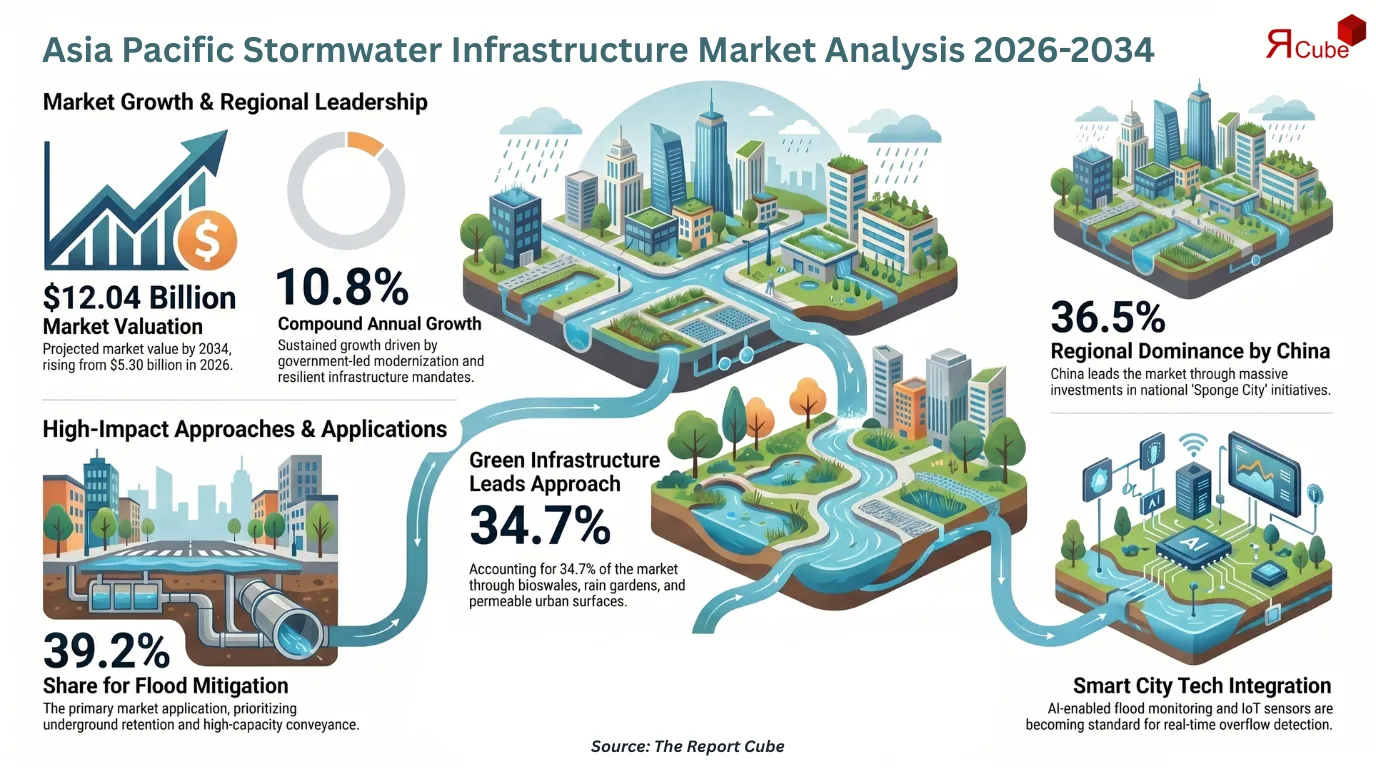
Green Infrastructure segment leads the market with nearly 34.7% share.
By Application:
Flood Mitigation segment dominates the market with around 39.2% of total revenue.
Regional Outlook:
China dominates the Asia Pacific Stormwater Infrastructure Market with approximately 36.5% share.
Asia Pacific Stormwater Infrastructure Market Insights & Analysis
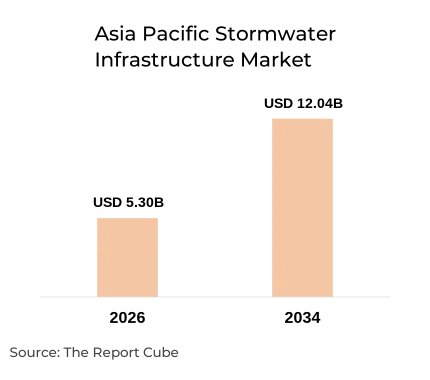
The Asia Pacific Stormwater Infrastructure Market is anticipated to register a CAGR of around 10.8% during the forecast period 2026-2034. The market size is valued at USD 5.30 billion in 2026 and is projected to reach USD 12.04 billion by 2034. Rapid urban construction across China, India, Southeast Asia, and Oceania has increased pressure on conventional drainage networks, particularly in flood-prone metropolitan regions. Governments are allocating larger infrastructure budgets toward resilient stormwater systems as recurring urban flooding continues to disrupt transportation, industrial operations, and residential communities. Cities such as Shanghai, Mumbai, Bangkok, Manila, and Sydney are increasingly investing in integrated drainage corridors, underground retention systems, and rainwater diversion infrastructure to improve urban resilience against extreme weather events.
Public authorities across the region are also strengthening long-term water sustainability strategies through nature-based infrastructure and smart flood management technologies. Expansion of sponge-city development programs, permeable urban surfaces, ecological retention zones, and AI-enabled flood monitoring systems is reshaping the regional infrastructure landscape. Funding support from institutions such as the Asian Development Bank and the Asian Infrastructure Investment Bank is accelerating large-scale drainage modernization projects across developing economies. Infrastructure contractors, drainage technology providers, and geosynthetic material manufacturers are witnessing rising project opportunities as municipalities transition toward climate-adaptive and digitally connected stormwater management frameworks.
Asia Pacific Stormwater Infrastructure Market Impact Analysis
| Factor | Type | Specific Impact on Market | Magnitude | Business Implication |
|---|---|---|---|---|
| Government Regulatory Mandates | Regulatory | Strict water quality and runoff laws drive compliance | High | Align solutions with national standards and green codes |
| Smart City Investment | Technological | USD 35B+ smart city spending integrates IoT sensors | High | Deploy real-time monitoring and predictive analytics |
| Green Infrastructure Adoption | Technological | Blue-green solutions and LID approaches gain traction | Medium | Develop permeable pavements and bio-retention products |
| Industrial & Commercial Growth | Market | Factories and commercial zones need treatment systems | Medium | Expand B2B offerings for industrial compliance clients |
| Water Scarcity & Reuse Demand | Consumer | Population growth drives rainwater harvesting interest | Medium | Market storage and reuse systems for water conservation |
| Public-Private Partnerships | Market | Government funding attracts private sector participation | Medium | Pursue PPP contracts for large-scale municipal projects |
| Infrastructure Investment Gaps | Competitive | Legacy systems and funding delays slow modernization | Medium | Offer scalable, modular solutions for phased rollouts |
| Sustainability & ESG Priorities | Consumer | Corporate ESG goals push eco-friendly drainage methods | Low | Highlight environmental certifications in sales messaging |
Asia Pacific Stormwater Infrastructure Market Dynamics
Key Driver: Rising Urban Flood Risks and Government Infrastructure Modernization Programs
Intensifying rainfall patterns and rapid urban expansion are significantly increasing the demand for advanced stormwater infrastructure across Asia Pacific countries. Large urban centers continue to face severe flooding challenges caused by inadequate drainage capacity, high surface runoff, and aging sewer systems. In response, governments are prioritizing flood mitigation infrastructure within national climate adaptation and urban resilience programs. China has accelerated sponge-city investments across multiple provinces, while India is strengthening drainage modernization projects under urban infrastructure development schemes. Similar investments are also expanding across Southeast Asia where flood-related economic disruptions continue to affect transportation systems, industrial production, and public safety.
Demand for high-capacity conveyance systems, retention basins, and smart drainage networks is increasing among municipalities and infrastructure planners seeking long-term resilience solutions. Public-private partnerships are supporting construction of underground drainage tunnels, flood barriers, and rainwater harvesting systems designed to reduce pressure on conventional urban drainage assets. Industrial parks, logistics corridors, and large residential developments are also integrating stormwater management systems into new infrastructure planning frameworks. These ongoing investments are expected to sustain strong market growth throughout the forecast period.
Book your FREE 30-minute expert consultation today
Contact UsIndustry Trends: Growing Integration of Smart Monitoring and Nature-Based Drainage Solutions
Technology-driven stormwater management systems are becoming increasingly important across Asia Pacific infrastructure projects. Municipal authorities are deploying smart monitoring platforms equipped with IoT sensors, predictive flood analytics, and automated water flow control technologies to improve emergency preparedness and drainage efficiency. Countries such as Singapore, Japan, and Australia are actively implementing digital flood monitoring networks capable of providing real-time rainfall tracking and overflow detection. The use of advanced analytics in urban water management is helping authorities reduce operational disruptions and improve long-term infrastructure planning.
Alongside digital transformation, regional cities are increasingly adopting hybrid infrastructure models that combine engineered drainage assets with ecological stormwater systems. Bioswales, retention ponds, urban wetlands, and permeable pavements are gaining wider acceptance due to their ability to absorb runoff naturally and reduce pressure on municipal drainage systems. This transition toward green-blue infrastructure is particularly visible in coastal and densely populated urban regions where land constraints and climate risks require more adaptive flood management strategies. Construction firms are also investing in modular stormwater solutions that simplify installation and improve long-term maintenance efficiency.
Major Challenge: Aging Urban Drainage Networks and High Project Development Costs
Many urban areas across Asia Pacific continue to operate with outdated drainage infrastructure that was not designed to handle current rainfall intensity levels or rapid population growth. Existing stormwater systems in several metropolitan regions face operational limitations due to undersized pipelines, blocked drainage channels, and deteriorating underground assets. Retrofitting these systems within highly congested urban environments often requires extensive excavation, utility relocation, and prolonged construction schedules. Such complexities can create delays in project execution and increase operational risks for infrastructure developers and municipal agencies.
Financial constraints also remain a major challenge for large-scale stormwater modernization programs, particularly in emerging economies with competing public infrastructure priorities. Rising construction material costs, labor shortages, and imported equipment expenses are increasing the total cost of drainage infrastructure deployment. Municipal governments frequently encounter budget allocation delays and lengthy approval procedures for climate-resilient infrastructure investments. In addition, fragmented urban planning coordination between transportation, water management, and environmental agencies may slow implementation timelines for integrated drainage and flood management systems.
Opportunity: Expansion of Sustainable Water Reuse and Climate-Adaptive Infrastructure
Increasing concerns regarding water scarcity and urban climate resilience are creating new opportunities for advanced stormwater reuse and infiltration systems across the Asia Pacific region. Governments are encouraging infrastructure projects that support groundwater recharge, rainwater harvesting, and decentralized water management to reduce dependence on conventional freshwater sources. Urban planners are integrating sustainable drainage systems into residential complexes, industrial facilities, and transportation infrastructure to improve long-term water efficiency and reduce flood risks. Demand for stormwater quality treatment systems is also increasing as environmental regulations become stricter across major regional economies.
The growing adoption of climate-adaptive urban planning frameworks is expected to create substantial opportunities for smart drainage technologies, ecological retention systems, and modular stormwater infrastructure solutions. International climate financing programs are supporting resilient urban water management projects throughout Southeast Asia and South Asia. Commercial developers and municipal authorities are increasingly prioritizing infrastructure capable of managing both water conservation and flood protection objectives within rapidly urbanizing environments. These evolving infrastructure priorities are likely to strengthen long-term investment activity across the Asia Pacific stormwater infrastructure market.
Asia Pacific Stormwater Infrastructure Market Segment-wise Analysis
By Infrastructure Approach:
- Hybrid Infrastructure
- Smart Infrastructure
- Green Infrastructure
- Gray Infrastructure
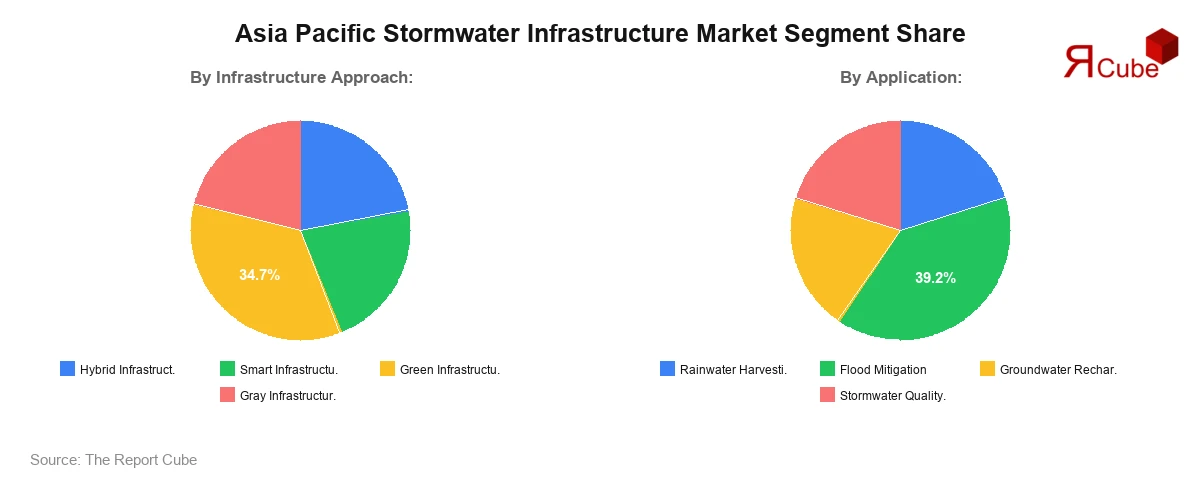
Green Infrastructure continues to hold the dominant share within the Asia Pacific stormwater infrastructure market due to rising investments in sustainable urban development and flood-resilient city planning. The segment accounts for nearly 34.7% of the regional market, supported by growing implementation of sponge-city concepts, ecological drainage systems, and permeable urban landscapes. Municipal governments are increasingly deploying bioswales, rain gardens, vegetative channels, and retention ponds to improve runoff absorption while minimizing environmental impact. Countries including China, Singapore, and Australia are actively integrating green infrastructure into transportation corridors, residential developments, and public infrastructure projects to strengthen urban water resilience.
The growing emphasis on low-impact development practices is further accelerating demand for green stormwater systems across both public and private construction sectors. Developers are recognizing the long-term operational benefits associated with reduced surface runoff, lower maintenance requirements, and improved groundwater recharge capabilities. Green infrastructure is also gaining preference because it aligns with broader regional sustainability goals and climate adaptation frameworks. Rising public investments in ecological flood mitigation infrastructure are expected to maintain strong growth momentum for the segment throughout the forecast timeline.
By Application:
- Rainwater Harvesting and Reuse
- Flood Mitigation
- Groundwater Recharge and Infiltration
- Stormwater Quality Treatment
Flood Mitigation remains the largest application segment within the Asia Pacific stormwater infrastructure market, contributing approximately 39.2% of total market revenue. Increasing occurrences of urban flooding, river overflow incidents, and coastal waterlogging events are driving substantial investments in flood control infrastructure across the region. Governments are strengthening drainage capacity through construction of underground storage tunnels, automated floodgates, retention reservoirs, and high-capacity conveyance systems. Major metropolitan areas such as Manila, Jakarta, Bangkok, and Mumbai continue to prioritize large-scale flood resilience projects to protect critical infrastructure and densely populated urban districts.
Public infrastructure agencies are also incorporating smart flood forecasting systems and digital monitoring technologies into flood management frameworks to improve operational response during extreme weather conditions. The expansion of transportation infrastructure, industrial zones, and smart city projects is further increasing demand for flood mitigation systems capable of handling large runoff volumes efficiently. Multilateral financing support for climate-resilient infrastructure development is expected to sustain long-term growth across the flood mitigation segment over the coming years.
Regional Projection of Asia Pacific Stormwater Infrastructure Industry
- China
- India
- Japan
- Singapore
- Thailand
- Australia
- New Zealand
China holds the leading position in the Asia Pacific Stormwater Infrastructure Market with an estimated revenue share of around 36.5%. The country continues to expand large-scale sponge-city initiatives aimed at improving urban flood resilience, runoff management, and sustainable water reuse capabilities. Strong government investment in climate-adaptive infrastructure has accelerated deployment of permeable pavements, underground drainage tunnels, ecological retention zones, and smart flood monitoring systems across major cities. Urban centers including Beijing, Shanghai, Shenzhen, and Guangzhou are actively modernizing drainage infrastructure to address increasing flood risks associated with rapid urbanization and extreme rainfall intensity.
China’s leadership position is also supported by its strong domestic manufacturing ecosystem for drainage materials, geosynthetics, smart monitoring technologies, and prefabricated stormwater systems. Public infrastructure spending continues to prioritize resilient urban construction as part of broader environmental sustainability and smart city development strategies. In addition, local authorities are increasingly integrating digital flood forecasting platforms and AI-enabled monitoring systems into municipal water management frameworks. These long-term infrastructure investments are expected to strengthen China’s dominance within the regional stormwater infrastructure industry throughout the forecast period.
Need insights for a specific region within this market?
Request Regional DataAsia Pacific Stormwater Infrastructure Industry - Countries Analysis
The Asia Pacific stormwater infrastructure industry varies significantly across countries due to diverse urbanization levels, flood risks, and government investment priorities.
| Country | Demand Level | Key Areas | System Dominance | Core Demand Logic | Growth Nature |
|---|---|---|---|---|---|
| China | Very High | Major cities nationwide | Green infrastructure & detention | Massive urbanization & flood control | Infrastructure renewal |
| India | Extremely High | Metro cities, AMRUT zones | Drainage networks & bioswales | Only 20% road network has drainage | Government-led expansion |
| Japan | High | Tokyo, Osaka, urban centers | Advanced detention systems | Typhoon resilience & tech innovation | Technology upgrades |
| Singapore | Very High | Island-wide network | ABC Waters & blue-green infra | 8,000 km drainage + 17 reservoirs | Climate adaptation focus |
| Thailand | Extremely High | Bangkok, Hat Yai, flood zones | Flood control & urban parks | Annual floods & climate intensification | Emergency-driven growth |
| Australia | High | Sydney, Melbourne, Brisbane | AI flood sensing & digital water | AUD 278B infrastructure pipeline | Smart technology adoption |
| New Zealand | High | Wellington, Auckland, coastal | Climate-resilient networks | NZD 20B+ asset base under threat | Climate adaptation surge |
Government Initiatives & Policies
- China Sponge City Expansion Program 2026: China expanded its national sponge-city framework in 2026 to strengthen urban flood resilience through permeable infrastructure, rainwater reuse systems, ecological retention zones, and smart drainage networks across high-risk metropolitan regions.
- India Urban Climate Resilience and Drainage Modernization Initiative 2025: India accelerated climate-resilient urban drainage projects under integrated smart city and water management programs to improve stormwater collection efficiency, reduce flood risks, and strengthen sustainable urban infrastructure development.
Asia Pacific Stormwater Infrastructure Industry Recent Developments
- 2026: MMDA and Asian Infrastructure Investment Bank launched the Metro Manila Sponge City Initiative to strengthen urban flood mitigation through wetlands, rainwater impounding systems, and integrated green-blue drainage infrastructure designed to improve runoff absorption, reduce pumping pressure, and support climate-adaptive urban development across the National Capital Region.
- 2026: HJ Heavy Industries signed a KRW 92.2 billion contract for the Tagum Flood Control Project in the Philippines under Asian Development Bank financing. The project includes river dredging, floodgate construction, bridge infrastructure, and basin widening works to strengthen regional flood resilience and urban drainage capacity.
- 2025: Asian Development Bank approved a USD 200 million loan for climate-resilient drainage and sewerage infrastructure development in Kolkata. The project includes trunk pipeline construction, pumping stations, drainage pipelines, and wastewater treatment infrastructure aimed at improving urban flood management and sanitation resilience.
Why Choose This Report?
- Provides a comprehensive overview of the overall market analysis, encompassing key trends, consumer behavior analysis, and risk assessment to support strategic decision-making.
- Provides accurate, up-to-date insights into market size, segmentation, and emerging opportunities, helping to minimize risk & capitalizing on growth.
- Gives deep understanding of target audience preferences, investment habits, and communication channels for enhanced product development & marketing effectiveness.
- Delivers competitive analysis & benchmarking, uncovering the strengths & weaknesses of market competitors to guide strategies.
- Consolidate comprehensive market intelligence, reducing reasoning & streamlining research efforts.
- Facilitates customized market segmentation & risk mitigation strategies, fine-tuned to the business objectives.
- Aids in identifying both market challenges & untapped opportunities within the industry to drive long-term business growth.
- Provides valuable information based on actual customer data & search trends.
Table of Contents
- Introduction
- Objective of the Study
- Product and Category Definition
- Market Segmentation
- Study Variables
- Research Methodology
- Secondary Data Points
- Breakdown of Secondary Sources
- Primary Data Points
- Breakdown of Primary Interviews
- Secondary Data Points
- Executive Summary
- Market Dynamics
- Emerging Opportunities
- Adoption Trends
- Demand Drivers
- Disruption Analysis (Challenges)
- Industry Analysis and Strategic Insights
- Supply and Value Chain Analysis
- Pricing Analysis
- Go-To-Market Strategy
- BCG Matrix
- Recent Trends and Developments
- Import and Export Analysis
- Regulatory and Policy Landscape
- Region-wise Policies
- Government Initiatives
- Asia Pacific Stormwater Infrastructure Market Overview and Forecast Analysis (2021-2034)
- Market Size, By Value, By Growth Rate (CAGR/USD Billion)
- Market Share, By Infrastructure Approach
- Hybrid Infrastructure
- Smart Infrastructure
- Green Infrastructure
- Gray Infrastructure
- Market Share, By System Function
- Treatment Systems
- Collection Systems
- Monitoring and Control Systems
- Storage Systems
- Conveyance Systems
- Market Share, By Material Type
- Geosynthetics
- Concrete
- Metal
- Plastics (HDPE, PVC)
- Market Share, By Drainage Mechanism
- Subsurface Drainage Systems
- Surface Drainage Systems
- Market Share, By Project Type
- Retrofit and Upgrade Projects
- New Development Projects
- Market Share, By Application
- Rainwater Harvesting and Reuse
- Flood Mitigation
- Groundwater Recharge and Infiltration
- Stormwater Quality Treatment
- Market Share, By End User
- Industrial
- Residential
- Commercial and Institutional
- Municipal and Government Authorities
- Market Share, By Country
- China
- India
- Japan
- Singapore
- Thailand
- Australia
- New Zealand
- Rest of Asia Pacific
- Market Share, By Company
- Revenue Shares and Analysis
- Competitive Landscape
- China Stormwater Infrastructure Market Overview and Forecast Analysis (2021-2034)
- Market Size, By Value, By Growth Rate (CAGR/USD Billion/Million)
- Market Context and Policy Environment
- Key Demand Drivers and Challenges
- Major Ongoing and Planned Projects
- Key Companies Operating in China
- India Stormwater Infrastructure Market Overview and Forecast Analysis (2021-2034)
- Market Size, By Value, By Growth Rate (CAGR/USD Billion/Million)
- Market Context and Policy Environment
- Key Demand Drivers and Challenges
- Major Ongoing and Planned Projects
- Key Companies Operating in India
- Japan Stormwater Infrastructure Market Overview and Forecast Analysis (2021-2034)
- Market Size, By Value, By Growth Rate (CAGR/USD Billion/Million)
- Market Context and Policy Environment
- Key Demand Drivers and Challenges
- Major Ongoing and Planned Projects
- Key Companies Operating in Japan
- Singapore Stormwater Infrastructure Market Overview and Forecast Analysis (2021-2034)
- Market Size, By Value, By Growth Rate (CAGR/USD Billion/Million)
- Market Context and Policy Environment
- Key Demand Drivers and Challenges
- Major Ongoing and Planned Projects
- Key Companies Operating in Singapore
- Thailand Stormwater Infrastructure Market Overview and Forecast Analysis (2021-2034)
- Market Size, By Value, By Growth Rate (CAGR/USD Billion/Million)
- Market Context and Policy Environment
- Key Demand Drivers and Challenges
- Major Ongoing and Planned Projects
- Key Companies Operating in Thailand
- Australia Stormwater Infrastructure Market Overview and Forecast Analysis (2021-2034)
- Market Size, By Value, By Growth Rate (CAGR/USD Billion/Million)
- Market Context and Policy Environment
- Key Demand Drivers and Challenges
- Major Ongoing and Planned Projects
- Key Companies Operating in Australia
- New Zealand Stormwater Infrastructure Market Overview and Forecast Analysis (2021-2034)
- Market Size, By Value, By Growth Rate (CAGR/USD Billion/Million)
- Market Context and Policy Environment
- Key Demand Drivers and Challenges
- Major Ongoing and Planned Projects
- Key Companies Operating in New Zealand
- Competitive Analysis, 2026
- Market Share of Key Players
- Competitive Mapping By Infrastructure Approach
- Competitive Mapping By System Function
- Competitive Mapping By Material Type
- Competitive Mapping By Drainage Mechanism
- Competitive Mapping By Project Type
- Competitive Mapping By Application
- Competitive Mapping By End User
- China Stormwater Infrastructure Companies Share and Competitive Analysis, 2026
- India Stormwater Infrastructure Companies Share and Competitive Analysis, 2026
- Japan Stormwater Infrastructure Companies Share and Competitive Analysis, 2026
- Singapore Stormwater Infrastructure Companies Share and Competitive Analysis, 2026
- Thailand Stormwater Infrastructure Companies Share and Competitive Analysis, 2026
- Australia Stormwater Infrastructure Companies Share and Competitive Analysis, 2026
- New Zealand Stormwater Infrastructure Companies Share and Competitive Analysis, 2026
- Company Profiles (Partial List)
- Shenzhen Doctor Rain Rainwater Recycling Co., Ltd.
- Company Overview
- Product Portfolio
- Strategic Alliances and Partnerships
- Recent Developments
- ACO Group
- Company Overview
- Product Portfolio
- Strategic Alliances and Partnerships
- Recent Developments
- SMEC Holdings Limited
- Company Overview
- Product Portfolio
- Strategic Alliances and Partnerships
- Recent Developments
- Oriental Consultants Global Co., Ltd.
- Company Overview
- Product Portfolio
- Strategic Alliances and Partnerships
- Recent Developments
- RELN Pty Ltd
- Company Overview
- Product Portfolio
- Strategic Alliances and Partnerships
- Recent Developments
- ORCA Civil Products Pty. Ltd
- Company Overview
- Product Portfolio
- Strategic Alliances and Partnerships
- Recent Developments
- GRAF China Environmental (Nanjing) Co., Ltd.
- Company Overview
- Product Portfolio
- Strategic Alliances and Partnerships
- Recent Developments
- Everhard Industries Pty Ltd
- Company Overview
- Product Portfolio
- Strategic Alliances and Partnerships
- Recent Developments
- Toshiba Infrastructure Systems and Solutions Corporation
- Company Overview
- Product Portfolio
- Strategic Alliances and Partnerships
- Recent Developments
- Beijing Tidelion S&I Rainwater Harvesting Technology Co. Ltd
- Company Overview
- Product Portfolio
- Strategic Alliances and Partnerships
- Recent Developments
- Others (Partial List)
- Shenzhen Doctor Rain Rainwater Recycling Co., Ltd.
- Contact Us and Disclaimer
Top Key Players & Market Share Outlook
- Shenzhen Doctor Rain Rainwater Recycling Co., Ltd.
- ACO Group
- SMEC Holdings Limited
- Oriental Consultants Global Co., Ltd.
- RELN Pty Ltd
- ORCA Civil Products Pty. Ltd
- GRAF China Environmental (Nanjing) Co., Ltd.
- Everhard Industries Pty Ltd
- Toshiba Infrastructure Systems & Solutions Corporation
- Beijing Tidelion S&I Rainwater Harvesting Technology Co. Ltd
- Others
Frequently Asked Questions