



Build Your Custom Market Intelligence Report
Customize Your ReportSoutheast Asia Water Pump Market Key Highlights
By Type of Pumps:
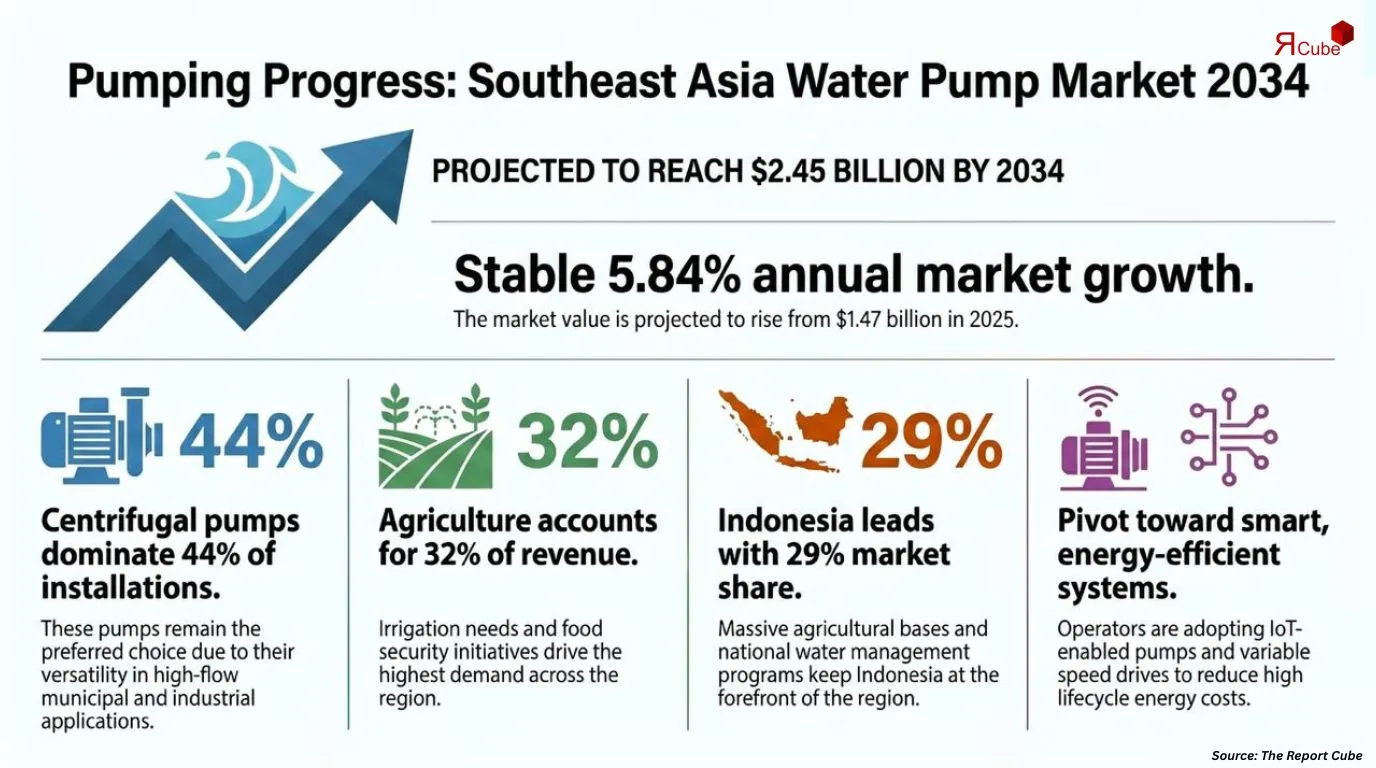
Centrifugal pumps lead the market, accounting for nearly 44% of total installations.
By End User:
Agriculture & irrigation dominate demand, contributing close to 32% of total revenue.
Regional Outlook:
Indonesia remains the leading country market, representing approximately 29% share.
Government Initiatives & Policies
- Indonesia National Water Resources Management Program: Focuses on irrigation modernization, flood control, and efficient pumping systems deployment.
- Thailand Eastern Economic Corridor (EEC) Infrastructure Plan: Includes municipal water supply and industrial utility upgrades requiring advanced pump systems.
Southeast Asia Water Pump Market Insights & Analysis
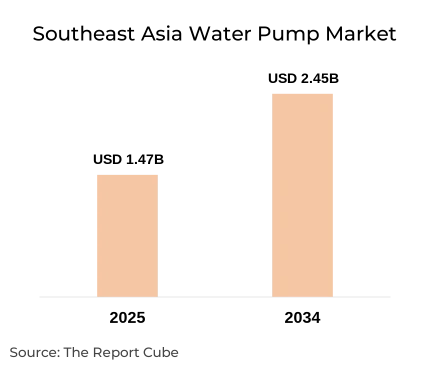
The Southeast Asia Water Pump Market is anticipated to register a CAGR of 5.84% during the forecast period. The market size was valued at USD 1.47 billion in 2025 and is projected to reach USD 2.45 billion by the forecast 2026-2034. Water pumps form the backbone of Southeast Asia’s agricultural productivity, urban water supply, industrial processing, and power generation ecosystems. Rapid population growth, rising urbanization rates exceeding 3% annually in several ASEAN economies, and expanding industrial corridors are steadily lifting demand for reliable pumping solutions. Countries such as Indonesia, Vietnam, and the Philippines are investing heavily in water security to address seasonal rainfall variability and recurring flood-drought cycles. These investments directly translate into higher adoption of centrifugal, submersible, and positive displacement pumps across public and private sectors.
Capital inflows into infrastructure remain a central growth pillar. Between 2023 and 2025, ASEAN governments collectively allocated over USD 45 billion toward water supply, sanitation, and irrigation projects. Industrial users are also upgrading pumping systems to meet stricter efficiency and emissions benchmarks, especially in food processing, chemicals, and power plants. Innovation plays a visible role, with manufacturers integrating variable frequency drives, smart monitoring, and corrosion-resistant materials to extend pump life in humid tropical environments. These combined factors create a stable and expanding foundation for long-term market growth.
Southeast Asia Water Pump Market Dynamics
Key Driver: Expanding Agricultural Irrigation and Food Security Investments
Growing food demand across Southeast Asia continues to accelerate irrigation development, directly supporting water pump adoption. Agriculture employs more than 30% of the regional workforce, and governments are prioritizing yield stability through controlled water access. Indonesia alone added over 1.2 million hectares of irrigated farmland between 2020 and 2024, creating sustained demand for submersible and centrifugal pumps. Electrification of rural zones and the gradual shift from diesel-powered systems to electric pumps further strengthen volumes. Large plantations increasingly prefer energy-efficient pumps to control operating costs, reinforcing demand for modern, high-capacity systems.
Book your FREE 30-minute expert consultation today
Contact UsIndustry Trends: Shift Toward Energy-Efficient and Smart Pumping Systems
Across Southeast Asia, energy efficiency is becoming a decisive purchasing criterion. Electricity costs account for nearly 40% of a pump’s lifecycle expense, pushing end users to adopt variable speed drives and high-efficiency motors. Smart pumps equipped with sensors and remote monitoring are gaining traction in municipal utilities, where leakage detection and predictive maintenance reduce downtime. Industrial operators are integrating digital pump management platforms to meet sustainability goals and reduce water losses. This trend is especially visible in Singapore and Malaysia, where smart infrastructure adoption rates exceed regional averages.
Major Challenge: High Installation and Maintenance Costs in Rural Markets
While demand fundamentals remain strong, cost sensitivity presents a structural challenge. Advanced pump systems require skilled installation, reliable power supply, and periodic maintenance, which raises total ownership costs. In remote agricultural regions, limited technical expertise and inconsistent electricity access slow adoption of premium systems. Imported components and currency fluctuations also elevate pricing for multinational brands, restricting penetration among small farmers and local utilities. These economic barriers moderate short-term uptake, particularly outside major urban and industrial clusters.
Opportunity: Municipal Water and Wastewater Infrastructure Expansion
Urban population growth is opening a major opportunity in municipal water and wastewater management. Southeast Asian cities are expanding sewage treatment coverage to meet public health and environmental standards. Vietnam and the Philippines plan to increase urban wastewater treatment rates from below 30% to over 60% by 2030. Such upgrades require large volumes of split case, vertical turbine, and solid-handling submersible pumps. Suppliers offering corrosion-resistant designs and long service intervals stand to benefit from these multi-year public projects.
Southeast Asia Water Pump Market Segment-wise Analysis
By Type of Pumps:
- Positive Displacement Pumps
- Centrifugal Pumps
- Split Case Pumps
- Overhung Pumps
Centrifugal pumps dominate the market with an estimated 44% share in 2025. Their dominance is supported by versatility, cost-effectiveness, and suitability for high-flow applications. Municipal water supply systems widely use centrifugal pumps for raw water intake, distribution, and wastewater handling. In agriculture, mixed-flow and axial variants are preferred for irrigation canals due to their ability to move large water volumes efficiently. Industrial facilities favor centrifugal pumps for cooling, process water circulation, and boiler feed operations. Continuous design improvements, including enhanced impeller geometry and energy-efficient motors, further reinforce their leadership position across Southeast Asia.
By End User:
- Residential
- Power Generation
- Agriculture & Irrigation
- Industrial
- Municipal & Utilities
- Other End Users
Agriculture & irrigation represent the leading end-user segment, accounting for nearly 32% of regional demand. Seasonal rainfall patterns and the need for consistent crop yields make pumping systems essential across rice, palm oil, and sugarcane cultivation. Government subsidies for irrigation equipment and rural electrification programs further strengthen adoption. Farmers increasingly select durable submersible and diesel-compatible pumps to manage groundwater extraction. As food export volumes rise, irrigation infrastructure upgrades will continue to anchor this segment’s growth trajectory.
Regional Projection of Southeast Asia Water Pump Industry
- Indonesia
- Thailand
- Vietnam
- Malaysia
- Philippines
- Singapore
- Rest of Southeast Asia
Indonesia leads the Southeast Asia water pump market with around 29% share, supported by its large agricultural base and infrastructure spending. Thailand and Vietnam follow closely, driven by industrial manufacturing zones and export-oriented agriculture. Singapore, while smaller in volume, represents a high-value market for smart and energy-efficient pump systems used in water recycling and desalination. The Philippines shows rising demand linked to flood control and urban water supply projects, positioning it as a fast-growing national market within the region.
Southeast Asia Water Pump Market Recent Developments
- 2025: Grundfos patented its next-generation DDA Smart Digital Dosing pump, designed for highly accurate and energy-efficient chemical dosing in industrial, water, and building applications, supporting more sustainable water and wastewater operations.
- 2025: Flowserve introduced the world’s first sealless magnetic drive pump, featuring double hermetic sealing and a secondary independent containment system, aiming to minimize leakage risks and improve safety in demanding process applications.
- 2025: Wilo expanded its role in sustainable infrastructure by entering strategic partnerships across the Middle East and Southeast Asia to promote energy-efficient pump systems for water supply, HVAC, and wastewater, reinforcing its regional presence in high-efficiency water management solutions.
- 2025: Xylem continued investing in smart, IoT-enabled pumping and water technologies for municipal and industrial users, focusing on remote monitoring, predictive maintenance, and energy-efficient systems to support digital water infrastructure projects globally, particularly in the Asia-Pacific region.
Need insights for a specific region within this market?
Request Regional DataWhy Choose This Report?
- Provides a comprehensive overview of the overall market analysis, encompassing key trends, consumer behavior analysis, and risk assessment to support strategic decision-making.
- Provides accurate, up-to-date insights into market size, segmentation, and emerging opportunities, helping to minimize risk & capitalizing on growth.
- Gives deep understanding of target audience preferences, investment habits, and communication channels for enhanced product development & marketing effectiveness.
- Delivers competitive analysis & benchmarking, uncovering the strengths & weaknesses of market competitors to guide strategies.
- Consolidate comprehensive market intelligence, reducing reasoning & streamlining research efforts.
- Facilitates customized market segmentation & risk mitigation strategies, fine-tuned to the business objectives.
- Aids in identifying both market challenges & untapped opportunities within the industry to drive long-term business growth.
- Provides valuable information based on actual customer data & search trends.
Table of Contents
- Introduction
- Objective of the Study
- Product and Category Definition
- Market Segmentation
- Study Variables
- Research Methodology
- Secondary Data Points
- Breakdown of Secondary Sources
- Primary Data Points
- Breakdown of Primary Interviews
- Secondary Data Points
- Executive Summary
- Market Dynamics
- Drivers
- Challenges
- Opportunity Assessment
- Recent Trends and Developments
- Regulatory and Policy Landscape
- Southeast Asia Water Pump Market Overview (2021-2034)
- Market Size, By Value (USD Billion)
- Market Share, By Type of Pumps
- Positive Displacement Pumps
- Piston Pumps
- Diaphragm Pumps
- Peristaltic Pumps
- Gear Pumps
- Lobe Pumps
- Progressive Cavity Pumps
- Screw Pumps
- Vane Pumps
- Centrifugal Pumps
- Submersible Pumps
- Non-solid Handling
- Solid Handling
- Vertical Pumps
- Mixed Flow
- Turbine
- Nonsolid Handling
- Solid Handling
- Axial
- Split Case Pumps
- Multistage
- Single/Two Stage
- Overhung Pumps
- Horizontal End Suction
- Vertical Inline
- Submersible Pumps
- Positive Displacement Pumps
- Market Share, By End User
- Residential
- Power Generation
- Agriculture and Irrigation
- Industrial
- Municipal and Utilities
- Other End Users
- Market Share, By Country
- Indonesia
- Thailand
- Vietnam
- Malaysia
- Philippines
- Singapore
- Rest of Southeast Asia
- Market Share, By Company
- Revenue Shares and Analysis
- Competitive Landscape
- Indonesia Water Pump Market
- Market Size, By Value (USD Billion)
- Market Share, By Type of Pumps
- Market Share, By End User
- Thailand Water Pump Market
- Market Size, By Value (USD Billion)
- Market Share, By Type of Pumps
- Market Share, By End User
- Vietnam Water Pump Market
- Market Size, By Value (USD Billion)
- Market Share, By Type of Pumps
- Market Share, By End User
- Malaysia Water Pump Market
- Market Size, By Value (USD Billion)
- Market Share, By Type of Pumps
- Market Share, By End User
- Philippines Water Pump Market
- Market Size, By Value (USD Billion)
- Market Share, By Type of Pumps
- Market Share, By End User
- Singapore Water Pump Market
- Market Size, By Value (USD Billion)
- Market Share, By Type of Pumps
- Market Share, By End User
- Competitive Outlook and Company Profiles
- Dover
- Company Overview
- Product Portfolio
- Strategic Alliances/Partnerships
- Recent Developments
- Wilo
- Company Overview
- Product Portfolio
- Strategic Alliances/Partnerships
- Recent Developments
- SPX Flow
- Company Overview
- Product Portfolio
- Strategic Alliances/Partnerships
- Recent Developments
- Grundfos
- Company Overview
- Product Portfolio
- Strategic Alliances/Partnerships
- Recent Developments
- Flowserve
- Company Overview
- Product Portfolio
- Strategic Alliances/Partnerships
- Recent Developments
- Pentair PLC
- Company Overview
- Product Portfolio
- Strategic Alliances/Partnerships
- Recent Developments
- ITT
- Company Overview
- Product Portfolio
- Strategic Alliances/Partnerships
- Recent Developments
- Ebara
- Company Overview
- Product Portfolio
- Strategic Alliances/Partnerships
- Recent Developments
- IDEX
- Company Overview
- Product Portfolio
- Strategic Alliances/Partnerships
- Recent Developments
- KSB
- Company Overview
- Product Portfolio
- Strategic Alliances/Partnerships
- Recent Developments
- Sulzer AG
- Company Overview
- Product Portfolio
- Strategic Alliances/Partnerships
- Recent Developments
- Xylem
- Company Overview
- Product Portfolio
- Strategic Alliances/Partnerships
- Recent Developments
- Others
- Dover
- Contact Us and Disclaimer
Top Key Players & Market Share Outlook
- Dover
- Wilo
- SPX Flow
- Grundfos
- Flowserve
- Pentair PLC
- ITT
- Ebara
- IDEX
- KSB
- Sulzer AG
- Xylem
- Others
Frequently Asked Questions






