



Build Your Custom Market Intelligence Report
Customize Your ReportUAE Supply Chain Tracking Software Market Key Takeaways
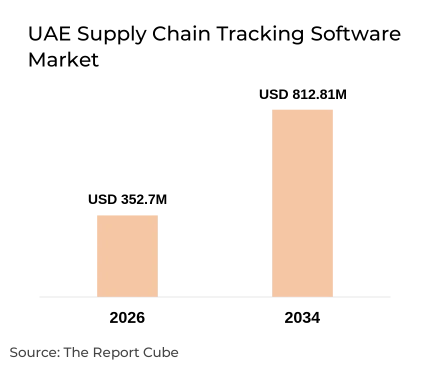
- Market valued at USD 352.7 million in 2026.
- Market projected to reach USD 812.81 million by 2034.
- Industry expected to expand at 11.00% CAGR through 2034.
- Blue Yonder, Savoye, and DoFort Technologies lead vendor competition.
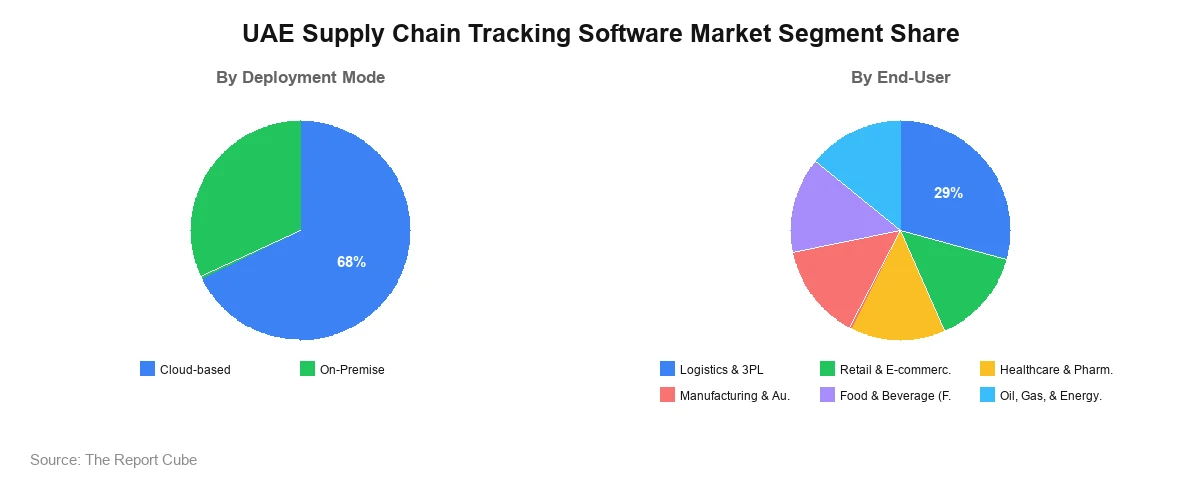
- Cloud-based deployment dominates, holding roughly 68% of total demand.
- Dubai Emirate leads regional revenue with strong logistics infrastructure.
- Abu Dhabi Emirate is the fastest-growing regional market.
- Real-time visibility and IoT integration are reshaping tracking adoption.
UAE Supply Chain Tracking Software Market Insights & Analysis
The UAE Supply Chain Tracking Software Market is anticipated to register a 11.00% CAGR during 2026–2034. The market size was valued at USD 352.7 million in 2026 and is projected to reach USD 812.81 million by 2034. Demand is anchored in the country's role as a transshipment hub, where Jebel Ali Port alone handled roughly 15.5 million TEUs in 2024. Shippers now need shipment-level visibility across ports, free zones, and last-mile networks, not just container status. This shift favors integrated logistics software platforms across carriers.
Public policy is reinforcing adoption. Operation 300bn targets lifting industrial GDP contribution to AED 300 billion by 2031, pushing manufacturers toward digital traceability. Dubai's D33 agenda and Abu Dhabi's industrial and port investments add pressure on logistics operators to modernize. Meanwhile, the Ministry of Health and Prevention's Tatmeen drug-tracking system has made serialization a compliance requirement for pharmaceutical supply chains. Private capital is following, with 3PLs and online retailers funding e-commerce fulfillment and last-mile tracking networks to meet delivery-window expectations.
UAE Supply Chain Tracking Software Market Dynamics
Demand for tracking software is rising as UAE shippers shift from periodic status checks to continuous, event-driven visibility. Transshipment volumes, cold-chain mandates, and fast-growing online retail are widening what must be tracked, from containers to individual parcels. Vendors that connect port community systems, telematics, and warehouse data are gaining share. Regulatory digitization across customs and healthcare further supports multi-year contracts, though buyers remain selective about integration depth.
|
Factor |
Type |
Specific Impact on Market |
Magnitude |
|---|---|---|---|
|
Rising transshipment volumes |
Driver |
Increases demand for port-to-door shipment visibility |
Very High |
|
Cold chain compliance needs |
Driver |
Drives temperature-linked tracking in pharma and food |
High |
|
E-commerce delivery expectations |
Opportunity |
Expands last-mile and parcel tracking adoption |
High |
|
Fragmented partner systems |
Challenge |
Slows integration and limits end-to-end visibility |
Medium |
|
AI-enabled predictive tracking |
Trend |
Improves ETA accuracy and exception management |
Very High |
Key Market Driver: Rising Transshipment Volumes Demand Visibility
The UAE re-exports a large share of the goods it imports, which makes container-level and shipment-level visibility a commercial necessity. Jebel Ali, Khalifa Port, and free-zone operators coordinate thousands of daily movements across vessels, trucks, and bonded warehouses. Tracking platforms with port community system integration reduce dwell-time uncertainty and customs delays. Growth is also reinforced by regional supply chain management software adoption among multinational shippers that standardize one visibility layer across Gulf operations. As a result, enterprises are replacing spreadsheet-based tracking with API-driven platforms.
Major Industry Challenge: Fragmented Multi-Party Data Integration Hurdles
A single UAE shipment can pass through a shipper, forwarder, port operator, customs authority, trucker, and warehouse, each running different systems. Inconsistent data formats and limited API availability among smaller carriers create blind spots that tracking software cannot fully close. Mixed legacy ERP and warehouse environments further slow rollouts, particularly in family-owned trading groups. Added to this are serialization and track-and-trace compliance requirements that vary by sector, forcing vendors to maintain multiple data models and regulatory connectors per customer.
Emerging Trend Shaping Outlook: IoT-Linked Cold Chain Visibility Expands
Extreme summer temperatures make temperature excursions a routine risk for pharmaceuticals and perishable food imports. Operators are therefore linking sensor data from reefers, trailers, and warehouses directly into tracking dashboards with automated alerts. Platforms that combine location, temperature, and door-open events help shippers document product integrity for regulators and insurers. Interest is also growing in blockchain-backed shipment provenance records for high-value cargo, while control-tower dashboards consolidate alerts from multiple carriers into one operational view.
Need Specific Data, Let’s Customize the Report for You
Request CustomizationUAE Supply Chain Tracking Software Market Segment-wise Analysis
UAE enterprises are choosing tracking software based on deployment flexibility and industry-specific compliance needs. Cloud platforms support multi-site visibility across free zones, ports, and warehouses, while on-premise systems remain relevant where data sovereignty or legacy integration is critical. End-user demand spans logistics, retail, healthcare, manufacturing, food, and energy.
By Deployment Mode
- Cloud-based
- On-Premise
Cloud-based deployment dominates the segment with an estimated 68% market share, supported by faster rollouts, subscription pricing, and easy integration with carrier and port APIs. Logistics providers and e-commerce operators favor cloud platforms because they scale during seasonal peaks and provide mobile access for drivers and warehouse staff. Vendors such as Blue Yonder have also expanded AI agents and network-based visibility on cloud foundations, which strengthens the appeal for multinational shippers requiring a single operational view of orders, inventory, and shipments.
On-premise deployment holds the remaining 32% share and remains relevant for oil, gas, and energy firms, government-linked entities, and manufacturers with strict data residency policies. Many buyers are moving toward hybrid models that keep sensitive operational data local while using cloud analytics for visibility. Cloud-based solutions are expected to remain the fastest-growing sub-segment through 2034, helped by open APIs, lower IT maintenance burden, and growing use of warehouse management system integrations for tracking.
By End-User
- Logistics & 3PL
- Retail & E-commerce
- Healthcare & Pharmaceuticals
- Manufacturing & Automotive
- Food & Beverage (F&B)
- Oil, Gas, & Energy
Logistics and 3PL leads the end-user segment with an estimated 29% market share, driven by the UAE's role as a regional distribution hub. Third-party providers manage multi-client inventory and cross-border freight, which requires shipment-level tracking, proof of delivery, and customer-facing status updates. Retail and e-commerce follows at 22%, as online retailers invest in last-mile visibility and delivery-window notifications. Together, these two groups account for just over half of segment revenue, anchoring vendor roadmaps around transport management, warehouse execution, and order tracking features.
Healthcare and pharmaceuticals holds about 15% share, supported by serialization and temperature-monitoring needs under national drug-tracking requirements. Manufacturing and automotive contributes 14%, aided by industrial diversification goals, while food and beverage accounts for 11% on the back of perishable import tracking. Oil, gas, and energy holds 9%, focused on asset and materials logistics. Healthcare is projected to grow fastest, while cold chain monitoring for perishable goods lifts demand across pharmaceutical and food shippers. Adoption is driven by compliance, audit readiness, and the need to reduce spoilage and stockouts.
Region Insights of UAE Supply Chain Tracking Software Market
Market activity varies across the four emirates based on port access, industrial zones, and population density. Dubai leads on trade volumes and logistics concentration, Abu Dhabi on industrial investment, and Sharjah and the Northern Emirates on warehousing capacity. Adoption of free zone and port logistics operations in Dubai continues to shape vendor demand.
|
Region |
Estimated Market Share |
Key Growth Factors |
Consumer Trends |
|---|---|---|---|
|
Dubai Emirate |
41.6% |
Jebel Ali, Dubai South, dense 3PL and e-commerce activity |
High demand for real-time, customs-integrated tracking |
|
Abu Dhabi Emirate |
33.8% |
Khalifa Port, KEZAD, energy and manufacturing logistics |
Rising adoption of asset and materials tracking |
|
Sharjah Emirate |
13.4% |
Warehousing clusters, airport free zone, trading companies |
Growing preference for scalable cloud platforms |
|
Northern Emirates |
11.2% |
New port, manufacturing, and storage capacity |
Early-stage fleet and shipment visibility adoption |
- Dubai Emirate: Dubai leads with approximately 41.6% share, supported by Jebel Ali, Dubai South, and dense 3PL and e-commerce activity requiring real-time shipment tracking and customs-integrated visibility.
- Abu Dhabi Emirate: Abu Dhabi is the fastest-growing emirate, driven by Khalifa Port, KEZAD industrial zones, and energy and manufacturing logistics requiring asset, materials, and inventory tracking.
- Sharjah Emirate: Sharjah benefits from warehousing clusters, trading companies, and airport free zone activity, with growing demand for scalable cloud tracking among mid-sized distributors and retailers.
- Northern Emirates: Ajman, Ras Al Khaimah, Fujairah, and Umm Al Quwain are adding port, manufacturing, and storage capacity, creating early-stage demand for shipment visibility and fleet tracking tools.
UAE Supply Chain Tracking Software Market: Recent Development (2025)
- Blue Yonder launched five new AI agents in early 2025 to accelerate supply chain decision-making.
- Blue Yonder won Microsoft's Global ISV Partner of the Year 2025 for supply chain AI.
- Savoye showcased WMS, OMS, TMS, robotics and automation solutions at Abu Dhabi's IntraLogisteX MEA 2025.
- Savoye supplied its Logys WMS to Maurel Distribution in March 2025 for smoother logistics operations.
UAE Supply Chain Tracking Software Market Future Outlook (2034)
The UAE Supply Chain Tracking Software Market is expected to expand at an 11.00% CAGR, reaching USD 812.81 million by 2034, more than double its 2026 value. Growth opportunities will come from healthcare serialization, food import monitoring, e-commerce fulfillment, and industrial diversification under national manufacturing targets. Etihad Rail's freight network and expanding free zones will add new tracking touchpoints, while exporters seek visibility that extends into Saudi supply chain tracking software demand across Gulf corridors.
AI will move tracking from passive reporting to predictive orchestration. Platforms are adding AI agents that forecast delays, recommend rerouting, and flag temperature or customs exceptions before they escalate. Knowledge-graph models will connect planning and execution data, improving ETA accuracy. Long-term expansion will also depend on GCC warehouse automation investment trends, as robotics and automated storage generate richer real-time data. Vendors offering open APIs, localized compliance modules, and Arabic-language interfaces are likely to hold the strongest position.
UAE Supply Chain Tracking Software Market Report Coverage
|
Report Attribute |
Details |
|---|---|
|
Market Name |
UAE Supply Chain Tracking Software Market |
|
Market Size (2026) |
USD 352.7 Million |
|
Market Size (2034) |
USD 812.81 Million |
|
Forecast Period |
2026–2034 |
|
CAGR |
11.00% |
|
Base Year |
2026 |
|
Historical Years |
2021–2025 |
|
Forecast Years |
2026–2034 |
|
Segments Covered |
By Component, By Application, By Deployment Mode, By End-User |
|
Regions Covered |
Abu Dhabi Emirate, Dubai Emirate, Sharjah Emirate, Northern Emirates |
|
Key Companies |
Blue Yonder, Savoye, DoFort Technologies, Logi-Sys, Bluesky Technologies, Canrone Software, Others |
|
Report Format |
PDF, Excel, PPT |
|
Customization |
Available as per client requirements |
Why Choose This Report?
- Comprehensive analysis of UAE tracking software demand across industries.
- Accurate market sizing with forecasts extending through 2034.
- Detailed segmentation by deployment mode and six end-users.
- Emirate-level insights covering Abu Dhabi, Dubai, Sharjah, and Northern Emirates.
- Competitive profiling of leading global and regional software vendors.
- Analysis of cold chain, IoT, and AI-driven visibility trends.
- Strategic insights supporting investment, partnership, and market-entry decisions.
- Data-driven research aligned with current UAE regulatory and trade developments.
Table of Contents
- Introduction
- Objective of the Study
- Product Definition
- Market Segmentation
- Study Variables
- Research Methodology
- Secondary Data Points
- Companies Interviewed
- Primary Data Points
- Breakdown of Primary Interviews
- Secondary Data Points
- Executive Summary
- Market Dynamics
- Drivers
- Challenges
- Opportunity Assessment
- Recent Trends and Developments
- Policy and Regulatory Landscape
- UAE Supply Chain Tracking Software Market Overview and Forecast Analysis (2021-2034)
- Market Size, By Value, By Growth Rate (CAGR/USD Millions)
- Demand – Supply Trends
- Market Share, By Component
- Software Platforms
- Professional Services
- Market Share, By Application
- Transportation Management Systems
- Warehouse Management Systems
- Supply Chain Visibility & Analytics
- Cold Chain Tracking
- Market Share, By Deployment Mode
- Cloud-based
- On-Premise
- Market Share, By End-User
- Logistics & 3PL
- Retail & E-commerce
- Healthcare & Pharmaceuticals
- Manufacturing & Automotive
- Food & Beverage (F&B)
- Oil, Gas, & Energy
- Market Share, By Region
- Abu Dhabi Emirate
- Dubai Emirate
- Sharjah Emirate
- Northern Emirates
- Market Share, By Competitors
- Competition Characteristics
- Revenue Shares
- Software Platforms UAE Supply Chain Tracking Software Market Overview, 2021-2034F
- By Value (USD Million)
- By Application – Market Size & Forecast 2021-2034, USD Million
- Transportation Management Systems
- Warehouse Management Systems
- Supply Chain Visibility & Analytics
- Cold Chain Tracking
- Professional Services UAE Supply Chain Tracking Software Market Overview, 2021-2034F
- By Value (USD Million)
- By Application – Market Size & Forecast 2021-2034, USD Million
- Transportation Management Systems
- Warehouse Management Systems
- Supply Chain Visibility & Analytics
- Cold Chain Tracking
- Competitive Outlook (Company Profile - Partial List)
- Blue Yonder
- Company Overview
- Business Segments
- Strategic Alliances/Partnerships
- Recent Developments
- Savoye
- Company Overview
- Business Segments
- Strategic Alliances/Partnerships
- Recent Developments
- DoFort Technologies
- Company Overview
- Business Segments
- Strategic Alliances/Partnerships
- Recent Developments
- Logi-Sys
- Company Overview
- Business Segments
- Strategic Alliances/Partnerships
- Recent Developments
- Bluesky Technologies
- Company Overview
- Business Segments
- Strategic Alliances/Partnerships
- Recent Developments
- Canrone Software
- Company Overview
- Business Segments
- Strategic Alliances/Partnerships
- Recent Developments
- Others
- Blue Yonder
- Contact Us & Disclaimer
Top Key Players & Market Share Outlook
- Blue Yonder
- Savoye
- DoFort Technologies
- Logi-Sys
- Bluesky Technologies
- Canrone Software
- Others
Frequently Asked Questions






