




Build Your Custom Market Intelligence Report
Customize Your ReportIndia Truck & Bus Air Conditioner Market Key Highlights
By Vehicle Type:
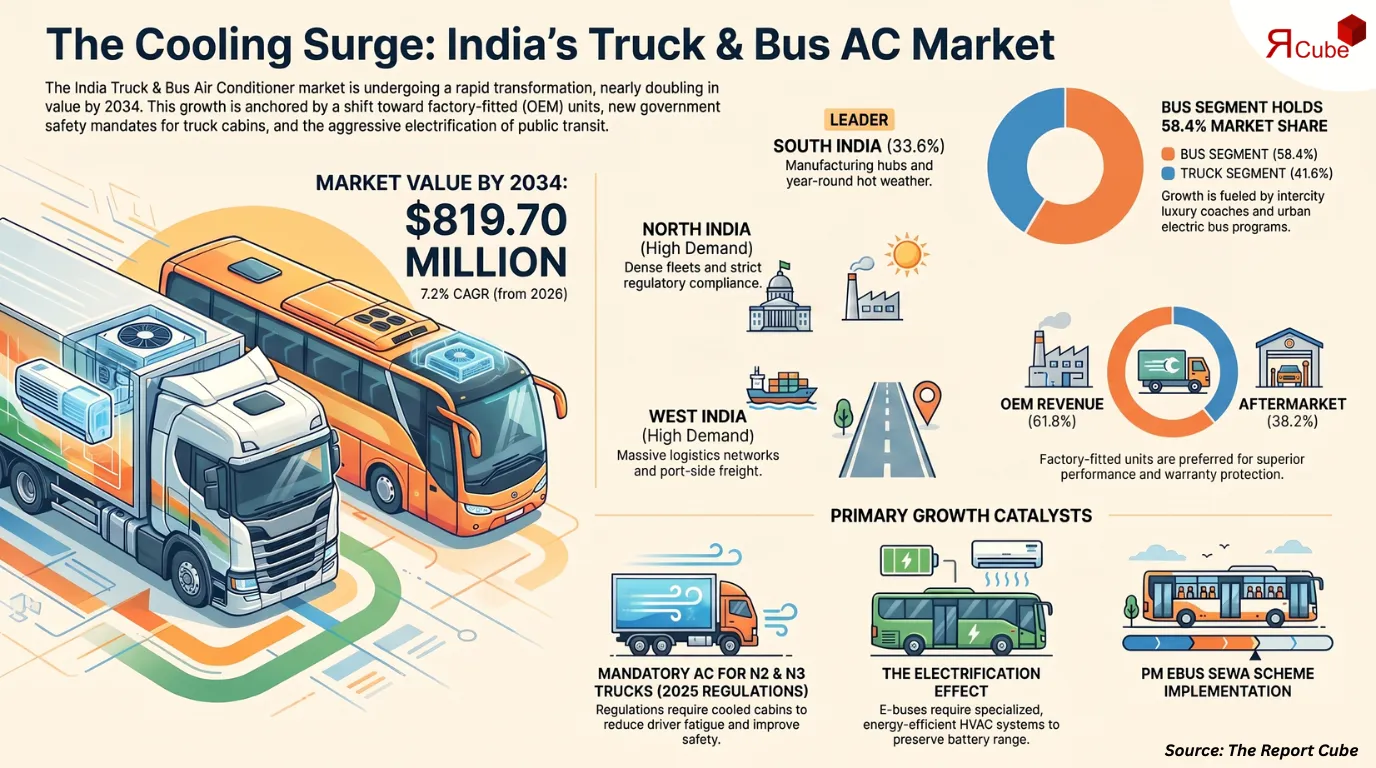
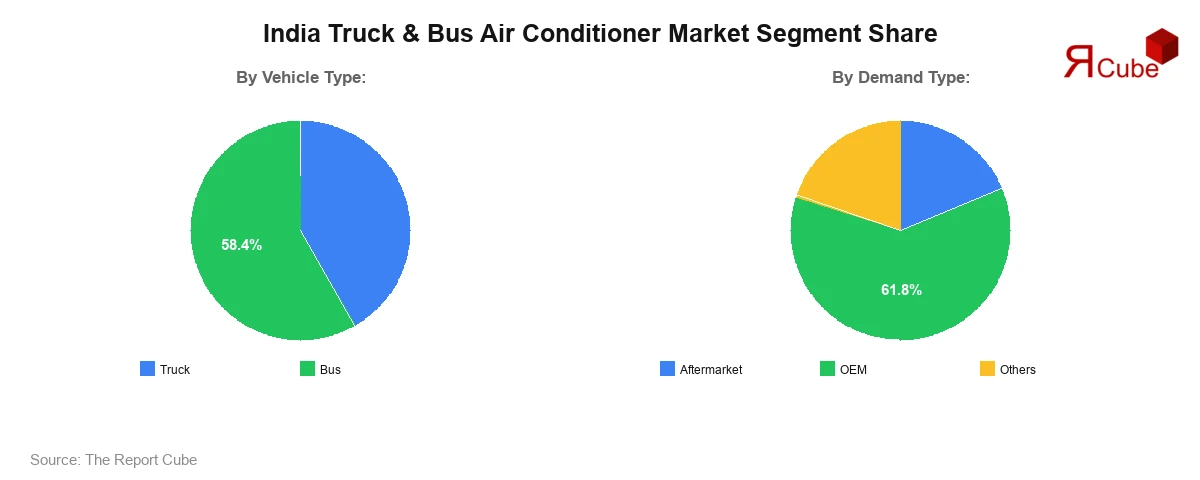
Bus segment leads the market with nearly 58.4% share.
By Demand Type:
OEM segment dominates the market with around 61.8% of total revenue.
Regional Outlook:
South India dominates the India Truck & Bus Air Conditioner Market with approximately 33.6% share.
India Truck & Bus Air Conditioner Market Insights & Analysis
The India Truck & Bus Air Conditioner Market is anticipated to register a CAGR of around 7.2% during the forecast period 2026-2034. The market size is valued at USD 470 million in 2026 and is projected to reach USD 819.70 million by 2034. Market growth is being fueled by rising demand for driver comfort, increasing penetration of premium buses, and continuous modernization of commercial transportation. Government regulations encouraging factory-fitted air-conditioned truck cabins, along with the rapid expansion of electric and hybrid buses, are creating favorable conditions for HVAC manufacturers. Commercial fleet operators are also investing in efficient transport climate control systems to improve driver productivity, reduce fatigue, and enhance passenger experience during long-distance operations. These developments continue to strengthen the overall India truck and bus air conditioner market size, demand, and future growth prospects.
Leading manufacturers are investing in energy-efficient compressors, lightweight HVAC modules, and intelligent climate control technologies to improve operational efficiency while lowering power consumption. Several OEMs are expanding their partnerships with domestic and global HVAC suppliers to integrate advanced cooling solutions into new commercial vehicle platforms. Rising investments in electric buses under urban mobility programs are further encouraging the adoption of battery-efficient air conditioning technologies that minimize energy loss while maintaining passenger comfort. Digital monitoring, predictive maintenance capabilities, and environmentally friendly refrigerants are also becoming integral to new product development strategies. These innovations are expected to improve system reliability, reduce lifecycle costs, and support the long-term expansion of the India truck and bus air conditioner market share across both OEM and aftermarket channels.
India Truck & Bus Air Conditioner Market Impact Analysis
| Factor | Type | Specific Impact on Market | Magnitude | Business Implication |
|---|---|---|---|---|
| Mandatory AC in N2/N3 Trucks | Regulatory | Rules require factory and retrofit AC fitment in truck cabins | High | Drives large retrofit demand and OEM integration volumes |
| Growth of Electric Buses & Trucks | Technological | E-bus and e-truck sales need efficient thermal and AC systems | High | Creates demand for integrated HVAC and BTMS solutions |
| Road Infrastructure Expansion | Market | New highways increase long haul routes needing cooled cabins | Medium | Supports higher AC penetration in freight and coach fleets |
| Passenger Comfort Expectations | Consumer | Riders prefer air conditioned buses for intercity and school use | High | Pushes operators to upgrade fleets with reliable bus AC units |
| High Upfront System Cost | Market | Initial AC price slows adoption for cost sensitive operators | Medium | Necessitates flexible pricing and financing for small fleets |
| Localized Production & Supply | Competitive | Local manufacturing lowers cost and improves service response | Medium | Enables price competitiveness and faster OEM partnerships |
| Geopolitical & Trade Volatility | Environmental | Global tensions risk component price spikes and shortages | Medium | Requires diversified sourcing and inventory risk buffers |
India Truck & Bus Air Conditioner Market Dynamics
Key Driver: Regulatory Push and Fleet Modernization Accelerating HVAC Adoption
Government regulations promoting safer working conditions for commercial vehicle drivers have substantially increased the adoption of factory-installed air conditioning systems across India's truck industry. The mandatory introduction of air-conditioned cabins for newly manufactured N2 and N3 category trucks has encouraged vehicle manufacturers to integrate advanced HVAC solutions as standard equipment. This regulatory change addresses driver fatigue caused by prolonged exposure to high cabin temperatures, particularly during long-haul freight operations in regions experiencing extreme summer conditions. Fleet operators are also recognizing measurable operational benefits, including improved driver retention, enhanced productivity, and reduced downtime associated with heat-related fatigue, making cabin cooling systems an increasingly valuable investment.
Commercial vehicle manufacturers are responding by expanding their range of integrated climate control systems designed to deliver higher cooling performance with lower energy consumption. Demand for Air Conditioner (AC) in Indian Truck & Bus platforms is further supported by increasing production of premium buses, luxury coaches, employee transportation vehicles, and long-distance logistics fleets where comfort has become an important purchasing criterion. Growing infrastructure development, rising freight movement, and continuous expansion of organized logistics companies are expected to sustain demand for commercial vehicle HVAC systems throughout the forecast period, strengthening the overall India Truck & Bus Air Conditioner Market size and growth trajectory.
Industry Trends: Electrification Reshaping Commercial Vehicle Climate Control Technologies
Rapid electrification of India's commercial transportation sector is driving significant innovation across truck and bus air conditioning technologies. Electric buses require HVAC systems that provide effective cooling while minimizing battery energy consumption, encouraging manufacturers to develop highly efficient electric compressors, intelligent thermal management systems, and lightweight cooling modules. Several OEMs are incorporating electronically controlled compressors and smart airflow management technologies that automatically adjust cooling output according to passenger load and ambient weather conditions. These innovations improve vehicle operating efficiency while supporting longer driving ranges for battery-powered commercial vehicles.
Product development is also shifting toward environmentally responsible solutions that comply with evolving emission and sustainability objectives. Manufacturers are increasingly adopting refrigerants with lower environmental impact, corrosion-resistant heat exchangers, compact modular HVAC architectures, and connected diagnostic platforms capable of monitoring system performance in real time. Fleet operators benefit from predictive maintenance alerts that reduce unexpected equipment failures and optimize service schedules. As electrified commercial mobility expands across urban transportation networks, these technological advancements will continue to influence product differentiation and strengthen demand within the India Truck & Bus Air Conditioner Market.
Book your FREE 30-minute expert consultation today
Contact UsMajor Challenge: Cost Sensitivity and Service Infrastructure Constraints
Although air-conditioned commercial vehicles are gaining wider acceptance, higher acquisition costs remain a significant challenge for many transport operators, particularly small fleet owners and independent truck businesses. Advanced HVAC systems incorporate sophisticated compressors, electronic controllers, sensors, and thermal management components that increase vehicle manufacturing costs compared with conventional cabin ventilation systems. Since purchasing decisions within the freight transportation sector are highly influenced by total ownership costs, some operators continue delaying investments in premium air conditioning technologies, especially for vehicles operating in short-haul applications.
Maintenance capability presents another important industry challenge. Commercial vehicles frequently operate across remote highways and industrial corridors where access to certified HVAC service centers and trained technicians remains limited. Delays in servicing or improper maintenance can reduce cooling efficiency, increase operating expenses, and shorten equipment lifespan. Electric commercial vehicles introduce additional servicing requirements because technicians must handle high-voltage thermal management systems using specialized equipment. Strengthening nationwide service networks and improving technical workforce training will remain essential to supporting long-term expansion of the India Truck & Bus Air Conditioner Market.
Opportunity: Rising Investment in Electric Mobility and Premium Passenger Transportation
Growing investment in electric commercial mobility presents a substantial opportunity for manufacturers of truck and bus air conditioning systems. Central and state governments continue expanding electric public transportation through large-scale procurement programs, resulting in rising production of battery-electric buses equipped with advanced climate control technologies. Every new electric bus requires HVAC systems specifically engineered to deliver high cooling performance while preserving battery efficiency, creating long-term opportunities for suppliers specializing in energy-efficient thermal management solutions.
Additional growth opportunities are emerging from premium intercity coaches, airport shuttle fleets, tourism operators, corporate employee transportation, and refrigerated logistics vehicles where passenger comfort and driver well-being directly influence service quality. Commercial fleet operators are increasingly prioritizing durable, intelligent, and low-maintenance cooling systems that improve vehicle reliability and reduce lifecycle operating expenses. Manufacturers investing in localized production, advanced compressor technologies, integrated HVAC modules, and environmentally sustainable refrigerants are well positioned to capitalize on the expanding demand for Air Conditioner (AC) in Indian Truck & Bus applications over the coming decade.
India Truck & Bus Air Conditioner Market Segment-wise Analysis
By Vehicle Type:
- Truck
- Bus
The Bus segment accounted for nearly 58.4% of the India Truck & Bus Air Conditioner Market in 2026, making it the leading vehicle category. Demand is supported by the steady expansion of air-conditioned city buses, intercity coaches, school buses, airport shuttles, and employee transportation fleets. Public transport agencies are increasingly procuring fully air-conditioned electric and CNG buses to improve passenger comfort while meeting sustainability goals. The expansion of organized tourism and premium travel services has also encouraged fleet operators to upgrade conventional buses with high-performance HVAC systems that ensure consistent cooling under India's diverse climatic conditions.
OEMs are responding by integrating lightweight roof-mounted air conditioning units, energy-efficient compressors, and intelligent climate control technologies that enhance passenger comfort while lowering operating costs. Modern bus HVAC systems are designed to maintain uniform cabin temperatures even under heavy passenger loads, improving overall travel quality and fleet reliability. Increasing investments in smart mobility, urban transportation infrastructure, and electric bus manufacturing continue to strengthen demand for advanced Air Conditioner (AC) in Indian Truck & Bus applications. With government-backed public transport modernization and rising expectations for premium travel experiences, the bus segment is expected to retain its leadership throughout the forecast period.
By Demand Type:
- Aftermarket
- OEM
- Others
The OEM segment dominated the India Truck & Bus Air Conditioner Market with approximately 61.8% of total revenue in 2026. Commercial vehicle manufacturers are increasingly installing factory-fitted HVAC systems as standard equipment, driven by regulatory requirements, customer expectations, and continuous improvements in vehicle design. Integrated OEM air conditioning systems offer superior performance, optimized cooling efficiency, and seamless compatibility with vehicle electrical architecture compared to retrofit installations. Growing production of premium trucks, luxury buses, electric buses, and long-haul commercial vehicles continues to strengthen OEM demand across India's automotive sector.
Vehicle manufacturers are also collaborating with specialized HVAC suppliers to develop customized thermal management solutions that improve durability, reduce maintenance requirements, and enhance energy efficiency. The mandatory implementation of air-conditioned cabins in medium and heavy-duty trucks has further accelerated factory-level installation of advanced climate control systems. OEM-installed solutions also provide warranty protection, improved lifecycle performance, and easier diagnostics, making them the preferred choice for commercial fleet operators. As domestic vehicle production expands and electrified commercial mobility gains momentum, the OEM segment is expected to remain the largest contributor to the India Truck & Bus Air Conditioner Market during the forecast period.
Regional Projection of India Truck & Bus Air Conditioner Industry
- North India
- South India
- West India
- East India
- Central India
South India held the leading position in the India Truck & Bus Air Conditioner Market with an estimated 33.6% revenue share in 2026. The region serves as one of India's largest automotive manufacturing hubs, supported by well-established commercial vehicle production facilities, component suppliers, and HVAC manufacturing units across Tamil Nadu, Karnataka, Telangana, and Andhra Pradesh. The presence of major bus manufacturers and automotive OEMs has created a strong ecosystem for advanced transport climate control systems. Warm weather conditions prevailing throughout much of the year further encourage the adoption of efficient air conditioning systems across trucks, buses, and other commercial transportation fleets.
South India is also witnessing rapid deployment of electric buses under state transport modernization programs, creating sustained demand for energy-efficient HVAC technologies that maximize passenger comfort without significantly affecting battery performance. Expanding industrial corridors, logistics parks, ports, and freight transportation activities continue to increase the utilization of commercial vehicles equipped with advanced cabin cooling systems. In addition, regional investments in automotive research, localized component manufacturing, and export-oriented production have strengthened the supply chain for commercial vehicle HVAC solutions. These combined factors are expected to help South India maintain its leadership in the India Truck & Bus Air Conditioner Market throughout the 2026-2034 forecast period.
Need insights for a specific region within this market?
Request Regional DataIndia Truck & Bus Air Conditioner Market Regional Analysis
India’s truck & bus AC market differs by climate, fleet mix, and route density.
| Region | Demand Level | Key Areas | System Dominance | Core Demand Logic | Growth Nature |
|---|---|---|---|---|---|
| North India | High | Delhi NCR, Punjab, Haryana, UP | Bus AC, truck cabin AC, HVAC | Dense fleets, heat, compliance push | Retrofit-led, policy-backed growth |
| South India | Very High | Chennai, Bengaluru, Hyderabad | Bus AC, VRF, advanced cabin AC | Hot weather, intercity mobility, premium fleets | Fastest growth, premiumization |
| West India | High | Mumbai, Pune, Ahmedabad, Surat | Bus AC, cabin AC, compact HVAC | Ports, logistics, urban bus networks | Commercial fleet expansion |
| East India | Medium | Kolkata, Patna, Bhubaneswar | Bus AC, basic cabin AC | Price focus, mixed road conditions | Gradual fleet upgrade cycle |
| Central India | Medium | Bhopal, Indore, Nagpur, Raipur | Cabin AC, bus AC | Freight corridors, long-haul routes | Steady growth from logistics |
Government Initiatives & Policies
- Mandatory Air-Conditioned Truck Cabins (2025): The Ministry of Road Transport and Highways implemented mandatory air-conditioned cabins for newly manufactured N2 and N3 category trucks to improve driver comfort, road safety, and working conditions.
- PM eBus Sewa Scheme: The Government of India continues expanding electric public transport under the PM eBus Sewa initiative, encouraging deployment of thousands of electric buses equipped with energy-efficient HVAC systems across major cities.
India Truck & Bus Air Conditioner Industry Recent Developments
- 2026: Subros Limited secured a USD 150 million electric compressor contract from Maruti Suzuki for hybrid and electrified vehicle platforms. The company is expanding its portfolio of electric compressors and integrated HVAC modules through its long-standing technical collaboration with DENSO. The development aligns with the increasing adoption of truck cabin air conditioning following the mandatory air-conditioned cabin requirement for N2 and N3 commercial vehicles. This investment is expected to strengthen Subros' presence in OEM commercial vehicle HVAC solutions while supporting advanced thermal management technologies for trucks and buses across India.
- 2025: DENSO Kirloskar Industries Pvt. Ltd. strengthened its electrification strategy by advancing the development of high-efficiency electric compressors, HVAC modules, and thermal management systems for hybrid and electric commercial vehicles. The company continued aligning its India operations with leading OEM electrification programs to meet growing demand for energy-efficient transport climate control solutions. This initiative is expected to accelerate the deployment of advanced bus HVAC systems and next-generation truck cabin cooling technologies while enhancing DENSO's position in India's premium commercial vehicle air conditioning market.
Why Choose This Report?
- Provides a comprehensive overview of the overall market analysis, encompassing key trends, consumer behavior analysis, and risk assessment to support strategic decision-making.
- Provides accurate, up-to-date insights into market size, segmentation, and emerging opportunities, helping organizations minimize business risk while capitalizing on future growth opportunities.
- Gives a deep understanding of target audience preferences, fleet purchasing patterns, investment trends, and commercial transportation requirements for enhanced product development and marketing effectiveness.
- Delivers competitive analysis and benchmarking, uncovering the strengths, strategies, and market positioning of leading truck and bus air conditioner manufacturers operating across India.
- Consolidates comprehensive market intelligence into a single report, reducing research time and streamlining strategic planning for stakeholders.
- Facilitates customized market segmentation and risk mitigation strategies that align with evolving business objectives and investment priorities.
- Helps identify key market challenges, emerging opportunities, technological innovations, and long-term revenue prospects across India's commercial vehicle HVAC industry.
- Provides valuable insights based on industry trends, customer demand patterns, technological advancements, and evolving regulatory developments.
Table of Contents
- Introduction
- Objective of the Study
- Product and Category Definition
- Market Segmentation
- Study Variables
- Research Methodology
- Secondary Data Points
- Breakdown of Secondary Sources
- Primary Data Points
- Breakdown of Primary Interviews
- Secondary Data Points
- Executive Summary
- Market Dynamics
- Emerging Opportunities
- Adoption Trends
- Demand Drivers
- Disruption Analysis (Challenges)
- Industry Analysis and Strategic Insights
- Supply and Value Chain Analysis
- Pricing Analysis
- Go-to-Market Strategy
- BCG Matrix
- Recent Trends and Developments
- Import and Export Analysis
- Regulatory and Policy Landscape
- Region-wise Policies
- Government Initiatives
- India Truck and Bus Air Conditioner Market Overview and Forecast Analysis (2021-2034)
- Market Size, By Value, By Growth Rate (CAGR/USD Million)
- Market Share, By Vehicle Type
- Truck
- Bus
- Market Share, By Product Type
- Back Wall AC
- Roof-Mounted AC
- Others
- Market Share, By Demand Type
- Aftermarket
- OEM
- Others
- Market Share, By Cooling Capacity
- Below 10 kW
- 10.1-20 kW
- 20.1-35 kW
- 35 kW and Above
- Market Share, By Region
- North
- South
- West
- East
- Central
- Market Share, By Company
- Revenue Shares and Analysis
- Competitive Landscape
- North India Truck and Bus Air Conditioner Market Overview and Forecast Analysis (2021-2034)
- Market Size, By Value, By Growth Rate (CAGR/USD Million)
- Market Share, By Vehicle Type
- Market Share, By Product Type
- Market Share, By Demand Type
- Market Share, By Cooling Capacity
- South India Truck and Bus Air Conditioner Market Overview and Forecast Analysis (2021-2034)
- Market Size, By Value, By Growth Rate (CAGR/USD Million)
- Market Share, By Vehicle Type
- Market Share, By Product Type
- Market Share, By Demand Type
- Market Share, By Cooling Capacity
- West India Truck and Bus Air Conditioner Market Overview and Forecast Analysis (2021-2034)
- Market Size, By Value, By Growth Rate (CAGR/USD Million)
- Market Share, By Vehicle Type
- Market Share, By Product Type
- Market Share, By Demand Type
- Market Share, By Cooling Capacity
- East India Truck and Bus Air Conditioner Market Overview and Forecast Analysis (2021-2034)
- Market Size, By Value, By Growth Rate (CAGR/USD Million)
- Market Share, By Vehicle Type
- Market Share, By Product Type
- Market Share, By Demand Type
- Market Share, By Cooling Capacity
- Central India Truck and Bus Air Conditioner Market Overview and Forecast Analysis (2021-2034)
- Market Size, By Value, By Growth Rate (CAGR/USD Million)
- Market Share, By Vehicle Type
- Market Share, By Product Type
- Market Share, By Demand Type
- Market Share, By Cooling Capacity
- Competitive Analysis, 2026
- Market Share of Key Players
- Competitive Mapping for Each Segment and Companies Operating Regionally
- North India Truck and Bus Air Conditioner Companies Share and Competitive Analysis, 2026
- South India Truck and Bus Air Conditioner Companies Share and Competitive Analysis, 2026
- West India Truck and Bus Air Conditioner Companies Share and Competitive Analysis, 2026
- East India Truck and Bus Air Conditioner Companies Share and Competitive Analysis, 2026
- Central India Truck and Bus Air Conditioner Companies Share and Competitive Analysis, 2026
- Company Profile (Partial List)
- Thermo King India Pvt. Ltd.
- Company Overview
- Product Portfolio
- Strategic Alliances and Partnerships
- Recent Developments
- Valeo
- Company Overview
- Product Portfolio
- Strategic Alliances and Partnerships
- Recent Developments
- Sphere Thermal Systems Pvt. Ltd.
- Company Overview
- Product Portfolio
- Strategic Alliances and Partnerships
- Recent Developments
- TKT HVAC Co., Ltd.
- Company Overview
- Product Portfolio
- Strategic Alliances and Partnerships
- Recent Developments
- DENSO Kirloskar Industries Pvt. Ltd.
- Company Overview
- Product Portfolio
- Strategic Alliances and Partnerships
- Recent Developments
- SONGZ Automobile Air Conditioning Co., Ltd.
- Company Overview
- Product Portfolio
- Strategic Alliances and Partnerships
- Recent Developments
- Subros Limited
- Company Overview
- Product Portfolio
- Strategic Alliances and Partnerships
- Recent Developments
- Eberspächer Gruppe GmbH and Co. KG
- Company Overview
- Product Portfolio
- Strategic Alliances and Partnerships
- Recent Developments
- Sidwal Refrigeration Industries Pvt. Ltd.
- Company Overview
- Product Portfolio
- Strategic Alliances and Partnerships
- Recent Developments
- Trans ACNR Solutions Pvt. Ltd. (JTAC)
- Company Overview
- Product Portfolio
- Strategic Alliances and Partnerships
- Recent Developments
- Others (Partial List)
- Thermo King India Pvt. Ltd.
- Contact Us and Disclaimer
Top Key Players & Market Share Outlook
- Thermo King India Pvt. Ltd.
- Valeo
- Sphere Thermal Systems Pvt. Ltd.
- TKT HVAC Co., Ltd.
- DENSO Kirloskar Industries Pvt. Ltd.
- SONGZ Automobile Air Conditioning Co., Ltd.
- Subros Limited
- Eberspächer Gruppe GmbH & Co. KG
- Sidwal Refrigeration Industries Pvt. Ltd.
- Trans ACNR Solutions Pvt. Ltd. (JTAC)
- Others
Frequently Asked Questions






