



Build Your Custom Market Intelligence Report
Customize Your ReportUS Waste Management Market Key Takeaways
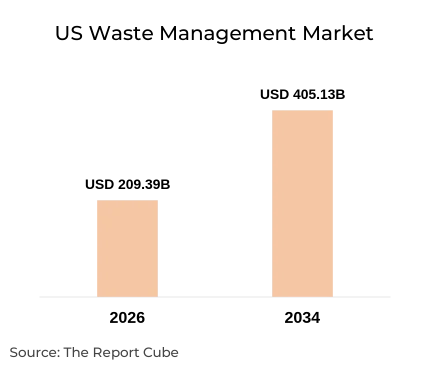
- US Waste Management Market valued at USD 209.39 billion in 2026, driven by rising waste volumes.
- Market projected to reach USD 405.13 billion by 2034, expanding at an 8.60% CAGR.
- Municipal waste dominates the By Type segment owing to rapid urbanization and population growth.
- Collection services lead service-type revenues as urban infrastructure demands continuous waste pickup.
- The US market holds dominant national leadership through mature regulatory frameworks and recycling mandates.
- Recycling and composting services represent the fastest-growing service segment through 2034.
- Leading companies include Waste Management Inc, Republic Services Inc, Clean Harbors Inc, and GFL Environmental.
- Extended producer responsibility mandates and circular economy targets continue accelerating long-term industry investments.
US Waste Management Market Insights & Analysis
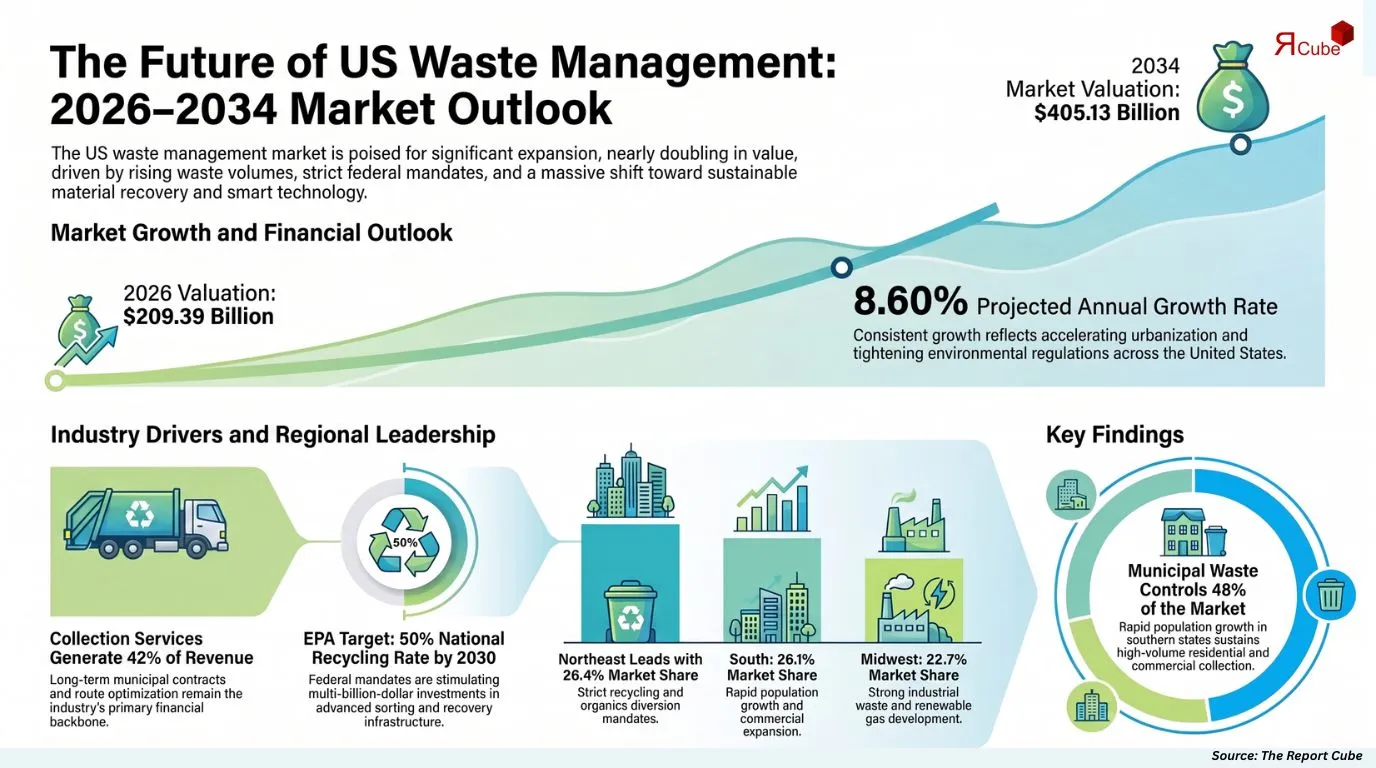
The US Waste Management Market is anticipated to register an 8.60% CAGR during 2026–2034. The market size was valued at USD 209.39 billion in 2026 and is projected to reach USD 405.13 billion by 2034. The industry is benefiting from accelerating urbanization, growing volumes of municipal and industrial waste, tightening federal and state environmental regulations, and increasing corporate investments in sustainable waste infrastructure. The EPA's National Recycling Goal targeting a 50% recycling rate by 2030 continues reinforcing capital deployment across collection, processing, and recovery segments.
Major operators including Waste Management Inc and Republic Services have committed multi-billion-dollar sustainability investment cycles to expand recycling centers, renewable natural gas facilities, and organics processing infrastructure. WM's USD 3 billion sustainability investment program targeting 39 upgraded recycling centers and 20 renewable natural gas plants through 2026 exemplifies the scale of industry commitment. Government programs including the EPA's National Strategy for Reducing Food Loss and Waste, which targets a 50% reduction in food waste by 2030, alongside federal procurement preferences for recycled materials, continue stimulating both public and private sector participation across all waste stream categories.
US Waste Management Market Dynamics
The US Waste Management Market continues expanding as municipalities, industrial operators, healthcare providers, and commercial enterprises generate increasingly diverse and complex waste streams requiring specialized handling, processing, and disposal services. Strengthening federal environmental standards, expanding extended producer responsibility programs, and corporate ESG commitments are collectively elevating waste management from a compliance function to a strategic infrastructure investment priority across the United States.
|
Factor |
Type |
Specific Impact on Market |
Magnitude |
|---|---|---|---|
|
Rising municipal and industrial waste volumes |
Driver |
Accelerates collection and disposal infrastructure expansion nationwide |
Very High |
|
Extended producer responsibility mandates |
Driver |
Boosts recycling, recovery, and material processing investments |
High |
|
EPA recycling and landfill diversion targets |
Driver |
Increases demand for sorting, composting, and recycling services |
High |
|
Waste-to-energy technology adoption |
Opportunity |
Creates new revenue streams from landfill gas and thermal conversion |
High |
|
IoT-enabled route optimization and smart fleet management |
Trend |
Reduces operational costs and improves service delivery efficiency |
High |
Key Market Driver: Regulatory Mandates Accelerating Recycling Infrastructure
Federal and state regulatory frameworks including the Resource Conservation and Recovery Act, new EPA New Source Performance Standards for landfills, and state-level landfill diversion mandates are compelling waste operators to significantly expand recycling, composting, and organic waste processing infrastructure. The EPA's national goal of achieving a 50% recycling rate by 2030, combined with state-level extended producer responsibility legislation requiring manufacturers to fund end-of-life material recovery, is directly stimulating multi-billion-dollar capital investments in advanced sorting facilities, anaerobic digestion plants, and material recovery infrastructure across the United States.
Major Industry Challenge: Landfill Capacity Constraints and Siting Opposition
Many US metropolitan regions are experiencing accelerating landfill capacity depletion, while permitting new disposal sites faces intense community opposition, lengthy environmental reviews, and increasingly restrictive zoning requirements. As existing landfill lifespans shorten, operators must invest substantially in alternative disposal pathways including waste-to-energy conversion, advanced recycling, and organics diversion programs. Waste Management Inc's acquisition of four new facilities in April 2025, including two recycling centers in Texas and Maryland, reflects the industry-wide urgency to build alternative disposal and material recovery capacity ahead of regional capacity shortfalls.
Emerging Trend Shaping Outlook: Smart Waste Technology and Route Intelligence
Waste management companies are integrating IoT-enabled sensors, AI-powered sorting systems, GPS fleet telematics, predictive route optimization algorithms, and computer vision-based waste classification platforms across collection and processing operations. Technologies such as deep-learning-enabled bin segregation systems and AI-powered recycling sorting lines are substantially improving material recovery rates while reducing per-ton processing costs. Waste Connections reported direct benefits from AI-related cost savings and improved recovered commodity pricing during 2026 earnings, signaling that technology integration is now delivering measurable financial returns for early-adopting operators.
Need Specific Data, Let’s Customize the Report for You
Request CustomizationUS Waste Management Market Segment-wise Analysis
The US Waste Management Market spans diverse waste streams and service categories as municipalities, industries, and commercial operators expand outsourced waste handling contracts across collection, processing, and disposal functions. Increasing regulatory requirements and sustainability mandates are driving parallel investment across all major waste types and service segments.
By Type
- Municipal Waste
- Industrial Waste
- Hazardous Waste
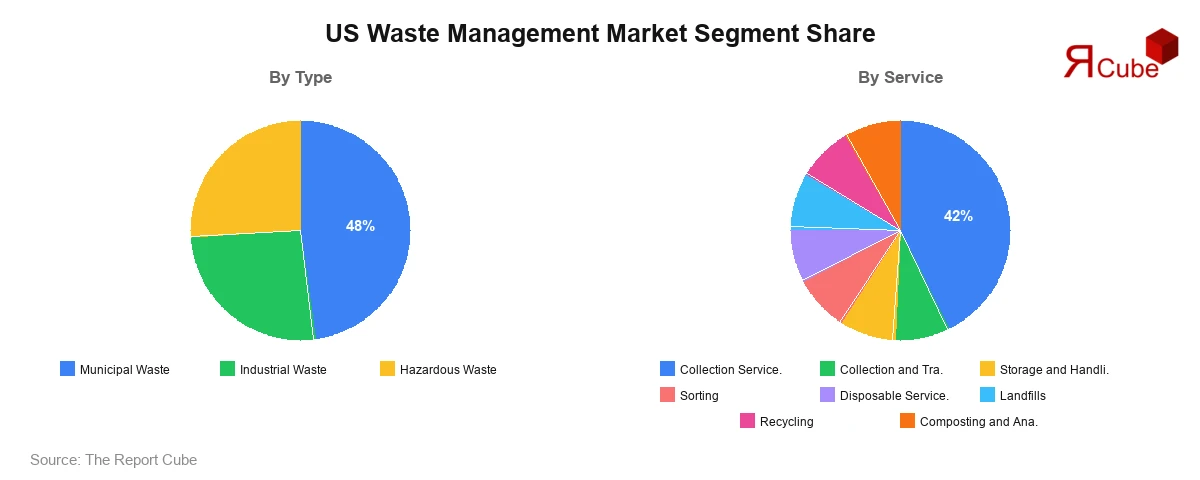
Municipal waste dominates the By Type segment with an estimated 48% share, driven by the United States generating approximately 265 million tons of municipal solid waste annually according to the EPA, reflecting consistent demand from expanding urban and suburban residential populations. Population growth across major metro regions including Texas, Florida, and the Southeast, combined with rising per capita waste generation of approximately 4.9 pounds per person per day, sustains high-volume municipal collection and processing contracts for leading operators such as Waste Management Inc, Republic Services, and Waste Connections Inc.
Industrial waste represents the second-largest revenue segment as manufacturing, energy, and construction sectors generate substantial volumes requiring compliant transport, treatment, and disposal. Hazardous waste is the fastest-growing type segment, expanding at an accelerating pace driven by stricter RCRA compliance enforcement, growing pharmaceutical and chemical manufacturing output, and increasing industrial sector demand for certified treatment and disposal services. Clean Harbors Inc expanded its hazardous waste management capabilities through the August 2025 acquisition of a regional competitor, reflecting strong demand for specialized compliance-driven waste services across industrial end-users.
By Service
- Collection Services
- Collection and Transportation
- Storage and Handling
- Sorting
- Disposable Services
- Landfills
- Recycling
- Composting and Anaerobic Digestion
Collection services represent the dominant service category with approximately 42% market share, underpinned by long-term municipal service contracts covering residential curbside pickup, commercial dumpster servicing, and bulk waste removal across US cities and counties. Collection and transportation infrastructure forms the operational backbone of the waste management value chain, with large national operators leveraging route density optimization and fuel-efficient fleet management to protect margins while serving expanding service territories. Republic Services' targeted USD 1 billion acquisition spending in 2025 focused heavily on building disposal and collection infrastructure density across strategic regional markets.
Recycling represents the fastest-growing service segment, driven by tightening landfill economics, extended producer responsibility regulations, corporate circularity commitments, and technology breakthroughs in hard-to-recycle material recovery. Composting and anaerobic digestion are also expanding rapidly as organic waste diversion mandates take effect across California, New York, Massachusetts, and other progressive states, while federal food waste reduction programs and renewable natural gas incentives make organics processing an increasingly attractive investment. Landfill services, though facing capacity pressures, continue generating stable long-term revenues as the industry's primary disposal backstop pending broader material recovery infrastructure buildout.
Regional Projection of US Waste Management Market
The US Waste Management Market reflects meaningful regional variation in waste volume, regulatory stringency, infrastructure maturity, and service demand concentration, with the Northeast and West Coast states driving regulatory innovation while the South and Midwest contribute high-volume growth.
|
Region |
Estimated Market Share |
Key Growth Factors |
Consumer Trends |
|---|---|---|---|
|
Northeast |
28.4% |
Dense urban populations, strict state recycling mandates, organics diversion laws |
High adoption of composting and anaerobic digestion |
|
South |
26.1% |
Rapid population growth, industrial expansion, suburban sprawl |
Rising collection contract volumes and landfill demand |
|
Midwest |
22.7% |
Strong industrial waste streams, agricultural organics, RNG development |
Increasing investment in landfill-gas-to-energy projects |
|
West |
18.3% |
California circular economy mandates, e-waste regulations, EPR laws |
Fastest growth in recycling and material recovery services |
|
Other States |
4.5% |
Emerging waste infrastructure needs in smaller metropolitan areas |
Growing private hauler consolidation activity |
- Northeast: The Northeast leads the US market with approximately 28.4% share, driven by dense urban populations in New York, New Jersey, Massachusetts, and Connecticut requiring high-frequency collection, and some of the nation's most stringent organics diversion and recycling mandates compelling major infrastructure investment.
- South: The South represents the second-largest revenue region, with Texas, Florida, Georgia, and the Carolinas generating consistently growing waste volumes driven by rapid population growth, accelerating commercial construction activity, and expanding manufacturing and logistics sectors.
- Midwest: The Midwest sustains strong revenues through industrial waste streams from manufacturing hubs, growing agricultural organics processing requirements, and significant landfill-gas-to-energy investment, with WM and Republic Services reporting active facility expansion across Illinois, Ohio, and Michigan.
- West: The West is the fastest-growing regional market as California's aggressive circular economy and extended producer responsibility legislation drives investment in advanced recycling, composting, and material recovery across major cities, with the state targeting 75% waste diversion by 2025 and beyond.
- Other States: Smaller metropolitan markets in Alaska, Hawaii, and Mountain West states represent emerging growth areas where private hauler consolidation and municipal contract expansions are supporting gradual infrastructure buildout and service diversification.
US Waste Management Market: Recent Development (2025)
- Waste Management Inc launched four major facilities including recycling centers in Texas and Maryland in April 2025.
- Republic Services acquired Shamrock Environmental in Q1 2025, expanding hazardous waste disposal infrastructure significantly.
- Clean Harbors Inc expanded hazardous waste management services through strategic acquisition of a regional competitor in August 2025.
- GFL Environmental completed multiple tuck-in acquisitions across Illinois and Oklahoma, securing integrated landfill and hauling assets.
US Waste Management Market Future Outlook (2034)
The US Waste Management Market is projected to expand at a sustained 8.60% CAGR, reaching approximately USD 405.13 billion by 2034, as waste generation volumes, regulatory compliance requirements, and circular economy investment commitments continue intensifying across all sectors. Accelerating adoption of waste-to-energy conversion, renewable natural gas production, advanced material recovery facilities, and smart waste monitoring technologies will reshape the industry's cost structure and revenue mix while enabling operators to monetize waste streams that were previously landfilled at declining margins.
Long-term market expansion will be supported by growing extended producer responsibility programs requiring manufacturers to fund product end-of-life management, expanding federal and state organics diversion mandates, and increasing corporate net-zero commitments driving demand for certified recycling and carbon accounting services. AI-enabled sorting technologies, autonomous collection vehicles, and predictive maintenance platforms will progressively reduce operational costs while expanding service capacity. Operators capable of integrating collection, processing, material recovery, and renewable energy generation into vertically integrated platforms will capture disproportionate long-term revenue growth across the USD 405.13 billion market by 2034.
US Waste Management Market Report Coverage
|
Report Attribute |
Details |
|---|---|
|
Market Name |
US Waste Management Market |
|
Market Size (2026) |
USD 209.39 Billion |
|
Market Size (2034) |
USD 405.13 Billion |
|
Forecast Period |
2026–2034 |
|
CAGR |
8.60% |
|
Base Year |
2026 |
|
Historical Years |
2021–2025 |
|
Forecast Years |
2026–2034 |
|
Segments Covered |
By Type (Municipal Waste, Industrial Waste, Hazardous Waste), By Service (Collection Services, Collection and Transportation, Storage and Handling, Sorting, Disposable Services, Landfills, Recycling, Composting and Anaerobic Digestion) |
|
Regions Covered |
Northeast, South, Midwest, West, Other States |
|
Key Companies |
Waste Management Inc, Republic Services Inc, Veolia North America, Waste Connections Inc, Stericycle Inc, Clean Harbors Inc, GFL Environmental Inc, Advanced Disposal Services Inc, Recology Inc, Others |
|
Report Format |
PDF, Excel, PPT |
|
Customization |
Available as per client requirements |
Why Choose This Report?
- Comprehensive analysis covering all major US waste type and service segments.
- Accurate market sizing with data-backed forecast through 2034 at 8.60% CAGR.
- Detailed segmentation identifying dominant and fastest-growing revenue opportunities.
- Regional insights reflecting state-level regulatory mandates and infrastructure trends.
- Competitive profiling of leading national and regional waste management operators.
- Analysis of recycling, composting, and waste-to-energy technology adoption trends.
- Strategic insights on M&A activity and consolidation trends shaping the industry.
- Data-driven research aligned with EPA frameworks and current circular economy directives.
Table of Contents
- Introduction
- Objective of the study
- Product Definition
- Market Segmentation
- Study Variables
- Research Methodology
- Secondary Data Points
- Companies Interviewed
- Primary Data Points
- Breakdown of Primary Interviews
- Secondary Data Points
- Executive Summary
- Market Dynamics
- Drivers
- Challenges
- Opportunity Assessment
- Recent Trends and Developments
- Policy and Regulatory Landscape
- US Waste Management Market Overview and Forecast Analysis (2021-2034)
- Market Size, By Value, By growth rate (CAGR/USD Billions)
- Demand - Supply Trends
- Market Share, By Type
- Municipal Waste
- Industrial Waste
- Hazardous Waste
- Market Share, By Service
- Collection Services
- Collection and Transportation
- Storage and Handling
- Sorting
- Disposable Services
- Landfills
- Recycling
- Composting and anaerobic digestion
- Market Share, By Region
- Northeast
- South
- Midwest
- West
- Other States
- Market Share, By Competitors
- Competition Characteristics
- Revenue Shares
- US Municipal Waste Management Market Overview, 2021-2034F
- By Value (USD Million)
- By Service- Market Size & Forecast 2021-2034, USD Million
- US Industrial Waste Management Market Overview, 2021-2034F
- By Value (USD Million)
- By Service- Market Size & Forecast 2021-2034, USD Million
- US Hazardous Waste Management Market Overview, 2021-2034F
- By Value (USD Million)
- By Service- Market Size & Forecast 2021-2034, USD Million
- Competitive Outlook (Company Profile - Partial List)
- Waste Management Inc
- Company Overview
- Business Segments
- Strategic Alliances/Partnerships
- Recent Developments
- Republic Services Inc
- Company Overview
- Business Segments
- Strategic Alliances/Partnerships
- Recent Developments
- Veolia North America
- Company Overview
- Business Segments
- Strategic Alliances/Partnerships
- Recent Developments
- Waste Connections Inc
- Company Overview
- Business Segments
- Strategic Alliances/Partnerships
- Recent Developments
- Stericycle Inc
- Company Overview
- Business Segments
- Strategic Alliances/Partnerships
- Recent Developments
- Clean Harbors Inc
- Company Overview
- Business Segments
- Strategic Alliances/Partnerships
- Recent Developments
- GFL Environmental Inc
- Company Overview
- Business Segments
- Strategic Alliances/Partnerships
- Recent Developments
- Advanced Disposal Services Inc
- Company Overview
- Business Segments
- Strategic Alliances/Partnerships
- Recent Developments
- Recology Inc
- Company Overview
- Business Segments
- Strategic Alliances/Partnerships
- Recent Developments
- Others
- Waste Management Inc
- Contact Us & Disclaimer
Top Key Players & Market Share Outlook
- Waste Management Inc
- Republic Services Inc
- Veolia North America
- Waste Connections Inc
- Stericycle Inc
- Clean Harbors Inc
- GFL Environmental Inc
- Advanced Disposal Services Inc
- Recology Inc
- Others
Frequently Asked Questions






