


Build Your Custom Market Intelligence Report
Customize Your ReportSouth Korea Water Pump Market Key Highlights
By Type of Pumps:
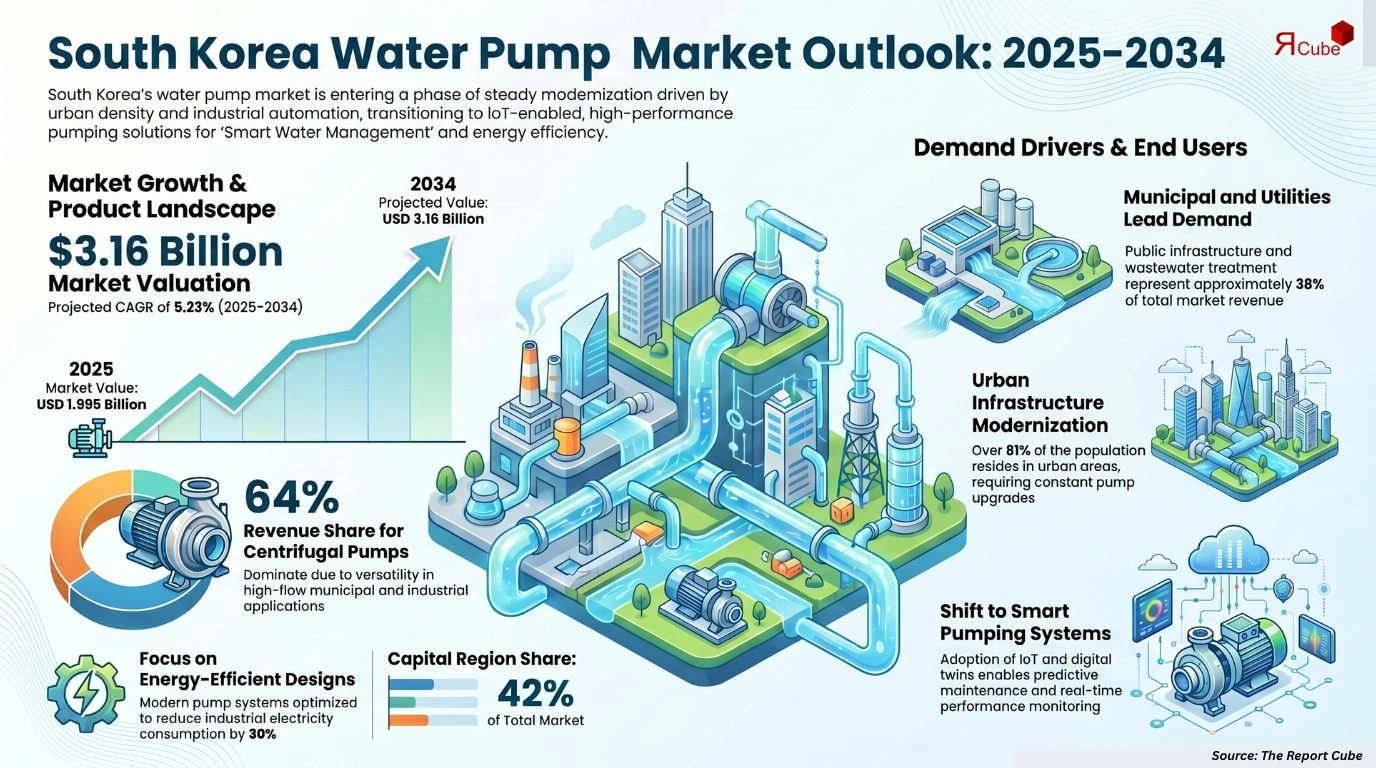
Centrifugal pumps lead the market, accounting for nearly 64% of total revenue.
By End User:
Municipal and utilities segment dominates the market, representing around 38% share.
Regional Outlook:
The Capital region holds the largest share of the South Korean Water Pump Market at approximately 42%.
Government Initiatives & Policies
- Smart Water Management Initiative (Ministry of Environment, South Korea): National program promoting digital water infrastructure, pump efficiency upgrades, and leakage reduction.
- Korean Green New Deal - Water Infrastructure Program: Focuses on energy-efficient pumping systems, flood control, and resilient water utilities.
South Korea Water Pump Market Insights & Analysis
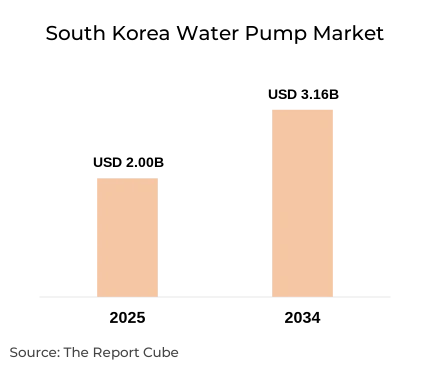
The South Korea Water Pump Market is anticipated to register a CAGR of 5.23% during 2026-2034. The market size was valued at USD 1.995 billion in 2025 and is projected to reach USD 3.16 billion by 2034. Water pumps are a foundational component of South Korea’s urban water supply, industrial processing, agricultural irrigation, and power generation ecosystems.
Market growth is closely tied to infrastructure modernization, urban density, and industrial automation. South Korea’s advanced manufacturing base requires highly reliable pumping systems for cooling, fluid transfer, and chemical processing. Simultaneously, aging municipal water infrastructure is undergoing phased replacement, creating sustained demand for high-capacity centrifugal and submersible pumps. Public spending on water and wastewater infrastructure exceeded USD 4.5 billion in 2024, with pumps representing a core procurement category. Technological upgrades such as variable frequency drives, energy-efficient impellers, and remote monitoring are further enhancing pump lifecycle value, positioning the market for steady long-term expansion.
South Korea Water Pump Market Dynamics
Market Driver: Urban Infrastructure Expansion and Water Security Focus
Rapid urban concentration and rising water security priorities are key drivers shaping the South Korea water pump market. More than 81% of the country’s population now resides in urban areas, increasing pressure on municipal water supply and wastewater systems. To maintain service reliability, utilities are upgrading pumping stations with higher-capacity and energy-efficient pumps. Flood mitigation has also emerged as a critical driver, particularly after increased frequency of extreme rainfall events. Large-scale drainage and stormwater management projects rely heavily on high-performance submersible and axial flow pumps. Additionally, industrial water demand continues to rise, especially in semiconductor fabrication, petrochemicals, and steel production, where uninterrupted fluid handling is essential. These factors collectively reinforce steady procurement of both centrifugal and positive displacement pumps across public and private sectors.
Market Trends: Shift Toward Energy-Efficient and Smart Pumping Systems
Energy efficiency has become a defining trend across the South Korea water pump market. Pumps account for nearly 20% of industrial electricity consumption nationwide, prompting both regulators and end users to prioritize efficiency upgrades. Manufacturers are increasingly integrating variable speed drives, high-efficiency motors, and optimized hydraulic designs to reduce energy usage by up to 30%. Smart pumping systems equipped with sensors and IoT-based monitoring are gaining traction, particularly in municipal utilities and industrial plants. These systems enable predictive maintenance, real-time performance optimization, and reduced downtime. Digital twins and automated control platforms are also being deployed in large pumping stations, reflecting South Korea’s broader push toward smart infrastructure and Industry 4.0 adoption.
Market Challenge: High Maintenance Costs and Complex Installation Requirements
Maintenance complexity and lifecycle costs remain key challenges within the water pump market. Large centrifugal and vertical pumps require specialized installation, alignment, and periodic overhaul, increasing operational expenditure for end users. In industrial environments, abrasive fluids and corrosive chemicals accelerate wear, shortening pump lifespan and increasing replacement frequency. Smaller municipalities and agricultural users often face budget constraints that limit their ability to adopt advanced pump technologies. Additionally, downtime during maintenance can disrupt critical operations, particularly in utilities and power generation facilities. While efficiency gains offer long-term savings, the upfront cost and technical expertise required continue to slow adoption in certain segments.
Market Opportunity: Agricultural Modernization and Climate-Resilient Infrastructure
Agricultural modernization presents a strong opportunity for market expansion. Although agriculture contributes a smaller share to GDP, irrigation efficiency is becoming a national priority amid changing rainfall patterns. Government-backed programs promoting automated irrigation and water reuse are increasing demand for durable centrifugal and positive displacement pumps. Climate-resilient infrastructure investments, including flood control and coastal protection projects, are also creating new demand for high-capacity pumping systems. Additionally, export-oriented pump manufacturers are using South Korea as a base for advanced manufacturing and R&D, supporting innovation and cost optimization. These opportunities position the market for diversified growth beyond traditional municipal and industrial demand.
South Korea Water Pump Market Segment-wise Analysis
By Type of Pumps:
- Positive Displacement Pumps
- Centrifugal Pumps
Centrifugal pumps dominate the South Korea water pump market with approximately 64% share in 2025. Their dominance is driven by versatility, ease of maintenance, and suitability for high-flow applications. Submersible and vertical centrifugal pumps are extensively used in municipal water supply, wastewater treatment, and flood control systems. Industrial users favor split case and overhung centrifugal pumps for cooling water circulation and process fluid handling. Continuous improvements in impeller design and material durability are further reinforcing this segment’s leadership.
By End User:
- Residential
- Power Generation
- Agriculture/Irrigation
- Industrial
- Municipal/Utilities
- Other End Users
Municipal and utilities segment accounts for nearly 38% of total market revenue, reflecting sustained investment in water supply and wastewater infrastructure. Urban water networks require constant pumping capacity upgrades to meet population growth and regulatory standards. Wastewater treatment plants rely on robust submersible and axial pumps to manage increasing volumes. Government funding and public-private partnerships continue to support steady demand in this segment, making it the most stable revenue contributor in the market.
Regional Projection of South Korea Water Pump Industry
- Capital
- Central
- Honam
- Yeongnam
- Gangwon
- Jeju
The Capital region leads the South Korea water pump market with around 42% share, supported by dense population, extensive water networks, and large industrial clusters. Major metropolitan areas drive continuous replacement and upgrade cycles for pumping systems. Yeongnam follows due to its strong industrial base, particularly in shipbuilding and heavy manufacturing. Central and Honam regions show steady growth driven by agricultural irrigation and regional utility investments, while Jeju focuses on desalination and tourism-related water infrastructure.
South Korea Water Pump Market Recent Developments
- 2025: Xylem raised its revenue and earnings forecast, driven by strong global demand for its water infrastructure and applied water segments. The company highlighted growth in its pumps and related solutions, reflecting solid momentum in water technology markets worldwide.
- 2025: Grundfos supported Alantech in testing a large dockyard pump for Cochin Shipyard at its South Korea facility. This collaboration strengthens Grundfos’ role in high-capacity, energy-efficient marine and industrial pumping projects connected to Korean manufacturing.
- 2025: Wilo continued its long-term investment in South Korea with a focus on sustainability. The company’s factory in Busan, designed to use renewable energy and rainwater recycling, enhances Wilo’s presence in industrial water treatment and supports product localization and upgrades.
- 2025: KSB won a major contract to supply high-capacity reactor coolant pumps for China’s Zhangzhou nuclear plant, boosting its global nuclear pump portfolio. This strengthens KSB’s position for upcoming nuclear and large infrastructure projects in East Asia, including South Korea.
- 2025: Ebara Precision Machinery Korea announced plans to build a second overhaul plant for dry vacuum pumps in Pyeongtaek, Gyeonggi Province. This new facility will enhance its supply and after-sales services for industrial customers in South Korea.
Need insights for a specific region within this market?
Request Regional DataWhy Choose This Report?
- Provides a comprehensive overview of the overall market analysis, encompassing key trends, consumer behavior analysis, and risk assessment to support strategic decision-making.
- Provides accurate, up-to-date insights into market size, segmentation, and emerging opportunities, helping to minimize risk & capitalizing on growth.
- Gives deep understanding of target audience preferences, investment habits, and communication channels for enhanced product development & marketing effectiveness.
- Delivers competitive analysis & benchmarking, uncovering the strengths & weaknesses of market competitors to guide strategies.
- Consolidate comprehensive market intelligence, reducing reasoning & streamlining research efforts.
- Facilitates customized market segmentation & risk mitigation strategies, fine-tuned to the business objectives.
- Aids in identifying both market challenges & untapped opportunities within the industry to drive long-term business growth.
- Provides valuable information based on actual customer data & search trends.
Table of Contents
- Introduction
- Objective of the Study
- Product and Category Definition
- Market Segmentation
- Study Variables
- Research Methodology
- Secondary Data Points
- Breakdown of Secondary Sources
- Primary Data Points
- Breakdown of Primary Interviews
- Secondary Data Points
- Executive Summary
- Market Dynamics
- Drivers
- Challenges
- Opportunity Assessment
- Recent Trends and Developments
- Regulatory and Policy Landscape
- South Korea Water Pump Market Overview (2021-2034)
- Market Size, By Value (USD Billion)
- Market Share, By Type of Pumps
- Positive Displacement Pumps
- Piston Pumps
- Diaphragm Pumps
- Peristaltic Pumps
- Gear Pumps
- Lobe Pumps
- Progressive Cavity Pumps
- Screw Pumps
- Vane Pumps
- Centrifugal Pumps
- Submersible Pumps
- Non-solid Handling
- Solid Handling
- Vertical Pumps
- Mixed Flow
- Turbine
- Nonsolid Handling
- Solid Handling
- Axial
- Split Case Pumps
- Multistage
- Single/Two Stage
- Overhung Pumps
- Horizontal End Suction
- Vertical Inline
- Submersible Pumps
- Positive Displacement Pumps
- Market Share, By End User
- Residential
- Power Generation
- Agriculture and Irrigation
- Industrial
- Municipal and Utilities
- Other End Users
- Market Share, By Region
- Capital
- Central
- Honam
- Yeongnam
- Gangwon
- Jeju
- Market Share, By Company
- Revenue Shares & Analysis
- Competitive Landscape
- Capital Region Water Pump Market
- Market Size, By Value (USD Billion/Million)
- Market Share, By Type of Pumps
- Market Share, By End User
- Central Region Water Pump Market
- Market Size, By Value (USD Billion/Million)
- Market Share, By Type of Pumps
- Market Share, By End User
- Honam Region Water Pump Market
- Market Size, By Value (USD Billion/Million)
- Market Share, By Type of Pumps
- Market Share, By End User
- Yeongnam Region Water Pump Market
- Market Size, By Value (USD Billion/Million)
- Market Share, By Type of Pumps
- Market Share, By End User
- Gangwon Region Water Pump Market
- Market Size, By Value (USD Billion/Million)
- Market Share, By Type of Pumps
- Market Share, By End User
- Jeju Region Water Pump Market
- Market Size, By Value (USD Billion/Million)
- Market Share, By Type of Pumps
- Market Share, By End User
- Competitive Outlook and Company Profiles
- Xylem
- Company Overview
- Product Portfolio
- Strategic Alliances/Partnerships
- Recent Developments
- Dover
- Company Overview
- Product Portfolio
- Strategic Alliances/Partnerships
- Recent Developments
- Grundfos
- Company Overview
- Product Portfolio
- Strategic Alliances/Partnerships
- Recent Developments
- SPX Flow
- Company Overview
- Product Portfolio
- Strategic Alliances/Partnerships
- Recent Developments
- Wilo
- Company Overview
- Product Portfolio
- Strategic Alliances/Partnerships
- Recent Developments
- KSB
- Company Overview
- Product Portfolio
- Strategic Alliances/Partnerships
- Recent Developments
- Flowserve
- Company Overview
- Product Portfolio
- Strategic Alliances/Partnerships
- Recent Developments
- Ebara
- Company Overview
- Product Portfolio
- Strategic Alliances/Partnerships
- Recent Developments
- ITT
- Company Overview
- Product Portfolio
- Strategic Alliances/Partnerships
- Recent Developments
- IDEX
- Company Overview
- Product Portfolio
- Strategic Alliances/Partnerships
- Recent Developments
- Sulzer AG
- Company Overview
- Product Portfolio
- Strategic Alliances/Partnerships
- Recent Developments
- Others
- Xylem
- Contact Us and Disclaimer
Top Key Players & Market Share Outlook
- Xylem
- Dover
- Grundfos
- SPX Flow
- Wilo
- KSB
- Flowserve
- Ebara
- ITT
- IDEX
- Sulzer AG
- Others
Frequently Asked Questions