



Build Your Custom Market Intelligence Report
Customize Your ReportGlobal Weight Loss Drugs Market Key Takeaways
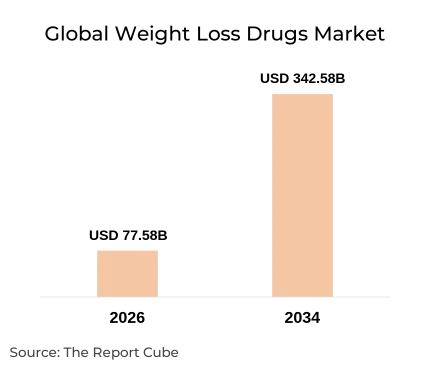
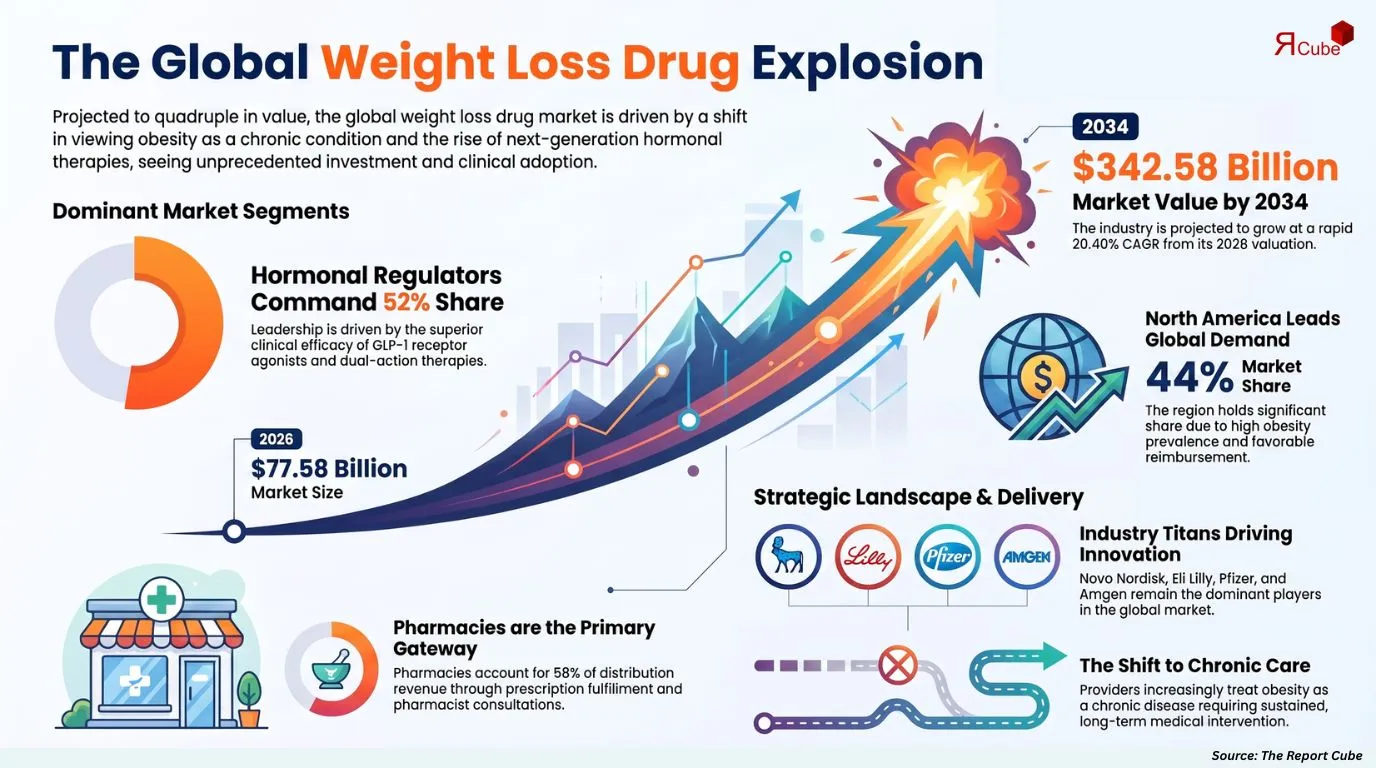
- Market size reached USD 77.58 billion during the 2026 assessment year.
- Industry projected to attain USD 342.58 billion by 2034 globally.
- Market forecast indicates a CAGR of 20.40% during 2026-2034.
- Novo Nordisk, Eli Lilly, Pfizer, and Amgen remain leading participants.
- Hormonal Regulators dominate the mechanism of action segment globally.
- Pharmacies account for the highest distribution channel revenue contribution.
- North America remains the leading regional weight loss drugs market.
- Rising obesity prevalence continues supporting strong pharmaceutical market expansion.
Global Weight Loss Drugs Market Insights & Analysis
The Global Weight Loss Drugs Market is anticipated to register a 20.40% CAGR during 2026-2034. The market size was valued at USD 77.58 billion in 2026 and is projected to reach USD 342.58 billion by 2034. The market is experiencing exceptional growth due to the increasing prevalence of obesity, growing awareness of weight-related health risks, and rising demand for clinically proven pharmacological therapies. The growing adoption of prescription medications alongside lifestyle management programs is significantly improving long-term weight management outcomes across developed and emerging healthcare markets.
Governments, healthcare organizations, and pharmaceutical companies are increasing investments in obesity management programs, innovative metabolic therapies, and large-scale clinical research. Regulatory approvals of next-generation weight management drugs, expanding reimbursement policies, and growing healthcare expenditure continue strengthening market expansion throughout the forecast period.
Global Weight Loss Drugs Market Dynamics
The global weight loss drugs market is rapidly transforming as healthcare providers increasingly recognize obesity as a chronic disease requiring long-term medical intervention. Continuous innovation in metabolic therapies, improved clinical evidence, and expanding physician confidence are accelerating treatment adoption across diverse patient populations.
Increasing healthcare investments, broader insurance coverage, and technological advancements in personalized medicine are supporting market development. Pharmaceutical manufacturers continue strengthening research capabilities and expanding production capacity to meet rising global demand, reinforcing long-term industry competitiveness.
|
Factor |
Type |
Specific Impact on Market |
Magnitude |
|---|---|---|---|
|
Rising obesity prevalence |
Driver |
Increases prescription drug demand |
High |
|
Growing metabolic disease burden |
Driver |
Expands therapeutic adoption |
High |
|
GLP-1 and hormonal innovations |
Trend |
Improves treatment effectiveness |
High |
|
Long-term patient adherence |
Challenge |
Influences sustained treatment outcomes |
Medium |
|
Expanding reimbursement programs |
Opportunity |
Accelerates market accessibility |
High |
Key Market Driver: Rising Global Obesity Burden
The growing prevalence of obesity remains the primary driver of the global weight loss drugs market. Sedentary lifestyles, unhealthy dietary habits, and increasing metabolic disorders have significantly expanded the patient population requiring pharmacological intervention. Healthcare providers increasingly recommend prescription medications alongside behavioral modification programs to achieve sustainable weight reduction and improve long-term health outcomes. This growing clinical acceptance continues driving substantial market expansion.
Major Industry Challenge: Ensuring Long-Term Treatment Adherence
Maintaining long-term patient adherence remains an important challenge for the weight loss drugs market. Successful obesity management requires continuous physician monitoring, lifestyle modification, and sustained medication compliance. Healthcare providers are increasingly emphasizing personalized treatment plans, patient education, and digital monitoring solutions to improve long-term therapeutic effectiveness while enhancing overall treatment satisfaction.
Emerging Trend Shaping Outlook: Next-Generation Hormonal Therapies
Next-generation hormonal therapies are transforming the future outlook of the market. Pharmaceutical companies are developing highly effective GLP-1 receptor agonists, dual agonists, and innovative metabolic therapies that deliver greater weight reduction with improved safety profiles. AI-assisted drug discovery, precision medicine, and digital patient monitoring are further accelerating therapeutic innovation and expanding treatment opportunities worldwide.
The market continues benefiting from increasing healthcare awareness, expanding obesity screening programs, and rising physician acceptance of pharmacological interventions. Industry participants are focusing on innovative therapies, manufacturing expansion, and global commercialization strategies to strengthen competitive positioning. Strategic collaborations among pharmaceutical companies, research institutions, and healthcare providers are accelerating product development and commercialization. Companies emphasizing advanced hormonal therapies, clinical innovation, and patient-centered treatment approaches are expected to maintain strong competitive advantages throughout the forecast period.
Need Specific Data, Let’s Customize the Report for You
Request CustomizationGlobal Weight Loss Drugs Market Segment-wise Analysis
The global weight loss drugs market demonstrates diversified segmentation based on mechanism of action and distribution channels. Rising obesity prevalence, increasing demand for prescription therapies, and continuous pharmaceutical innovation continue influencing segment performance. Expanding investments in metabolic disease management are creating substantial opportunities across multiple therapeutic categories.
By Mechanism of Action
- Appetite Suppressants
- Fat Blockers
- Stimulants
- Hormonal Regulators
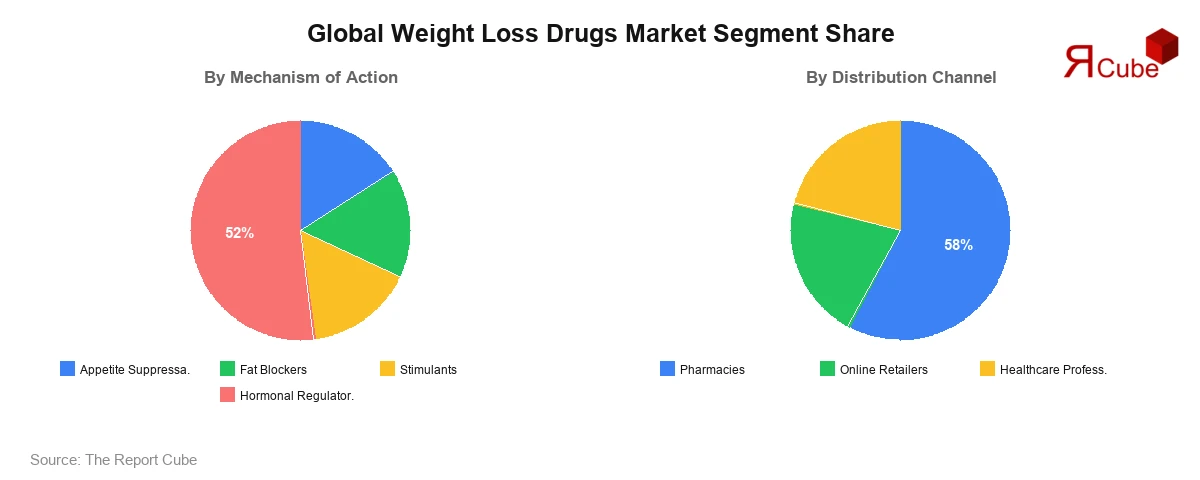
Hormonal Regulators dominate the mechanism of action segment with an estimated market share of approximately 52%. Their leadership is supported by superior clinical efficacy, sustained weight reduction, improved metabolic control, and increasing physician preference. Continuous innovation in GLP-1 receptor agonists and dual-action therapies continues reinforcing segment dominance while expanding treatment accessibility across global healthcare systems.
Appetite Suppressants continue maintaining strong market demand due to their effectiveness in calorie intake management. Fat Blockers and Stimulants also contribute significantly through targeted therapeutic applications and complementary obesity management strategies.
By Distribution Channel
- Pharmacies
- Online Retailers
- Healthcare Professionals
Pharmacies account for approximately 58% market share, making them the dominant distribution channel within the global weight loss drugs market. Growth is supported by widespread prescription fulfillment, pharmacist consultation services, insurance reimbursement programs, and broad product availability. Strong healthcare infrastructure further reinforces pharmacy leadership across major pharmaceutical markets.
Healthcare Professionals also represent a major distribution segment through hospital-based prescribing and specialized obesity clinics. Online Retailers continue experiencing rapid expansion due to increasing digital healthcare adoption, convenient ordering platforms, and growing telemedicine utilization.
Regional Projection of Global Weight Loss Drugs Market
The regional landscape of the global weight loss drugs market reflects differences in obesity prevalence, healthcare infrastructure, pharmaceutical innovation, and reimbursement policies. Demand remains concentrated in regions with advanced healthcare systems and strong prescription drug accessibility. Continued investments in obesity management programs are expected to support market growth worldwide.
|
Region |
Estimated Market Share |
Key Growth Factors |
Consumer Trends |
|---|---|---|---|
|
North America |
44% |
High obesity prevalence and reimbursement support |
Strong prescription adoption |
|
Europe |
27% |
Growing metabolic disease management |
Increasing physician prescribing |
|
Asia-Pacific |
21% |
Expanding healthcare infrastructure |
Rising obesity awareness |
|
Rest of World |
8% |
Improving pharmaceutical accessibility |
Growing preventive healthcare |
- North America
- Europe
- Asia-Pacific
- Rest of World
North America leads the market with an estimated 44% share due to high obesity prevalence, advanced healthcare infrastructure, favorable reimbursement policies, and strong adoption of innovative prescription therapies. The region benefits from continuous pharmaceutical innovation, substantial clinical research activities, and high healthcare expenditure.
The region also experiences strong physician awareness, increasing patient acceptance of medical weight management, and expanding insurance coverage for obesity treatment. These factors are expected to reinforce North America's leadership position throughout the forecast period.
Global Weight Loss Drugs Market: Recent Development (2025)
- Novo Nordisk expanded manufacturing capacity supporting increasing worldwide demand for innovative obesity treatment medications significantly.
- Eli Lilly received additional regulatory approvals expanding advanced hormonal weight management therapy availability globally successfully.
- Pfizer strengthened obesity drug research collaborations accelerating innovative metabolic treatment pipeline development across multiple regions.
- Amgen advanced late-stage clinical studies supporting next-generation obesity therapy commercialization and global expansion initiatives successfully.
Global Weight Loss Drugs Market Future Outlook (2034)
The Global Weight Loss Drugs Market is expected to reach USD 342.58 billion by 2034 while expanding at a CAGR of 20.40% throughout the forecast period. Rising obesity prevalence, expanding clinical acceptance, increasing healthcare investments, and broader reimbursement support are expected to create substantial opportunities for pharmaceutical manufacturers and healthcare providers.
Technological advancements in AI-driven drug discovery, precision medicine, digital patient monitoring, and advanced hormonal therapies are expected to improve treatment outcomes and accelerate pharmaceutical innovation. Continued investments in metabolic research, manufacturing expansion, and personalized obesity management programs will support sustained long-term market growth through 2034.
Global Weight Loss Drugs Market Report Coverage
|
Report Attribute |
Details |
|---|---|
|
Market Name |
Global Weight Loss Drugs Market |
|
Market Size (2026) |
USD 77.58 billion |
|
Market Size (2034) |
USD 342.58 billion |
|
Forecast Period |
2026-2034 |
|
CAGR |
20.40% |
|
Customization |
Available Upon Request |
|
Segments Covered |
By Type, By Dosage Form, By Target Audience, By Mechanism of Action, By Distribution Channel |
|
Regions Covered |
North America, Europe, Asia-Pacific, Rest of World |
|
Key Companies |
Novo Nordisk, Eli Lilly, Pfizer, Boehringer Ingelheim, Amgen, Sanofi, GSK, AstraZeneca, Bristol-Myers Squibb, Others |
|
Report Format |
PDF, Excel, PPT |
Why Choose This Report?
- Comprehensive assessment of market size, growth forecasts, and emerging opportunities.
- Detailed evaluation of therapeutic segments and distribution channel performance.
- In-depth regional analysis supported by market share estimates and growth drivers.
- Competitive intelligence covering leading pharmaceutical companies and strategic developments.
- Insights into AI-driven drug discovery and next-generation obesity therapies.
- Reliable forecasting methodology supporting investment and strategic business decisions.
Table of Contents
- Introduction
- Objective of the study
- Product Definition
- Market Segmentation
- Study Variables
- Research Methodology
- Secondary Data Points
- Companies Interviewed
- Primary Data Points
- Breakdown of Primary Interviews
- Secondary Data Points
- Executive Summary
- Market Dynamics
- Drivers
- Challenges
- Opportunity Assessment
- Recent Trends and Developments
- Policy and Regulatory Landscape
- Global Weight Loss Drugs Market Overview and Forecast Analysis (2021-2034)
- Market Size, By Value, By growth rate (CAGR/USD Billions)
- Demand - Supply Trends
- Market Share, By Type
- Prescription Drugs
- Over-the-Counter Drugs
- Herbal and Natural Supplements
- Market Share, By Dosage Form
- Tablets
- Capsules
- Liquids
- Injections
- Market Share, By Target Audience
- Individuals with Obesity or Overweight
- Individuals with Chronic Diseases
- Fitness and Wellness Enthusiasts
- Market Share, By Mechanism of Action
- Appetite Suppressants
- Fat Blockers
- Stimulants
- Hormonal Regulators
- Market Share, By Distribution Channel
- Pharmacies
- Online Retailers
- Healthcare Professionals
- Market Share, By Region
- North America
- Europe
- Asia-Pacific
- Rest of World
- Market Share, By Competitors
- Competition Characteristics
- Revenue Shares
- Global Prescription Drugs Weight Loss Drugs Market Overview, 2021-2034F
- By Value (USD Million)
- By Dosage Form- Market Size & Forecast 2021-2034, USD Million
- By Target Audience- Market Size & Forecast 2021-2034, USD Million
- By Mechanism of Action- Market Size & Forecast 2021-2034, USD Million
- By Distribution Channel- Market Size & Forecast 2021-2034, USD Million
- Global Over-the-Counter Drugs Weight Loss Drugs Market Overview, 2021-2034F
- By Value (USD Million)
- By Dosage Form- Market Size & Forecast 2021-2034, USD Million
- By Target Audience- Market Size & Forecast 2021-2034, USD Million
- By Mechanism of Action- Market Size & Forecast 2021-2034, USD Million
- By Distribution Channel- Market Size & Forecast 2021-2034, USD Million
- Global Herbal and Natural Supplements Weight Loss Drugs Market Overview, 2021-2034F
- By Value (USD Million)
- By Dosage Form- Market Size & Forecast 2021-2034, USD Million
- By Target Audience- Market Size & Forecast 2021-2034, USD Million
- By Mechanism of Action- Market Size & Forecast 2021-2034, USD Million
- By Distribution Channel- Market Size & Forecast 2021-2034, USD Million
- Competitive Outlook (Company Profile - Partial List)
- Novo Nordisk
- Company Overview
- Business Segments
- Strategic Alliances/Partnerships
- Recent Developments
- Eli Lilly
- Company Overview
- Business Segments
- Strategic Alliances/Partnerships
- Recent Developments
- Pfizer
- Company Overview
- Business Segments
- Strategic Alliances/Partnerships
- Recent Developments
- Boehringer Ingelheim
- Company Overview
- Business Segments
- Strategic Alliances/Partnerships
- Recent Developments
- Amgen
- Company Overview
- Business Segments
- Strategic Alliances/Partnerships
- Recent Developments
- Sanofi
- Company Overview
- Business Segments
- Strategic Alliances/Partnerships
- Recent Developments
- GSK
- Company Overview
- Business Segments
- Strategic Alliances/Partnerships
- Recent Developments
- AstraZeneca
- Company Overview
- Business Segments
- Strategic Alliances/Partnerships
- Recent Developments
- Bristol-Myers Squibb
- Company Overview
- Business Segments
- Strategic Alliances/Partnerships
- Recent Developments
- Others
- Novo Nordisk
- Contact Us & Disclaimer
Top Key Players & Market Share Outlook
- Novo Nordisk
- Eli Lilly
- Pfizer
- Boehringer Ingelheim
- Amgen
- Sanofi
- GSK
- AstraZeneca
- Bristol-Myers Squibb
- Others
Frequently Asked Questions






