



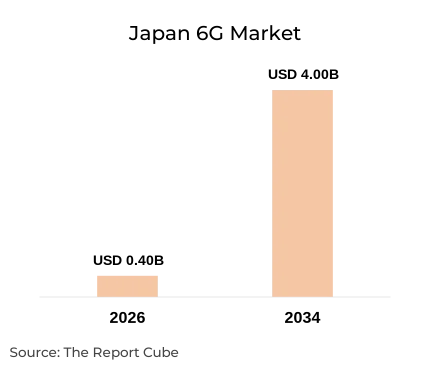
Build Your Custom Market Intelligence Report
Customize Your ReportJapan 6G Market Key Highlights
By Component:
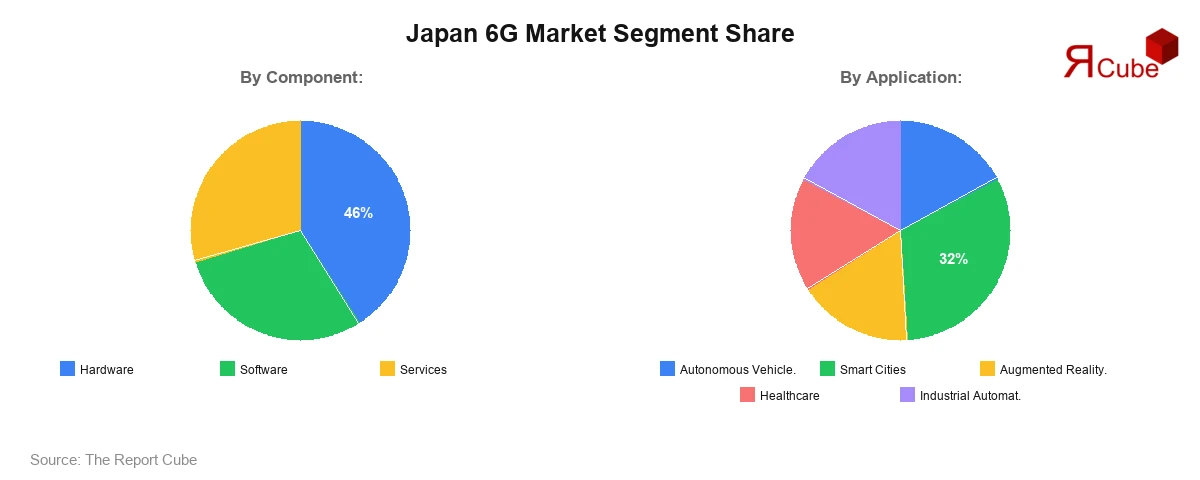
Hardware segment leads the market with around 46% market share.
By Technology:
Terahertz Communication segment dominates the market with nearly 34% of revenue.
Regional Outlook:
Honshu region dominates the Japan 6G market with approximately 68% share.
Japan 6G Market Insights & Analysis
The Japan 6G Market is anticipated to register a CAGR of around 29.5% during the forecast period 2026-2034. The market size is valued at USD 0.40 billion in 2026 and is projected to reach USD 4.0 billion by 2034. The rapid evolution of next-generation communication technologies, combined with Japan’s strong digital infrastructure, is accelerating the Japan 6G market size expansion. Government-backed R&D programs and collaborations between telecom providers and technology firms are laying the groundwork for early commercialization. Japan’s strategic vision to lead global 6G innovation is reflected in increased funding for terahertz spectrum research and AI-driven network optimization.
Investment trends indicate that telecom operators and equipment manufacturers are focusing heavily on advanced antenna systems, edge computing, and AI-integrated networks to enhance network efficiency and ultra-low latency capabilities. The Japan 6G market growth is further supported by rising demand for smart city ecosystems, autonomous mobility, and immersive technologies such as augmented reality. With pilot deployments already underway, Japan is transitioning from theoretical research to practical implementation, strengthening its position as a global innovation hub for next-generation wireless technologies.
Japan 6G Market Dynamics
Key Driver: Rising Demand for Ultra-High-Speed Connectivity Across Smart Ecosystems
The increasing adoption of smart technologies across industries is a primary factor driving the Japan 6G market growth. Applications such as autonomous vehicles, remote healthcare, and industrial automation require ultra-reliable, low-latency communication, which 6G networks are designed to deliver. Japan’s advanced urban infrastructure and high digital adoption rates create a favorable environment for rapid deployment of such technologies. This growing dependence on seamless connectivity is pushing telecom providers to accelerate innovation and expand infrastructure investments.
In addition, enterprises are seeking advanced connectivity solutions to enhance operational efficiency and enable real-time data processing. The integration of edge computing with 6G networks allows faster decision-making and improved system performance. As industries increasingly shift toward automation and digital transformation, the demand for high-speed and intelligent communication networks continues to rise, strengthening the Japan 6G market value.
Book your FREE 30-minute expert consultation today
Contact UsIndustry Trends: Integration of AI-Native Networks and Terahertz Communication
The Japan 6G market trends highlight a strong shift toward AI-native network architectures and terahertz communication technologies. AI is being embedded directly into network operations to enable predictive maintenance, dynamic resource allocation, and enhanced security. This transition is transforming traditional network models into intelligent systems capable of self-optimization, which improves efficiency and reduces operational costs.
Simultaneously, terahertz communication is emerging as a critical enabler of ultra-high-speed data transmission. Research initiatives in Japan are focusing on achieving data rates exceeding 100 Gbps, which significantly surpass current 5G capabilities. These advancements are expected to support next-generation applications such as holographic communication and immersive virtual environments, further accelerating the Japan 6G market growth.
Major Challenge: High Infrastructure Costs and Technological Complexity
The development and deployment of 6G networks involve significant financial investments, posing a challenge for widespread adoption. Building advanced infrastructure such as terahertz transceivers, massive MIMO systems, and edge computing platforms requires substantial capital expenditure. These costs can limit participation from smaller telecom operators and slow down overall market expansion.
Moreover, the complexity of integrating multiple advanced technologies, including AI, machine learning, and high-frequency communication systems, creates additional technical barriers. Ensuring interoperability, maintaining network security, and achieving consistent performance across different environments remain key concerns. These challenges may affect the pace of deployment and hinder the overall Japan 6G market share growth.
Opportunity: Expansion of 6G Applications in Emerging Industry Verticals
The growing adoption of 6G technology across diverse industry verticals presents significant opportunities for market expansion. Sectors such as healthcare, transportation, and manufacturing are increasingly leveraging advanced communication technologies to enhance efficiency and innovation. For instance, remote surgeries and real-time patient monitoring rely heavily on ultra-low latency and high-speed connectivity, which 6G networks can provide.
Additionally, the rise of smart cities and digital infrastructure projects is creating new avenues for growth in the Japan 6G market. Government initiatives aimed at improving urban connectivity and sustainability are driving demand for advanced communication systems. As industries continue to explore new use cases, the Japan 6G market revenue is expected to witness substantial growth over the forecast period.
Japan 6G Market Segment-wise Analysis
By Component:
- Hardware
- Software
- Services
The hardware segment dominates the Japan 6G market with an estimated 46% share, driven by extensive investments in advanced communication infrastructure. Components such as terahertz transceivers, massive MIMO radio units, and advanced antenna systems form the backbone of 6G networks. Telecom operators are prioritizing infrastructure upgrades to support higher data speeds and lower latency requirements.
Additionally, the increasing deployment of edge computing hardware is enhancing network efficiency and enabling real-time data processing. Japan’s focus on developing domestic manufacturing capabilities for critical hardware components further strengthens this segment’s growth. As network deployment accelerates, the hardware segment is expected to maintain its leading position in the Japan 6G market.
By Application:
- Autonomous Vehicles
- Smart Cities
- Augmented Reality
- Healthcare
- Industrial Automation
The smart cities segment holds a dominant position with approximately 32% of the Japan 6G market share, supported by ongoing urban development projects and digital transformation initiatives. 6G technology enables efficient management of urban infrastructure, including traffic systems, energy distribution, and public safety networks.
Furthermore, the integration of IoT devices and real-time data analytics enhances operational efficiency and improves quality of life in urban areas. Japan’s commitment to developing smart and sustainable cities is driving significant investments in advanced communication technologies, reinforcing the growth of this segment.
Regional Projection of Japan 6G Industry
- Hokkaido
- Honshu
- Shikoku
- Kyushu
Honshu dominates the Japan 6G market with a share of approximately 68%, driven by the presence of major metropolitan areas such as Tokyo and Osaka. These regions serve as key hubs for technological innovation and infrastructure development. High population density and strong industrial activity create significant demand for advanced communication networks.
Additionally, the concentration of leading telecom companies, research institutions, and government initiatives in Honshu accelerates the development and deployment of 6G technologies. Continuous investments in smart city projects and digital infrastructure further strengthen the region’s leading position in the Japan 6G market.
Government Initiatives & Policies
- Japan MIC 6G Promotion Strategy 2025: Focuses on terahertz spectrum allocation and national 6G R&D funding expansion.
- Beyond 5G Promotion Consortium (2026): Public-private initiative accelerating 6G trials, innovation, and global standardization efforts.
Japan 6G Industry Recent Developments
- 2026: Ericsson announced a new R&D center in Yokohama focusing on 6G, AI-driven networks, and energy-efficient wireless technologies, strengthening Japan’s domestic innovation ecosystem.
- 2026: NTT DoCoMo demonstrated AI-driven RAN control achieving up to 20% throughput improvement, validating AI-native network concepts for future 6G deployments.
- 2025: SoftBank and Nokia conducted 7 GHz band trials in Tokyo using Massive MIMO to evaluate urban 6G coverage capabilities and spectrum efficiency.
Need insights for a specific region within this market?
Request Regional DataWhy Choose This Report?
- Provides a comprehensive overview of the overall market analysis, encompassing key trends, consumer behavior analysis, and risk assessment to support strategic decision-making.
- Provides accurate, up-to-date insights into market size, segmentation, and emerging opportunities, helping to minimize risk & capitalizing on growth.
- Gives deep understanding of target audience preferences, investment habits, and communication channels for enhanced product development & marketing effectiveness.
- Delivers competitive analysis & benchmarking, uncovering the strengths & weaknesses of market competitors to guide strategies.
- Consolidate comprehensive market intelligence, reducing reasoning & streamlining research efforts.
- Facilitates customized market segmentation & risk mitigation strategies, fine-tuned to the business objectives.
- Aids in identifying both market challenges & untapped opportunities within the industry to drive long-term business growth.
- Provides valuable information based on actual customer data & search trends.
Table of Contents
- Introduction
- Objective of the Study
- Product and Category Definition
- Market Segmentation
- Study Variables
- Research Methodology
- Secondary Data Points
- Breakdown of Secondary Sources
- Primary Data Points
- Breakdown of Primary Interviews
- Secondary Data Points
- Executive Summary
- Market Dynamics
- Drivers
- Challenges
- Opportunity Assessment
- Recent Trends and Developments
- Regulatory and Policy Landscape
- Japan 6G Market Overview (2021-2034)
- Market Size, By Value (USD Billion)
- Market Share, By Component
- Hardware
- Terahertz Transceivers
- Massive MIMO Radio Units
- Advanced Antenna Systems
- Optical Wireless Terminals
- Edge Computing Hardware
- Core Network Equipment
- Devices and User Equipment
- Software
- Network Management Software
- Software-Defined Networking Platforms
- Network Slicing Software
- Security and Analytics Software
- Artificial Intelligence and Machine Learning Platforms
- Services
- Professional Services
- Consulting and System Integration
- Deployment and Testing Services
- Managed Services
- Support and Maintenance Services
- Hardware
- Market Share, By Technology
- Terahertz Communication
- Massive MIMO
- Advanced Antenna Systems
- Optical Wireless Communication
- Market Share, By Application
- Autonomous Vehicles
- Smart Cities
- Augmented Reality
- Healthcare
- Industrial Automation
- Market Share, By End Use
- Telecommunications
- Transportation
- Healthcare
- Manufacturing
- Market Share, By Network Type
- Private Networks
- Public Networks
- Hybrid Networks
- Market Share, By Deployment Device
- Smartphones
- Tablets
- Wearables
- Internet of Things
- Others
- Market Share, By Communication Infrastructure
- Wireless
- Mobile Cellular
- Mobile Broadband
- Fixed
- Market Share, By Region
- Hokkaido
- Honshu
- Shikoku
- Kyushu
- Market Share, By Company
- Revenue Shares and Analysis
- Competitive Landscape
- Hokkaido 6G Market
- Market Size, By Value (USD Billion/Million)
- Market Share, By Component
- Market Share, By Technology
- Market Share, By Application
- Market Share, By End Use
- Market Share, By Network Type
- Market Share, By Deployment Device
- Market Share, By Communication Infrastructure
- Honshu 6G Market
- Market Size, By Value (USD Billion/Million)
- Market Share, By Component
- Market Share, By Technology
- Market Share, By Application
- Market Share, By End Use
- Market Share, By Network Type
- Market Share, By Deployment Device
- Market Share, By Communication Infrastructure
- Shikoku 6G Market
- Market Size, By Value (USD Billion/Million)
- Market Share, By Component
- Market Share, By Technology
- Market Share, By Application
- Market Share, By End Use
- Market Share, By Network Type
- Market Share, By Deployment Device
- Market Share, By Communication Infrastructure
- Kyushu 6G Market
- Market Size, By Value (USD Billion/Million)
- Market Share, By Component
- Market Share, By Technology
- Market Share, By Application
- Market Share, By End Use
- Market Share, By Network Type
- Market Share, By Deployment Device
- Market Share, By Communication Infrastructure
- Competitive Outlook and Company Profiles
- Qualcomm
- Company Overview
- Product Portfolio
- Strategic Alliances/Partnerships
- Recent Developments
- Samsung
- Company Overview
- Product Portfolio
- Strategic Alliances/Partnerships
- Recent Developments
- Apple Inc.
- Company Overview
- Product Portfolio
- Strategic Alliances/Partnerships
- Recent Developments
- Ericsson
- Company Overview
- Product Portfolio
- Strategic Alliances/Partnerships
- Recent Developments
- Huawei
- Company Overview
- Product Portfolio
- Strategic Alliances/Partnerships
- Recent Developments
- LG
- Company Overview
- Product Portfolio
- Strategic Alliances/Partnerships
- Recent Developments
- AT&T
- Company Overview
- Product Portfolio
- Strategic Alliances/Partnerships
- Recent Developments
- Nokia
- Company Overview
- Product Portfolio
- Strategic Alliances/Partnerships
- Recent Developments
- Orange
- Company Overview
- Product Portfolio
- Strategic Alliances/Partnerships
- Recent Developments
- NTT DoCoMo
- Company Overview
- Product Portfolio
- Strategic Alliances/Partnerships
- Recent Developments
- Others
- Qualcomm
- Contact Us and Disclaimer
Top Key Players & Market Share Outlook
- Qualcomm
- Samsung
- Apple Inc.
- Ericsson
- Huawei
- LG
- AT&T
- Nokia
- Orange
- NTT DoCoMo
Frequently Asked Questions






