



Build Your Custom Market Intelligence Report
Customize Your ReportKey Highlights
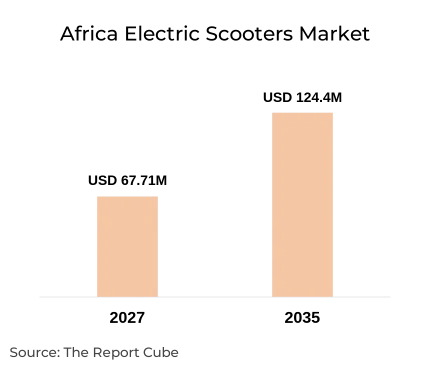
- Africa Electric Scooters Market size is valued at USD 67.71 million in 2027 and is forecast to reach USD 124.40 million by 2035.
- The supplied forecast implies a CAGR of 7.90% during 2027–2035.
- The base year is 2026, with the supplied historical period 2022–2026 and forecast period 2027–2035.
- The input identifies 4 segmentation dimensions; all supplied subsegments are retained in the segment analysis.
- The supplied leading-segment shares are analyst estimates, not independently verified public market statistics.
- The market's demand profile is shaped by: Electric scooters include seated and standing two-wheelers, with battery chemistry, voltage, range, charging, swapping, durability and local service determining commercial suitability. Urban
- Regional revenue shares, competitor rankings and company market shares are not assigned without comparable primary evidence.
Market Outlook
Electric scooters include seated and standing two-wheelers, with battery chemistry, voltage, range, charging, swapping, durability and local service determining commercial suitability. Urban delivery, commuting and shared mobility use cases have different ownership economics. The market value and forecast in this.
The commercial structure of the Africa Electric Scooters Market varies across national markets and end-user groups. Buyers assess availability, quality assurance, operating cost, delivery reliability and suitability for local conditions. Suppliers compete through product performance, service networks, technical support, regulatory.
Forecast interpretation should therefore separate three evidence layers: supplied market estimates, official sector indicators and qualitative market analysis. Official sources can validate the operating environment, but they do not independently validate the supplied market valuation. The report does not treat.
Government Regulations
Electric scooters are subject to national vehicle classification, roadworthiness, helmet, speed, licensing, insurance and road-use rules. Battery transport and end-of-life handling can trigger dangerous-goods, waste and extended producer responsibility requirements. Charging equipment is affected by electrical safety and local grid.
Africa Electric Scooters Market Dynamics
Market dynamics reflect the interaction of end-user demand, procurement cycles, infrastructure readiness, affordability and regulatory requirements. The strongest growth signals are not necessarily the same as the largest current revenue pools: a fast-growing application may start from a small base.
| Factor | Type | Specific Impact on Market | Magnitude |
|---|---|---|---|
| Structural demand | Driver | Recurring or project-linked need supports baseline demand, depending on the market's operating cycle. | High relevance |
| Technology and service improvement | Driver | Better performance, reliability, convenience or digital workflow integration can improve adoption. | Medium–High relevance |
| Local capability and distribution | Opportunity | Local service, assembly, partnerships and channel reach can reduce delivery friction. | Medium–High relevance |
| Regulatory alignment | Opportunity | Clearer standards and predictable approvals can improve procurement confidence. | Medium relevance |
| Affordability and financing | Challenge | Budget constraints, foreign exchange and payment delays can defer purchases or restrict coverage. | High relevance |
| Infrastructure and skills gaps | Challenge | Power, logistics, connectivity, trained staff and maintenance capacity can limit deployment. | High relevance |
The driver entries identify the demand foundations: Structural demand (Recurring or project-linked need supports baseline demand, depending on the market's operating cycle.); Technology and service improvement (Better performance, reliability, convenience or digital workflow integration can improve adoption.). The opportunity entries point to areas where suppliers may improve adoption or access: Local capability and distribution (Local service, assembly, partnerships and channel reach can reduce delivery friction.); Regulatory alignment (Clearer standards and predictable approvals can improve procurement confidence.). The challenge entries show constraints that may delay purchasing or deployment: Affordability and financing (Budget constraints, foreign exchange and payment delays can defer purchases or restrict coverage.); Infrastructure and skills gaps (Power, logistics, connectivity, trained staff and maintenance capacity can limit deployment.). The magnitude labels are qualitative assessments from this report framework, not measured market shares or independently quantified impact values.
Growth Drivers
Demand growth is supported by the underlying activity that creates the need for africa electric scooters market. This may be corporate outsourcing demand, healthcare delivery, industrial and mining projects, transport electrification, trade flows or offshore development, depending on the market..
Need Specific Data, Let’s Customize the Report for You
Request CustomizationMarket Opportunities
Opportunities include urban commuter mobility, delivery fleets, shared mobility, fleet leasing, battery servicing and charging or swapping infrastructure. Local assembly, financing options and dependable after-sales networks can improve adoption, particularly where scooters offer a practical alternative for short-distance travel.
Opportunity Assessment
Commercial potential should be assessed by customer economics, procurement access, distribution reach, product performance and local service capability. The supplied market forecast indicates the expected direction and scale of the market under the provided assumptions; it does not by itself establish the addressable opportunity for every supplier. Companies should validate country-level demand, purchasing power, import requirements and channel economics before committing capacity.
Industry Challenges
Market development faces purchase-price sensitivity, limited charging infrastructure, battery replacement costs, uncertain resale values, safety concerns and inconsistent policy frameworks. Import dependence, spare-parts availability and the suitability of vehicles for local road conditions also influence total cost of ownership.
Market-wide data availability is another constraint. Public sources often describe policy, sector activity, disease burden, industrial output or infrastructure rather than the exact revenue pool defined by this market. Accordingly, segment and regional shares supplied in the input are treated as analyst estimates, not independently verified published statistics. They should not be interpreted as audited market measurements.
Market Trends
The sector is increasingly focused on lithium-ion battery systems, fleet electrification, battery-swapping models and integration with delivery and mobility platforms. Policy support and pilot programmes are developing in some markets, but adoption rates will depend on infrastructure, affordability and reliable local service.
Across the forecast period, supplier performance is likely to depend on the ability to combine product or service quality with reliable delivery, technical support, compliance and transparent total-cost economics. The pace of adoption will differ by country and customer group; the forecast should therefore be read as a market-level projection rather than a guarantee of uniform growth.
Africa Electric Scooters Market Segment Analysis
The segmentation below reproduces the two segmentation dimensions and all subsegments supplied for this market. Each category includes focused commentary on the leading segment and the second analyzed segment. Share figures are labelled as analyst estimates where supplied and are not represented as independently verified market statistics.
By Product
- Retro Electric Scooter
- Standing/Self-Balancing Electric Scooters
- Folding Electric Scooters
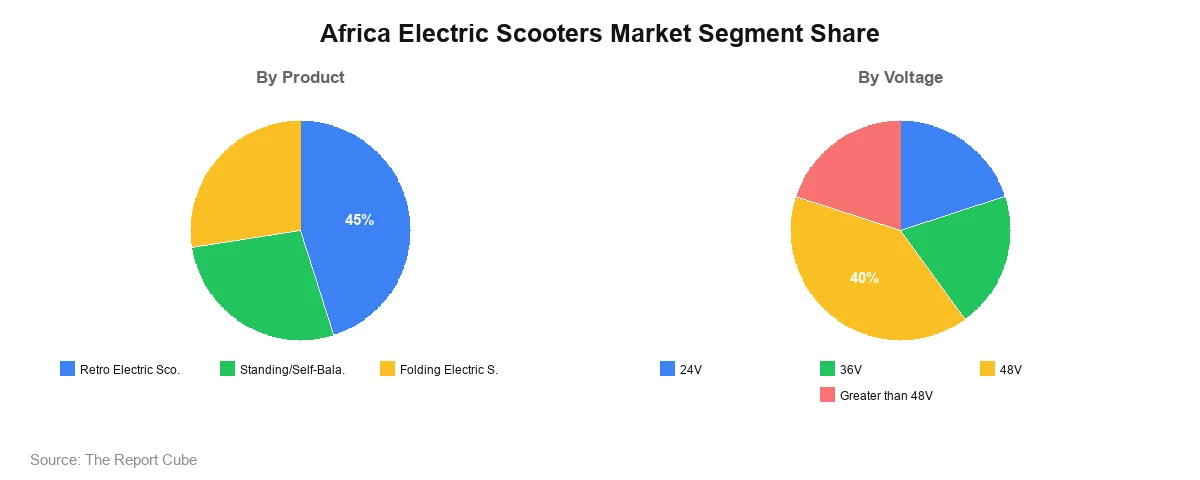
Retro Electric Scooter leads this category with an approximate 45% share in 2026. Standing/Self-Balancing Electric Scooters is the second analyzed segment. Its commercial role is linked to a distinct product, customer, technology or use-case requirement within the category. The remaining subsegments Folding Electric Scooters are retained in the scope, but their individual shares are not reliably quantifiable from the available sources.
By Voltage
- 24V
- 36V
- 48V
- Greater than 48V
48V leads this category with an approximate 40% share in 2026. 24V is the second analyzed segment. Its commercial role is linked to a distinct product, customer, technology or use-case requirement within the category. The remaining subsegments 36V, Greater than 48V are retained in the scope, but their individual shares are not reliably quantifiable from the available sources.
Africa Electric Scooters Market Regional Analysis
Regional performance varies by market, geography and the supplied country or regional scope. The table summarizes the available regional assessment. Region-specific industry trends are shown only where supported; otherwise, they are identified as not reliably established from available sources.
| Region | Key Growth Factors | Industry Trends |
|---|---|---|
| East Africa | Kenya and Uganda have emerging electric two-wheeler ecosystems, including commercial motorcycle use and battery-swapping networks. | Battery swapping, fleet financing and delivery/ride-hailing use cases are becoming important adoption models. |
| West Africa | Urban motorcycle and delivery activity creates potential use cases for electric two-wheelers, subject to charging access and purchase affordability. | Local assembly, battery access and pay-as-you-go or lease models are relevant to market development. |
| Southern Africa | Urban commuting and fleet electrification create opportunities, while vehicle cost and charging infrastructure affect adoption. | Product range, battery durability and total cost of ownership influence consumer and fleet decisions. |
| North Africa | Large urban centers and transport electrification initiatives offer potential, but country-specific electric scooter deployment evidence remains limited. | Import availability, charging/swapping infrastructure and regulatory frameworks shape adoption. |
The table covers South Africa, Morocco, Algeria, Egypt. South Africa is identified as the leading region or country group in the supplied input; the stated share remains an analyst estimate where shown and is not independently verified. Other growth-factor details are limited to the supplied assessment, while comparable industry-trend evidence was not available for reliable region-by-region comparison.
These groupings are not necessarily exhaustive or mutually exclusive at the level of all possible market activity. The input estimate for the leading group is retained as an estimate and is not used to calculate the shares of other regions. A comparable regional revenue-share series was not established from the reviewed source set.
Company Profiles
- Honda Motor Co Ltd: Honda Motor Co Ltd is included among the companies identified for this market in the supplied input. The available project source set does not establish a verified market-specific revenue figure, share, ranking, contract award or country-level footprint for this company. Its position should therefore be evaluated through official product information, regulatory or certification records, disclosed regional operations and customer announcements before assigning a competitive rank.
- KTM AG: KTM AG is included among the companies identified for this market in the supplied input. The available project source set does not establish a verified market-specific revenue figure, share, ranking, contract award or country-level footprint for this company. Its position should therefore be evaluated through official product information, regulatory or certification records, disclosed regional operations and customer announcements before assigning a competitive rank.
Africa Electric Scooters Market Future Outlook
The supplied forecast places the Africa Electric Scooters Market at USD 67.71 million in 2027 and USD 124.40 million by 2035, at the supplied CAGR of 7.9% over 2027–2035. These are input values retained for CMS publication and are not independently re-estimated in this narrative. The forecast trajectory will depend on market-specific adoption, capital availability, policy execution, customer affordability, supply-chain resilience and the ability of providers to deliver consistent quality.
In the near term, suppliers are likely to prioritise operational reliability, channel access and compliance. Over the medium term, investment in technology, local capability, partnerships and service infrastructure may influence competitive outcomes. Forecast uncertainty remains material where public datasets do not directly measure the defined market; readers should interpret the projection alongside the disclosed evidence limitations.
Africa Electric Scooters Market Report Coverage
The Africa Electric Scooters Market report coverage table summarizes the supplied market values, forecast assumptions, geographic scope, segmentation and named companies. No base-year market value was supplied, so it is identified as unavailable; the 2027 and forecast-year values are reproduced from the input.
| Parameter | Details |
|---|---|
| Market Name | Africa Electric Scooters Market |
| Market Size (2027) | 67.71 million |
| Market Size (Forecast Year) | 124.40 million |
| CAGR | 7.90% |
| Base Year | 2026 |
| Historical Period | 2022-2026 |
| Forecast Period | 2027-2035 |
| Segmentation | By Product, By Battery, By Voltage, By Country |
| Regions Covered | South Africa, Morocco, Algeria, Egypt |
| Key Companies | Honda Motor Co Ltd, KTM AG, Mahindra GenZe, Peugeot Scooters, Ninebot Limited, Suzuki Motor Corporation, Terra Motors Corporation, Vmoto Limited, Yadea Technology Group Co. Ltd., Yamaha Motor Company Limited |
| Customization | Yes |
The table consolidates the report scope and supplied assumptions for the Africa Electric Scooters Market. The supplied market value moves from 67.71 million in 2027 to 124.40 million in 2035. The supplied CAGR is 7.9%; it is reproduced as provided and should be read alongside the stated forecast period. The historical reference period is 2021–2025. The forecast reference period is 2027–2035. These are the report inputs and scope descriptors; the table does not independently validate the underlying market estimates.
Why Choose This Africa Electric Scooters Market Report
- Presents the supplied 2027 market value, 2035 forecast value and CAGR without altering the input assumptions.
- Organises all supplied segmentation categories and retains every listed subsegment.
- Explains the leading and second analyzed segment within each category while distinguishing estimates from verified statistics.
- Provides a regional or country-group assessment without inventing unsupported revenue shares.
- Identifies the companies supplied for the competitive landscape without assigning unsupported rankings or market shares.
- Uses institutional and official sources for relevant policy, regulatory and sector context, with source limitations disclosed.
- Highlights market opportunities, operating constraints, trends and forecast uncertainties to support further commercial assessment.
Table of Contents
- Introduction
- Objective of the Study
- Product Definition
- Market Segmentation
- Study Variables
- Research Methodology
- Secondary Data Points
- Companies Interviewed
- Primary Data Points
- Breakdown of Primary Interviews
- Secondary Data Points
- Executive Summary
- Market Dynamics
- Drivers
- Challenges
- Opportunity Assessment
- Recent Trends and Developments
- Policy and Regulatory Landscape
- Africa Electric Scooters Market Overview and Forecast Analysis (2022-2035)
- Market Size, By Value, By Growth Rate (CAGR/USD Millions)
- Demand – Supply Trends
- Market Share, By Product
- Retro Electric Scooter
- Standing/Self-Balancing Electric Scooters
- Folding Electric Scooters
- Market Share, By Battery
- Sealed Lead Acid
- NiMH
- Li-Ion
- Market Share, By Voltage
- 24V
- 36V
- 48V
- Greater than 48V
- Market Share, By Country
- South Africa
- Morocco
- Algeria
- Egypt
- Market Share, By Competitors
- Competition Characteristics
- Revenue Shares
- Retro Electric Scooter Africa Electric Scooters Market Overview, 2022-2035F
- By Value (USD Million)
- By Battery – Market Size & Forecast 2022-2035, USD Million
- Sealed Lead Acid
- NiMH
- Li-Ion
- Standing/Self-Balancing Electric Scooters Africa Electric Scooters Market Overview, 2022-2035F
- By Value (USD Million)
- By Battery – Market Size & Forecast 2022-2035, USD Million
- Sealed Lead Acid
- NiMH
- Li-Ion
- Folding Electric Scooters Africa Electric Scooters Market Overview, 2022-2035F
- By Value (USD Million)
- By Battery – Market Size & Forecast 2022-2035, USD Million
- Sealed Lead Acid
- NiMH
- Li-Ion
- Competitive Outlook (Company Profile – Partial List)
- Honda Motor Co Ltd
- Company Overview
- Business Segments
- Strategic Alliances/Partnerships
- Recent Developments
- KTM AG
- Company Overview
- Business Segments
- Strategic Alliances/Partnerships
- Recent Developments
- Mahindra GenZe
- Company Overview
- Business Segments
- Strategic Alliances/Partnerships
- Recent Developments
- Peugeot Scooters
- Company Overview
- Business Segments
- Strategic Alliances/Partnerships
- Recent Developments
- Ninebot Limited
- Company Overview
- Business Segments
- Strategic Alliances/Partnerships
- Recent Developments
- Suzuki Motor Corporation
- Company Overview
- Business Segments
- Strategic Alliances/Partnerships
- Recent Developments
- Terra Motors Corporation
- Company Overview
- Business Segments
- Strategic Alliances/Partnerships
- Recent Developments
- Vmoto Limited
- Company Overview
- Business Segments
- Strategic Alliances/Partnerships
- Recent Developments
- Yadea Technology Group Co. Ltd.
- Company Overview
- Business Segments
- Strategic Alliances/Partnerships
- Recent Developments
- Yamaha Motor Company Limited
- Company Overview
- Business Segments
- Strategic Alliances/Partnerships
- Recent Developments
- Honda Motor Co Ltd
- Contact Us & Disclaimer
Top Key Players & Market Share Outlook
- Honda Motor Co Ltd
- KTM AG
- Mahindra GenZe
- Peugeot Scooters
- Ninebot Limited
- Suzuki Motor Corporation
- Terra Motors Corporation
- Vmoto Limited
- Yadea Technology Group Co. Ltd.
- Yamaha Motor Company Limited
Frequently Asked Questions