



Build Your Custom Market Intelligence Report
Customize Your ReportGlobal AI Inference and Accelerator Chips Market Key Highlights
By Chip Type:
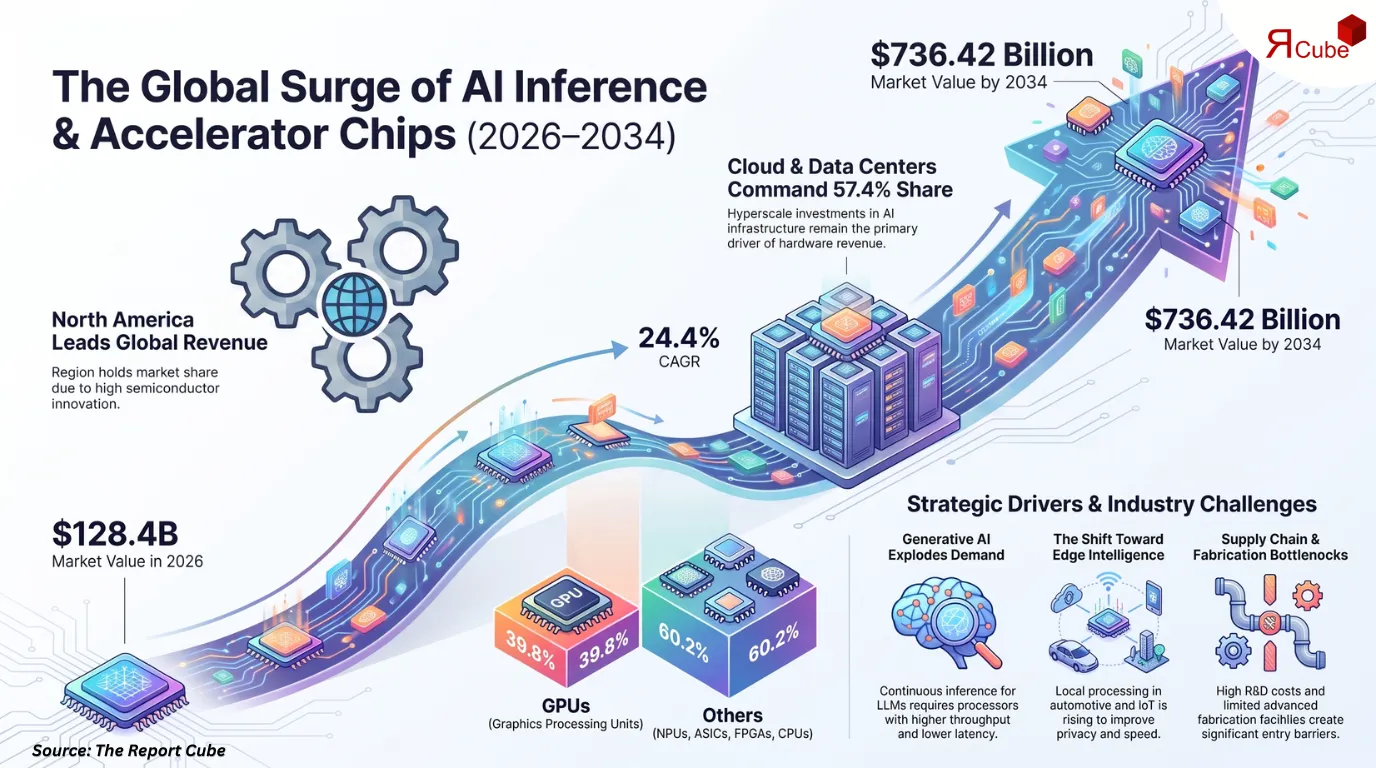
GPUs segment leads the market with approximately 39.8% share.
By Deployment:
Cloud and Data Center Inference segment dominates the market with nearly 57.4% of total revenue.
Regional Outlook:
North America dominates the Global AI Inference and Accelerator Chips Market with around 43.6% market share.
Global AI Inference and Accelerator Chips Market Insights & Analysis
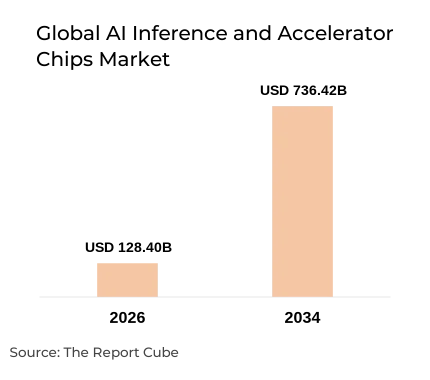
The Global AI Inference and Accelerator Chips Market is anticipated to register a CAGR of around 24.40% during the forecast period 2026-2034. The market size is valued at USD 128.40 billion in 2026 and is projected to reach USD 736.42 billion by 2034. Growing deployment of artificial intelligence across cloud platforms, edge computing, autonomous systems, enterprise software, and consumer electronics is accelerating demand for specialized inference processors. Organizations are increasingly shifting from general-purpose computing toward dedicated AI accelerators capable of delivering higher throughput while reducing latency and power consumption. Continuous improvements in semiconductor manufacturing, advanced chip packaging, high-bandwidth memory technologies, and heterogeneous computing architectures are further strengthening market growth. Increasing investments from hyperscale cloud providers, automotive manufacturers, healthcare organizations, and industrial automation companies continue to expand commercial opportunities across the AI inference ecosystem.
Technology companies are investing billions of dollars in next-generation AI infrastructure to support generative AI, large language model inference, and multimodal AI applications. Governments across North America, Europe, and Asia Pacific are also strengthening semiconductor manufacturing through incentive programs, research funding, and domestic chip production initiatives to improve supply chain resilience. Industry participants are introducing custom AI accelerators, domain-specific processors, and energy-efficient inference chips designed for edge devices, robotics, telecommunications, and industrial automation. The rapid expansion of AI-enabled services, combined with increasing enterprise adoption of private AI infrastructure and cloud-native inference platforms, is expected to create substantial opportunities throughout the forecast period while encouraging continuous innovation across chip design, software optimization, and advanced packaging technologies.
Global AI Inference and Accelerator Chips Market Impact Analysis
| Factor | Type | Specific Impact on Market | Magnitude | Business Implication |
|---|---|---|---|---|
| Explosive AI Workload Growth | Market | Surging demand for generative and inferencing compute drives chip uptake worldwide | High | Vendors must scale capacity and product lines to serve hyperscale, enterprise, and edge users |
| Specialized Accelerator Architectures | Technological | GPUs, TPUs and custom ASICs improve performance per watt for AI inference tasks | High | Continuous architecture innovation and software stacks are needed to stay competitive |
| Cloud and Hyperscale Investments | Market | Major cloud providers deploy custom accelerators to lower cost of AI services | High | Chip vendors must form strategic design wins and long term supply agreements with clouds |
| Shift Toward Edge AI Inference | Consumer | Growing on device processing needs create demand for low power edge chips | Medium | Requires differentiated edge portfolios tuned for automotive, IoT, and mobile use |
| Capital and R&D Intensiveness | Environmental | High design and fabrication costs raise entry barriers and favor large players | High | Firms need focused R&D bets and partnerships to manage risk and time to market |
| Geopolitical and Supply Risks | Regulatory | Export controls and supply constraints affect access to advanced AI chips | Medium | Necessitates geographic fab diversification and compliance led market planning |
| Intensifying Competitive Landscape | Competitive | Established vendors and startups vie for share across niches and regions | High | Requires clear positioning, ecosystem building, and software toolchain strength |
Global AI Inference and Accelerator Chips Market Dynamics
Key Driver: Commercial Deployment of Generative AI Across Enterprise Operations
Rapid commercialization of generative AI is fundamentally changing enterprise computing requirements and significantly increasing demand for specialized AI inference processors. Organizations are embedding conversational AI, intelligent document processing, software development assistants, recommendation engines, fraud detection platforms, and predictive analytics into daily business operations. Since inference workloads execute whenever users interact with AI applications, processors must deliver consistent performance while maintaining low response times and efficient power utilization. This operational requirement has accelerated purchases of dedicated AI accelerators across cloud environments, private data centers, and enterprise infrastructure. Growing adoption of multimodal AI models capable of processing text, images, audio, and video simultaneously has further increased computational requirements, encouraging businesses to modernize their AI infrastructure with purpose-built semiconductor solutions.
Hardware innovation is progressing alongside software optimization, allowing organizations to improve AI performance while reducing infrastructure costs. Semiconductor companies continue introducing processors featuring higher tensor computing capability, expanded memory bandwidth, and optimized inference engines capable of handling increasingly larger language models. Software frameworks that support quantization, model compression, and runtime optimization are also improving hardware utilization across diverse deployment environments. These technological advances enable enterprises to process more AI workloads using fewer computing resources, strengthening the business case for investing in dedicated inference accelerators instead of relying solely on traditional general-purpose processors.
Industry Trends: Specialized AI Silicon and Edge Intelligence Are Reshaping Semiconductor Demand
Chip architecture is becoming increasingly application-specific as organizations seek greater efficiency for different AI workloads. Instead of deploying identical hardware across every environment, businesses are selecting processors optimized for computer vision, natural language processing, robotics, autonomous driving, recommendation systems, and generative AI inference. Domain-specific accelerators reduce unnecessary computing overhead while improving throughput and lowering operational costs. This transition is encouraging semiconductor vendors to develop customized inference engines capable of delivering higher performance within specific application environments. Continuous improvements in software compatibility are also enabling enterprises to deploy AI models across heterogeneous hardware platforms without extensive redevelopment.
Edge computing has emerged as another major growth area within the AI inference and accelerator chips market. Manufacturing facilities, hospitals, connected vehicles, retail stores, telecommunications infrastructure, and industrial automation systems increasingly require AI decisions to be processed locally rather than transmitted to centralized cloud platforms. Local inference improves response speed, reduces bandwidth consumption, strengthens data privacy, and enables uninterrupted operation even when network connectivity is limited. As edge AI adoption expands, demand is increasing for compact, energy-efficient processors capable of delivering enterprise-grade inference performance within constrained power and thermal environments.
Book your FREE 30-minute expert consultation today
Contact UsMajor Challenge: Supply Chain Constraints and Rising Semiconductor Development Complexity
Designing competitive AI inference processors requires extensive investment in semiconductor engineering, software optimization, advanced packaging, and manufacturing partnerships. Development costs continue to rise as transistor densities increase and AI models require larger memory capacity, faster interconnects, and more sophisticated computing architectures. Only a limited number of fabrication facilities currently support the most advanced process technologies, creating production bottlenecks during periods of elevated market demand. Access to high-bandwidth memory and advanced packaging capacity has also become a strategic consideration for companies expanding AI accelerator production.
International trade regulations, export controls, and geopolitical uncertainty have introduced additional complexity into global semiconductor supply chains. Manufacturers must balance regional compliance requirements while maintaining reliable access to fabrication, testing, packaging, and component suppliers. At the same time, enterprise customers expect rapid product upgrades capable of supporting increasingly larger AI models, forcing chip developers to accelerate research cycles without compromising product reliability. Successfully managing these technical and operational challenges will remain essential for sustaining long-term competitiveness within the AI inference semiconductor industry.
Opportunity: Enterprise AI Modernization and Next-Generation Edge Computing
Organizations across healthcare, banking, manufacturing, telecommunications, government, transportation, and retail are expanding investments in AI-enabled decision-making systems, creating long-term opportunities for AI inference hardware suppliers. Hospitals increasingly deploy AI-assisted diagnostic imaging and clinical decision support, while manufacturers rely on intelligent inspection systems, predictive maintenance, and collaborative robotics. Financial institutions continue expanding fraud detection, customer analytics, and risk management platforms powered by real-time inference. These rapidly growing enterprise workloads require processors capable of delivering reliable performance with lower operating costs, strengthening demand for specialized AI accelerator technologies.
Future market growth will also be supported by the expansion of intelligent edge infrastructure across smart cities, industrial Internet of Things networks, autonomous mobility, defense applications, and connected consumer devices. Processing AI workloads closer to the source reduces latency while improving security and operational resilience. Semiconductor companies that combine efficient hardware architectures with optimized AI software ecosystems will be well positioned to capture emerging opportunities as enterprises increasingly distribute AI inference across cloud, on-premises, and edge computing environments. Continued investment in advanced memory technologies, energy-efficient chip design, and heterogeneous computing platforms is expected to further strengthen the long-term outlook for the Global AI Inference and Accelerator Chips Market.
Global AI Inference and Accelerator Chips Market Segment-wise Analysis
By Chip Type:
- NPUs
- TPUs and Domain-Specific AI Processors
- FPGAs
- CPUs with Integrated AI Acceleration
- ASICs and Custom Inference Accelerators
- GPUs
- Others
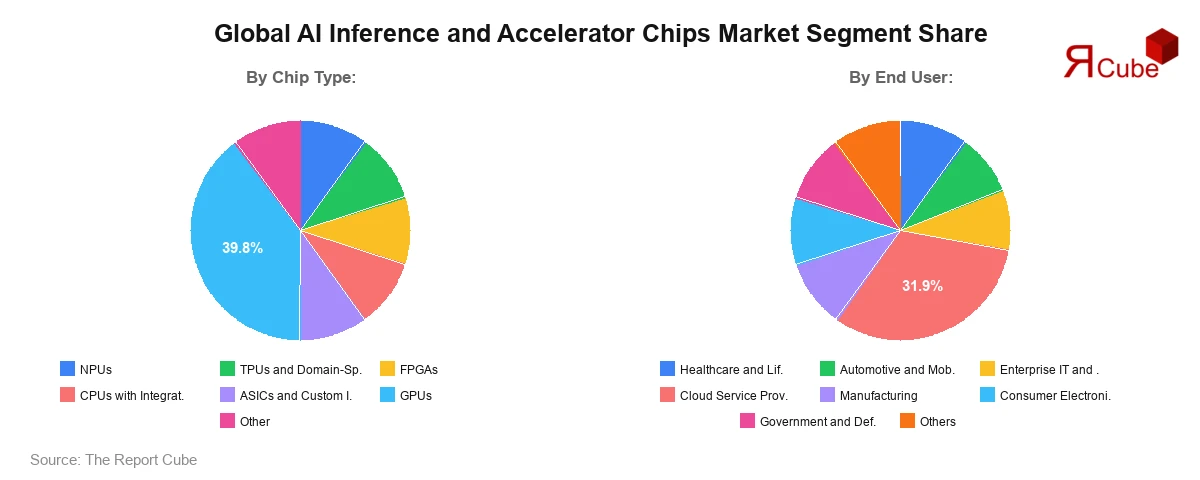
The GPUs segment accounted for approximately 39.8% of the Global AI Inference and Accelerator Chips Market in 2026 and continues to generate the highest revenue among all chip categories. Market leadership is supported by the ability of modern GPUs to execute billions of parallel mathematical operations required for transformer models, recommendation engines, computer vision, and multimodal AI applications. Their mature software ecosystem, including optimized AI frameworks and developer tools, allows enterprises to deploy inference workloads without significant redevelopment. Continuous improvements in tensor processing capabilities, high-bandwidth memory integration, advanced interconnect technologies, and chiplet-based architectures have further increased throughput while improving energy efficiency.
Cloud providers, research organizations, enterprise software companies, and digital platform operators continue to prioritize GPU deployments because they provide the flexibility needed to support evolving AI models. Although specialized NPUs and custom ASICs are gaining adoption for dedicated workloads, GPUs remain the preferred platform for large-scale commercial AI inference due to their balanced combination of performance, scalability, and software compatibility.
By End User:
- Healthcare and Life Sciences
- Automotive and Mobility
- Enterprise IT and SaaS Companies
- Cloud Service Providers and Hyperscalers
- Manufacturing
- BFSI
- Consumer Electronics
- Telecom
- Research Institutions
- Government and Defense
The Cloud Service Providers and Hyperscalers segment generated approximately 31.9% of global market revenue in 2026, making it the largest end-user category. AI services delivered through public cloud platforms continue expanding across software development, cybersecurity, healthcare, financial analytics, retail, media, and industrial applications, driving sustained investment in accelerator hardware. Leading hyperscale operators are building AI-focused data centers equipped with thousands of specialized processors, high-performance networking solutions, and advanced cooling technologies capable of supporting continuous inference workloads.
Many providers are also developing proprietary AI accelerators to optimize infrastructure efficiency while reducing operating costs and improving service differentiation. As enterprise demand for AI platforms, managed inference services, and foundation model hosting continues to increase, hyperscale cloud companies are expected to remain the primary purchasers of next-generation AI accelerator chips throughout the forecast period.
Regional Projection of Global AI Inference and Accelerator Chips Industry
- North America
- Europe
- Asia Pacific
- Middle East and Africa
- South America
North America accounted for approximately 43.6% of the Global AI Inference and Accelerator Chips Market in 2026 and continues to lead global revenue generation. The region benefits from a highly integrated ecosystem that combines semiconductor innovation, AI software development, cloud computing infrastructure, venture capital investment, and advanced research capabilities. Technology companies headquartered in the United States continue investing billions of dollars in AI-ready data centers, custom accelerator development, high-bandwidth networking, and advanced semiconductor packaging to support growing enterprise AI demand.
Strong adoption of artificial intelligence across healthcare, financial services, automotive, aerospace, manufacturing, and government organizations further strengthens regional market performance. Public policies supporting semiconductor manufacturing, research collaboration, and domestic fabrication capacity are also improving supply chain resilience. While North America maintains technological leadership, Asia Pacific is expected to register the fastest growth over the forecast period, supported by expanding semiconductor manufacturing, increasing AI commercialization, and substantial investments in digital infrastructure across China, South Korea, Japan, Taiwan, and India.
Need insights for a specific region within this market?
Request Regional DataRegional Analysis of Global AI Inference and Accelerator Chips Market
Global AI inference and accelerator chips demand varies by region due to cloud build‑out, enterprise AI adoption, and semiconductor ecosystem maturity.
| Region | Demand Level | Key Areas | System Dominance | Core Demand Logic | Growth Nature |
|---|---|---|---|---|---|
| North America | Very High | US, Canada | GPU, custom ASIC, data center cards | Hyperscaler AI clouds and enterprise AI | Upgrade‑driven, capacity expansion |
| Europe | High | Germany, UK, France | Data center accelerators, edge AI SoCs | Regulated AI in industry and automotive | Policy‑led, steady scaling |
| Asia Pacific | Extremely High | China, Taiwan, South Korea | Foundry‑backed GPUs, NPUs, edge chips | Mass digitalization and device OEM demand | Fastest‑growing, volume‑driven |
| Middle East and Africa | Medium | UAE, Saudi Arabia, Israel | Cloud accelerators, sovereign AI stacks | State‑funded AI hubs and smart cities | Project‑led, emerging ramp‑up |
| South America | Low to Medium | Brazil, Mexico | Cloud GPUs, edge inference modules | AI in fintech, retail, and public services | Adoption‑driven, catch‑up growth |
Government Initiatives & Policies
- United States CHIPS and Science Act Implementation (2025–2026): The U.S. government continued awarding semiconductor manufacturing and advanced packaging incentives to strengthen domestic AI chip production, research, and supply chain resilience.
- European Union AI Factories Initiative (2025): The European Commission expanded investments in AI supercomputing infrastructure and AI factories to strengthen development, deployment, and commercialization of advanced AI technologies across Europe.
Global AI Inference and Accelerator Chips Industry Recent Developments
- 2025: NVIDIA Corporation announced that its Blackwell platform achieved industry-leading results in the MLPerf Inference v5.0 benchmarks. The GB200 NVL72 rack-scale platform demonstrated exceptional AI reasoning and high-throughput inference performance, reinforcing NVIDIA's leadership in large language model and generative AI inference infrastructure.
- 2025: Advanced Micro Devices, Inc. expanded its AI accelerator portfolio with the launch of the Instinct MI350 Series GPUs. Featuring up to 288GB of HBM3E memory and 8TB/s memory bandwidth, the processors were designed to accelerate large-scale AI inference, foundation models, and enterprise AI training workloads while improving computing efficiency.
- 2025: Qualcomm Technologies, Inc. introduced the AI200 and AI250 data center AI inference accelerator platforms. The new accelerator cards and rack-scale systems support high-performance generative AI inference through large memory capacity, direct liquid cooling, improved energy efficiency, and a lower total cost of ownership for enterprise and cloud deployments.
Why Choose This Report?
- Provides a comprehensive overview of the overall market analysis, encompassing key trends, consumer behavior analysis, and risk assessment to support strategic decision-making.
- Provides accurate, up-to-date insights into market size, segmentation, and emerging opportunities, helping to minimize risk while capitalizing on growth.
- Gives deep understanding of target audience preferences, investment habits, and communication channels for enhanced product development and marketing effectiveness.
- Delivers competitive analysis and benchmarking, uncovering the strengths and weaknesses of market competitors to guide business strategies.
- Consolidates comprehensive market intelligence, reducing research efforts and streamlining strategic planning.
- Facilitates customized market segmentation and risk mitigation strategies that align with specific business objectives.
- Aids in identifying both market challenges and untapped opportunities within the industry to drive long-term business growth.
- Provides valuable information based on actual customer data, industry developments, and search trends.
Table of Contents
- Introduction
- Objective of the Study
- Product and Category Definition
- Market Segmentation
- Study Variables
- Research Methodology
- Secondary Data Points
- Breakdown of Secondary Sources
- Primary Data Points
- Breakdown of Primary Interviews
- Secondary Data Points
- Executive Summary
- Market Dynamics
- Emerging Opportunities
- Adoption Trends
- Demand Drivers
- Disruption Analysis (Challenges)
- Industry Analysis & Strategic Insights
- Supply and Value Chain Analysis
- Pricing Analysis
- Go-To-Market Strategy
- BCG Matrix
- Recent Trends and Developments
- Import and Export Analysis
- Regulatory and Policy Landscape
- Region-wise Policies
- Government Initiatives
- Global AI Inference and Accelerator Chips Market Overview and Forecast Analysis (2021-2034)
- Market Size, By Value and Growth Rate (CAGR/USD Billion)
- Market Share, By Chip Type
- NPUs, TPUs and Domain-Specific AI Processors
- FPGAs
- CPUs with Integrated AI Acceleration
- ASICs and Custom Inference Accelerators
- GPUs
- Other Domain-Specific Processors
- Market Share, By Deployment
- Edge AI Inference
- On-Premises Enterprise AI Inference
- Cloud and Data Center Inference
- Market Share, By Application
- Computer Vision
- Autonomous Systems, Robotics and Industrial AI
- Recommendation Systems, Search and Digital Advertising
- Natural Language Processing and Conversational AI
- Generative AI and Large Language Model Inference
- Other AI Workloads
- Market Share, By End User
- Healthcare and Life Sciences
- Automotive and Mobility
- Enterprise IT and SaaS Companies
- Cloud Service Providers and Hyperscalers
- Manufacturing
- BFSI
- Consumer Electronics
- Telecom
- Research Institutions
- Government and Defense
- Market Share, By Region
- North America
- Europe
- Asia Pacific
- Middle East and Africa
- South America
- Market Share, By Company
- Revenue Shares and Analysis
- Competitive Landscape
- North America AI Inference and Accelerator Chips Market Overview and Forecast Analysis (2021-2034)
- Market Size, By Value and Growth Rate (CAGR/USD Billion/Million)
- Market Share, By Chip Type
- Market Share, By Deployment
- Market Share, By Application
- Market Share, By End User
- Market Share, By Country
- United States
- Canada
- Mexico
- Rest of North America
- Europe AI Inference and Accelerator Chips Market Overview and Forecast Analysis (2021-2034)
- Market Size, By Value and Growth Rate (CAGR/USD Billion/Million)
- Market Share, By Chip Type
- Market Share, By Deployment
- Market Share, By Application
- Market Share, By End User
- Market Share, By Country
- Germany
- United Kingdom
- France
- Italy
- Spain
- Netherlands
- Russia
- Poland
- Belgium
- Sweden
- Rest of Europe
- Asia Pacific AI Inference and Accelerator Chips Market Overview and Forecast Analysis (2021-2034)
- Market Size, By Value and Growth Rate (CAGR/USD Billion/Million)
- Market Share, By Chip Type
- Market Share, By Deployment
- Market Share, By Application
- Market Share, By End User
- Market Share, By Country
- China
- India
- Japan
- South Korea
- Australia
- Indonesia
- Thailand
- Malaysia
- Vietnam
- Philippines
- Singapore
- New Zealand
- Rest of Asia Pacific
- Middle East and Africa AI Inference and Accelerator Chips Market Overview and Forecast Analysis (2021-2034)
- Market Size, By Value and Growth Rate (CAGR/USD Billion/Million)
- Market Share, By Chip Type
- Market Share, By Deployment
- Market Share, By Application
- Market Share, By End User
- Market Share, By Country
- Saudi Arabia
- United Arab Emirates
- South Africa
- Egypt
- Nigeria
- Morocco
- Turkey
- Rest of Middle East and Africa
- South America AI Inference and Accelerator Chips Market Overview and Forecast Analysis (2021-2034)
- Market Size, By Value and Growth Rate (CAGR/USD Billion/Million)
- Market Share, By Chip Type
- Market Share, By Deployment
- Market Share, By Application
- Market Share, By End User
- Market Share, By Country
- Brazil
- Argentina
- Chile
- Colombia
- Peru
- Rest of South America
- Competitive Analysis, 2026
- Market Share of Key Players
- Competitive Mapping for Each Chip Type, Deployment, Application and End User
- North America AI Inference and Accelerator Chips Companies Share and Competitive Analysis, 2026
- Europe AI Inference and Accelerator Chips Companies Share and Competitive Analysis, 2026
- Asia Pacific AI Inference and Accelerator Chips Companies Share and Competitive Analysis, 2026
- Middle East and Africa AI Inference and Accelerator Chips Companies Share and Competitive Analysis, 2026
- South America AI Inference and Accelerator Chips Companies Share and Competitive Analysis, 2026
- Company Profile (Partial List)
- Broadcom Inc.
- Company Overview
- Product Portfolio
- Strategic Alliances/Partnerships
- Recent Developments
- Google
- Company Overview
- Product Portfolio
- Strategic Alliances/Partnerships
- Recent Developments
- Groq
- Company Overview
- Product Portfolio
- Strategic Alliances/Partnerships
- Recent Developments
- NVIDIA Corporation
- Company Overview
- Product Portfolio
- Strategic Alliances/Partnerships
- Recent Developments
- Tenstorrent
- Company Overview
- Product Portfolio
- Strategic Alliances/Partnerships
- Recent Developments
- MediaTek Inc.
- Company Overview
- Product Portfolio
- Strategic Alliances/Partnerships
- Recent Developments
- Samsung Electronics
- Company Overview
- Product Portfolio
- Strategic Alliances/Partnerships
- Recent Developments
- Intel Corporation
- Company Overview
- Product Portfolio
- Strategic Alliances/Partnerships
- Recent Developments
- Marvell Technology
- Company Overview
- Product Portfolio
- Strategic Alliances/Partnerships
- Recent Developments
- Huawei Technologies Co., Ltd.
- Company Overview
- Product Portfolio
- Strategic Alliances/Partnerships
- Recent Developments
- Hailo Technologies
- Company Overview
- Product Portfolio
- Strategic Alliances/Partnerships
- Recent Developments
- Advanced Micro Devices, Inc.
- Company Overview
- Product Portfolio
- Strategic Alliances/Partnerships
- Recent Developments
- Amazon Web Services
- Company Overview
- Product Portfolio
- Strategic Alliances/Partnerships
- Recent Developments
- Qualcomm Technologies, Inc.
- Company Overview
- Product Portfolio
- Strategic Alliances/Partnerships
- Recent Developments
- Rebellions Inc.
- Company Overview
- Product Portfolio
- Strategic Alliances/Partnerships
- Recent Developments
- Apple Inc.
- Company Overview
- Product Portfolio
- Strategic Alliances/Partnerships
- Recent Developments
- Arm Holdings
- Company Overview
- Product Portfolio
- Strategic Alliances/Partnerships
- Recent Developments
- Cerebras Systems
- Company Overview
- Product Portfolio
- Strategic Alliances/Partnerships
- Recent Developments
- Microsoft
- Company Overview
- Product Portfolio
- Strategic Alliances/Partnerships
- Recent Developments
- SK Hynix
- Company Overview
- Product Portfolio
- Strategic Alliances/Partnerships
- Recent Developments
- SiMa.ai
- Company Overview
- Product Portfolio
- Strategic Alliances/Partnerships
- Recent Developments
- SambaNova Systems
- Company Overview
- Product Portfolio
- Strategic Alliances/Partnerships
- Recent Developments
- Others (Partial List)
- Broadcom Inc.
- Contact Us and Disclaimer
Top Key Players & Market Share Outlook
- Broadcom Inc.
- Groq
- NVIDIA Corporation
- Tenstorrent
- MediaTek Inc.
- Samsung Electronics
- Intel Corporation
- Marvell Technology
- Huawei Technologies Co., Ltd.
- Hailo Technologies
- Advanced Micro Devices, Inc.
- Amazon Web Services
- Qualcomm Technologies, Inc.
- Rebellions Inc.
- Apple Inc.
- Arm Holdings
- Cerebras Systems
- Microsoft
- SK Hynix
- SiMa.ai
- SambaNova Systems
- Others
Frequently Asked Questions






