



Build Your Custom Market Intelligence Report
Customize Your ReportChina Semiconductor Manufacturing Market Key Highlights
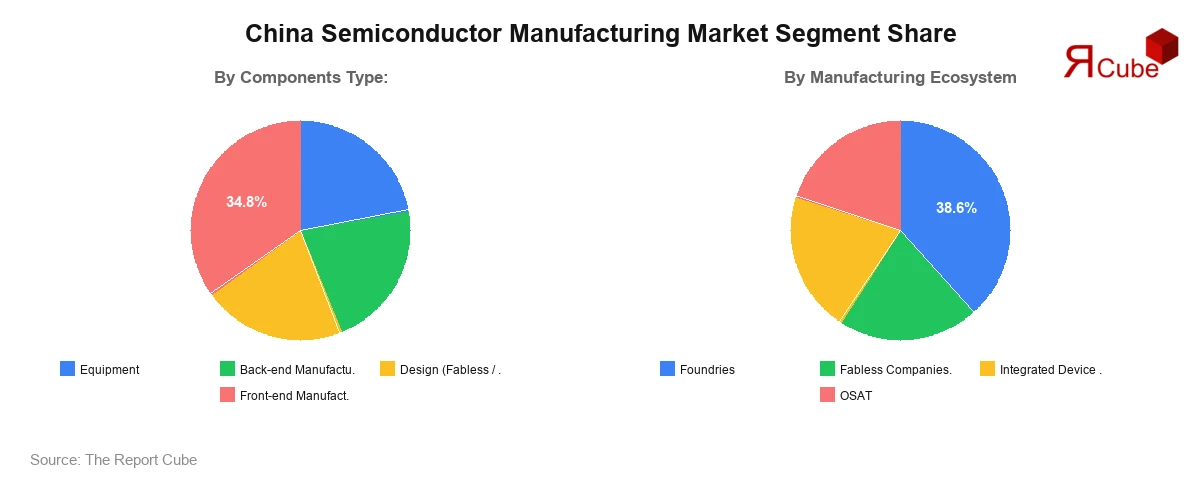
By Components Type:
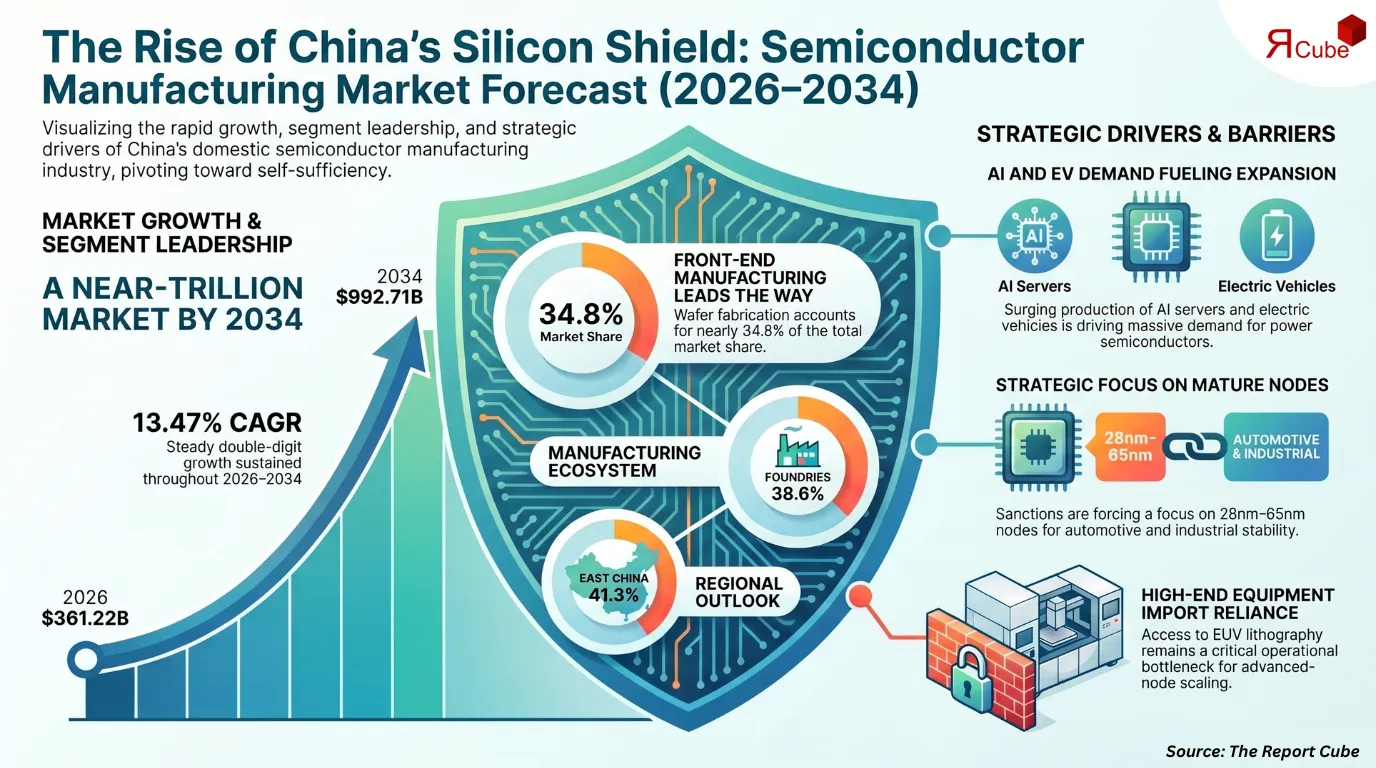
Front-end Manufacturing (Wafer Fabrication) segment leads the market with nearly 34.8% share.
By Manufacturing Ecosystem:
Foundries segment dominates the market with around 38.6% of revenue.
Regional Outlook:
East China dominates the China Semiconductor Manufacturing Market with approximately 41.3% share.
China Semiconductor Manufacturing Market Insights & Analysis
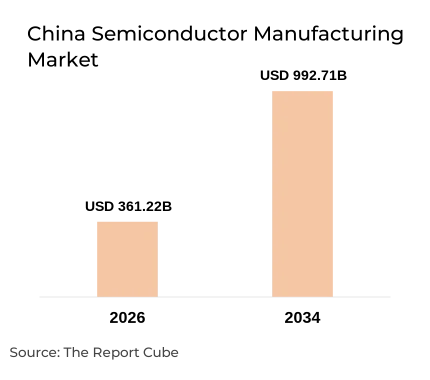
The China Semiconductor Manufacturing Market is anticipated to register a CAGR of around 13.47% during the forecast period 2026-2034. The market size is valued at USD 361.22 billion in 2026 and is projected to reach USD 992.71 billion by 2034. Rising large-scale industrial investments, domestic technology development, and accelerating semiconductor demand across advanced electronics industries. China remains one of the world’s largest semiconductor consumption hubs, creating strong momentum for localized wafer fabrication, semiconductor packaging, testing services, and chip design capabilities. Rising deployment of AI servers, electric vehicles, industrial automation systems, and cloud computing infrastructure is increasing production demand for memory chips, power semiconductors, analog ICs, and high-performance processors. Domestic semiconductor companies are also strengthening production resilience by expanding fabrication capacity for mature and mid-level process nodes used extensively across automotive electronics, industrial controls, and communication devices.
Industrial policies introduced across major semiconductor provinces continue supporting equipment localization, advanced packaging expansion, and semiconductor material production. Companies including SMIC, Hua Hong Semiconductor, and ChangXin Memory Technologies are increasing capital expenditure on wafer fabrication and process optimization technologies to strengthen domestic supply-chain reliability. The growing adoption of silicon carbide and gallium nitride semiconductors is also creating new growth opportunities linked to EV charging infrastructure, renewable energy systems, and high-frequency communication equipment. At the same time, investments in domestic EDA software, AI accelerators, and RISC-V processor ecosystems are helping China strengthen long-term semiconductor innovation capabilities while reducing reliance on imported technologies.
China Semiconductor Manufacturing Market Impact Analysis
| Factor | Type | Specific Impact on Market | Magnitude | Business Implication |
|---|---|---|---|---|
| State Backing and Subsidies | Regulatory | Large public funding accelerates fab capacity expansion | High | Enables aggressive scaling but heightens policy exposure |
| Export Controls and Sanctions | Environmental | Restrictions limit access to advanced tools and know how | High | Forces strategic focus on mature nodes and local sourcing |
| Surge in Mature Node Capacity | Market | Rapid build out risks oversupply in legacy technology lines | High | Drives price pressure and need for differentiation by service |
| Domestic Demand from Key Sectors | Market | Growth in autos, 5G and AI raises chip consumption volumes | High | Supports long term fab utilization if supply is well aligned |
| Technology Gap at Leading Edge | Technological | Lag in advanced nodes constrains participation in premium tiers | Medium | Encourages niche focus such as power and specialty processes |
| Import Reliance and Localization Push | Competitive | Policies promote replacing imported chips with domestic output | Medium | Opens share gain chances for capable local manufacturers |
| Global Demand Cycles and Volatility | Environmental | Downturns in electronics weaken export driven chip revenues | Medium | Requires flexible production and diversified customer base |
China Semiconductor Manufacturing Market Dynamics
Key Driver: Expansion of Domestic Semiconductor Production Capacity
China’s semiconductor manufacturing industry is benefiting from accelerated expansion of domestic fabrication facilities and production ecosystems. National and provincial investment programs are supporting construction of new wafer fabrication plants, semiconductor industrial parks, and advanced packaging facilities across regions including Shanghai, Jiangsu, Shenzhen, and Wuhan. The increasing need for localized semiconductor supply has encouraged domestic companies to strengthen production capabilities for logic chips, DRAM memory, power semiconductors, and automotive-grade ICs. This transition is particularly important for industries requiring long-term component stability, including electric vehicles, telecommunications infrastructure, and industrial automation systems.
The rapid growth of AI computing infrastructure is also driving semiconductor manufacturing demand across China. Cloud service providers and enterprise AI developers are increasing purchases of AI accelerators, high-bandwidth memory, and server processors to support large-scale data processing operations. Domestic foundries are therefore expanding mature-node and advanced-node production capacity to meet rising demand from AI, consumer electronics, and industrial applications. Strong coordination between government agencies, research institutes, and semiconductor manufacturers is further improving the country’s semiconductor production ecosystem.
Industry Trends: Increasing Adoption of Advanced Packaging and AI Processors
Advanced semiconductor packaging technologies are becoming increasingly important across China’s semiconductor manufacturing ecosystem. Semiconductor companies are investing in heterogeneous integration, chiplet architecture, wafer-level packaging, and high-density interconnect technologies to improve chip performance and energy efficiency. Demand for advanced packaging has increased significantly due to rapid growth in AI computing, data center infrastructure, and high-performance consumer electronics. Domestic OSAT companies are expanding packaging capacity to support rising production requirements for AI accelerators, automotive processors, and communication semiconductors.
Chinese technology firms are also intensifying investment in proprietary AI semiconductor development. Companies including Alibaba and Huawei are strengthening AI chip production to support enterprise cloud services, generative AI platforms, and intelligent computing infrastructure. Demand for high-performance processors and AI inference chips is encouraging semiconductor manufacturers to improve fabrication precision, testing efficiency, and thermal packaging capabilities. At the same time, the growing use of RISC-V processor architecture is creating broader opportunities for domestic semiconductor design innovation and long-term ecosystem development.
Book your FREE 30-minute expert consultation today
Contact UsMajor Challenge: Dependence on High-End Semiconductor Equipment Imports
Access to advanced semiconductor manufacturing equipment remains a major operational challenge for China’s semiconductor industry. Critical production technologies such as EUV lithography systems, advanced process control equipment, and certain semiconductor software platforms are still largely controlled by international suppliers. This creates limitations for manufacturers attempting to scale production of advanced-node semiconductors used in AI processors, premium smartphones, and next-generation computing systems. Semiconductor companies must therefore invest heavily in domestic alternatives while maintaining production efficiency under evolving global trade conditions.
The industry also faces pressure related to rising manufacturing costs and long investment cycles. Semiconductor fabrication facilities require substantial capital expenditure for cleanroom infrastructure, process equipment, semiconductor materials, and technical workforce development. Smaller manufacturers may face financial constraints while attempting to compete with larger state-supported semiconductor firms. In addition, fluctuations in memory chip pricing and periodic supply-demand imbalances can affect profitability across the semiconductor value chain. Strengthening local semiconductor equipment development remains essential for improving long-term manufacturing stability.
Opportunity: Growth in Automotive and Power Semiconductor Applications
China’s expanding electric vehicle industry is creating strong long-term opportunities for semiconductor manufacturers specializing in power devices and automotive-grade chips. Electric vehicles require significantly higher semiconductor content compared to conventional vehicles, particularly for battery management systems, onboard computing, power conversion modules, and advanced driver-assistance systems. Rising EV production across China is increasing demand for silicon carbide and gallium nitride semiconductors due to their superior efficiency in high-voltage automotive applications.
Industrial automation, renewable energy systems, and smart grid deployment are also supporting wider adoption of power semiconductors across China. Manufacturers are increasing production of insulated-gate bipolar transistors, MOSFETs, and analog power devices to support industrial equipment and energy infrastructure modernization. At the same time, rising deployment of AI-enabled edge devices, telecommunications hardware, and industrial IoT systems is strengthening demand for communication chips, mixed-signal ICs, and sensor semiconductors. These developments are expected to create sustainable revenue opportunities across China’s semiconductor manufacturing ecosystem throughout the forecast period.
China Semiconductor Manufacturing Market Segment-wise Analysis
By Components Type:
- Equipment
- Portable Systems
- Inspection & Metrology Tools
- Etching Equipment
- Lithography Equipment
- Assembly & Packaging Equipment
- Back-end Manufacturing
- Packaging (OSAT)
- Testing
- Assembly
- Design (Fabless / Chip Design)
- RF / Communication Chip Design
- Analog IC Design
- AI / HPC Chip Design
- Digital IC Design (CPU, GPU, SoC)
- Mixed-Signal Design
- Front-end Manufacturing (Wafer Fabrication)
- Manufacturing Node
- Mature Nodes (>65nm)
- Advanced Nodes (<28nm)
- Mid Nodes (28nm - 65nm)
- Process Stage
- Wafer Cleaning
- Photolithography
- CMP (Polishing)
- Etching
- Ion Implantation
- Deposition (CVD/PVD)
- Manufacturing Node
Front-end manufacturing, particularly wafer fabrication, continues to hold the dominant position within the China semiconductor manufacturing market with close to 34.8% revenue contribution due to rising investments in domestic chip production capacity and process technology expansion. The segment benefits from strong demand for mature-node semiconductors used in automotive electronics, industrial automation equipment, communication systems, and consumer devices. Several domestic foundries are increasing fabrication output for 28nm to 65nm nodes, which remain widely utilized across industrial and automotive applications because of cost efficiency and supply reliability.
Investment activity is also increasing in advanced-node semiconductor production linked to AI processors, cloud infrastructure, and high-performance computing systems. Semiconductor manufacturers are expanding photolithography, etching, deposition, and wafer inspection capabilities to improve process efficiency and yield optimization. Government-supported semiconductor industrial clusters are strengthening integration between wafer fabrication facilities, semiconductor equipment suppliers, and materials manufacturers. This integrated production environment is helping improve operational resilience while supporting long-term expansion of China’s semiconductor manufacturing capabilities.
By End-Use Industry:
- Consumer Electronics Industry
- Telecommunications Industry
- Healthcare and Medical Devices
- Aerospace and Defense
- Automotive Industry
The consumer electronics industry accounts for the largest share of semiconductor demand across China due to the country’s extensive electronics manufacturing ecosystem and high domestic consumption of smart devices. Smartphones, tablets, wearable electronics, gaming hardware, and AI-enabled personal devices continue driving demand for processors, memory chips, sensors, and power management semiconductors. Chinese electronics manufacturers are increasingly sourcing locally manufactured chips as domestic fabrication and packaging capabilities continue improving across the semiconductor value chain.
Demand for semiconductors within telecommunications and automotive industries is also expanding steadily. The deployment of 5G infrastructure, cloud data centers, and intelligent networking systems is increasing consumption of RF semiconductors, communication processors, and optical interconnect components. At the same time, rising electric vehicle production is supporting higher demand for automotive microcontrollers, analog ICs, and power semiconductors. Semiconductor suppliers capable of supporting automotive-grade reliability and high-performance communication systems are expected to gain stronger market positioning during the forecast period.
Regional Projection of China Semiconductor Manufacturing Industry
- North
- Northeast
- East
- South Central
- Southwest
- Northwest
East China remains the leading regional market within China’s semiconductor manufacturing industry with around 41.3% share due to its highly developed semiconductor infrastructure, advanced fabrication facilities, and strong industrial supply-chain integration. Major semiconductor production hubs including Shanghai, Jiangsu, and Zhejiang host some of the country’s largest wafer fabrication plants, packaging facilities, and semiconductor research centers. The region benefits from strong logistics connectivity, skilled engineering talent, and extensive collaboration between universities, semiconductor companies, and industrial research institutes.
Regional governments across East China continue introducing investment incentives, tax support measures, and semiconductor industrial development programs aimed at strengthening domestic production capabilities. Large-scale investments in AI chips, memory semiconductors, advanced packaging, and semiconductor materials are further reinforcing regional market leadership. South Central China is also emerging as an important semiconductor manufacturing hub supported by growing investments in integrated circuits, automotive electronics, and communication semiconductor production. Continuous infrastructure modernization and semiconductor ecosystem development are expected to strengthen China’s overall manufacturing competitiveness during the forecast timeline.
Need insights for a specific region within this market?
Request Regional DataChina Semiconductor Manufacturing Industry Regional Analysis
The China semiconductor manufacturing industry varies significantly across regions due to government investment, talent concentration, and industrial infrastructure.
| Region | Demand Level | Key Areas | System Dominance | Core Demand Logic | Growth Nature |
|---|---|---|---|---|---|
| North (Beijing, Tianjin, Hebei) | High | Beijing, Tianjin | Chip design & R&D hubs | Government policy & R&D concentration | Design innovation-led |
| Northeast (Liaoning, Jilin) | Low | Dalian, Shenyang | Electronics assembly | Legacy industrial base transition | Emerging tech collaboration |
| East (Shanghai, Jiangsu, Zhejiang) | Extremely High | Shanghai, Suzhou, Wuxi | SMIC fabs & advanced nodes | Dense fab clusters & design houses (20% share) | Advanced node expansion |
| South Central (Guangdong, Hubei) | Very High | Shenzhen, Guangzhou, Wuhan | IC design & packaging | Electronics hub & 5b yuan investment fund | Design & packaging growth |
| Southwest (Sichuan, Chongqing) | Medium-High | Chengdu | OLED & memory production | Display chips & 51.6b yuan revenue in 2022 | Display tech leadership |
| Northwest (Shaanxi, Gansu) | High | Xi'an | Samsung memory fabs | Foreign investment ($29.3b) & flash memory | Global fab investment |
Government Initiatives & Policies
- 2026 National Integrated Circuit Industry Development Guidelines: China expanded financial support for advanced semiconductor manufacturing, AI chips, and domestic semiconductor equipment localization under the National IC Industry Fund framework.
- 2025 Greater Bay Area RISC-V Semiconductor Innovation Program: Hong Kong and Greater Bay Area authorities launched semiconductor collaboration initiatives supporting RISC-V processor development, semiconductor talent training, and open-source chip ecosystem expansion.
China Semiconductor Manufacturing Industry Recent Developments
- 2026: KB Asset Management launched the RISE China AI Semiconductor Top 4 Plus ETF focused on AI semiconductor foundries, AI chips, semiconductor materials, and optical communication companies. The initiative reflects rising institutional confidence in China’s semiconductor localization and AI infrastructure expansion strategy.
- 2026: Hong Kong Investment Corporation (HKIC) partnered with StarFive Semiconductor and technology firms to establish the Hong Kong RISC-V Alliance supporting open-source chip development, semiconductor R&D collaboration, and commercialization of domestically developed processor technologies.
- 2025: SiCarrier Subsidiaries introduced China’s first domestic 3nm-compatible EDA software and advanced semiconductor testing equipment during SEMiBAY 2025, strengthening domestic semiconductor design and validation capabilities while reducing reliance on imported technologies.
- 2026: Alibaba unveiled an upgraded Zhenwu AI chip and a new large language model designed to strengthen AI computing infrastructure and enterprise cloud AI deployment capabilities across China’s growing AI semiconductor ecosystem.
Why Choose This Report?
- Provides a comprehensive overview of the overall market analysis, encompassing key trends, consumer behavior analysis, and risk assessment to support strategic decision-making.
- Provides accurate, up-to-date insights into market size, segmentation, and emerging opportunities, helping to minimize risk & capitalizing on growth.
- Gives deep understanding of target audience preferences, investment habits, and communication channels for enhanced product development & marketing effectiveness.
- Delivers competitive analysis & benchmarking, uncovering the strengths & weaknesses of market competitors to guide strategies.
- Consolidate comprehensive market intelligence, reducing reasoning & streamlining research efforts.
- Facilitates customized market segmentation & risk mitigation strategies, fine-tuned to the business objectives.
- Aids in identifying both market challenges & untapped opportunities within the industry to drive long-term business growth.
- Provides valuable information based on actual customer data & search trends.
Table of Contents
- Introduction
- Objective of the Study
- Product and Category Definition
- Market Segmentation
- Study Variables
- Research Methodology
- Secondary Data Points
- Breakdown of Secondary Sources
- Primary Data Points
- Breakdown of Primary Interviews
- Secondary Data Points
- Executive Summary
- Market Dynamics
- Emerging Opportunities
- Adoption Trends
- Demand Drivers
- Disruption Analysis (Challenges)
- Industry Analysis & Strategic Insights
- Supply/Value Chain Analysis
- Pricing Analysis
- Go-To-Market (GTM) Strategy
- BCG Matrix
- Recent Trends and Developments
- Import and Export Analysis
- Regulatory and Policy Landscape
- Region-wise Policies
- Government Initiatives
- China Semiconductor Manufacturing Market Overview and Forecast Analysis (2021-2034)
- Market Size, By Value, By Growth Rate (CAGR/USD Billion)
- Market Share, By Components Type
- Equipment
- Portable Systems
- Inspection & Metrology Tools
- Etching Equipment
- Lithography Equipment
- Assembly & Packaging Equipment
- Back-end Manufacturing
- Packaging (OSAT)
- Testing
- Assembly
- Design (Fabless / Chip Design)
- RF / Communication Chip Design
- Analog IC Design
- AI / HPC Chip Design
- Digital IC Design (CPU, GPU, SoC)
- Mixed-Signal Design
- Front-end Manufacturing (Wafer Fabrication)
- Manufacturing Node
- Mature Nodes (>65nm)
- Advanced Nodes (<28nm)
- Mid Nodes (28nm - 65nm)
- Process Stage
- Wafer Cleaning
- Photolithography
- CMP (Polishing)
- Etching
- Ion Implantation
- Deposition (CVD/PVD)
- Manufacturing Node
- Equipment
- Market Share, By Material Type
- Silicon Wafers
- Gallium Nitride (GaN)
- Silicon Carbide (SiC)
- Compound Semiconductors
- Market Share, By Manufacturing Ecosystem
- Foundries
- Fabless Companies
- Integrated Device Manufacturers
- OSAT
- Market Share, By End-Use Industry
- Consumer Electronics Industry
- Automotive Industry
- Telecommunications Industry
- Healthcare and Medical Devices
- Aerospace and Defense
- Market Share, By Region
- North China
- Northeast China
- East China
- South Central China
- Southwest China
- Northwest China
- Market Share, By Company
- Revenue Shares & Analysis
- Competitive Landscape
- North China Semiconductor Manufacturing Market Overview and Forecast Analysis (2021-2034)
- Market Size, By Value, By Growth Rate (CAGR/USD Billion/Million)
- Market Share, By Components Type
- Market Share, By Material Type
- Market Share, By Manufacturing Ecosystem
- Market Share, By End-Use Industry
- Northeast China Semiconductor Manufacturing Market Overview and Forecast Analysis (2021-2034)
- Market Size, By Value, By Growth Rate (CAGR/USD Billion/Million)
- Market Share, By Components Type
- Market Share, By Material Type
- Market Share, By Manufacturing Ecosystem
- Market Share, By End-Use Industry
- East China Semiconductor Manufacturing Market Overview and Forecast Analysis (2021-2034)
- Market Size, By Value, By Growth Rate (CAGR/USD Billion/Million)
- Market Share, By Components Type
- Market Share, By Material Type
- Market Share, By Manufacturing Ecosystem
- Market Share, By End-Use Industry
- South Central China Semiconductor Manufacturing Market Overview and Forecast Analysis (2021-2034)
- Market Size, By Value, By Growth Rate (CAGR/USD Billion/Million)
- Market Share, By Components Type
- Market Share, By Material Type
- Market Share, By Manufacturing Ecosystem
- Market Share, By End-Use Industry
- Southwest China Semiconductor Manufacturing Market Overview and Forecast Analysis (2021-2034)
- Market Size, By Value, By Growth Rate (CAGR/USD Billion/Million)
- Market Share, By Components Type
- Market Share, By Material Type
- Market Share, By Manufacturing Ecosystem
- Market Share, By End-Use Industry
- Northwest China Semiconductor Manufacturing Market Overview and Forecast Analysis (2021-2034)
- Market Size, By Value, By Growth Rate (CAGR/USD Billion/Million)
- Market Share, By Components Type
- Market Share, By Material Type
- Market Share, By Manufacturing Ecosystem
- Market Share, By End-Use Industry
- Competitive Analysis, 2026
- Market Share of Key Players
- Competitive Mapping for Each Segment and Companies Operating Regionally
- North China Semiconductor Manufacturing Companies Share & Competitive Analysis, 2026
- Northeast China Semiconductor Manufacturing Companies Share & Competitive Analysis, 2026
- East China Semiconductor Manufacturing Companies Share & Competitive Analysis, 2026
- South Central China Semiconductor Manufacturing Companies Share & Competitive Analysis, 2026
- Southwest China Semiconductor Manufacturing Companies Share & Competitive Analysis, 2026
- Northwest China Semiconductor Manufacturing Companies Share & Competitive Analysis, 2026
- Company Profile (Partial List)
- SMIC (Semiconductor Manufacturing International Corporation)
- Company Overview
- Product Portfolio
- Strategic Alliances/Partnerships
- Recent Developments
- Huawei HiSilicon
- Company Overview
- Product Portfolio
- Strategic Alliances/Partnerships
- Recent Developments
- Hua Hong Semiconductor
- Company Overview
- Product Portfolio
- Strategic Alliances/Partnerships
- Recent Developments
- Yangtze Memory Technologies Corp
- Company Overview
- Product Portfolio
- Strategic Alliances/Partnerships
- Recent Developments
- ChangXin Memory Technologies
- Company Overview
- Product Portfolio
- Strategic Alliances/Partnerships
- Recent Developments
- JCET (Jiangsu Changjiang Electronics Technology)
- Company Overview
- Product Portfolio
- Strategic Alliances/Partnerships
- Recent Developments
- GigaDevice Semiconductor
- Company Overview
- Product Portfolio
- Strategic Alliances/Partnerships
- Recent Developments
- Silan Microelectronics (Hangzhou)
- Company Overview
- Product Portfolio
- Strategic Alliances/Partnerships
- Recent Developments
- Dongguan Merry Electronic Co., Ltd.
- Company Overview
- Product Portfolio
- Strategic Alliances/Partnerships
- Recent Developments
- Compound Semiconductors
- Company Overview
- Product Portfolio
- Strategic Alliances/Partnerships
- Recent Developments
- Others (Partial List)
- SMIC (Semiconductor Manufacturing International Corporation)
- Contact Us and Disclaimer
Top Key Players & Market Share Outlook
- Dongguan Merry Electronic Co., Ltd.
- ChangXin Memory Technologies
- Hua Hong Semiconductor
- SMIC (Semiconductor Manufacturing International Corporation)
- Yangtze Memory Technologies Corp
- Huawei HiSilicon
- JCET (Jiangsu Changjiang Electronics Technology)
- Silan Microelectronics (Hangzhou)
- Compound Semiconductors
- GigaDevice Semiconductor
- Others
Frequently Asked Questions






