



Build Your Custom Market Intelligence Report
Customize Your ReportKey Highlights
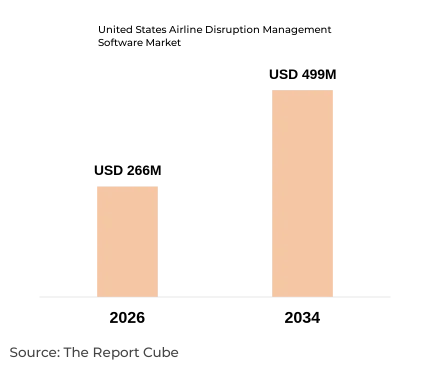
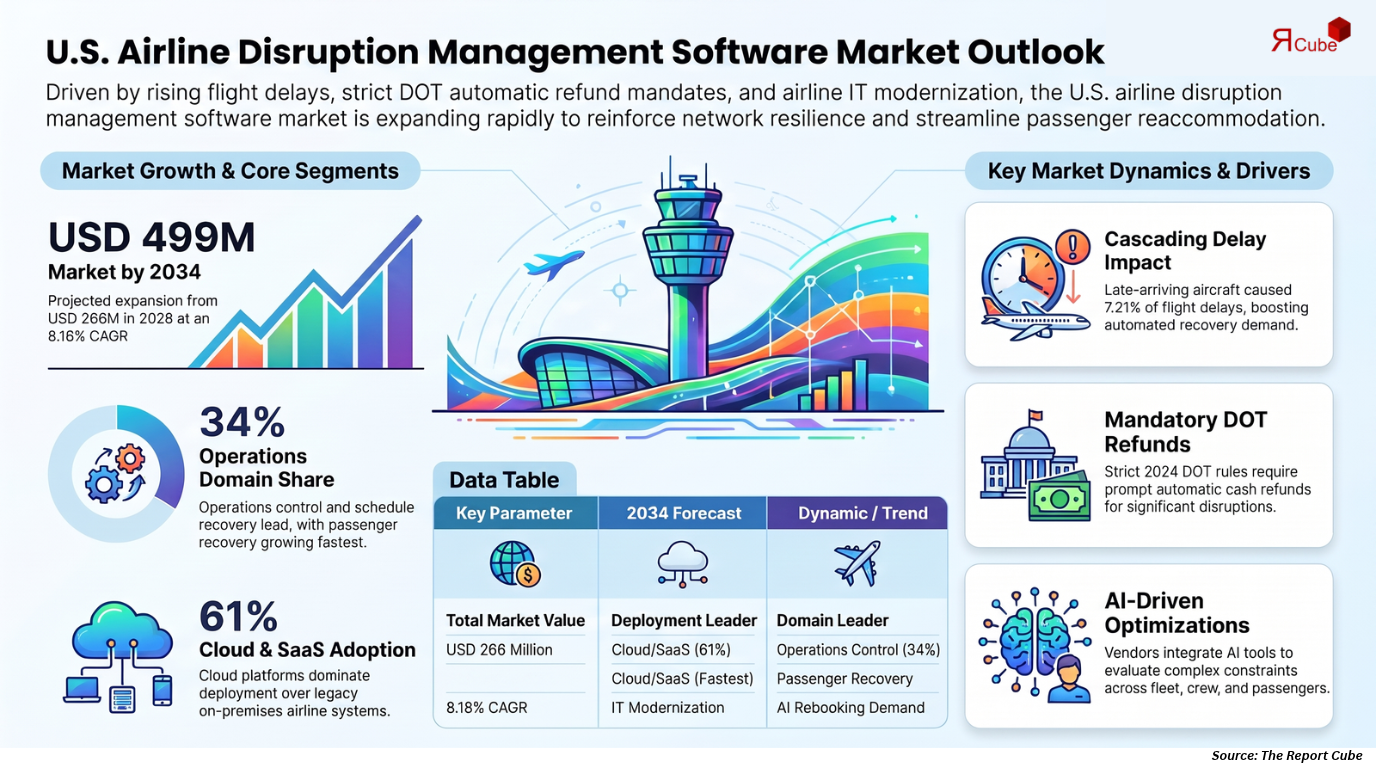
- The United States Airline Disruption Management Software Market was valued at USD 266 million in 2026.
- Market size is forecast to reach USD 499 million by 2034.
- The market is expected to expand at a CAGR of 8.18% during 2026-2034.
- By recovery domain, operations control and schedule recovery led with an approximate 34% share in 2026, while passenger recovery is expected to be the fastest-growing domain.
- By deployment mode, cloud-based and SaaS platforms are expected to grow fastest, supported by airline IT modernization and integrated operational platforms.
- Rising delays, cancellations and aircraft availability problems are the major growth driver, with U.S. DOT data showing 76.8% of reported flights arriving on time in January-October 2025.
- Established airline IT providers and AI-focused specialists are expanding recovery portfolios, including SITA’s June 2026 acquisition of Big Blue Analytics.
Market Outlook
The United States Airline Disruption Management Software Market covers platforms that help airlines detect, manage and recover from disruptions affecting flight schedules, aircraft, crew, passengers and airport operations. As networks become more interconnected, one delayed aircraft can cascade across connecting flights and crew assignments. This makes coordinated recovery tools commercially important for operational resilience, cost control and passenger service across large domestic networks.
Demand comes from full-service carriers, low-cost and hybrid airlines, cargo operators and charter airlines. Core applications include schedule and aircraft rotation recovery, crew reassignment, passenger reaccommodation, automated notifications and disruption analytics. According to the U.S. Department of Transportation, 79.5% of reported flight operations arrived on time in October 2025, and late-arriving aircraft were the largest single delay cause at 7.21% of operations.
The market is valued at USD 266 million in 2026 and is forecast to reach USD 499 million by 2034, a CAGR of 8.18%. Growth is expected to rely on cloud migration, AI-based recovery, automated passenger rebooking and refund workflows. Established airline IT providers and specialist optimization vendors compete on integrated recovery platforms, while integration cost and reliability requirements remain barriers.
Government Regulations
Airline disruption software is shaped mainly by U.S. Department of Transportation oversight. Airlines file on-time, delay and cancellation data to the Bureau of Transportation Statistics under 14 CFR Part 234, and DOT’s Office of Aviation Consumer Protection publishes it in the Air Travel Consumer Report. On 24 April 2024, DOT announced a final rule requiring automatic refunds when airlines cancel or significantly change flights and passengers decline the alternatives offered. Refunds must be issued within seven business days for credit card purchases and 20 calendar days for other payment methods. Airlines must also notify affected passengers promptly of their refund rights. These requirements raise the value of software that links disruption detection, rebooking, communication and payment workflows. Vendors able to document compliance support, audit trails and reliable integration with reservation systems are better positioned to win airline contracts.
United States Airline Disruption Management Software Market Dynamics
Demand is shaped by operational complexity, passenger protection requirements, AI adoption and airline IT modernization. Airlines need tools that coordinate aircraft, crew and passenger recovery in real time, supporting United States Airline Disruption Management Software Market Growth. However, implementation cost, legacy system integration and reliability expectations in mission-critical environments slow adoption, particularly among smaller carriers with limited technology budgets.
|
Factor |
Type |
Specific Impact on Market |
Magnitude |
|---|---|---|---|
|
Rising delays and cancellations |
Driver |
Increases need for automated aircraft, crew and schedule recovery |
High |
|
AI and predictive analytics adoption |
Driver |
Enables faster recovery recommendations and scenario evaluation |
Medium–High |
|
Automatic refund and rebooking requirements |
Opportunity |
Creates demand for integrated passenger recovery workflows |
Medium–High |
|
Integration with legacy airline systems |
Challenge |
Raises deployment time, cost and maintenance requirements |
High |
|
High implementation cost and reliability needs |
Challenge |
Delays purchasing decisions, especially for smaller airlines |
Medium |
|
Shift to cloud and SaaS platforms |
Trend |
Supports subscription models and faster software upgrades |
Medium–High |
Growth Drivers: Rising Flight Delays and Cancellations Strengthen Demand for Automated Recovery
DOT data show 79.5% of reported flights arrived on time in October 2025 and 76.8% year to date. That month, 3,694 of 668,332 reported operations were cancelled, while late-arriving aircraft, national aviation system and air carrier causes each affected roughly 6-7% of flights. These cascading patterns increase the value of software that coordinates aircraft, crew and passengers simultaneously and recommends alternative recovery plans.
Market Opportunities: Integrated Passenger Recovery and Refund Automation
DOT’s automatic refund rule requires prompt refunds in cash or the original form of payment and timely notification of passenger rights. Airlines must therefore connect disruption monitoring, rebooking, communication and payment-related workflows. This creates room for vendors offering integrated passenger recovery platforms that reduce manual handling, speed reaccommodation and document compliance. Low-cost and hybrid carriers, which often rely on leaner service teams, may find automation especially attractive.
Industry Challenges: Complex Integration and Mission-Critical Reliability Requirements
Airlines operate interconnected passenger service, reservation, crew management, flight operations and airport information systems. Differences in data formats and architecture can complicate disruption software deployment and raise integration cost. Because platforms operate during large-scale irregular operations, airlines are cautious about replacing established systems. Smaller carriers face additional budget limits. These factors lengthen sales cycles and favor vendors with proven airline integrations, though this assessment is analytical rather than an official statistic.
Need Specific Data, Let’s Customize the Report for You
Request CustomizationMarket Trends: Shift Toward Cloud-Based, AI-Enabled Recovery Platforms
Vendors are moving from sequential, reactive recovery tools toward platforms that evaluate multiple constraints at once. In June 2026, SITA acquired Big Blue Analytics to add the AI-enabled OCCam disruption platform and pursue an integrated operations control environment. Cloud delivery supports faster upgrades, centralized data access and subscription pricing. These United States Airline Disruption Management Software Market Trends favor flexible, interoperable platforms.
United States Airline Disruption Management Software Market Segment Analysis
The market is segmented by recovery domain, solution type, deployment mode and airline business model. Each category reflects a different dimension of airline technology spending, from the operational problem being solved to how software is delivered and which carriers buy it. Leading-segment shares are approximate 2026 estimates.
By Recovery Domain
- Operations Control and Schedule Recovery
- Passenger Recovery
- Crew Recovery
- Baggage, Turnaround and Disruption Analytics
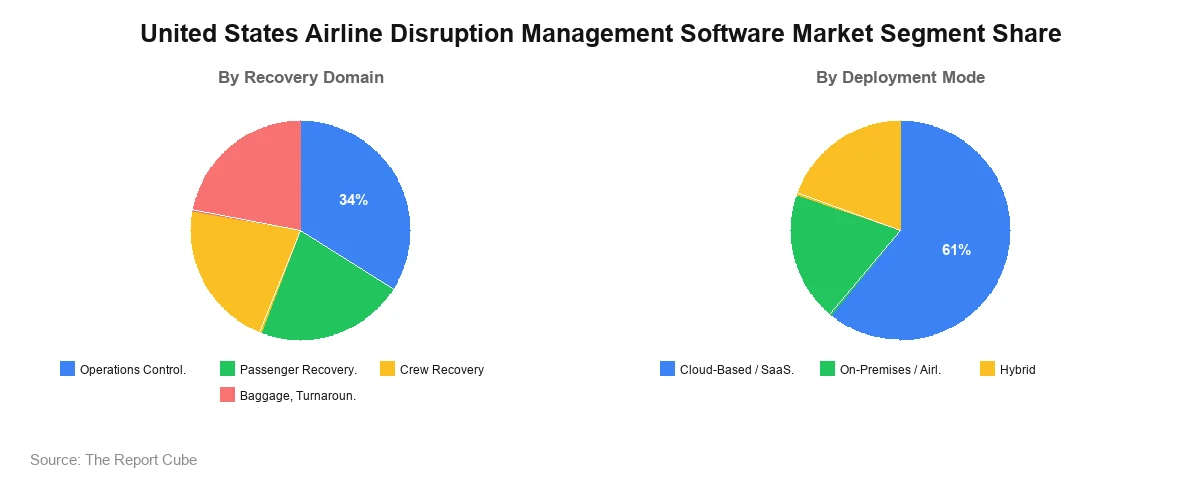
Operations control and schedule recovery leads this category with an approximate 34% share in 2026, because flight schedule optimization, aircraft rotation management and cancellation or diversion recovery sit at the center of airline network control. Airlines use these systems to assess the network impact of a disruption and select alternatives. Passenger recovery is the second analytical focus and is expected to be the fastest-growing domain, supported by automated rebooking, notifications and refund workflows. Crew recovery and baggage, turnaround and disruption analytics address duty-time compliance, turnaround coordination and performance monitoring.
By Deployment Mode
- Cloud-Based / SaaS
- On-Premises / Airline-Hosted
- Hybrid
Cloud-based and SaaS deployment leads this category with an approximate 61% share in 2026 and is expected to be the fastest-growing model. Airlines are modernizing legacy infrastructure and prefer scalable platforms that share real-time operational data, receive frequent updates and integrate with other airline applications. On-premises and airline-hosted deployment is the second-leading segment, remaining relevant for carriers with established internal infrastructure, specific security requirements and legacy operational platforms, although maintenance cost and upgrade complexity limit its growth. Hybrid environments combine both approaches and are grouped with cloud-based deployment in the underlying estimates.
Competitive Landscape
The market includes established airline IT providers, specialist operations software suppliers, passenger service technology companies and AI-based optimization vendors. Competition depends on real-time operational visibility, recovery automation, integration with existing airline systems and software reliability. The table summarizes supplied companies by general capability and does not represent numerical market share or ranking. Not every company is a pure-play disruption management vendor.
|
Company |
Competitive Strength |
Primary Segment Served |
|---|---|---|
|
Jeppesen / ForeFlight |
Flight planning and airline operations technology |
Operations control and schedule recovery |
|
CAE Inc. |
Airline operations solutions, including capabilities linked to the former Sabre AirCentre portfolio |
Operations control and crew recovery |
|
Amadeus IT Group |
Passenger service and airline operations platforms |
Passenger recovery |
|
SITA |
Operational connectivity, aviation systems integration and AI-enabled disruption management |
Operations control and passenger recovery |
|
Lufthansa Systems |
NetLine operations control and crew management products |
Operations control and crew recovery |
|
IBS Software |
Airline operations management platforms |
Operations control |
|
Collins Aerospace |
Flight information and aviation operational technology |
Operations and information management |
|
Sabre Corporation |
Reservation, passenger services and itinerary management systems |
Passenger recovery |
|
INFORM GmbH |
AI-based optimization and decision-support software |
Resource allocation and recovery planning |
|
AIMS International |
Crew scheduling and resource management software |
Crew recovery |
SITA: SITA provides information technology and connectivity solutions for airlines, airports and aviation organizations. In June 2026 it acquired Big Blue Analytics, adding the AI-enabled OCCam disruption management and recovery platform to its airline operations business. Financial terms were not disclosed. The move supports SITA’s plan for an integrated operations control center linking planning, monitoring and recovery, strengthening its position in AI-based recovery.
Jeppesen / ForeFlight: Jeppesen provides aviation technology covering flight planning, airline operations and operational coordination. Reporting in October 2026 indicated that Jeppesen ForeFlight introduced AI tools to help airlines manage flight disruptions, extending its operations portfolio toward automated recovery support. Detailed product and customer information should be validated against company disclosures before publication.
Recent Developments and Updates
- October 2026: Accelya announced FLX Recover, an agentic AI-powered solution for airline passenger recovery, on 13 October 2026. The product is designed to help airlines assist disrupted passengers faster and at scale, reflecting vendor investment in passenger recovery automation.
- June 2026: SITA acquired Big Blue Analytics, adding the OCCam AI-enabled disruption optimization platform to its airline operations portfolio. Financial terms were not disclosed. The acquisition shows consolidation toward integrated, AI-based operations control and recovery environments.
United States Airline Disruption Management Software Market Future Outlook
The United States Airline Disruption Management Software Market Forecast indicates growth from USD 266 million in 2026 to USD 499 million by 2034 at a CAGR of 8.18%. Annual growth is projected to peak at approximately 9.0% in 2028 as predictive analytics, cloud platforms and automated passenger recovery spread, then moderate gradually after 2030 as modernization projects mature. Recurring subscriptions, upgrades and replacement of fragmented legacy systems are expected to sustain demand.
Competition is likely to favor vendors that combine aircraft, crew and passenger recovery in one platform and integrate smoothly with reservation, crew and operations systems. Continued AI investment, acquisitions and new product launches are expected. Risks include high implementation cost, integration complexity, reliability requirements during large-scale disruptions and limited technology budgets at smaller airlines. Actual outcomes will depend on airline technology spending, regulation and vendor execution.
United States Airline Disruption Management Software Market Report Coverage
This United States Airline Disruption Management Software Market Report summarizes market valuation, forecast, segmentation, geographic context and the competitive ecosystem for 2026-2034.
|
Parameter |
Details |
|---|---|
|
Market Name |
United States Airline Disruption Management Software Market |
|
Market Size (Base Year) |
USD 266 million (2026) |
|
Market Size (Forecast Year) |
USD 499 million (2034) |
|
CAGR |
8.18% |
|
Base Year |
2026 |
|
Historical Period |
2021-2025 |
|
Forecast Period |
2026-2034 |
|
Geographic Scope |
United States |
|
Segmentation |
By Recovery Domain, By Solution Type, By Deployment Mode, By Airline Business Model |
|
Key Companies |
Jeppesen / ForeFlight, CAE Inc., Amadeus IT Group, SITA, Lufthansa Systems, IBS Software, Collins Aerospace, Sabre Corporation, INFORM GmbH, Others |
|
Customization |
Available as per requirement |
Why Choose This United States Airline Disruption Management Software Market Report?
- Presents the 2026 valuation, 2034 forecast and 8.18% CAGR with year-by-year context.
- Segments the market by recovery domain, solution type, deployment mode and airline business model.
- Reviews drivers, opportunities, challenges and trends using DOT and other government evidence.
- Provides hub-based regional context for the United States, with unmeasured shares clearly identified.
- Profiles relevant airline technology providers by capability and primary segment served.
- Identifies emerging opportunities in AI-based recovery, passenger automation and cloud delivery.
- Supports technology investment, vendor selection and product planning decisions.
Table of Contents
- Introduction
- Objective of the Study
- Product Definition
- Market Segmentation
- Study Variables
- Research Methodology
- Secondary Data Points
- Companies Interviewed
- Primary Data Points
- Breakdown of Primary Interviews
- Secondary Data Points
- Executive Summary
- Market Dynamics
- Drivers
- Challenges
- Opportunity Assessment
- Recent Trends and Developments
- Policy and Regulatory Landscape
- United States Airline Disruption Management Software Market Overview and Forecast Analysis (2021-2034)
- Market Size, By Value, By Growth Rate (CAGR/USD Millions)
- Demand – Supply Trends
- Market Share, By Recovery Domain
- Operations Control and Schedule Recovery
- Flight Schedule Recovery
- Aircraft Rotation and Fleet Recovery
- Flight Cancellation and Diversion Management
- Others
- Passenger Recovery and Reaccommodation
- Passenger Rebooking and Reaccommodation
- Automated Passenger Notifications
- Refund and Compensation Management
- Others
- Crew Recovery
- Crew Reassignment and Rescheduling
- Crew Availability Management
- Crew Duty-Time Compliance
- Others
- Baggage, Turnaround and Disruption Analytics
- Baggage Recovery
- Aircraft Turnaround Coordination
- Disruption Monitoring and Analytics
- Others
- Operations Control and Schedule Recovery
- Market Share, By Solution Type
- Software
- Licensed Software
- Cloud-Based Software
- SaaS Platforms
- AI-Enabled Recovery Software
- Services
- Implementation and Integration
- Consulting and Advisory
- Others
- Software
- Market Share, By Deployment Mode
- Cloud-Based / SaaS
- On-Premises / Airline-Hosted
- Hybrid Deployment
- Market Share, By Airline Business Model
- Full-Service and Network Carriers
- Low-Cost and Hybrid Carriers
- Cargo Airlines
- Charter and Leisure Airlines
- Market Share, By Competitors
- Competition Characteristics
- Revenue Shares
- Operations Control and Schedule Recovery United States Airline Disruption Management Software Market Overview, 2021-2034F
- By Value (USD Million)
- By Solution Type – Market Size & Forecast 2021-2034, USD Million
- Software (Licensed Software, Cloud-Based Software, SaaS Platforms, AI-Enabled Recovery Software)
- Services (Implementation and Integration, Consulting and Advisory, Others)
- Passenger Recovery and Reaccommodation United States Airline Disruption Management Software Market Overview, 2021-2034F
- By Value (USD Million)
- By Solution Type – Market Size & Forecast 2021-2034, USD Million
- Software (Licensed Software, Cloud-Based Software, SaaS Platforms, AI-Enabled Recovery Software)
- Services (Implementation and Integration, Consulting and Advisory, Others)
- Crew Recovery United States Airline Disruption Management Software Market Overview, 2021-2034F
- By Value (USD Million)
- By Solution Type – Market Size & Forecast 2021-2034, USD Million
- Software (Licensed Software, Cloud-Based Software, SaaS Platforms, AI-Enabled Recovery Software)
- Services (Implementation and Integration, Consulting and Advisory, Others)
- Baggage, Turnaround and Disruption Analytics United States Airline Disruption Management Software Market Overview, 2021-2034F
- By Value (USD Million)
- By Solution Type – Market Size & Forecast 2021-2034, USD Million
- Software (Licensed Software, Cloud-Based Software, SaaS Platforms, AI-Enabled Recovery Software)
- Services (Implementation and Integration, Consulting and Advisory, Others)
- Competitive Outlook (Company Profile – Partial List)
- Jeppesen / ForeFlight
- Company Overview
- Business Segments
- Strategic Alliances/Partnerships
- Recent Developments
- CAE Inc.
- Company Overview
- Business Segments
- Strategic Alliances/Partnerships
- Recent Developments
- Amadeus IT Group
- Company Overview
- Business Segments
- Strategic Alliances/Partnerships
- Recent Developments
- SITA
- Company Overview
- Business Segments
- Strategic Alliances/Partnerships
- Recent Developments
- Lufthansa Systems
- Company Overview
- Business Segments
- Strategic Alliances/Partnerships
- Recent Developments
- IBS Software
- Company Overview
- Business Segments
- Strategic Alliances/Partnerships
- Recent Developments
- Collins Aerospace
- Company Overview
- Business Segments
- Strategic Alliances/Partnerships
- Recent Developments
- Sabre Corporation
- Company Overview
- Business Segments
- Strategic Alliances/Partnerships
- Recent Developments
- INFORM GmbH
- Company Overview
- Business Segments
- Strategic Alliances/Partnerships
- Recent Developments
- Others
- Company Overview
- Business Segments
- Strategic Alliances/Partnerships
- Recent Developments
- Jeppesen / ForeFlight
- Contact Us & Disclaimer
Top Key Players & Market Share Outlook
- Jeppesen / ForeFlight
- CAE Inc.
- Amadeus IT Group
- SITA
- Lufthansa Systems
- IBS Software
- Collins Aerospace
- Sabre Corporation
- INFORM GmbH
- Others
Frequently Asked Questions