




Build Your Custom Market Intelligence Report
Customize Your ReportAsia Pacific Airway Management Devices Market Insights & Analysis
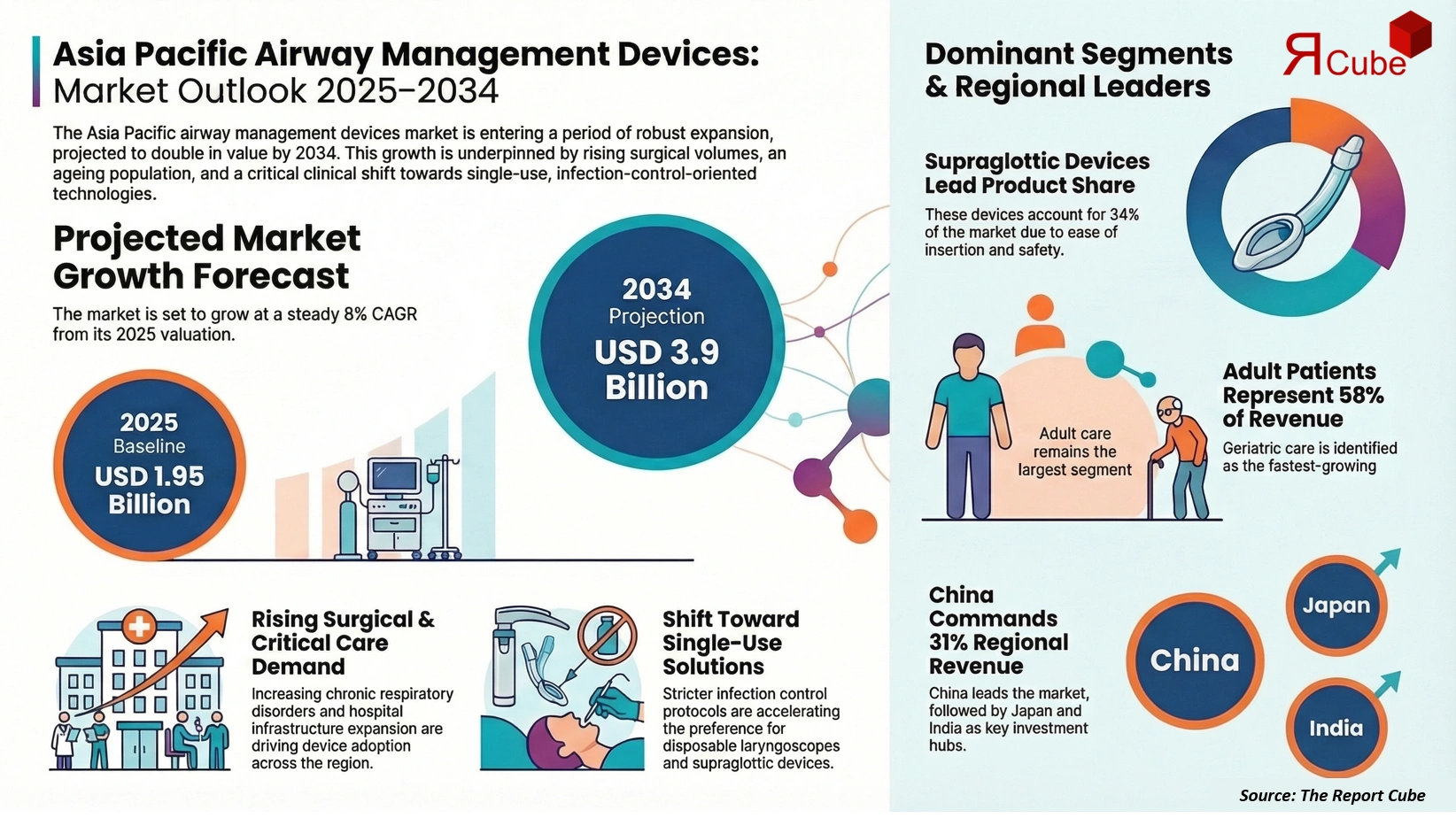
The Asia Pacific Airway Management Devices Market is anticipated to register a CAGR of 8% during the forecast period. The market size was valued at USD 1.95 billion and is projected to reach USD 3.9 billion by the end of the forecast timeline. This strong growth trajectory is driven by rising surgical volumes, increasing prevalence of respiratory disorders, and expanding critical care infrastructure across emerging and developed Asia Pacific economies.
The region is witnessing a steady rise in hospital admissions linked to chronic obstructive pulmonary disease, asthma, sleep apnea, and emergency trauma cases, all of which require effective airway management solutions. Growing investments in healthcare infrastructure, particularly in China, India, and Southeast Asia, are improving access to advanced medical devices in both urban and semi-urban settings. At the same time, favorable reimbursement scenarios in developed markets such as Japan and Australia are supporting the adoption of technologically advanced airway management devices.
Furthermore, the rapid expansion of intensive care units, coupled with increasing adoption of minimally invasive ventilation techniques, is reshaping clinical practices. Medical device manufacturers are focusing on ergonomically designed, single-use, and infection-control-oriented products to meet rising safety standards. As healthcare systems across the region continue to modernize, the Asia Pacific Airway Management Devices Market is positioned for sustained and broad-based growth.
Asia Pacific Airway Management Devices Market Recent Developments
- 2025: Medtronic expanded its airway portfolio in Asia with enhanced single-use laryngoscope solutions.
- 2025: Ambu A/S strengthened distribution partnerships across Southeast Asia for disposable airway devices.
Government Initiatives & Policies
- National Health Mission (India): Focus on strengthening emergency and critical care infrastructure nationwide.
- Healthy China 2030: Policy promoting advanced medical technologies and hospital capacity expansion.
Asia Pacific Airway Management Devices Market Dynamics
Key Driver: Rising Surgical Procedures and Critical Care Admissions
The increasing number of surgical procedures and critical care admissions across Asia Pacific is a key driver of the airway management devices market. Aging populations in Japan, China, and South Korea are contributing to higher incidences of chronic diseases requiring surgical interventions. Additionally, the growth of medical tourism in countries such as India and Thailand has further increased procedural volumes. Airway management devices are essential in anesthesia administration, emergency medicine, and intensive care, making them indispensable across hospitals. The expansion of tertiary care centers and trauma units has also elevated demand for reliable airway solutions. As surgical backlogs clear and healthcare access improves, consistent demand for airway management devices is expected to persist throughout the forecast period.
Book your FREE 30-minute expert consultation today
Contact UsIndustry Trends: Shift Toward Disposable and Infection-Control Devices
A major trend influencing the market is the growing preference for disposable and single-use airway management devices. Heightened awareness of hospital-acquired infections and stricter sterilization protocols have accelerated this shift, particularly in high-volume hospitals. Disposable supraglottic devices and laryngoscopes reduce cross-contamination risks while improving workflow efficiency for clinicians. Manufacturers are increasingly investing in cost-effective, high-quality disposable solutions tailored for emerging markets. In parallel, ergonomic improvements and video-assisted technologies are enhancing clinician ease-of-use and procedural success rates. These trends collectively reflect a move toward safer, more efficient airway management practices across the region.
Major Challenge: Cost Sensitivity in Emerging Economies
Despite strong demand fundamentals, cost sensitivity remains a significant challenge in several Asia Pacific countries. Public hospitals in emerging economies often operate under constrained budgets, limiting their ability to adopt premium airway management devices. Price competition among manufacturers can compress margins, particularly for advanced products. Additionally, uneven reimbursement coverage across markets can slow adoption of innovative technologies. Smaller healthcare facilities may continue relying on basic devices, delaying widespread penetration of advanced solutions. Addressing affordability while maintaining quality will remain a critical challenge for market participants aiming to scale across diverse regional markets.
Opportunity: Expansion of Pediatric and Geriatric Care Services
The rapid expansion of pediatric and geriatric care services presents a significant opportunity for the Asia Pacific Airway Management Devices Market. Countries across the region are investing in specialized care units to address the unique airway needs of vulnerable patient populations. Pediatric patients require size-specific and anatomically appropriate devices, while geriatric patients often need advanced airway support due to comorbidities. Manufacturers offering differentiated, patient-centric product portfolios can gain a competitive advantage. As demographic shifts continue, tailored airway management solutions for these patient groups are expected to generate long-term growth opportunities.
Asia Pacific Airway Management Devices Market Segment-wise Analysis
By Product Type:
- Supraglottic Devices
- Endotracheal Tubes
- Tracheostomy Tubes
- Resuscitators
- Laryngoscopes
Supraglottic devices lead the product type segment, accounting for approximately 34% of the market share. Their ease of insertion, reduced complication rates, and suitability for emergency and elective procedures drive widespread adoption. Endotracheal tubes follow closely due to their critical role in long-term ventilation and intensive care. Laryngoscopes, particularly video-assisted models, are gaining traction as clinicians seek improved visualization and success rates. The steady demand across product categories reflects the diverse clinical applications of airway management devices in the region.
By Patient Group:
- Adult Patients
- Pediatric Patients
- Geriatric Patients
Adult patients represent the largest patient group, contributing nearly 58% of overall market revenue, driven by high surgical and ICU admission rates. However, the geriatric segment is growing rapidly due to aging demographics and higher respiratory risk profiles. Pediatric patients, while a smaller segment, require specialized devices, creating niche growth opportunities. The balanced expansion across patient groups highlights the need for comprehensive product portfolios addressing varied clinical requirements.
Regional Projection of Asia Pacific Airway Management Devices Industry
- China
- Japan
- India
- Australia
- South Korea
- ASEAN
- Rest of Asia Pacific
China leads the Asia Pacific Airway Management Devices Market, accounting for approximately 31% of regional revenue. The country’s dominance is supported by large patient volumes, rapid hospital expansion, and increasing adoption of advanced medical devices. Japan and India follow, driven by aging populations and rising healthcare investments, respectively. ASEAN countries are emerging as high-growth markets due to improving healthcare access and expanding private hospital networks. China is expected to maintain its leadership position throughout the forecast period, supported by sustained policy backing and infrastructure development.
Need insights for a specific region within this market?
Request Regional DataWhy Choose This Report?
- Provides a comprehensive overview of the overall market analysis, encompassing key trends, consumer behavior analysis, and risk assessment to support strategic decision-making.
- Provides accurate, up-to-date insights into market size, segmentation, and emerging opportunities, helping to minimize risk & capitalizing on growth.
- Gives deep understanding of target audience preferences, investment habits, and communication channels for enhanced product development & marketing effectiveness.
- Delivers competitive analysis & benchmarking, uncovering the strengths & weaknesses of market competitors to guide strategies.
- Consolidate comprehensive market intelligence, reducing reasoning & streamlining research efforts.
- Facilitates customized market segmentation & risk mitigation strategies, fine-tuned to the business objectives.
- Aids in identifying both market challenges & untapped opportunities within the industry to drive long-term business growth.
- Provides valuable information based on actual customer data & search trends.
Table of Contents
- Introduction
- Objective of the Study
- Product and Category Definition
- Market Segmentation
- Study Variables
- Research Methodology
- Secondary Data Points
- Breakdown of Secondary Sources
- Primary Data Points
- Breakdown of Primary Interviews
- Secondary Data Points
- Executive Summary
- Market Dynamics
- Drivers
- Challenges
- Opportunity Assessment
- Recent Trends and Developments
- Regulatory and Policy Landscape
- Asia Pacific Airway Management Devices Market Overview (2020-2034)
- Market Size, By Value (USD Million)
- Market Share, By Product Type
- Supraglottic Devices
- Endotracheal Tubes
- Tracheostomy Tubes
- Resuscitators
- Laryngoscopes
- Market Share, By Patient Group
- Adult Patients
- Pediatric Patients
- Geriatric Patients
- Market Share, By Application
- Anesthesia
- Emergency Care
- Intensive Care
- Others
- Market Share, By End User
- Hospitals
- Ambulatory Centers
- Clinics
- Homecare
- Market Share, By Country
- China
- Japan
- India
- Australia
- South Korea
- ASEAN
- Rest of Asia Pacific
- Market Share, By Company
- Competition Characteristics
- Revenue Shares & Analysis
- China Airway Management Devices Market
- Market Size, By Value (USD Million)
- Market Share, By Product Type
- Market Share, By Patient Group
- Market Share, By Application
- Market Share, By End User
- Japan Airway Management Devices Market
- Market Size, By Value (USD Million)
- Market Share, By Product Type
- Market Share, By Patient Group
- Market Share, By Application
- Market Share, By End User
- India Airway Management Devices Market
- Market Size, By Value (USD Million)
- Market Share, By Product Type
- Market Share, By Patient Group
- Market Share, By Application
- Market Share, By End User
- Australia Airway Management Devices Market
- Market Size, By Value (USD Million)
- Market Share, By Product Type
- Market Share, By Patient Group
- Market Share, By Application
- Market Share, By End User
- South Korea Airway Management Devices Market
- Market Size, By Value (USD Million)
- Market Share, By Product Type
- Market Share, By Patient Group
- Market Share, By Application
- Market Share, By End User
- ASEAN Airway Management Devices Market
- Market Size, By Value (USD Million)
- Market Share, By Product Type
- Market Share, By Patient Group
- Market Share, By Application
- Market Share, By End User
- Competitive Outlook and Company Profiles
- Medtronic plc
- Company Overview
- Product Portfolio
- Strategic Alliances/Partnerships
- Recent Developments
- Teleflex Incorporated
- Company Overview
- Product Portfolio
- Strategic Alliances/Partnerships
- Recent Developments
- Ambu A/S
- Company Overview
- Product Portfolio
- Strategic Alliances/Partnerships
- Recent Developments
- ICU Medical (Smiths)
- Company Overview
- Product Portfolio
- Strategic Alliances/Partnerships
- Recent Developments
- Intersurgical Ltd
- Company Overview
- Product Portfolio
- Strategic Alliances/Partnerships
- Recent Developments
- Vyaire Medical
- Company Overview
- Product Portfolio
- Strategic Alliances/Partnerships
- Recent Developments
- KARL STORZ SE
- Company Overview
- Product Portfolio
- Strategic Alliances/Partnerships
- Recent Developments
- Flexicare Group
- Company Overview
- Product Portfolio
- Strategic Alliances/Partnerships
- Recent Developments
- SunMed LLC
- Company Overview
- Product Portfolio
- Strategic Alliances/Partnerships
- Recent Developments
- Convatec Group
- Company Overview
- Product Portfolio
- Strategic Alliances/Partnerships
- Recent Developments
- Others
- Medtronic plc
- Contact Us and Disclaimer
Top Key Players & Market Share Outlook
- Medtronic plc
- Teleflex Incorporated
- Ambu A/S
- ICU Medical (Smiths)
- Intersurgical Ltd
- Vyaire Medical
- KARL STORZ SE
- Flexicare Group
- SunMed LLC
- Convatec Group
- Others
Frequently Asked Questions






