



Build Your Custom Market Intelligence Report
Customize Your ReportGlobal Alumina Market Key Highlights
By Product:
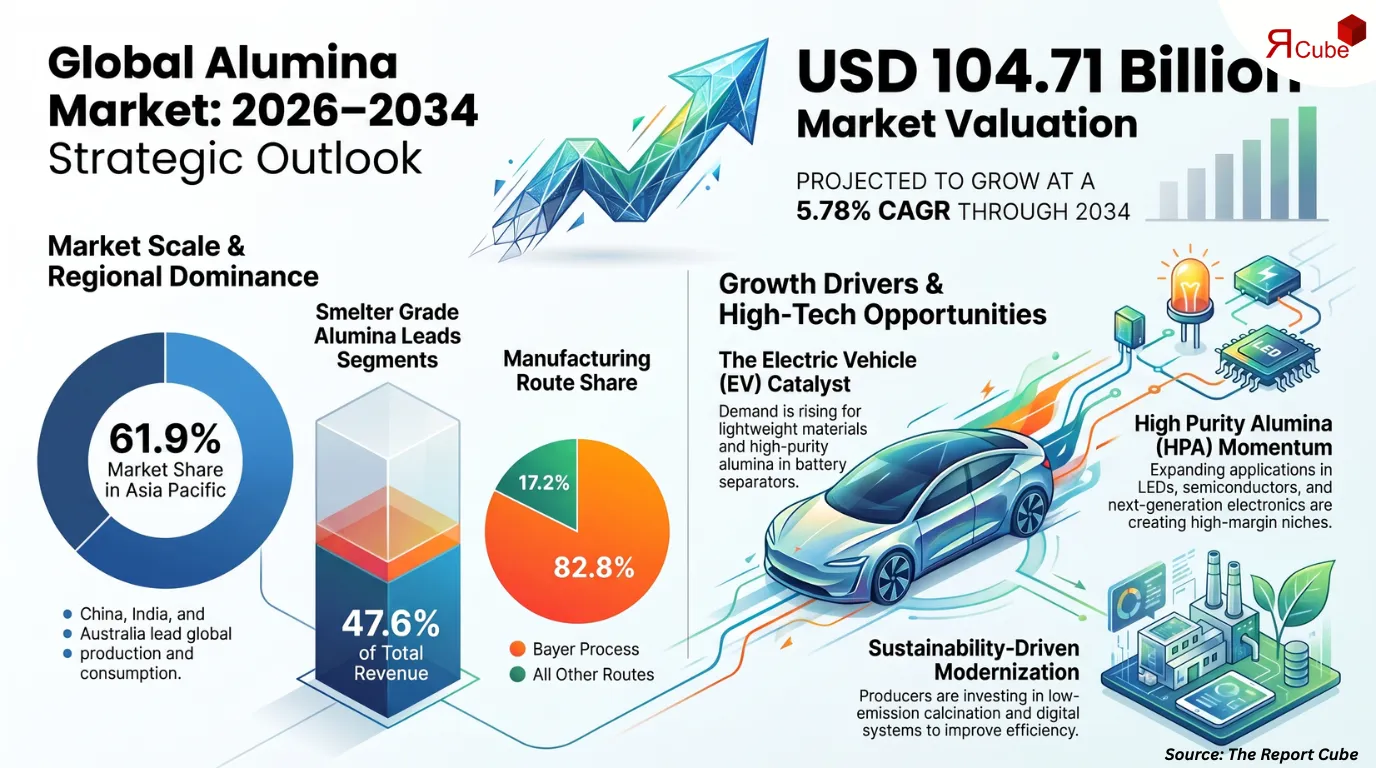
Smelter Grade Alumina segment leads the market with approximately 47.6% share.
By Manufacturing Route:
Bayer Process dominates the market with nearly 82.8% of total revenue.
Regional Outlook:
Asia Pacific dominates the Global Alumina Market with around 61.9% share
Global Alumina Market Insights & Analysis
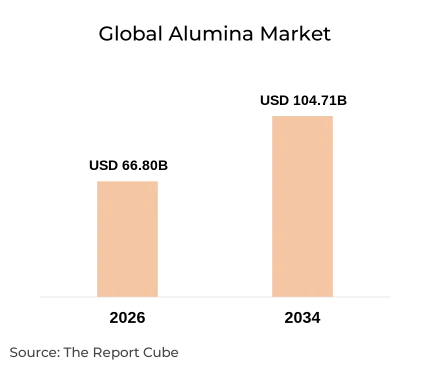
The Global Alumina Market is anticipated to register a CAGR of around 5.78% during the forecast period 2026-2034. The market size is valued at USD 66.8 billion in 2026 and is projected to reach USD 104.71 billion by 2034. The growth of the market is primarily supported by rising aluminum consumption across transportation, construction, aerospace, packaging, renewable energy, and consumer electronics industries. The increasing demand for lightweight materials to improve fuel efficiency and reduce emissions has encouraged manufacturers to expand alumina refining capacity. High purity alumina is also gaining strong momentum because of its growing use in lithium-ion batteries, LED lighting, semiconductor substrates, and sapphire glass production. Investments in battery manufacturing facilities across Asia Pacific, Europe, and North America continue to create long-term opportunities for specialty alumina producers. In addition, ongoing modernization of alumina refineries and adoption of energy-efficient production technologies are improving operational productivity while reducing production costs.
Growing government support for critical minerals, domestic manufacturing, and clean energy infrastructure continues to strengthen the long-term outlook for the Alumina Market. Countries including Australia, the United States, India, and China are investing in resilient supply chains for battery materials and strategic minerals, encouraging higher production of specialty alumina grades. Producers are also increasing research spending to develop ultra-high purity alumina suitable for advanced electronics and next-generation battery applications. Several companies are expanding refining capacity while integrating digital monitoring systems, predictive maintenance, and carbon reduction technologies to improve sustainability. The industry is also witnessing strategic collaborations among mining companies, aluminum producers, and technology providers to secure raw material availability and improve supply chain resilience. These developments are expected to support market growth while creating opportunities across high-value industrial and advanced manufacturing applications throughout the forecast period.
Global Alumina Market Impact Analysis
| Factor | Type | Specific Impact on Market | Magnitude | Business Implication |
|---|---|---|---|---|
| Rising Aluminum Consumption | Market | Higher demand from automotive, construction and packaging sectors | High | Supports sustained growth in smelter grade alumina volumes globally |
| Growth in Electric Vehicles | Technological | EV production raises need for high purity alumina in components | Medium | Creates premium niche for battery and electronics grade alumina products |
| Asia Pacific Production Dominance | Competitive | Large refining base in China, Indonesia and APAC drives supply | High | Intensifies price competition and shifts trade flows toward APAC output |
| Energy Cost and Price Volatility | Environmental | Elevated power prices and feedstock swings move alumina margins | High | Requires hedging, flexible contracts and cost focused refinery operations |
| Geopolitical Trade Disruptions | Regulatory | Sanctions and export bans reshape bauxite and alumina supply chains | Medium | Drives sourcing diversification and localized investment in new refineries |
| Looming Global Alumina Oversupply | Market | New capacity in Asia and Africa risks prolonged price pressure | High | Pushes producers to focus on efficiency, specialty grades and value added uses |
| Demand for High Purity Alumina | Consumer | Expanding applications in LEDs, ceramics and advanced electronics | Medium | Opens higher margin segments requiring quality and technology capability |
Global Alumina Market Dynamics
Key Driver: Expanding Aluminum Production Across High-Growth Industrial Sectors
Steady growth in global aluminum production continues to create a solid foundation for the Alumina Market. Industries including transportation, renewable energy, electrical infrastructure, construction, and consumer packaging are increasing their reliance on aluminum because of its lightweight characteristics, corrosion resistance, and high recyclability. Electric vehicle manufacturers are using more aluminum components to improve driving range and reduce vehicle weight, while renewable energy projects require aluminum-intensive structures for solar installations and transmission networks. These long-term industrial developments continue to stimulate consistent demand for alumina, particularly smelter-grade material used in primary aluminum production.
Large-scale investments in refinery expansion and integrated aluminum production are further strengthening market fundamentals. Leading producers are increasing refining capacity while improving process efficiency through automation, advanced process controls, and energy management systems. In addition, infrastructure development across emerging economies is driving demand for aluminum products used in bridges, commercial buildings, rail networks, and power distribution systems. The combination of industrial expansion, infrastructure modernization, and rising consumption of lightweight materials is expected to sustain healthy demand for alumina throughout the forecast period.
Industry Trends: Rising Adoption of High Purity Alumina for Advanced Technology Applications
High purity alumina is emerging as one of the fastest-growing product categories within the Alumina Market as advanced manufacturing industries require materials with exceptional purity, thermal conductivity, and electrical insulation properties. Battery manufacturers are increasing the use of high purity alumina in lithium-ion battery separators to improve safety, thermal stability, and battery lifespan. At the same time, semiconductor manufacturers, LED producers, and precision ceramic companies continue expanding procurement to support next-generation electronic devices and high-performance industrial components.
Production technologies are also evolving as refiners focus on improving operational efficiency and reducing environmental impact. Companies are investing in low-emission calcination systems, waste heat recovery, digital process monitoring, and advanced quality control technologies to enhance productivity while lowering energy consumption. Sustainability initiatives, including residue recycling and renewable energy integration, are becoming standard investment priorities across major refining operations. These technological improvements not only strengthen production efficiency but also help manufacturers comply with increasingly stringent environmental regulations and customer sustainability expectations.
Book your FREE 30-minute expert consultation today
Contact UsMajor Challenge: Cost Pressures from Energy Consumption and Raw Material Volatility
Maintaining stable production costs remains a significant challenge for alumina producers due to the energy-intensive nature of refining operations. Electricity, natural gas, steam generation, and fuel costs represent a substantial share of total production expenses, making refinery profitability sensitive to fluctuations in energy markets. Changes in bauxite mining costs, freight charges, and shipping availability further influence operating margins, particularly for producers dependent on imported raw materials or long-distance logistics networks.
Environmental regulations are adding another layer of complexity as governments introduce stricter emission standards and waste management requirements for mineral processing industries. Compliance often requires significant investments in cleaner technologies, residue storage improvements, water recycling systems, and carbon reduction initiatives. While large integrated producers generally possess the financial capacity to modernize operations, smaller refiners may experience greater pressure to maintain profitability. Efficient resource management, diversified sourcing strategies, and continuous operational improvements will remain essential for sustaining long-term competitiveness across the alumina industry.
Opportunity: Expanding Demand from Battery Manufacturing and Advanced Electronics
Rapid investment in electric mobility, renewable energy storage, and semiconductor fabrication is creating new long-term opportunities for specialty alumina manufacturers. High purity alumina has become an essential material for lithium-ion battery separators, semiconductor substrates, LED lighting, optical components, and sapphire-based electronic products. As countries accelerate domestic battery production and strengthen advanced manufacturing capabilities, demand for premium alumina grades is expected to increase steadily. This shift enables producers to diversify beyond traditional aluminum smelting markets while generating higher-value revenue streams.
Additional growth opportunities are emerging through government initiatives that encourage domestic processing of critical minerals and advanced industrial materials. Producers are establishing strategic partnerships with battery manufacturers, electronics companies, and research organizations to secure long-term supply agreements and accelerate product innovation. Investments in ultra-high purity refining technologies, circular production methods, and digital manufacturing solutions are expected to improve competitiveness while supporting sustainable industry development. These structural changes position the Alumina Market for continued expansion as advanced technologies become increasingly important across the global industrial economy.
Global Alumina Market Segment-wise Analysis
By Product:
- High Purity Alumina (6N Alumina, 5N Alumina, 4N Alumina)
- Fused Alumina
- Calcined Alumina
- Chemical Grade Alumina
- Tabular Alumina
- Smelter Grade Alumina
- Specialty Alumina
- Others
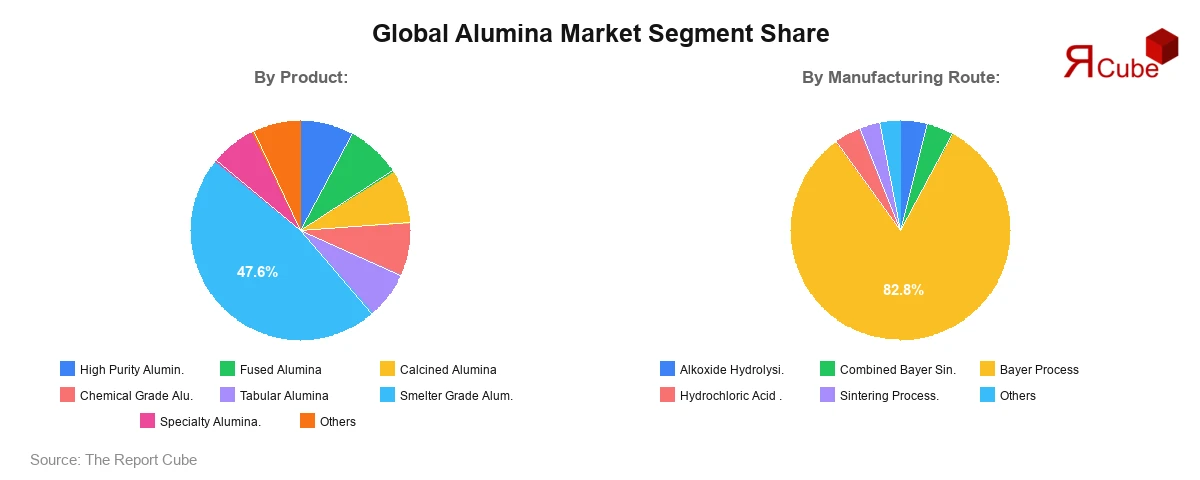
Smelter Grade Alumina held the leading position in the Global Alumina Market, accounting for approximately 47.6% of total revenue in 2026. Its dominance is attributed to its critical role as the primary feedstock in the Hall-Héroult electrolytic process used for aluminum production. Rising aluminum consumption across transportation, construction, packaging, aerospace, and electrical industries has consistently supported demand for smelter-grade alumina. Major aluminum-producing countries, particularly China, India, Australia, and the Gulf nations, continue expanding refining and smelting capacities to meet growing domestic and export requirements. The availability of large-scale integrated bauxite mining and alumina refining operations further strengthens the commercial position of this segment.
Ongoing investments in energy-efficient refineries, digital process optimization, and low-carbon aluminum production are expected to sustain demand for smelter-grade alumina throughout the forecast period. Aluminum producers are increasingly adopting advanced refining technologies to improve recovery rates, reduce energy consumption, and lower greenhouse gas emissions while maintaining stable production volumes. The continued expansion of renewable energy infrastructure, electric vehicle manufacturing, and lightweight transportation components is projected to create long-term opportunities for this segment, ensuring its market leadership over the coming years.
By Manufacturing Route:
- Alkoxide Hydrolysis Route
- Combined Bayer Sintering Process
- Bayer Process
- Hydrochloric Acid Leaching Route
- Sintering Process
- Others
The Bayer Process represented nearly 82.8% of the Global Alumina Market revenue in 2026, making it the most widely adopted alumina refining technology worldwide. The process offers high extraction efficiency, consistent product quality, and lower operating costs compared with alternative refining methods. Most commercial alumina refineries utilize the Bayer Process because it efficiently converts bauxite into alumina while supporting large-scale continuous production. Countries with abundant bauxite reserves, including Australia, China, Brazil, and India, continue relying on Bayer-based refining facilities to strengthen their aluminum value chains and meet increasing industrial demand.
Continuous technological advancements are further enhancing the competitiveness of the Bayer Process. Refiners are investing in advanced digestion systems, process automation, predictive maintenance, and residue management technologies to improve operational efficiency while reducing environmental impact. Energy optimization initiatives, waste heat recovery systems, and improved red mud utilization are also helping producers lower production costs and comply with stricter environmental regulations. These developments are expected to reinforce the Bayer Process as the preferred manufacturing route for commercial alumina production during the forecast period.
Regional Projection of Global Alumina Industry
- North America
- Europe
- Asia Pacific
- Middle East and Africa
- South America
Asia Pacific dominated the Global Alumina Market with approximately 61.9% of global revenue in 2026. The region benefits from abundant bauxite reserves, extensive alumina refining infrastructure, and the world's largest aluminum production capacity. China remains the leading producer and consumer of alumina due to its well-established aluminum industry, while Australia continues to serve as one of the largest exporters of bauxite and refined alumina. India is also emerging as a significant growth market, supported by expanding infrastructure projects, industrial development, and increasing investments in domestic aluminum production. These factors collectively strengthen the region's position in the global market.
Future market growth across Asia Pacific is expected to be supported by rising investments in electric vehicles, renewable energy projects, battery manufacturing, and advanced electronics production. Governments across the region are encouraging domestic manufacturing through industrial development programs and investments in critical mineral processing capabilities. In addition, leading alumina producers are expanding refinery capacities, adopting energy-efficient production technologies, and implementing sustainability initiatives to reduce carbon emissions. These strategic developments are expected to help Asia Pacific maintain its leadership position throughout the 2026-2034 forecast period.
Need insights for a specific region within this market?
Request Regional DataRegional Analysis of Global Alumina Market
The alumina market shows distinct regional trends in 2026, driven by smelting, industrial use, and energy cost dynamics.
| Region | Demand Level | Key Areas | System Dominance | Core Demand Logic | Growth Nature |
|---|---|---|---|---|---|
| North America | Medium | U.S. Gulf Coast, Canada | Metallurgical & high purity alumina | Aerospace, autos, steady smelting | Stable, efficiency-led growth |
| Europe | Medium | Germany, France, Spain | Non-metallurgical specialty grades | Advanced ceramics, electronics use | Regulation-driven, modest growth |
| Asia Pacific | Very High | China, India, Australia | Bulk smelter alumina supply | Mass smelting, infrastructure push | Volume-led, dominant expansion |
| Middle East & Africa | Low to Medium | Saudi Arabia, UAE, South Africa | Smelter-linked alumina imports | Energy-rich metal production | Capacity-building, gradual rise |
| South America | Medium | Brazil, Jamaica, Suriname | Bauxite-rich refinery output | Export-led alumina processing | Cyclical, commodity-led growth |
Government Initiatives & Policies
- Australia Critical Minerals Facility (2025): The Australian Government continues expanding financial support for critical minerals processing projects, including high purity alumina and strategic mineral value chains, strengthening domestic advanced manufacturing and export competitiveness.
- U.S. Executive Actions on Critical Minerals (2025): The United States continued supporting domestic production and processing of critical minerals through federal financing initiatives and supply chain resilience programs, encouraging investments in high purity alumina and advanced battery materials.
Global Alumina Industry Recent Developments
- 2025: Alcoa Corporation and Sojitz advanced the Gallium Recovery Project at the Wagerup refinery in Western Australia after securing up to USD 200 million in concessional equity financing under the U.S.-Australia critical minerals partnership. The project utilizes alumina refinery by-products to strengthen global gallium supply for semiconductor and defense industries.
- 2025: Alpha HPA signed a Letter of Intent with a leading Japanese electronics manufacturer to supply high purity alumina from its Gladstone HPA First Project. The agreement supports increasing demand for semiconductor thermal management materials, advanced electronics, and next-generation battery applications.
Why Choose This Report?
- Provides a comprehensive overview of the overall market analysis, encompassing key trends, consumer behavior analysis, and risk assessment to support strategic decision-making.
- Provides accurate, up-to-date insights into market size, segmentation, and emerging opportunities, helping to minimize risk while capitalizing on growth.
- Gives deep understanding of target audience preferences, investment habits, and communication channels for enhanced product development and marketing effectiveness.
- Delivers competitive analysis and benchmarking, uncovering the strengths and weaknesses of market competitors to guide business strategies.
- Consolidates comprehensive market intelligence, reducing research efforts while improving decision-making efficiency.
- Facilitates customized market segmentation and risk mitigation strategies, fine-tuned to specific business objectives.
- Aids in identifying both market challenges and untapped opportunities within the industry to drive long-term business growth.
- Provides valuable information based on actual customer data, industry developments, and evolving search trends.
Table of Contents
- Introduction
- Objective of the Study
- Product and Category Definition
- Market Segmentation
- Study Variables
- Research Methodology
- Secondary Data Points
- Breakdown of Secondary Sources
- Primary Data Points
- Breakdown of Primary Interviews
- Secondary Data Points
- Executive Summary
- Market Dynamics
- Emerging Opportunities
- Adoption Trends
- Demand Drivers
- Disruption Analysis (Challenges)
- Industry Analysis & Strategic Insights
- Supply/Value Chain Analysis
- Pricing Analysis
- Go-To-Market (GTM) Strategy
- BCG Matrix
- Recent Trends and Developments
- Import and Export Analysis
- Regulatory and Policy Landscape
- Region-wise policies
- Government Initiatives
- Global Alumina Market Overview and Forecast Analysis (2021-2034)
- Market Size, By Value, By Growth Rate (CAGR/USD Billion)
- Market Share, By Product
- High Purity Alumina
- 6N Alumina
- 5N Alumina
- 4N Alumina
- Fused Alumina
- Calcined Alumina
- Chemical Grade Alumina
- Tabular Alumina
- Smelter Grade Alumina
- Specialty Alumina
- Others
- High Purity Alumina
- Market Share, By Manufacturing Route
- Alkoxide Hydrolysis Route
- Combined Bayer Sintering Process
- Bayer Process
- Hydrochloric Acid Leaching Route
- Sintering Process
- Others
- Market Share, By Application
- Battery Materials
- Refractories
- Abrasives
- Technical Ceramics
- Aluminum Smelting
- Catalyst and Catalyst Supports
- Flame Retardants
- Polishing Compounds
- Glass and Coatings
- Water Treatment
- Others
- Market Share, By End-User
- Battery Material Producers
- Electronics Manufacturers
- Refractory Manufacturers
- Chemical Companies
- Primary Aluminum Producers
- Glass Manufacturers
- Ceramic Manufacturers
- Water Treatment Companies
- Abrasive Manufacturers
- Others
- Market Share, By Region
- North America
- Europe
- Asia Pacific
- Middle East and Africa
- South America
- Market Share, By Company
- Revenue Shares & Analysis
- Competitive Landscape
- North America Alumina Market Overview and Forecast Analysis (2021-2034)
- Market Size, By Value, By Growth Rate (CAGR/USD Billion/Million)
- Market Share, By Product
- Market Share, By Manufacturing Route
- Market Share, By Application
- Market Share, By End-User
- Market Share, By Country
- The US
- Canada
- Mexico
- Rest of North America
- Europe Alumina Market Overview and Forecast Analysis (2021-2034)
- Market Size, By Value, By Growth Rate (CAGR/USD Billion/Million)
- Market Share, By Product
- Market Share, By Manufacturing Route
- Market Share, By Application
- Market Share, By End-User
- Market Share, By Country
- Germany
- The UK
- France
- Italy
- Spain
- Netherlands
- Russia
- Poland
- Belgium
- Sweden
- Rest of Europe
- Asia Pacific Alumina Market Overview and Forecast Analysis (2021-2034)
- Market Size, By Value, By Growth Rate (CAGR/USD Billion/Million)
- Market Share, By Product
- Market Share, By Manufacturing Route
- Market Share, By Application
- Market Share, By End-User
- Market Share, By Country
- China
- India
- Japan
- South Korea
- Australia
- Indonesia
- Thailand
- Malaysia
- Vietnam
- Philippines
- Singapore
- New Zealand
- Rest of Asia-Pacific
- Middle East and Africa Alumina Market Overview and Forecast Analysis (2021-2034)
- Market Size, By Value, By Growth Rate (CAGR/USD Billion/Million)
- Market Share, By Product
- Market Share, By Manufacturing Route
- Market Share, By Application
- Market Share, By End-User
- Market Share, By Country
- Saudi Arabia
- The UAE
- South Africa
- Egypt
- Nigeria
- Morocco
- Turkey
- Rest of the Middle East & Africa
- South America Alumina Market Overview and Forecast Analysis (2021-2034)
- Market Size, By Value, By Growth Rate (CAGR/USD Billion/Million)
- Market Share, By Product
- Market Share, By Manufacturing Route
- Market Share, By Application
- Market Share, By End-User
- Market Share, By Country
- Brazil
- Argentina
- Chile
- Colombia
- Peru
- Rest of South America
- Competitive Analysis, 2026
- Market Share of Key Players
- Competitive Mapping for Each Segment and Companies Operating Regionally
- North America Alumina Companies Share & Competitive Analysis, 2026
- Europe Alumina Companies Share & Competitive Analysis, 2026
- Asia Pacific Alumina Companies Share & Competitive Analysis, 2026
- Middle East and Africa Alumina Companies Share & Competitive Analysis, 2026
- South America Alumina Companies Share & Competitive Analysis, 2026
- Company Profile (Partial List)
- National Aluminum Company Limited
- Company Overview
- Product Portfolio
- Strategic Alliances/Partnerships
- Recent Developments
- Alteo Holding
- Company Overview
- Product Portfolio
- Strategic Alliances/Partnerships
- Recent Developments
- Rio Tinto Group
- Company Overview
- Product Portfolio
- Strategic Alliances/Partnerships
- Recent Developments
- Huber Advanced Materials
- Company Overview
- Product Portfolio
- Strategic Alliances/Partnerships
- Recent Developments
- Norsk Hydro ASA
- Company Overview
- Product Portfolio
- Strategic Alliances/Partnerships
- Recent Developments
- Rusal
- Company Overview
- Product Portfolio
- Strategic Alliances/Partnerships
- Recent Developments
- Alcoa Corporation
- Company Overview
- Product Portfolio
- Strategic Alliances/Partnerships
- Recent Developments
- Shandong Aluminum Corporation
- Company Overview
- Product Portfolio
- Strategic Alliances/Partnerships
- Recent Developments
- South32 Limited
- Company Overview
- Product Portfolio
- Strategic Alliances/Partnerships
- Recent Developments
- Kaiser Aluminum Corporation
- Company Overview
- Product Portfolio
- Strategic Alliances/Partnerships
- Recent Developments
- Vedanta Limited
- Company Overview
- Product Portfolio
- Strategic Alliances/Partnerships
- Recent Developments
- Sasol Limited
- Company Overview
- Product Portfolio
- Strategic Alliances/Partnerships
- Recent Developments
- Emirates Global Aluminum PJSC
- Company Overview
- Product Portfolio
- Strategic Alliances/Partnerships
- Recent Developments
- Nabaltec AG
- Company Overview
- Product Portfolio
- Strategic Alliances/Partnerships
- Recent Developments
- Hindalco Industries Limited
- Company Overview
- Product Portfolio
- Strategic Alliances/Partnerships
- Recent Developments
- Aluminum Corporation of China Limited
- Company Overview
- Product Portfolio
- Strategic Alliances/Partnerships
- Recent Developments
- Nippon Light Metal Holdings Company, Ltd.
- Company Overview
- Product Portfolio
- Strategic Alliances/Partnerships
- Recent Developments
- Almatis GmbH
- Company Overview
- Product Portfolio
- Strategic Alliances/Partnerships
- Recent Developments
- Zibo Honghe Chemical Co., Ltd.
- Company Overview
- Product Portfolio
- Strategic Alliances/Partnerships
- Recent Developments
- Sumitomo Chemical Co., Ltd.
- Company Overview
- Product Portfolio
- Strategic Alliances/Partnerships
- Recent Developments
- Others (Partial List)
- National Aluminum Company Limited
- Contact Us and Disclaimer
Top Key Players & Market Share Outlook
- National Aluminum Company Limited
- Alteo Holding
- Rio Tinto Group
- Huber Advanced Materials
- Norsk Hydro ASA
- Rusal
- Alcoa Corporation
- Shandong Aluminum Corporation
- South32 Limited
- Kaiser Aluminum Corporation
- Vedanta Limited
- Sasol Limited
- Emirates Global Aluminum PJSC
- Nabaltec AG
- Hindalco Industries Limited
- Aluminum Corporation of China Limited
- Nippon Light Metal Holdings Company, Ltd.
- Almatis GmbH
- Zibo Honghe Chemical Co., Ltd.
- Sumitomo Chemical Co., Ltd.
Frequently Asked Questions






