



Build Your Custom Market Intelligence Report
Customize Your ReportUS Automotive Steer-by-Wire System Market Key Takeaways
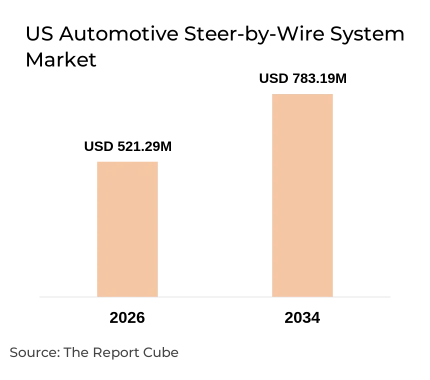
- Market valued at USD 521.29 million in 2026, driven by accelerating vehicle electrification across the United States.
- Industry projected to reach USD 783.19 million by 2034, expanding at a steady 5.22% CAGR.
- Passenger cars dominate vehicle type segmentation owing to rising electric vehicle adoption in premium segments.
- Steering actuators represent the fastest-growing component segment supported by brushless motor technology advancements.
- The US market leads North American regional revenue through strong ADAS integration and autonomous vehicle programs.
- Heavy commercial vehicles represent an emerging opportunity driven by autonomous trucking and logistics electrification.
- Leading companies include Bosch, Continental, ZF Friedrichshafen, Nissan, Toyota, General Motors, Ford, Honda, and Daimler.
- Functional safety mandates under NHTSA FMVSS 126 and ISO 26262 ASIL-D continue shaping supplier qualification and market entry.
US Automotive Steer-by-Wire System Market Insights & Analysis
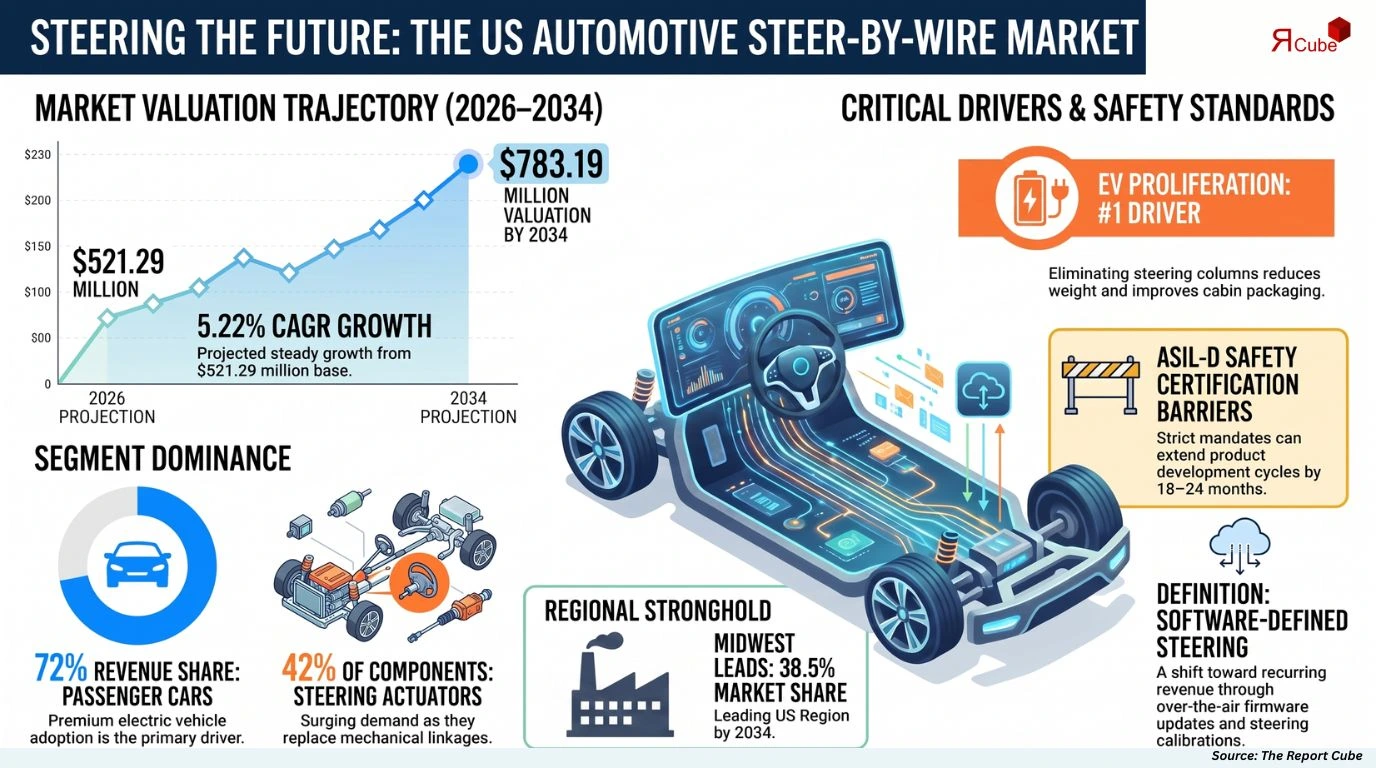
The US Automotive Steer-by-Wire System Market is anticipated to register a 5.22% CAGR during 2026–2034. The market size was valued at USD 521.29 million in 2026 and is projected to reach USD 783.19 million by 2034. The market benefits from growing deployment of electric vehicles across passenger car segments, increasing integration of advanced driver assistance systems in new US model year vehicles, and accelerating investments by Tier-1 suppliers and original equipment manufacturers in software-defined steering architectures that eliminate traditional mechanical column linkages.
Federal regulatory modernization, including NHTSA FMVSS 126 stability mandates and emerging electronic steering exemption frameworks, continues expanding the homologation pathway for full steer-by-wire platforms in the United States. Supplier ecosystems anchored by Bosch, Continental, and ZF Friedrichshafen are channeling sustained R&D capital into redundant feedback actuator systems for autonomous vehicle platforms, with Texas and Michigan collectively representing over 37% of steer-by-wire software engineering employment nationally, reinforcing long-term domestic market expansion.
US Automotive Steer-by-Wire System Market Dynamics
The US Automotive Steer-by-Wire System Market continues expanding as vehicle electrification, software-defined vehicle architectures, and advancing ADAS specifications elevate demand for electronic chassis control technologies. Tier-1 suppliers and domestic OEMs are intensifying investments in fail-operational redundancy, cybersecurity integration, and variable steering ratio software to satisfy increasingly stringent functional safety requirements and evolving consumer expectations for precision-driven connected vehicles.
|
Factor |
Type |
Specific Impact on Market |
Magnitude |
|---|---|---|---|
|
Electric vehicle platform proliferation |
Driver |
Accelerates steer-by-wire integration across passenger car OEM programs |
Very High |
|
NHTSA FMVSS 126 and ISO 26262 ASIL-D compliance |
Driver |
Filters supplier participation and reinforces safety-certified component demand |
High |
|
Autonomous and semi-autonomous driving investment |
Opportunity |
Expands heavy commercial vehicle and premium passenger car adoption |
High |
|
ASIL-D certification development timelines |
Challenge |
Extends product qualification cycles by 18–24 months for new entrants |
High |
|
Software-defined vehicle steering calibration |
Trend |
Shifts OEM procurement toward integrated firmware and actuator subscription models |
Very High |
Key Market Driver: EV Proliferation Accelerating Steer-by-Wire Demand
Electric vehicle penetration in the United States reached approximately 38% across premium automotive platforms by 2025, directly expanding deployment opportunities for steer-by-wire systems that complement electrified chassis architectures. Eliminating the mechanical steering column reduces vehicle weight, improves cabin packaging, and enables variable steering ratio adjustments of up to 26% based on vehicle speed and terrain conditions. These attributes satisfy tightening Corporate Average Fuel Economy standards while supporting OEM differentiation strategies in a competitive premium passenger car market, propelling sustained steer-by-wire adoption across General Motors, Ford, and Honda electrified vehicle programs.
Major Industry Challenge: ASIL-D Certification Barriers Constraining Entry
ISO 26262 Automotive Safety Integrity Level-D certification requirements govern control algorithm development across steer-by-wire steering systems, extending development cycles by an estimated 18 to 24 months for suppliers without pre-certified safety-case documentation. Sensor fusion redundancy requirements driven by lidar and camera integration are further pulling redundant angular position verification into core system specifications, increasing engineering complexity for mid-tier component manufacturers. This certification burden concentrates market participation among established Tier-1 suppliers capable of maintaining comprehensive safety-case documentation libraries, limiting competitive disruption from new entrants while reinforcing the precision angular sensor redundancy requirements for steer-by-wire platforms.
Emerging Trend Shaping Outlook: Software-Defined Steering Calibration Models
Leading Tier-1 suppliers are recalibrating commercial models to shift steer-by-wire contracts beyond hardware-only supply toward recurring firmware update streams and over-the-air steering calibration services. Continental, Bosch, and ZF Friedrichshafen are developing integrated sensor-actuator software stacks capable of autonomous steering parameter adjustments aligned to real-time road and environmental conditions. This shift creates recurring post-sale revenue pools for suppliers and deepens OEM dependency on long-term software licensing relationships, fundamentally altering procurement dynamics across the US automotive steering supply chain.
Need Specific Data, Let’s Customize the Report for You
Request CustomizationUS Automotive Steer-by-Wire System Market Segment-wise Analysis
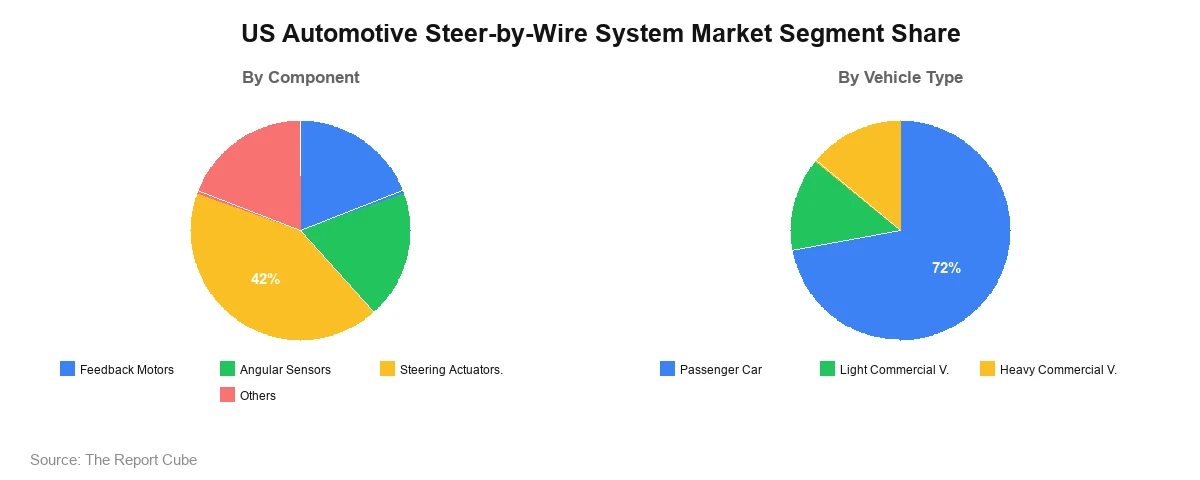
The US Automotive Steer-by-Wire System Market demonstrates distinct revenue concentration across component and vehicle type segments, with premium passenger car platforms and safety-certified feedback and sensing hardware commanding the highest current share while commercial vehicle applications represent accelerating long-term growth potential.
By Component
- Feedback Motors
- Angular Sensors
- Steering Actuators
- Others
Steering actuators account for an estimated 42% of the by-component market share, reflecting the critical role of electromechanical actuation in steer-by-wire systems that lack any mechanical fallback linkage. Advancements in permanent magnet synchronous motors and brushless DC motor technologies have meaningfully improved actuator performance while reducing power consumption and maintenance requirements, encouraging broader adoption across General Motors and Ford EV platforms that demand compact, lightweight steering modules. OEM sourcing contracts for steering actuator assemblies continue consolidating around Bosch and ZF Friedrichshafen, whose integrated chassis portfolios offer validated ASIL-D certified actuator modules aligned with platform-level safety requirements.
Feedback motors and angular sensors collectively represent the remaining high-value share, with angular sensors projected to grow at accelerating rates driven by sensor fusion redundancy mandates requiring dual-channel Hall-effect and inductive position verification in steer-by-wire architectures. The multi-axis angular sensing technologies deployed in steer-by-wire feedback systems are increasingly specified at sub-0.1-degree resolution thresholds to satisfy NHTSA calibration requirements for automatic emergency braking and lane-keeping performance. Emerging applications within the Others subsegment, including electronic control units and communication interfaces, further expand component-level revenue capture as software-defined steering architectures deepen across US OEM vehicle programs.
By Vehicle Type
- Passenger Car
- Light Commercial Vehicle
- Heavy Commercial Vehicle
Passenger cars hold the dominant vehicle type position with an estimated 72% revenue share, as premium and electric passenger vehicles continue leading steer-by-wire system integration in the United States. Honda's 0 Series EV lineup featuring steer-by-wire yoke steering wheels, alongside Toyota and Nissan's expanding electrified platform roadmaps, reflects the acceleration of full electronic steering across the passenger car segment. Advanced driver assistance system penetration exceeded 68% in new passenger vehicles sold in 2025, reinforcing the structural need for steer-by-wire architectures that deliver seamless ADAS steering overlay without mechanical interference.
Light commercial vehicles and heavy commercial vehicles represent the fastest-growing adoption trajectory, propelled by autonomous trucking development programs and increasing regulatory focus on driver safety in commercial applications. ZF Friedrichshafen's EasyTurn steer-by-wire system targeting urban delivery and logistics vehicles demonstrates active OEM engagement in commercial vehicle steer-by-wire maneuverability and autonomous trucking applications, with heavy commercial vehicle CAGR projected to outpace passenger car adoption rates through 2034. Increased fleet electrification by US logistics operators further accelerates steer-by-wire specification across heavy commercial platforms requiring regenerative braking integration and chassis control coordination.
Regional Projection of US Automotive Steer-by-Wire System Market
As a country-level report, regional analysis focuses on intra-US geographic and vehicle production ecosystem dynamics, covering the leading automotive manufacturing corridors, technology development clusters, and state-level policy environments shaping steer-by-wire system adoption across the United States.
|
Region |
Estimated Market Share |
Key Growth Factors |
Consumer Trends |
|---|---|---|---|
|
Midwest (Michigan, Ohio, Indiana) |
38.5% |
Big Three OEM engineering centers, Tier-1 supplier concentration |
ASIL-D certified actuator and sensor procurement |
|
Southeast (Tennessee, South Carolina, Alabama) |
24.2% |
Foreign OEM transplant assembly growth, EV plant investments |
Steer-by-wire integration in luxury and EV models |
|
South/Southwest (Texas, Tennessee) |
18.7% |
SbW software engineering employment, EV startup activity |
Software-defined steering and ADAS integration |
|
West (California) |
12.4% |
Autonomous vehicle testing corridors, EV consumer leadership |
Premium EV steer-by-wire platform demand |
|
Northeast and Other States |
6.2% |
Fleet and logistics vehicle procurement centers |
Light and heavy commercial vehicle adoption |
- Midwest: The Midwest corridor, anchored by Michigan, Ohio, and Indiana, commands approximately 38.5% of US steer-by-wire demand through its concentration of General Motors, Ford, and Stellantis engineering and production operations, alongside Tier-1 supplier R&D facilities for certified steering module development.
- Southeast: The Southeast reflects growing steer-by-wire integration driven by expanding foreign OEM transplant operations from BMW, Mercedes-Benz, and Volkswagen, which are incorporating electronic steering architectures into their US-assembled electric and autonomous vehicle platforms.
- South/Southwest: Texas and Tennessee represent the leading software engineering employment nodes for steer-by-wire systems, with autonomous vehicle technology startups and established Tier-1 engineering centers actively developing firmware calibration and sensor fusion platforms aligned to NHTSA safety mandates.
- West: California leads US consumer adoption of premium electric vehicles with steer-by-wire integration, supported by active autonomous driving testing corridors operated by multiple technology and automotive companies developing Level 3 and Level 4 steering systems.
- Northeast and Other States: Fleet procurement centers across the Northeast are emerging as buyers of light and heavy commercial vehicle steer-by-wire systems, particularly for urban logistics and last-mile delivery electrification programs that require precision electronic chassis control.
US Automotive Steer-by-Wire System Market: Recent Development (2025)
- Daimler and Bosch partnered in March 2025 to co-develop steer-by-wire safety architecture for next-generation automated driving platforms.
- ZF Friedrichshafen secured volume steering-by-wire supply agreements with multiple major US and global OEM automotive manufacturers in 2025.
- Continental deepened its integrated sensor-actuator steer-by-wire software stack targeting Ford and General Motors electrified vehicle platforms.
- Honda advanced its 0 Series steer-by-wire yoke steering system toward production readiness for the US electric vehicle market.
US Automotive Steer-by-Wire System Market Future Outlook (2034)
The US Automotive Steer-by-Wire System Market is projected to expand at a 5.22% CAGR, reaching USD 783.19 million by 2034. Continued electric vehicle platform proliferation, deepening integration of Level 3 and Level 4 autonomous driving functions, and accelerating OEM adoption of software-defined vehicle architectures will sustain long-term steer-by-wire system demand. Expansion of over-the-air firmware calibration services, coupled with growing heavy commercial vehicle electrification and logistics automation programs, will progressively broaden addressable market segments beyond premium passenger car applications.
Future market growth will be reinforced by continued NHTSA regulatory evolution supporting full steer-by-wire homologation without mechanical backup systems, enabling OEMs to realize maximum weight, packaging, and design freedom benefits. Supplier investments in end-of-mechanical-column vehicle architecture and steer-by-wire platform convergence will accelerate as ISO 26262 ASIL-D certification libraries mature across established Tier-1 suppliers. Cybersecurity integration into steering control algorithms, real-time driver intention modeling, and autonomous emergency steering functions will collectively define next-generation steer-by-wire system differentiation through the 2034 forecast horizon.
US Automotive Steer-by-Wire System Market Report Coverage
|
Report Attribute |
Details |
|---|---|
|
Market Name |
US Automotive Steer-by-Wire System Market |
|
Market Size (2026) |
USD 521.29 Million |
|
Market Size (2034) |
USD 783.19 Million |
|
Forecast Period |
2026–2034 |
|
CAGR |
5.22% |
|
Base Year |
2026 |
|
Historical Years |
2021–2025 |
|
Forecast Years |
2026–2034 |
|
Segments Covered |
By Component, By Vehicle Type |
|
Regions Covered |
Midwest, Southeast, South/Southwest, West, Northeast and Other States |
|
Key Companies |
Bosch, Continental, ZF Friedrichshafen, Nissan, Toyota, General Motors, Ford, Honda, Daimler, Others |
|
Report Format |
PDF, Excel, PPT |
|
Customization |
Available as per client requirements |
Why Choose This Report?
- Comprehensive analysis covering all steer-by-wire component and vehicle type segments across the US market.
- Accurate market sizing anchored to USD 521.29 million in 2026 with reliable 2034 forecast.
- Intra-US regional breakdown covering five distinct automotive manufacturing and technology corridors.
- Regulatory intelligence covering NHTSA FMVSS 126 and ISO 26262 ASIL-D compliance dynamics.
- Competitive profiling of leading Tier-1 suppliers and OEMs shaping US steer-by-wire deployment.
- Detailed analysis of software-defined steering calibration and over-the-air update commercial models.
- Strategic insights on heavy commercial vehicle and autonomous trucking adoption trajectories.
- Data-driven research reflecting verified 2025 industry developments and forward-looking technology trends.
Table of Contents
- Introduction
- Objective of the Study
- Product Definition
- Market Segmentation
- Study Variables
- Research Methodology
- Secondary Data Points
- Companies Interviewed
- Primary Data Points
- Breakdown of Primary Interviews
- Secondary Data Points
- Executive Summary
- Market Dynamics
- Drivers
- Challenges
- Opportunity Assessment
- Recent Trends and Developments
- Policy and Regulatory Landscape
- US Automotive Steer-by-Wire System Market Overview and Forecast Analysis (2021-2034)
- Market Size, By Value, By Growth Rate (CAGR/USD Millions)
- Demand – Supply Trends
- Market Share, By Component
- Feedback Motors
- Angular Sensors
- Steering Actuators
- Others
- Market Share, By Vehicle Type
- Passenger Car
- Light Commercial Vehicle
- Heavy Commercial Vehicle
- Market Share, By Propulsion Type
- ICE
- Electric
- Market Share, By Region
- Midwest (Michigan, Ohio, Indiana)
- Southeast (Tennessee, South Carolina, Alabama)
- South/Southwest (Texas, Tennessee)
- West (California)
- Northeast and Other States
- Market Share, By Competitors
- Competition Characteristics
- Revenue Shares
- Feedback Motors US Automotive Steer-by-Wire System Market Overview, 2021-2034F
- By Value (USD Million)
- By Vehicle Type – Market Size & Forecast 2021-2034, USD Million
- Passenger Car
- Light Commercial Vehicle
- Heavy Commercial Vehicle
- Angular Sensors US Automotive Steer-by-Wire System Market Overview, 2021-2034F
- By Value (USD Million)
- By Vehicle Type – Market Size & Forecast 2021-2034, USD Million
- Passenger Car
- Light Commercial Vehicle
- Heavy Commercial Vehicle
- Steering Actuators US Automotive Steer-by-Wire System Market Overview, 2021-2034F
- By Value (USD Million)
- By Vehicle Type – Market Size & Forecast 2021-2034, USD Million
- Passenger Car
- Light Commercial Vehicle
- Heavy Commercial Vehicle
- Others US Automotive Steer-by-Wire System Market Overview, 2021-2034F
- By Value (USD Million)
- By Vehicle Type – Market Size & Forecast 2021-2034, USD Million
- Passenger Car
- Light Commercial Vehicle
- Heavy Commercial Vehicle
- Competitive Outlook (Company Profile – Partial List)
- Bosch
- Company Overview
- Business Segments
- Strategic Alliances/Partnerships
- Recent Developments
- Continental
- Company Overview
- Business Segments
- Strategic Alliances/Partnerships
- Recent Developments
- ZF Friedrichshafen
- Company Overview
- Business Segments
- Strategic Alliances/Partnerships
- Recent Developments
- Nissan
- Company Overview
- Business Segments
- Strategic Alliances/Partnerships
- Recent Developments
- Toyota
- Company Overview
- Business Segments
- Strategic Alliances/Partnerships
- Recent Developments
- General Motors
- Company Overview
- Business Segments
- Strategic Alliances/Partnerships
- Recent Developments
- Ford
- Company Overview
- Business Segments
- Strategic Alliances/Partnerships
- Recent Developments
- Honda
- Company Overview
- Business Segments
- Strategic Alliances/Partnerships
- Recent Developments
- Daimler
- Company Overview
- Business Segments
- Strategic Alliances/Partnerships
- Recent Developments
- Others
- Bosch
- Contact Us & Disclaimer
Top Key Players & Market Share Outlook
- Bosch
- Continental
- ZF Friedrichshafen
- Nissan
- Toyota
- General Motors
- Ford
- Honda
- Daimler
- Others
Frequently Asked Questions






