



Build Your Custom Market Intelligence Report
Customize Your ReportGlobal Battery as a Service Market Insights & Analysis
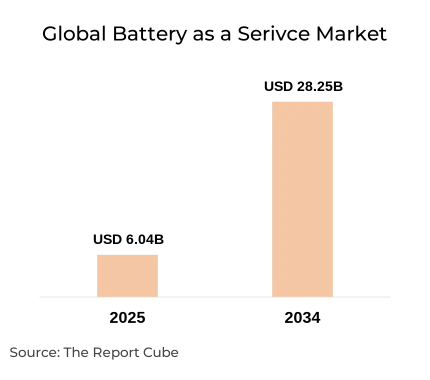
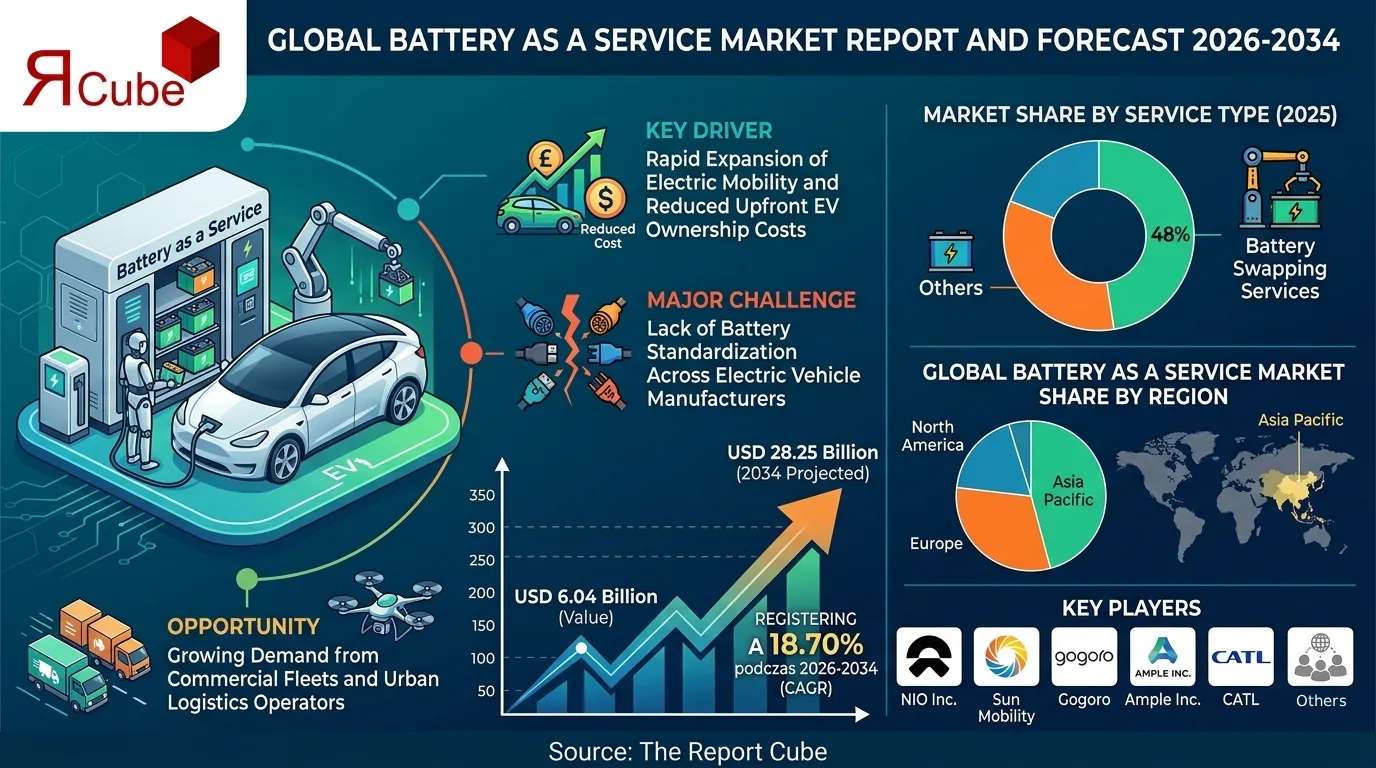
The Battery as a Service Market Market is anticipated to register a 18.70% during 2026-2034. The market size was valued at USD 6.04 Billion and is projected to reach USD 28.25 Billion by 2034.
The global Battery as a Service (BaaS) Market is gaining substantial momentum as electric mobility adoption accelerates worldwide. Battery as a Service allows electric vehicle owners to lease or subscribe to batteries instead of purchasing them outright, reducing the upfront cost of EV ownership and addressing concerns related to battery degradation and replacement expenses. This model also enables rapid battery swapping and centralized battery management, significantly improving vehicle uptime for commercial fleets and logistics providers. Governments across major economies are promoting EV adoption through incentives, emissions regulations, and charging infrastructure development, which indirectly supports the BaaS ecosystem. Rapid urbanization and increasing demand for clean transportation solutions are also encouraging energy service providers and automakers to explore innovative battery management business models.
Furthermore, the expansion of battery swapping infrastructure and digital fleet management platforms is strengthening the operational viability of BaaS solutions. Major companies are developing standardized battery modules to enable interoperability between vehicles and swapping stations. Such developments help reduce charging downtime and improve operational efficiency for commercial vehicle operators. Technological advancements in lithium-ion batteries, enhanced battery lifecycle analytics, and the emergence of cloud-connected energy management systems are also contributing to market growth. As urban mobility transitions toward electrification, Battery as a Service is expected to become a critical component of sustainable transportation ecosystems by lowering ownership barriers and enabling scalable energy distribution networks.
Battery as a Service Market Recent Developments
- 2025: NIO expanded its battery swapping network across Europe, launching new automated stations to support long-distance EV travel.
- 2025: Gogoro partnered with Southeast Asian mobility companies to deploy new battery swapping infrastructure for electric two-wheelers.
Government Initiatives & Policies
- India Battery Swapping Policy: Supports EV battery swapping networks and standardized battery ecosystems.
- EU Green Deal Mobility Initiative: Promotes electrification and sustainable transport infrastructure across Europe.
Battery as a Service Market Dynamics
Key Driver: Rapid Expansion of Electric Mobility and Reduced Upfront EV Ownership Costs
The rapid growth of electric mobility worldwide is the most influential driver supporting the Battery as a Service Market. One of the primary barriers to EV adoption has been the high upfront cost of batteries, which can account for nearly 35–40% of the total vehicle price. The BaaS model eliminates this barrier by separating the battery from vehicle ownership and allowing users to pay through subscriptions or leasing arrangements. This cost-efficient model is particularly attractive for fleet operators, logistics companies, and urban mobility providers who prioritize operational efficiency and cost predictability. By shifting battery ownership to specialized energy service providers, businesses can significantly reduce capital investment while ensuring reliable battery performance through centralized monitoring and maintenance systems.
Additionally, battery swapping technology integrated with BaaS services enables electric vehicles to replace depleted batteries in less than five minutes, compared to traditional charging that may require 30 minutes to several hours. This capability is particularly valuable for commercial fleets such as delivery services, ride-hailing vehicles, and public transportation operators where downtime directly impacts revenue. Governments are also encouraging EV adoption through subsidies, tax incentives, and stricter emissions regulations, indirectly accelerating BaaS market growth. In countries like China, India, and several European nations, policy frameworks supporting battery standardization and swapping infrastructure are further driving the development of BaaS ecosystems. As global EV sales are projected to exceed 45 million units annually by 2030, the demand for flexible battery ownership models is expected to rise significantly.
Book your FREE 30-minute expert consultation today
Contact UsIndustry Trends: Expansion of Battery Swapping Infrastructure and Smart Battery Management Systems
A key industry trend shaping the Battery as a Service Market is the increasing deployment of automated battery swapping stations integrated with advanced battery management platforms. Companies are investing heavily in modular battery technologies that allow quick removal and installation without manual intervention. These stations utilize robotic systems and digital authentication processes to complete battery swaps in a matter of minutes, improving convenience for EV users and reducing operational delays. The growing popularity of electric two-wheelers and three-wheelers in Asia Pacific markets has particularly accelerated the deployment of such infrastructure. For example, several urban mobility providers are integrating battery swapping stations in high-traffic locations including parking hubs, commercial centers, and logistics warehouses.
Another important trend is the integration of artificial intelligence and IoT-enabled battery monitoring platforms. These technologies enable real-time tracking of battery health, usage patterns, charging cycles, and predictive maintenance requirements. By analyzing operational data, service providers can optimize battery utilization and extend battery lifecycle by up to 20%. Moreover, energy companies are increasingly integrating renewable power sources such as solar and wind energy into battery charging stations to improve sustainability. Strategic partnerships between automotive manufacturers, battery manufacturers, and energy service companies are also becoming common as stakeholders attempt to build interoperable battery ecosystems. Such collaborative initiatives are expected to accelerate infrastructure development and create standardized battery platforms that support multiple vehicle brands.
Major Challenge: Lack of Battery Standardization Across Electric Vehicle Manufacturers
Despite its promising potential, the Battery as a Service Market faces significant challenges related to battery standardization and infrastructure compatibility. Currently, different EV manufacturers design batteries with unique dimensions, voltage systems, and thermal management requirements. This lack of standardization creates difficulties for battery swapping networks, as each vehicle model may require specific battery designs or station configurations. As a result, service providers often need to invest in multiple battery formats and complex station architectures, increasing capital expenditure and operational complexity.
Another challenge arises from the high cost of building large-scale battery swapping infrastructure. Establishing automated swapping stations requires advanced robotics, battery storage systems, and sophisticated safety monitoring equipment. The investment required for a single station can range from USD 500,000 to over USD 1 million depending on capacity and technology level. Additionally, battery inventory management becomes critical since operators must maintain a large pool of fully charged batteries to ensure uninterrupted service availability. Managing this inventory while maintaining battery health and safety standards can be operationally demanding. Furthermore, regulatory uncertainties in certain regions regarding battery ownership, recycling responsibilities, and energy trading policies may slow market expansion. Addressing these challenges will require industry-wide collaboration, regulatory clarity, and continued technological innovation.
Opportunity: Growing Demand from Commercial Fleets and Urban Logistics Operators
The rapid expansion of e-commerce and urban logistics presents a significant growth opportunity for the Battery as a Service Market. Delivery fleets, ride-hailing operators, and commercial transportation providers increasingly rely on electric vehicles to reduce operational costs and meet environmental regulations. However, fleet operators require high vehicle utilization rates and minimal downtime, which traditional charging infrastructure often cannot support efficiently. BaaS solutions address this need by enabling quick battery swapping and predictable energy costs through subscription models. This approach allows fleet operators to scale their electric vehicle deployments without the burden of battery ownership or maintenance responsibilities.
Another promising opportunity lies in emerging markets where electric two-wheelers and three-wheelers dominate urban mobility. Countries across Asia, Latin America, and Africa are experiencing strong growth in electric scooters and small commercial EVs used for last-mile deliveries and passenger transport. Battery swapping solutions are particularly well suited for these vehicles because their battery packs are smaller and easier to standardize. Furthermore, energy service providers can deploy compact swapping stations that occupy less space and require lower investment compared to traditional charging infrastructure. With global urban delivery volumes expected to grow by more than 60% by 2030, BaaS providers have a significant opportunity to support sustainable logistics networks and accelerate EV adoption across densely populated cities.
Battery as a Service Market Segment-wise Analysis
By Service Type:
- Battery Subscription Services
- Battery Leasing Services
- Battery Swapping Services
- Other Service Models
Battery swapping services currently dominate the Battery as a Service Market due to their ability to minimize vehicle downtime and enhance operational efficiency for commercial fleets. This segment accounts for nearly 48% of the global market share as of 2025, largely driven by increasing adoption among electric two-wheelers, three-wheelers, and commercial delivery vehicles. Battery swapping stations enable drivers to exchange depleted batteries with fully charged ones within minutes, significantly improving vehicle utilization compared to conventional charging systems. The subscription model is also gaining traction among individual EV owners who prefer predictable monthly energy expenses rather than high upfront battery costs. Leasing services, on the other hand, are widely adopted by fleet operators seeking flexible financing solutions for large EV deployments. Battery subscription services also provide added value through battery health monitoring, predictive maintenance, and performance guarantees offered by service providers. These features reduce operational risks for fleet operators while ensuring optimal battery lifespan management. As battery standardization improves and infrastructure expands globally, the battery swapping segment is expected to maintain its leadership position in the market.
By Vehicle Type:
- Electric Two-Wheelers
- Electric Three-Wheelers
- Electric Passenger Cars
- Electric Commercial Vehicles
Electric two-wheelers represent the leading segment in the Battery as a Service Market, accounting for nearly 41% of the global market share. This dominance is primarily driven by the widespread adoption of electric scooters and motorcycles in densely populated urban regions, particularly across Asia Pacific countries such as China, India, Indonesia, and Vietnam. These vehicles typically use smaller battery packs, making them well suited for battery swapping networks and subscription-based energy services. The ability to quickly replace batteries rather than wait for charging significantly improves convenience for daily commuters and commercial delivery riders. Electric three-wheelers also contribute substantially to the market due to their extensive use in passenger transport and last-mile logistics services.
Meanwhile, electric passenger cars are gradually adopting BaaS models as automakers explore innovative ownership structures to reduce vehicle prices. Some manufacturers offer vehicles without batteries, allowing customers to subscribe to battery services separately. This approach can reduce the upfront cost of EVs by up to 30%, making them more accessible to consumers. Electric commercial vehicles are also emerging as an important segment as logistics companies transition to electrified fleets. Battery swapping and leasing models help fleet operators manage energy costs efficiently while maintaining continuous vehicle operation. With the global push toward zero-emission transportation, all vehicle categories are expected to contribute to the expansion of BaaS solutions over the forecast period.
Need insights for a specific region within this market?
Request Regional DataRegional Projection of Battery as a Service Industry
- Asia Pacific
- North America
- Europe
- Middle East & Africa
Asia Pacific leads the global Battery as a Service Market, accounting for approximately 46% of the total market share. The region’s leadership is largely attributed to strong electric vehicle adoption, supportive government policies, and rapid expansion of battery swapping infrastructure. China remains the dominant market within the region due to extensive investments in EV technology and the presence of major BaaS providers such as NIO and CATL. The Chinese government has actively supported battery swapping through favorable regulations and incentives aimed at accelerating electric mobility adoption. Additionally, the country has already deployed thousands of automated battery swapping stations across major cities and highways.
India is also emerging as a major contributor to regional growth due to its rapidly expanding electric two-wheeler and three-wheeler markets. Government programs promoting battery swapping policies and EV incentives are encouraging domestic startups and energy companies to develop large battery service networks. Southeast Asian countries including Indonesia, Thailand, and Vietnam are also witnessing increasing adoption of electric scooters supported by battery swapping ecosystems. In contrast, North America and Europe are gradually adopting BaaS models primarily for passenger cars and commercial fleets. While these regions currently rely more on fast-charging infrastructure, several pilot projects for battery swapping networks are underway. With rising environmental regulations and growing demand for sustainable transportation, Asia Pacific is expected to maintain its leadership position in the Battery as a Service Market through 2034.
Why Choose This Report?
- Provides a comprehensive overview of the overall market analysis, encompassing key trends, consumer behavior analysis, and risk assessment to support strategic decision-making.
- Provides accurate, up-to-date insights into market size, segmentation, and emerging opportunities, helping to minimize risk & capitalizing on growth.
- Gives deep understanding of target audience preferences, investment habits, and communication channels for enhanced product development & marketing effectiveness.
- Delivers competitive analysis & benchmarking, uncovering the strengths & weaknesses of market competitors to guide strategies.
- Consolidate comprehensive market intelligence, reducing reasoning & streamlining research efforts.
- Facilitates customized market segmentation & risk mitigation strategies, fine-tuned to the business objectives.
- Aids in identifying both market challenges & untapped opportunities within the industry to drive long-term business growth.
- Provides valuable information based on actual customer data & search trends.
Table of Contents
- Introduction
- Objective of the Study
- Battery as a Service Definition
- Market Segmentation
- Study Variables
- Research Methodology
- Secondary Data Points
- Breakdown of Secondary Sources
- Primary Data Points
- Breakdown of Primary Interviews
- Secondary Data Points
- Executive Summary
- Market Dynamics
- Drivers
- Challenges
- Opportunity Assessment
- Recent Trends and Developments
- Regulatory and Policy Landscape
- Global Battery as a Service Market Overview (2021–2034)
- Market Size, By Value (USD Billion)
- Market Share, By Service Type
- Battery Subscription Services
- Battery Leasing Services
- Battery Swapping Services
- Market Share, By Battery Type
- Lithium-Ion Batteries
- Lithium Iron Phosphate Batteries
- Nickel-Based Batteries
- Other Battery Types
- Market Share, By Vehicle Type
- Electric Two-Wheelers
- Electric Three-Wheelers
- Electric Passenger Cars
- Electric Commercial Vehicles
- Market Share, By End User
- Individual EV Owners
- Fleet Operators
- Logistics & Delivery Companies
- Public Transport Operators
- Market Share, By Company
- Competition Characteristics
- Revenue Shares & Analysis
- Market Share, By Region
- Asia Pacific Battery as a Service Market
- Market Size, By Value
- Market Share, By Service Type
- Market Share, By Vehicle Type
- North America Battery as a Service Market
- Market Size, By Value
- Market Share, By Service Type
- Market Share, By Vehicle Type
- Europe Battery as a Service Market
- Market Size, By Value
- Market Share, By Service Type
- Market Share, By Vehicle Type
- Middle East and Africa Battery as a Service Market
- Market Size, By Value
- Market Share, By Service Type
- Market Share, By Vehicle Type
- South America Battery as a Service Market
- Market Size, By Value
- Market Share, By Service Type
- Market Share, By Vehicle Type
- Asia Pacific Battery as a Service Market
- Competitive Outlook and Company Profiles
- NIO Inc.
- Company Overview
- Battery Swapping & BaaS Portfolio
- Strategic Alliances/Partnerships
- Recent Developments
- Sun Mobility
- Company Overview
- Battery Swapping Solutions
- Strategic Alliances/Partnerships
- Recent Developments
- Gogoro
- Company Overview
- Battery Swapping Ecosystem
- Strategic Alliances/Partnerships
- Recent Developments
- Ample Inc.
- Company Overview
- Modular Battery Swapping Technology
- Strategic Alliances/Partnerships
- Recent Developments
- CATL (Contemporary Amperex Technology Co. Ltd.)
- Company Overview
- Battery Leasing & Swapping Solutions
- Strategic Alliances/Partnerships
- Recent Developments
- Others
- Company Overview
- Business Segments
- Strategic Alliances/Partnerships
- Recent Developments
- NIO Inc.
- Contact Us / Disclaimer
Top Key Players & Market Share Outlook
- NIO Inc.
- Sun Mobility
- Gogoro
- Ample Inc.
- CATL (Contemporary Amperex Technology Co. Ltd.)
- Others
Frequently Asked Questions






