



Build Your Custom Market Intelligence Report
Customize Your ReportGlobal Carbon Accounting Software Market Insights & Analysis
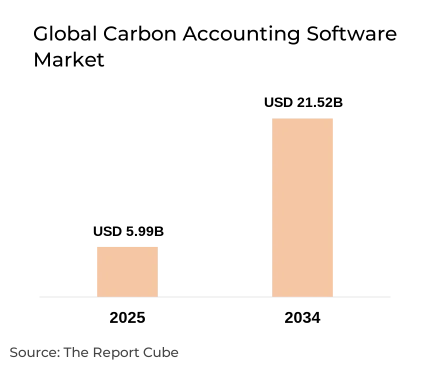
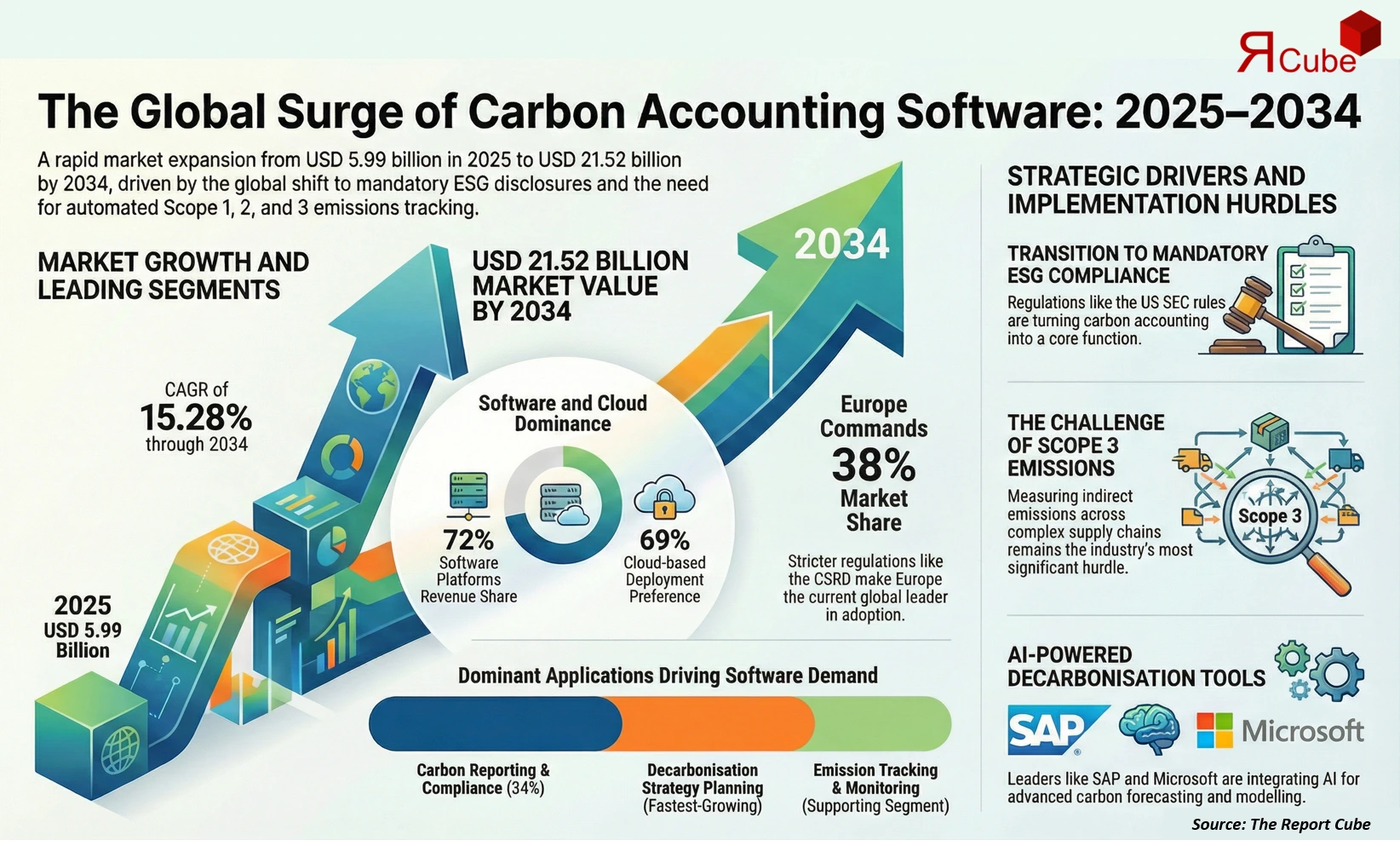
The Global Carbon Accounting Software Market is anticipated to register a CAGR of 15.28% during 2026–2034. The market size was valued at USD 5.99 Billion in 2025 and is projected to reach USD 21.52 Billion by 2034.
The global carbon accounting software market is expanding rapidly as organizations worldwide intensify efforts to measure, manage, and reduce greenhouse gas emissions. Rising climate change concerns, increasing corporate sustainability commitments, and mandatory ESG disclosures are driving enterprises to adopt structured carbon accounting solutions. Businesses are shifting from manual spreadsheets to automated platforms capable of tracking Scope 1, Scope 2, and Scope 3 emissions across complex value chains.
Carbon accounting software enables enterprises to improve data accuracy, streamline regulatory compliance, and align decarbonization strategies with long-term business goals. Large enterprises initially dominated adoption; however, growing affordability, cloud-based delivery models, and regulatory pressure are accelerating uptake among SMEs. As carbon reporting evolves from voluntary to mandatory across multiple jurisdictions, demand for scalable, audit-ready software platforms continues to strengthen globally.
Global Carbon Accounting Software Market Recent Developments
- 2025: Microsoft enhanced Sustainability Manager with advanced Scope 3 supplier emissions modeling capabilities.
- 2025: SAP introduced AI-powered carbon forecasting tools within its sustainability control tower platform.
Government Initiatives & Policies
- EU Corporate Sustainability Reporting Directive (CSRD): Mandatory emissions disclosure framework.
- U.S. SEC Climate Disclosure Rules: Proposed standardized climate risk and emissions reporting.
Global Carbon Accounting Software Market Dynamics
Key Driver: Mandatory ESG and Carbon Disclosure Requirements
Regulatory mandates represent the most powerful growth driver for the carbon accounting software market. Governments and financial regulators across Europe, North America, and Asia-Pacific are implementing strict climate disclosure rules that require organizations to report emissions data with greater transparency and accuracy. Frameworks such as CSRD, TCFD, and ISSB standards are compelling companies to adopt standardized digital tools capable of handling complex emissions calculations. Investors and financial institutions increasingly rely on verified carbon data to assess climate-related risks, pushing enterprises to invest in robust accounting platforms. As regulatory scrutiny intensifies, carbon accounting software has transitioned from a sustainability add-on to a core enterprise compliance function.
https://www.thereportcubes.com/report-store/cloud-mobile-baas-market-global
Industry Trends: Integration of Carbon Data with Enterprise Systems
A major trend shaping the market is the integration of carbon accounting software with enterprise resource planning, supply chain management, and financial systems. Organizations are seeking unified platforms that connect emissions data directly with procurement, operations, and financial planning. Cloud-based deployment dominates due to its scalability, lower upfront cost, and real-time reporting capabilities. Advanced analytics, scenario modeling, and automated data ingestion from IoT and supplier platforms are becoming standard features. Vendors are increasingly offering modular solutions that support decarbonization planning alongside emissions tracking, enabling businesses to move from measurement to actionable reduction strategies.
Major Challenge: Data Complexity and Scope 3 Measurement
Accurately capturing Scope 3 emissions remains the most significant challenge for market participants. These indirect emissions often span thousands of suppliers, logistics partners, and product life cycles, making data collection complex and inconsistent. Many organizations struggle with data gaps, supplier engagement, and lack of standardized methodologies across regions. Integration issues with legacy systems and concerns around data verification further complicate adoption. While software platforms are evolving to address these challenges, implementation complexity and internal capability gaps continue to restrain faster adoption, particularly among SMEs.
Opportunity: Expansion Among SMEs and Emerging Markets
Significant growth opportunities exist in SME adoption and emerging economies. As sustainability regulations extend beyond large corporations, mid-sized businesses are increasingly required to track emissions. Cloud-native, subscription-based carbon accounting solutions are lowering entry barriers for smaller organizations. Additionally, rapid industrialization and climate policy development in Asia-Pacific, Latin America, and the Middle East are creating new demand for localized carbon management solutions. Vendors that offer region-specific compliance frameworks and simplified user experiences are well positioned to capitalize on these opportunities.
Global Carbon Accounting Software Market Segment-wise Analysis
By Component:
- Software
- Services
The software segment dominates the market, accounting for approximately 72% of total revenue in 2025. Organizations prioritize software platforms for continuous emissions tracking, automated reporting, and analytics. Services, including consulting and implementation support, play a critical role during deployment and regulatory audits but contribute a smaller revenue share.
By Deployment Mode:
- Cloud-Based
- On-Premise
Cloud-based solutions lead the market with nearly 69% share, driven by scalability, ease of updates, and lower infrastructure costs. Cloud platforms enable real-time collaboration and seamless integration with enterprise systems. On-premise deployments remain relevant in highly regulated industries with strict data sovereignty requirements.
By Application:
- Carbon Footprint Management
- Emission Tracking & Monitoring
- Carbon Reporting & Compliance
- Carbon Credit Management
- Decarbonization Strategy Planning
Carbon reporting and compliance applications dominate, representing nearly 34% of market demand. Organizations focus heavily on regulatory adherence and investor reporting. Decarbonization strategy planning is the fastest-growing sub-segment, as businesses increasingly seek software that supports emissions reduction roadmaps and scenario analysis.
Need insights for a specific region within this market?
Request Regional DataRegional Projection of Global Carbon Accounting Software Industry
- North America
- Europe
- Asia-Pacific
- Middle East & Africa
- South America
Europe leads the global market with an estimated 38% share in 2025, driven by stringent climate regulations and early adoption of mandatory sustainability reporting. North America follows closely, supported by growing investor pressure and expanding regulatory frameworks. Asia-Pacific is the fastest-growing region due to rapid digitalization, industrial growth, and increasing climate policy alignment in countries such as China, Japan, and Australia.
Why Choose This Report?
- Provides a comprehensive overview of market trends, ESG adoption, and regulatory impacts.
- Offers accurate market sizing, segmentation, and growth forecasts.
- Delivers deep insights into enterprise sustainability decision-making.
- Includes competitive benchmarking and strategic positioning analysis.
- Reduces research complexity with consolidated market intelligence.
- Supports customized segmentation and risk mitigation strategies.
- Identifies emerging opportunities across regions and industries.
- Backed by real-world adoption patterns and search behavior trends.
Table of Contents
- Introduction
- Objective of the Study
- Carbon Accounting Software Definition
- Market Segmentation
- Study Variables
- Research Methodology
- Secondary Data Points
- Breakdown of Secondary Sources
- Primary Data Points
- Breakdown of Primary Interviews
- Secondary Data Points
- Executive Summary
- Market Dynamics
- Drivers
- Challenges
- Opportunity Assessment
- Recent Trends and Developments
- Regulatory and Policy Landscape
- Global Carbon Accounting Software Market Overview (2021-2034)
- Market Size, By Value (USD Billion)
- Market Share, By Component
- Software
- Services
- Market Share, By Deployment Mode
- Cloud-Based
- On-Premise
- Market Share, By Organization Size
- Large Enterprises
- Small & Medium Enterprises (SMEs)
- Market Share, By Scope
- Scope 1 Emissions
- Scope 2 Emissions
- Scope 3 Emissions
- Market Share, By Application
- Carbon Footprint Management
- Emission Tracking & Monitoring
- Carbon Reporting & Compliance
- Carbon Credit Management
- Decarbonization Strategy Planning
- Market Share, By End User
- Manufacturing
- Energy & Utilities
- IT & Telecom
- BFSI
- Healthcare
- Retail & E-Commerce
- Transportation & Logistics
- Government & Public Sector
- Others
- Market Share, By Company
- Competition Characteristics
- Revenue Shares & Analysis
- Market Share, By Region
- North America Carbon Accounting Software Market
- Market Size, By Value
- Market Share, By Deployment Mode
- Market Share, By End User
- Europe Carbon Accounting Software Market
- Market Size, By Value
- Market Share, By Deployment Mode
- Market Share, By End User
- Asia-Pacific Carbon Accounting Software Market
- Market Size, By Value
- Market Share, By Deployment Mode
- Market Share, By End User
- Middle East & Africa Carbon Accounting Software Market
- Market Size, By Value
- Market Share, By Deployment Mode
- Market Share, By End User
- South America Carbon Accounting Software Market
- Market Size, By Value
- Market Share, By Deployment Mode
- Market Share, By End User
- North America Carbon Accounting Software Market
- Competitive Outlook and Company Profiles
- IBM
- Company Overview
- Carbon Accounting Solutions
- Strategic Alliances/Partnerships
- Recent Developments
- SAP
- Company Overview
- Carbon Accounting Software Portfolio
- Strategic Alliances/Partnerships
- Recent Developments
- Microsoft
- Company Overview
- Sustainability Manager & Carbon Tools
- Strategic Alliances/Partnerships
- Recent Developments
- Salesforce
- Company Overview
- Net Zero Cloud Platform
- Strategic Alliances/Partnerships
- Recent Developments
- Sphera
- Company Overview
- Carbon Management Software
- Strategic Alliances/Partnerships
- Recent Developments
- Enablon (Wolters Kluwer)
- Company Overview
- Carbon & EHS Software Solutions
- Strategic Alliances/Partnerships
- Recent Developments
- Persefoni
- Company Overview
- Carbon Accounting Platform
- Strategic Alliances/Partnerships
- Recent Developments
- Watershed
- Company Overview
- Enterprise Carbon Platform
- Strategic Alliances/Partnerships
- Recent Developments
- Plan A
- Company Overview
- Decarbonization Software Solutions
- Strategic Alliances/Partnerships
- Recent Developments
- Others
- Company Overview
- Business Segments
- Strategic Alliances/Partnerships
- Recent Developments
- IBM
- Contact Us / Disclaimer
Top Key Players & Market Share Outlook
- IBM
- SAP
- Microsoft
- Salesforce
- Sphera
- Enablon (Wolters Kluwer)
- Persefoni
- Watershed
- Plan A
- Others
Frequently Asked Questions






