



Build Your Custom Market Intelligence Report
Customize Your ReportGCC Chlorine Gas Market Key Highlights
By Production Technology:
Membrane Cell Process segment leads the market with approximately 61.8% share.
By Application:
Ethylene Dichloride (EDC) Production segment dominates the market with nearly 34.7% of total revenue.
Regional Outlook:
Saudi Arabia dominates the GCC Chlorine Gas Market with around 52.4% market share.
GCC Chlorine Gas Market Insights & Analysis
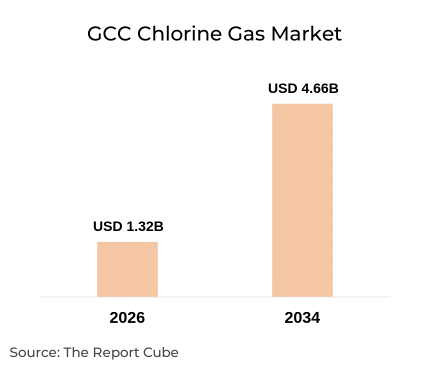
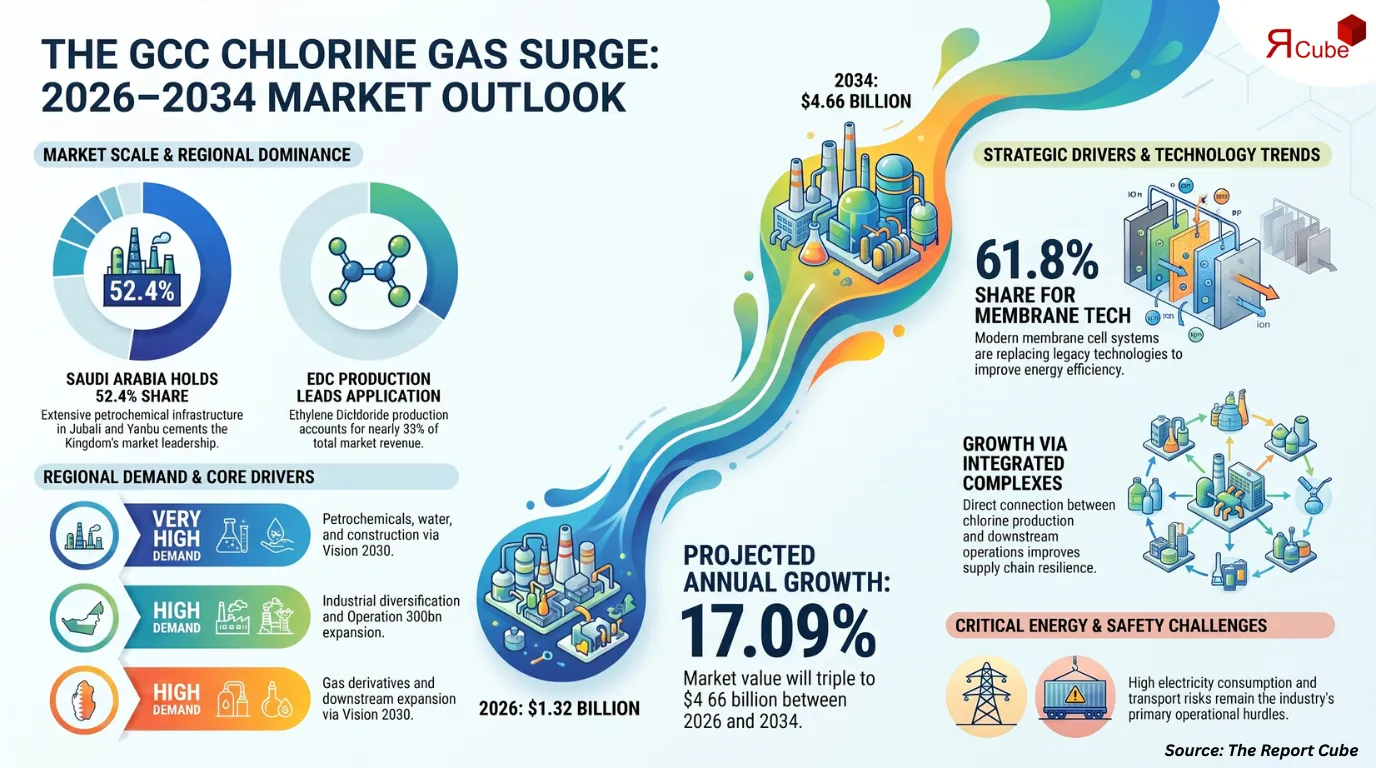
The GCC Chlorine Gas Market is anticipated to register a CAGR of around 17.09% during the forecast period from 2026 to 2034. The market size is valued at USD 1.32 billion in 2026 and is projected to reach USD 4.66 billion by 2034. Growth is closely supported by the GCC's long-term strategy of strengthening downstream chemical manufacturing and reducing dependence on imported industrial intermediates. Chlorine gas remains a critical feedstock for producing ethylene dichloride (EDC), vinyl chloride monomer (VCM), polyvinyl chloride (PVC), hydrochloric acid, sodium hypochlorite, and numerous specialty chemicals. Countries including Saudi Arabia, the United Arab Emirates, and Qatar continue investing in integrated chlor-alkali facilities that connect chlorine production directly with downstream petrochemical operations. This integrated manufacturing model improves production efficiency, enhances value addition, and supports regional exports of higher-value chemical products while improving supply chain resilience across the Gulf region.
Public and private sector investments are reshaping the chlorine gas industry throughout the GCC. Industrial development programs under Saudi Vision 2030, Operation 300bn in the UAE, and similar national diversification strategies continue attracting investment into advanced manufacturing and petrochemical infrastructure. Modern chlor-alkali plants are increasingly replacing conventional technologies with membrane cell systems that consume less electricity, improve product purity, and reduce environmental impact. At the same time, expanding desalination capacity, wastewater recycling projects, pharmaceutical manufacturing, electronics production, and specialty chemical industries are creating additional demand for chlorine and its derivatives. Recent investments in integrated EDC, VCM, and PVC production facilities further strengthen domestic value chains, positioning the GCC as an increasingly competitive supplier of chlorine-based chemicals to regional and international markets over the forecast period.
GCC Chlorine Gas Market Impact Analysis
| Factor | Type | Specific Impact on Market | Magnitude | Business Implication |
|---|---|---|---|---|
| Growth in PVC and construction demand | Market | Stronger consumption of chlorine for PVC and derivatives | High | Supports capacity additions aligned to downstream projects |
| Expansion of water and wastewater treatment | Market | Higher requirement for disinfection chemicals in utilities | High | Creates stable offtake contracts with municipal customers |
| Energy intensive chlor alkali production costs | Environmental | Electricity price swings directly affect unit margins | High | Drives investments in energy efficient and membrane cells |
| Stringent safety and environmental regulations | Regulatory | Tighter rules on storage, emissions and transport risks | Medium | Requires higher compliance spend but limits unsafe rivals |
| Integrated chlor alkali and downstream complexes | Competitive | Backward and forward integration improve cost positions | High | Favors large GCC players with scale and captive demand |
| Co production of hydrogen and caustic soda | Technological | Enables additional revenue streams from existing assets | Medium | Supports transition to low carbon chemicals and fuels |
| Global shift toward greener chemistries | Environmental | Pressure on chlorine heavy processes in some applications | Medium | Encourages R&D into cleaner routes and safer derivatives |
GCC Chlorine Gas Market Dynamics
Key Driver: Expansion of Integrated Petrochemical and Chlor-Alkali Manufacturing Capacity
Industrial diversification remains a defining factor supporting demand across the GCC chlorine gas market. Regional governments continue encouraging investments in downstream chemical manufacturing to capture greater value from hydrocarbon resources while expanding non-oil industrial output. Chlorine serves as an indispensable feedstock for manufacturing EDC, VCM, PVC, hydrochloric acid, chlorinated solvents, and numerous inorganic chemicals that supply construction, infrastructure, automotive, healthcare, and manufacturing industries. Large integrated production complexes across Saudi Arabia and the UAE continue increasing captive chlorine consumption, ensuring stable demand while reducing dependence on imported intermediates. As regional production of chlorine derivatives expands, manufacturers benefit from stronger supply chain integration and improved operational efficiency.
Recent investments in chlor-alkali facilities demonstrate the industry's long-term confidence in regional demand fundamentals. New production projects are designed to integrate chlorine generation with downstream chemical processing, allowing manufacturers to maximize feedstock utilization while lowering logistics costs. This production model supports greater industrial localization and enhances export competitiveness by enabling the manufacture of higher-value chemical products within the GCC. Continued expansion of industrial cities, petrochemical hubs, and specialty chemical clusters is expected to sustain chlorine consumption across multiple industrial applications throughout the forecast period.
Industry Trends: Transition Toward Membrane Cell Technology and Smart Manufacturing
Technology modernization has become a defining trend across chlorine manufacturing facilities in the GCC. Producers are steadily replacing legacy mercury and diaphragm cell technologies with membrane cell systems that deliver higher operational efficiency, lower electricity consumption, and improved environmental performance. Besides reducing operating costs, membrane technology produces higher-purity chlorine and caustic soda, making it particularly suitable for pharmaceutical, electronics, and specialty chemical applications where product quality remains critical. Ongoing modernization also supports stricter environmental compliance while improving plant reliability.
Digital transformation is further improving plant productivity across regional chlor-alkali operations. Industrial facilities increasingly deploy automated process controls, predictive maintenance platforms, advanced sensors, and real-time production monitoring to optimize electrolysis performance and minimize unplanned shutdowns. These technologies enable manufacturers to improve energy utilization, reduce maintenance costs, and maintain consistent product quality. As sustainability objectives become more prominent across the GCC's industrial sector, investments in energy-efficient production technologies are expected to remain a central theme shaping future market development.
Book your FREE 30-minute expert consultation today
Contact UsMajor Challenge: Safe Transportation and Energy-Intensive Production Processes
Handling and transporting chlorine gas continues to present operational challenges for producers and distributors across the GCC. Owing to its highly reactive nature, chlorine requires specialized storage systems, dedicated transportation equipment, and rigorous safety protocols throughout the supply chain. Industrial customers located outside integrated petrochemical zones often depend on cylinders, ton containers, or bulk tanker deliveries, increasing logistics complexity and operational expenses. Maintaining reliable transportation networks while complying with stringent safety regulations remains essential for uninterrupted market supply.
Electricity consumption also represents a significant component of chlor-alkali production costs because electrolysis is inherently energy intensive. Although membrane technology substantially improves energy efficiency, producers continue seeking opportunities to optimize operating expenses while maintaining environmental compliance. Regular investments in emission control systems, leak detection technologies, plant modernization, and workforce training further increase capital requirements. These factors can influence production economics, particularly for facilities operating older manufacturing assets that require technological upgrades to remain competitive.
Opportunity: Water Infrastructure Expansion and Industrial Localization Create Long-Term Demand
Growing investment in water security projects is expected to generate sustained demand for chlorine gas across the GCC. Rapid urbanization, population growth, and industrial expansion continue increasing requirements for desalinated water, municipal water treatment, wastewater recycling, and industrial water reuse. Chlorine remains one of the most effective disinfectants used to eliminate harmful microorganisms while maintaining water quality across distribution networks. Continuous expansion of desalination facilities and wastewater treatment plants throughout Saudi Arabia, the UAE, Qatar, and Oman is expected to support stable chlorine consumption over the coming years.
Industrial localization policies are opening new growth opportunities beyond conventional petrochemical applications. Governments continue encouraging domestic production of specialty chemicals, pharmaceuticals, electronics materials, and industrial intermediates that utilize chlorine-based compounds during manufacturing. Simultaneously, integrated investments linking chlor-alkali production with EDC, VCM, PVC, and other downstream chemical facilities strengthen regional value chains and reduce dependence on imported products. These structural developments position the GCC chlorine gas market for sustained long-term expansion while improving industrial competitiveness across global chemical markets.
GCC Chlorine Gas Market Segment-wise Analysis
By Production Technology:
- Mercury Cell Process
- Diaphragm Cell Process
- Membrane Cell Process
The Membrane Cell Process represented the largest production technology segment in the GCC Chlorine Gas Market, accounting for approximately 61.8% of total revenue in 2026. Its market leadership reflects the region's shift toward energy-efficient chlor-alkali production as governments and manufacturers prioritize cleaner industrial operations. Unlike conventional mercury and diaphragm cell technologies, membrane cell systems deliver higher-purity chlorine and caustic soda while consuming considerably less electricity, making them well suited for integrated petrochemical complexes. The technology also supports compliance with increasingly stringent environmental regulations by eliminating mercury emissions and reducing waste generation. As new chlor-alkali projects are developed across Saudi Arabia and the United Arab Emirates, membrane technology has become the preferred choice for both greenfield investments and modernization of existing facilities.
Investment activity across the GCC continues to reinforce the dominance of membrane-based production. Chemical producers are integrating advanced electrolysis systems with digital monitoring, predictive maintenance, and automated process controls to maximize production efficiency and improve asset reliability. The 2025 expansion of the chlor-alkali facility in Jubail using thyssenkrupp nucera's membrane technology further highlights the industry's commitment to high-efficiency production while reducing operating costs and electricity consumption. Supported by expanding downstream demand for PVC, EDC, hydrochloric acid, and water treatment chemicals, the Membrane Cell Process segment is expected to strengthen its position throughout the forecast period.
By Application:
- Organic Chemicals Manufacturing
- Disinfection & Sanitization
- Pulp & Paper Bleaching
- Ethylene Dichloride (EDC) Production
- Inorganic Chemicals Manufacturing
- Water & Wastewater Treatment
- Others
Ethylene Dichloride (EDC) Production remained the largest application segment, contributing nearly 34.7% of the GCC Chlorine Gas Market revenue in 2026. Chlorine is an essential feedstock in the manufacture of EDC, which serves as the primary intermediate for producing vinyl chloride monomer (VCM) and subsequently polyvinyl chloride (PVC). Demand for PVC continues to increase across the Gulf region due to ongoing investments in residential construction, industrial facilities, water transmission networks, electrical infrastructure, and oil and gas projects. This has encouraged chemical producers to expand integrated chlorine-to-PVC value chains, ensuring stable captive consumption of chlorine while improving regional self-sufficiency in downstream petrochemicals.
The UAE and Saudi Arabia are emerging as strategic production hubs for chlorine derivatives through large-scale downstream investments. The TA'ZIZ integrated chemicals complex in Abu Dhabi, announced in 2025, will significantly expand regional production of EDC, VCM, PVC, and caustic soda, strengthening the domestic chlor-alkali ecosystem. Similar investments across industrial cities are improving feedstock integration and reducing dependence on imported chlorinated intermediates. As infrastructure development and manufacturing diversification continue across the GCC, EDC production is expected to remain the largest and fastest-growing application for chlorine gas over the forecast period.
Regional Projection of GCC Chlorine Gas Industry
- Saudi Arabia
- United Arab Emirates
- Kuwait
- Oman
- Qatar
- Bahrain
Saudi Arabia dominated the GCC Chlorine Gas Market with an estimated 52.4% market share in 2026, supported by its extensive petrochemical infrastructure, abundant feedstock availability, and strong industrial investment pipeline. The country hosts some of the region's largest chlor-alkali and downstream chemical facilities, particularly within Jubail and Yanbu Industrial Cities, where chlorine is extensively utilized for manufacturing EDC, PVC, hydrochloric acid, sodium hypochlorite, and other industrial chemicals. Continuous expansion of petrochemical capacity, combined with growing investments in desalination plants and municipal water treatment facilities, has strengthened domestic chlorine consumption across multiple end-use industries.
Saudi Arabia's long-term industrial development strategy continues to accelerate investments in specialty chemicals and value-added manufacturing under Vision 2030. Ongoing expansion of integrated petrochemical complexes, modernization of chlor-alkali production facilities, and adoption of advanced membrane technologies are enhancing production efficiency while improving export competitiveness. Rising private-sector participation, industrial localization initiatives, and increasing demand from construction, pharmaceuticals, and water infrastructure projects are expected to reinforce the country's leadership position in the GCC Chlorine Gas Market throughout the forecast period.
Need insights for a specific region within this market?
Request Regional DataGCC Chlorine Gas Market Countries Analysis
The GCC chlorine gas market shows strong growth, driven by petrochemicals, water treatment, and construction-linked demand.
| Country | Demand Level | Key Areas | System Dominance | Core Demand Logic | Growth Nature |
|---|---|---|---|---|---|
| Saudi Arabia | Very High | Jubail, Yanbu, Riyadh | Large chlor-alkali complexes | Petrochemicals, water, construction | Vision 2030 driven capacity growth |
| United Arab Emirates | High | Abu Dhabi, Jebel Ali, Ruwais | Integrated chemical clusters | Industrial diversification & utilities | Operation 300bn industrial expansion |
| Kuwait | Medium | Shuaiba, Ahmadi, Kuwait City | Refinery-linked chlor-alkali | Refining, plastics, water treatment | Steady, refinery project led growth |
| Oman | Medium | Sohar, Duqm, Muscat | Mid-scale petrochem units | Port-based industry & desalination | Logistics corridor driven scaling |
| Qatar | High | Ras Laffan, Mesaieed, Doha | Gas-based chemical complexes | Gas derivatives and power water | Vision 2030 downstream expansion |
| Bahrain | Low to Medium | Sitra, Hidd, Manama | Smaller chlor-alkali plants | Aluminium, textiles, water utilities | Niche, regional supply-linked growth |
Government Initiatives & Policies
- Operation 300bn (United Arab Emirates): The UAE continues expanding its national industrial strategy through investments in advanced manufacturing and downstream chemicals. The program supports local production, industrial competitiveness, supply chain development, and foreign investment across strategic manufacturing sectors, including chlor-alkali and petrochemicals.
- Saudi Vision 2030 National Industrial Strategy: Saudi Arabia continues accelerating investments in specialty chemicals, industrial localization, and advanced manufacturing through Vision 2030 initiatives. The strategy promotes downstream petrochemical expansion, technology adoption, and private-sector participation while strengthening domestic chemical production capabilities.
GCC Chlorine Gas Industry Recent Developments
- 2025: TA'ZIZ awarded an engineering, procurement, and construction (EPC) contract valued at approximately USD 1.99 billion for its integrated chlor-alkali and downstream chemicals complex in Ruwais, Abu Dhabi. The project will manufacture polyvinyl chloride (PVC), ethylene dichloride (EDC), vinyl chloride monomer (VCM), and caustic soda, strengthening the UAE's downstream chlorine derivatives ecosystem while increasing domestic production capacity for high-value industrial chemicals.
- 2025: Chemical Marketing and Distribution Company (CMDC), part of BCI Group, awarded thyssenkrupp nucera a contract worth approximately USD 17.6 million to expand its chlor-alkali facility in Jubail Industrial City. The project will deploy advanced BM2.7 membrane technology to increase production of liquid chlorine, caustic soda, sodium hypochlorite, and hydrochloric acid while improving energy efficiency and environmental performance.
Why Choose This Report?
- Provides a comprehensive overview of the overall market analysis, encompassing key trends, consumer behavior analysis, and risk assessment to support strategic decision-making.
- Provides accurate, up-to-date insights into market size, segmentation, and emerging opportunities, helping to minimize risk while capitalizing on growth.
- Gives deep understanding of target audience preferences, investment habits, and communication channels for enhanced product development and marketing effectiveness.
- Delivers competitive analysis and benchmarking, uncovering the strengths and weaknesses of market competitors to guide business strategies.
- Consolidates comprehensive market intelligence, reducing research time and streamlining strategic planning.
- Facilitates customized market segmentation and risk mitigation strategies, fine-tuned to specific business objectives.
- Aids in identifying both market challenges and untapped opportunities within the industry to drive long-term business growth.
- Provides valuable information based on actual customer demand patterns, industrial developments, and market trends.
Table of Contents
- Introduction
- Objective of the Study
- Product and Category Definition
- Market Segmentation
- Study Variables
- Research Methodology
- Secondary Data Points
- Breakdown of Secondary Sources
- Primary Data Points
- Breakdown of Primary Interviews
- Secondary Data Points
- Executive Summary
- Market Dynamics
- Emerging Opportunities
- Adoption Trends
- Demand Drivers
- Disruption Analysis (Challenges)
- Industry Analysis & Strategic Insights
- Supply/Value Chain Analysis
- Pricing Analysis
- Go-To-Market (GTM) Strategy
- BCG Matrix
- Recent Trends and Developments
- Import and Export Analysis
- Regulatory and Policy Landscape
- Country-wise Policies
- Government Initiatives
- GCC Chlorine Gas Market Overview and Forecast Analysis (2021-2034)
- Market Size, By Value, By Growth Rate (CAGR/USD Billion)
- Market Share, By Production Technology
- Mercury Cell Process
- Diaphragm Cell Process
- Membrane Cell Process
- Market Share, By Supply Form
- Gaseous Chlorine
- Liquefied Chlorine
- Market Share, By Distribution Mode
- Bulk Tankers
- Cylinders
- Pipeline Supply
- Ton Containers
- Market Share, By Application
- Organic Chemicals Manufacturing
- Disinfection & Sanitization
- Pulp & Paper Bleaching
- Ethylene Dichloride (EDC) Production
- Inorganic Chemicals Manufacturing
- Water & Wastewater Treatment
- Others
- Market Share, By End User
- Electronics & Semiconductor Industry
- Water & Wastewater Utilities
- Textile Industry
- Metallurgical Industry
- Pharmaceutical Industry
- Chemical Industry
- Pulp & Paper Industry
- Others
- Market Share, By Country
- Saudi Arabia
- United Arab Emirates
- Kuwait
- Oman
- Qatar
- Bahrain
- Market Share, By Company
- Revenue Shares & Analysis
- Competitive Landscape
- Saudi Arabia Chlorine Gas Market Overview and Forecast Analysis (2021-2034)
- Market Size, By Value, By Growth Rate (CAGR/USD Billion/Million)
- Market Share, By Production Technology
- Market Share, By Supply Form
- Market Share, By Distribution Mode
- Market Share, By Application
- Market Share, By End User
- United Arab Emirates Chlorine Gas Market Overview and Forecast Analysis (2021-2034)
- Market Size, By Value, By Growth Rate (CAGR/USD Billion/Million)
- Market Share, By Production Technology
- Market Share, By Supply Form
- Market Share, By Distribution Mode
- Market Share, By Application
- Market Share, By End User
- Kuwait Chlorine Gas Market Overview and Forecast Analysis (2021-2034)
- Market Size, By Value, By Growth Rate (CAGR/USD Billion/Million)
- Market Share, By Production Technology
- Market Share, By Supply Form
- Market Share, By Distribution Mode
- Market Share, By Application
- Market Share, By End User
- Oman Chlorine Gas Market Overview and Forecast Analysis (2021-2034)
- Market Size, By Value, By Growth Rate (CAGR/USD Billion/Million)
- Market Share, By Production Technology
- Market Share, By Supply Form
- Market Share, By Distribution Mode
- Market Share, By Application
- Market Share, By End User
- Qatar Chlorine Gas Market Overview and Forecast Analysis (2021-2034)
- Market Size, By Value, By Growth Rate (CAGR/USD Billion/Million)
- Market Share, By Production Technology
- Market Share, By Supply Form
- Market Share, By Distribution Mode
- Market Share, By Application
- Market Share, By End User
- Bahrain Chlorine Gas Market Overview and Forecast Analysis (2021-2034)
- Market Size, By Value, By Growth Rate (CAGR/USD Billion/Million)
- Market Share, By Production Technology
- Market Share, By Supply Form
- Market Share, By Distribution Mode
- Market Share, By Application
- Market Share, By End User
- Competitive Analysis, 2026
- Market Share of Key Players
- Competitive Mapping for Each Segment and Companies Operating Countryally
- Saudi Arabia Chlorine Gas Companies Share & Competitive Analysis, 2026
- United Arab Emirates Chlorine Gas Companies Share & Competitive Analysis, 2026
- Kuwait Chlorine Gas Companies Share & Competitive Analysis, 2026
- Oman Chlorine Gas Companies Share & Competitive Analysis, 2026
- Qatar Chlorine Gas Companies Share & Competitive Analysis, 2026
- Bahrain Chlorine Gas Companies Share & Competitive Analysis, 2026
- Company Profile (Partial List)
- Union Chlorine L.L.C.
- Company Overview
- Product Portfolio
- Strategic Alliances/Partnerships
- Recent Developments
- Saudi Industrial Investment Group (SIIG)
- Company Overview
- Product Portfolio
- Strategic Alliances/Partnerships
- Recent Developments
- National Chlorine Industries Company
- Company Overview
- Product Portfolio
- Strategic Alliances/Partnerships
- Recent Developments
- Qatar Vinyl Company Ltd. (QVC)
- Company Overview
- Product Portfolio
- Strategic Alliances/Partnerships
- Recent Developments
- Saudi Basic Industries Corporation (SABIC)
- Company Overview
- Product Portfolio
- Strategic Alliances/Partnerships
- Recent Developments
- Emirates National Chemicals Industries LLC (ENCI)
- Company Overview
- Product Portfolio
- Strategic Alliances/Partnerships
- Recent Developments
- Bahrain Chlorine W.L.L.
- Company Overview
- Product Portfolio
- Strategic Alliances/Partnerships
- Recent Developments
- Al Kout Industrial Projects Company K.P.S.C.
- Company Overview
- Product Portfolio
- Strategic Alliances/Partnerships
- Recent Developments
- Sahara International Petrochemical Company (SIPCHEM)
- Company Overview
- Product Portfolio
- Strategic Alliances/Partnerships
- Recent Developments
- Gulf Chlorine W.L.L.
- Company Overview
- Product Portfolio
- Strategic Alliances/Partnerships
- Recent Developments
- Qatar Petrochemical Company Q.P.J.S.C. (QAPCO)
- Company Overview
- Product Portfolio
- Strategic Alliances/Partnerships
- Recent Developments
- Oman Chlorine S.A.O.G.
- Company Overview
- Product Portfolio
- Strategic Alliances/Partnerships
- Recent Developments
- Others (Partial List)
- Union Chlorine L.L.C.
- Contact Us and Disclaimer
Top Key Players & Market Share Outlook
- Union Chlorine L.L.C.
- Saudi Industrial Investment Group (SIIG)
- National Chlorine Industries Company
- Qatar Vinyl Company Ltd. (QVC)
- Saudi Basic Industries Corporation (SABIC)
- Emirates National Chemicals Industries LLC (ENCI)
- Bahrain Chlorine W.L.L.
- Al Kout Industrial Projects Company K.P.S.C.
- Sahara International Petrochemical Company (SIPCHEM)
- Gulf Chlorine W.L.L.
- Qatar Petrochemical Company Q.P.J.S.C. (QAPCO)
- Oman Chlorine S.A.O.G.
- Others
Frequently Asked Questions






