




Build Your Custom Market Intelligence Report
Customize Your ReportChina Cold Chain Warehousing Market Insights & Analysis
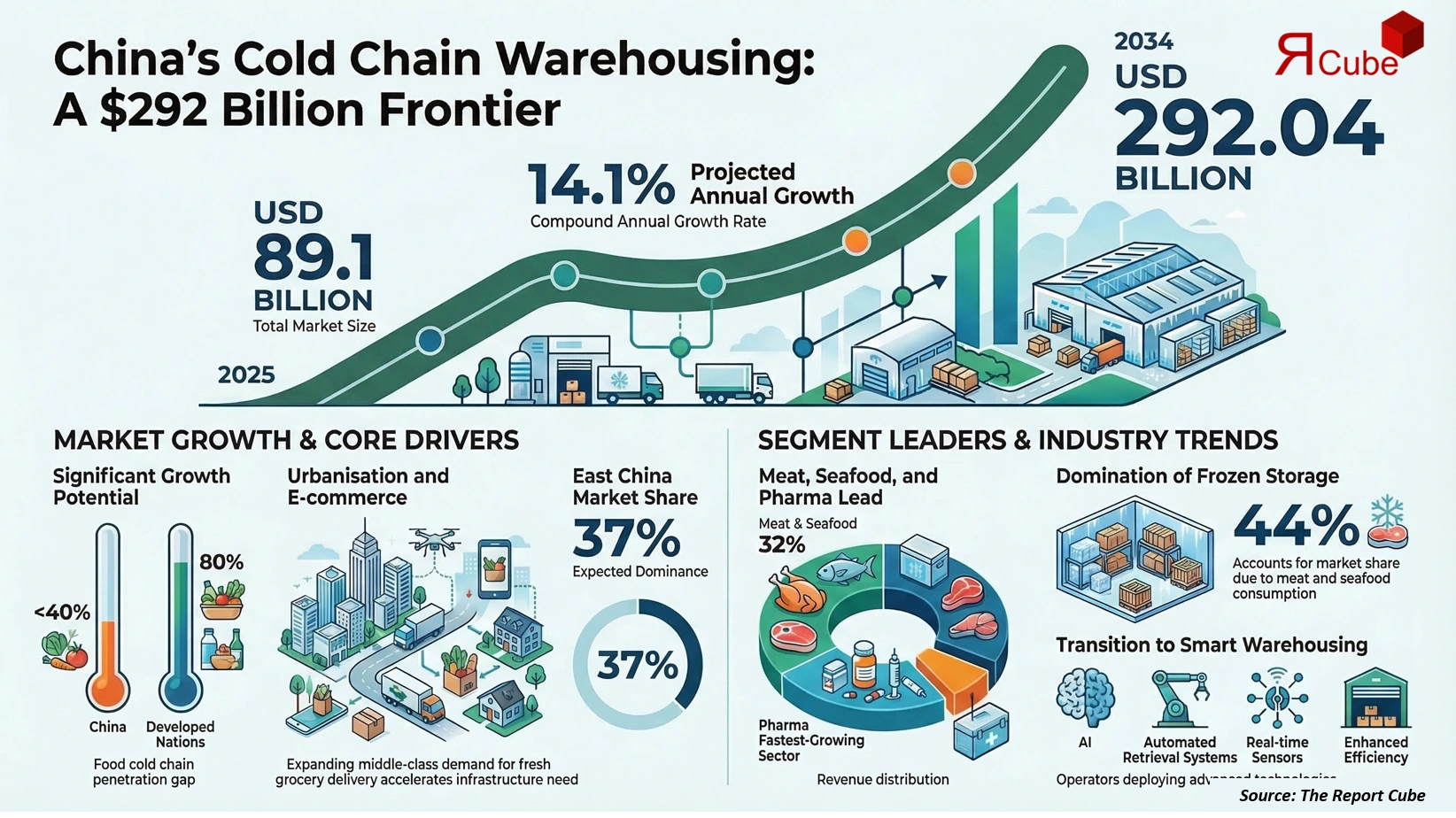
The China Cold Chain Warehousing Market is anticipated to register a CAGR of 14.1% during the forecast period 2026-2034. The market size was valued at USD 89.1 billion in 2025 and is projected to reach USD 292.04 billion by 2034. This exceptional growth trajectory is underpinned by rising demand for temperature-controlled logistics across food, agriculture, and pharmaceutical sectors, supported by China’s expanding middle-class population and rapid urbanization.
The increasing penetration of e-commerce grocery platforms, fresh food retail chains, and online pharmaceutical distribution has significantly elevated the need for modern cold storage infrastructure. Consumers are placing greater emphasis on food safety, quality assurance, and extended shelf life, prompting manufacturers and distributors to invest heavily in refrigerated warehousing networks. At the same time, China’s pharmaceutical and biologics industry is expanding at double-digit rates, further reinforcing the need for compliant cold chain facilities.
Additionally, government-backed investments in logistics parks, smart warehousing, and integrated transportation corridors are accelerating cold chain capacity expansion across key consumption hubs. As supply chains become more complex and time-sensitive, cold chain warehousing is emerging as a strategic pillar of China’s logistics ecosystem, ensuring sustained market momentum through 2034.
China Cold Chain Warehousing Market Recent Developments
- 2025: JD Logistics expanded automated cold storage hubs to support fresh food and pharma distribution nationwide.
- 2025: China Merchants Americold commissioned new multi-temperature warehouses in East and South China.
Government Initiatives & Policies
- National Cold Chain Logistics Development Plan: Focuses on reducing food loss and expanding cold storage capacity.
- Agricultural Product Cold Chain Program: Supports rural cold storage and fresh produce distribution.
China Cold Chain Warehousing Market Dynamics
Key Driver: Rising Demand for Fresh Food and Pharmaceutical Cold Storage
The primary driver of the China Cold Chain Warehousing Market is the surging demand for fresh food, dairy, meat, seafood, and temperature-sensitive pharmaceuticals. Rapid urbanization and rising disposable incomes have increased consumption of frozen and chilled foods, particularly in tier-one and tier-two cities. In parallel, the expansion of vaccine distribution, biologics, and specialty drugs has heightened the need for compliant cold storage facilities. Industry estimates suggest that cold chain penetration for food products in China remains below 40%, compared to over 80% in developed economies, highlighting substantial growth potential. As retailers and healthcare providers focus on reducing spoilage and ensuring regulatory compliance, investment in advanced cold warehousing infrastructure continues to accelerate.
Book your FREE 30-minute expert consultation today
Contact UsIndustry Trends: Automation and Smart Cold Warehousing
A key trend shaping the market is the adoption of automation and smart warehousing technologies. Operators are increasingly deploying automated storage and retrieval systems, temperature monitoring sensors, and warehouse management software to improve efficiency and reduce operating costs. These technologies enable precise temperature control, real-time inventory tracking, and faster order fulfillment. Energy-efficient refrigeration systems and renewable energy integration are also gaining traction as operators seek to lower carbon footprints and comply with sustainability goals. This shift toward intelligent cold chain infrastructure is enhancing scalability and reliability, making modern facilities more attractive to multinational food and pharmaceutical companies.
Major Challenge: High Capital and Operating Costs
Despite strong demand, high capital expenditure and operating costs remain a major challenge for the China Cold Chain Warehousing Market. Building and maintaining temperature-controlled facilities requires significant upfront investment in refrigeration equipment, insulation, and energy systems. Additionally, cold warehouses incur higher electricity and maintenance costs compared to ambient storage. Smaller logistics providers often struggle to achieve economies of scale, limiting their competitiveness. Regulatory compliance, including food safety and pharmaceutical storage standards, further adds to operational complexity. These cost pressures may constrain profitability, particularly for operators with limited access to long-term financing.
Opportunity: Expansion of Integrated Cold Chain Logistics Services
The growing demand for end-to-end cold chain solutions presents a significant opportunity for market participants. Customers increasingly prefer integrated services that combine refrigerated storage, transportation, and value-added services such as packaging and labeling. This trend is particularly strong in the pharmaceutical and high-value food segments, where supply chain reliability is critical. Logistics providers that invest in nationwide networks and digital integration are well-positioned to capture long-term contracts from large retailers and manufacturers. As outsourcing of cold chain logistics increases, integrated service models are expected to drive revenue growth and differentiation.
China Cold Chain Warehousing Market Segment-wise Analysis
By Service Type:
- Refrigerated Storage
- Refrigerated Transport
- Value-Added Services
Refrigerated Storage dominates the market, accounting for approximately 48% of total revenue in 2025. This leadership reflects the critical role of warehousing in preserving product quality across food and pharmaceutical supply chains. Refrigerated Transport follows, driven by the expansion of intercity fresh food distribution networks. Value-Added Services, including sorting, packaging, and labeling, are gaining momentum as customers seek integrated logistics solutions. The growing complexity of supply chains is expected to increase demand for bundled services, strengthening the overall market ecosystem.
By Temperature Range:
- Chilled Storage
- Frozen Storage
- Deep-Frozen Storage
Frozen Storage leads this segment with an estimated 44% market share, supported by rising consumption of frozen meat, seafood, and processed foods. Chilled Storage is widely used for dairy, fruits, and vegetables, while Deep-Frozen Storage is expanding rapidly due to its importance in pharmaceutical and high-value food applications. The diversification of temperature-controlled requirements underscores the need for multi-temperature facilities, encouraging operators to invest in flexible infrastructure.
By Application:
- Dairy Products
- Meat & Seafood
- Fruits & Vegetables
- Processed Foods
- Pharma & Biologics
Meat & Seafood represent the leading application segment, contributing nearly 32% of total market revenue, driven by rising protein consumption and import volumes. Pharma & Biologics is the fastest-growing segment, supported by vaccine distribution and biologics manufacturing. Fruits & Vegetables and Dairy Products also contribute significantly, reflecting the growing emphasis on freshness and food safety across urban markets.
Regional Projection of China Cold Chain Warehousing Industry
- East China
- North China
- South China
- Central China
- West China
East China leads the China Cold Chain Warehousing Market, accounting for approximately 37% of total capacity. The region benefits from high population density, strong consumer demand, and well-developed logistics infrastructure in cities such as Shanghai and surrounding provinces. South China follows closely, supported by import-export activities and fresh food consumption. East China’s dominance is expected to persist due to continued investments in smart logistics parks and proximity to major consumption hubs.
Need insights for a specific region within this market?
Request Regional DataWhy Choose This Report?
- Provides a comprehensive overview of the overall market analysis, encompassing key trends, consumer behavior analysis, and risk assessment to support strategic decision-making.
- Provides accurate, up-to-date insights into market size, segmentation, and emerging opportunities, helping to minimize risk & capitalizing on growth.
- Gives deep understanding of target audience preferences, investment habits, and communication channels for enhanced product development & marketing effectiveness.
- Delivers competitive analysis & benchmarking, uncovering the strengths & weaknesses of market competitors to guide strategies.
- Consolidate comprehensive market intelligence, reducing reasoning & streamlining research efforts.
- Facilitates customized market segmentation & risk mitigation strategies, fine-tuned to the business objectives.
- Aids in identifying both market challenges & untapped opportunities within the industry to drive long-term business growth.
- Provides valuable information based on actual customer data & search trends.
Table of Contents
- Introduction
- Objective of the Study
- Product and Category Definition
- Market Segmentation
- Study Variables
- Research Methodology
- Secondary Data Points
- Breakdown of Secondary Sources
- Primary Data Points
- Breakdown of Primary Interviews
- Secondary Data Points
- Executive Summary
- Market Dynamics
- Drivers
- Challenges
- Opportunity Assessment
- Recent Trends and Developments
- Regulatory and Policy Landscape
- China Cold Chain Warehousing Market Overview (2020-2034)
- Market Size, By Value (USD Billion)
- Market Share, By Service Type
- Refrigerated Storage
- Refrigerated Transport
- Value‑Added Services
- Market Share, By Temperature Range
- Chilled Storage
- Frozen Storage
- Deep‑Frozen Storage
- Market Share, By Application
- Dairy Products
- Meat Seafood
- Fruits Vegetables
- Processed Foods
- Pharma Biologics
- Market Share, By User Type
- Food Retailers
- Foodservice Chains
- E‑Commerce Grocery
- Pharma Companies
- Market Share, By Region
- East
- North
- South
- Central
- West
- Market Share, By Company
- Market Share, By Company
- Competition Characteristics
- Revenue Shares & Analysis
- East China Cold Chain Warehousing Market
- Market Size, By Value (USD Billion)
- Market Share, By Service Type
- Market Share, By Temperature Range
- Market Share, By Application
- Market Share, By User Type
- Market Share, By Province/City Group
- Market Share, By Province
- Shanghai
- Jiangsu
- Zhejiang
- Shandong
- Rest of East China
- North China Cold Chain Warehousing Market
- Market Size, By Value (USD Billion)
- Market Share, By Service Type
- Market Share, By Temperature Range
- Market Share, By Application
- Market Share, By User Type
- Market Share, By Province/City Group
- Market Share, By Province
- Beijing
- Tianjin
- Hebei
- Shanxi
- Rest of North China
- South China Cold Chain Warehousing Market
- Market Size, By Value (USD Billion)
- Market Share, By Service Type
- Market Share, By Temperature Range
- Market Share, By Application
- Market Share, By User Type
- Market Share, By Province/City Group
- Market Share, By Province
- Guangdong
- Guangxi
- Hainan
- Rest of South China
- Central China Cold Chain Warehousing Market
- Market Size, By Value (USD Billion)
- Market Share, By Service Type
- Market Share, By Temperature Range
- Market Share, By Application
- Market Share, By User Type
- Market Share, By Province/City Group
- Market Share, By Province
- Henan
- Hubei
- Hunan
- Rest of Central China
- West China Cold Chain Warehousing Market
- Market Size, By Value (USD Billion)
- Market Share, By Service Type
- Market Share, By Temperature Range
- Market Share, By Application
- Market Share, By User Type
- Market Share, By Province/City Group
- Market Share, By Province
- Sichuan
- Chongqing
- Shaanxi
- Yunnan
- Rest of West China
- Competitive Outlook and Company Profiles
- China Merchants Americold
- Company Overview
- Warehouse Network
- Strategic Alliances/Partnerships
- Recent Developments
- Swire Cold Storage
- Company Overview
- Warehouse Network
- Strategic Alliances/Partnerships
- Recent Developments
- Lineage Logistics China
- Company Overview
- Warehouse Network
- Strategic Alliances/Partnerships
- Recent Developments
- JD Logistics
- Company Overview
- Warehouse Network
- Strategic Alliances/Partnerships
- Recent Developments
- SF Express
- Company Overview
- Warehouse Network
- Strategic Alliances/Partnerships
- Recent Developments
- Sinotrans Limited
- Company Overview
- Warehouse Network
- Strategic Alliances/Partnerships
- Recent Developments
- Beijing Ershang Group
- Company Overview
- Warehouse Network
- Strategic Alliances/Partnerships
- Recent Developments
- Jinjiang International
- Company Overview
- Warehouse Network
- Strategic Alliances/Partnerships
- Recent Developments
- CIMC Cold Chain
- Company Overview
- Warehouse Network
- Strategic Alliances/Partnerships
- Recent Developments
- Alibaba Cainiao
- Company Overview
- Warehouse Network
- Strategic Alliances/Partnerships
- Recent Developments
- Others
- China Merchants Americold
- Contact Us and Disclaimer
Top Key Players & Market Share Outlook
- China Merchants Americold
- Swire Cold Storage
- Lineage Logistics China
- JD Logistics
- SF Express
- Sinotrans Limited
- Beijing Ershang Group
- Jinjiang International
- CIMC Cold Chain
- Alibaba Cainiao
- Others
Frequently Asked Questions






