




Build Your Custom Market Intelligence Report
Customize Your ReportChina Warehousing Market Insights & Analysis
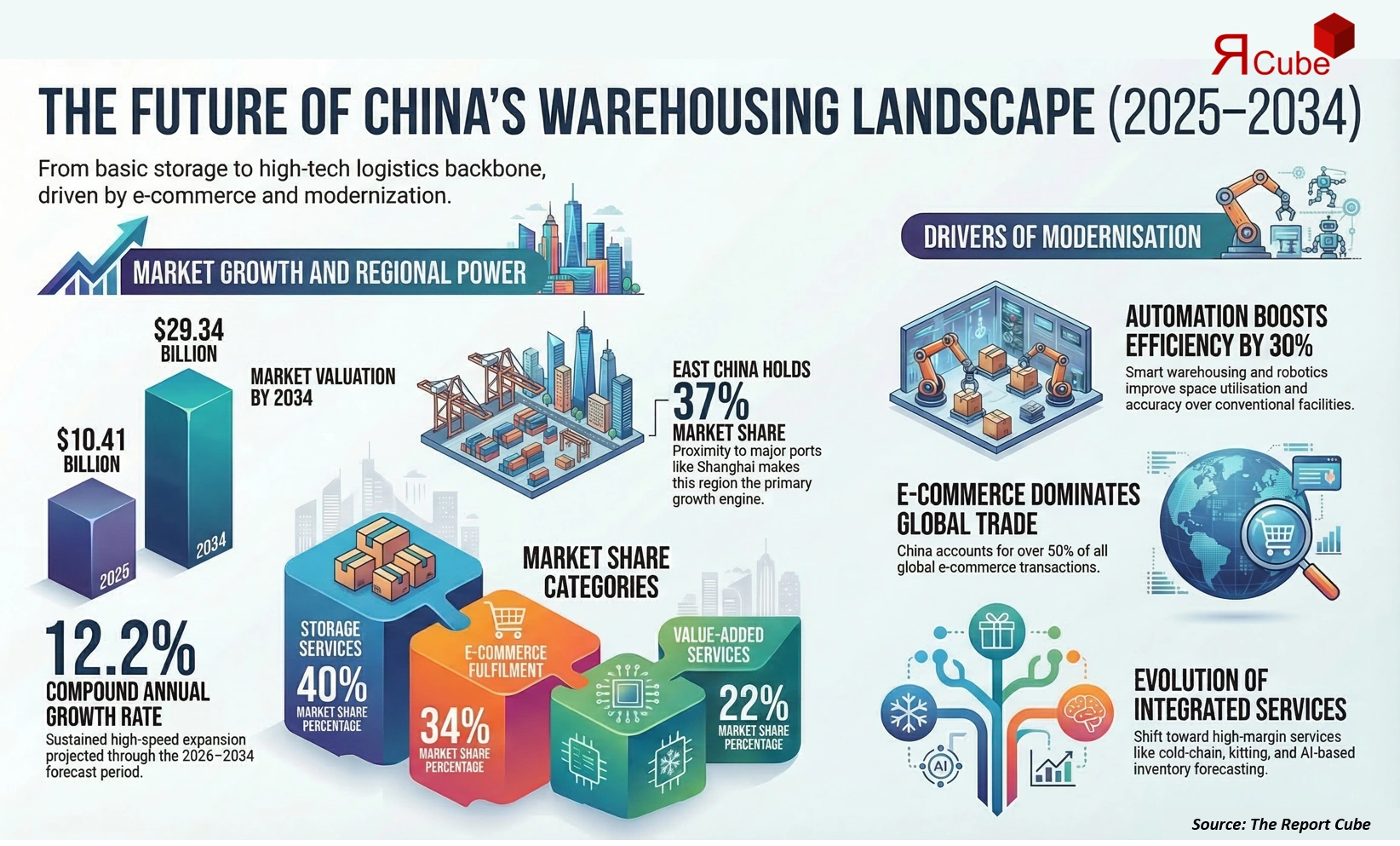
The China Warehousing Market is anticipated to register a CAGR of 12.2% during the forecast period 2026-2034. The market size was valued at USD 10.41 billion in 2025 and is projected to reach USD 29.34 billion by 2034. This rapid expansion is closely linked to China’s accelerating e-commerce penetration, manufacturing decentralization, and the country’s strategic position as a global trade and logistics hub.
Warehousing has evolved from basic storage infrastructure into an integrated logistics backbone supporting fast delivery, inventory visibility, and omnichannel fulfillment. As consumer expectations shift toward same-day and next-day deliveries, enterprises are investing heavily in modern warehousing formats, particularly automated and e-commerce fulfillment centers. These facilities are increasingly located near major consumption clusters, ports, and transportation corridors, improving last-mile efficiency while lowering overall logistics costs.
Furthermore, the Chinese government’s continued emphasis on supply chain resilience and logistics modernization is strengthening long-term demand. Growth in cross-border trade, cold-chain logistics for pharmaceuticals and fresh food, and bonded warehousing for import-export activities has diversified revenue streams for warehouse operators. As a result, the China Warehousing Market is transitioning into a technology-enabled, value-added services industry with strong growth momentum through 2034.
China Warehousing Market Recent Developments
- 2025: JD Logistics expanded automated fulfillment centers to enhance same-day delivery coverage across major Chinese cities.
- 2025: Cainiao Network upgraded smart warehousing hubs integrating AI-based inventory forecasting systems.
Government Initiatives & Policies
- National Logistics Hub Development Plan: Focuses on building smart logistics parks and modern warehousing infrastructure.
- 14th Five-Year Modern Logistics Plan: Promotes cold-chain, bonded, and digital warehousing development nationwide.
China Warehousing Market Dynamics
Key Driver: Rapid Growth of E-Commerce and Omnichannel Retail
The primary driver of the China Warehousing Market is the sustained expansion of e-commerce and omnichannel retail models. China accounts for over 50% of global e-commerce transactions, generating immense demand for scalable, high-throughput warehousing facilities. Online retailers require strategically located warehouses to shorten delivery times and manage high order volumes during peak sales events. This demand has accelerated investments in e-commerce fulfillment and automated warehousing, particularly by large platforms and third-party logistics providers. Additionally, traditional retailers are restructuring supply chains to integrate online and offline inventory, further boosting warehousing demand. The need for real-time inventory visibility, rapid order processing, and flexible storage solutions continues to push enterprises toward modern warehouse infrastructure.
Book your FREE 30-minute expert consultation today
Contact UsIndustry Trends: Automation and Smart Warehousing Adoption
Automation is emerging as a defining trend in the China Warehousing Market. Labor shortages, rising wages, and the need for operational efficiency are encouraging warehouse operators to deploy robotics, automated storage and retrieval systems, and AI-driven warehouse management software. Automated warehousing not only improves picking accuracy but also enhances space utilization by up to 30% compared to conventional facilities. Cold-chain and bonded warehouses are also adopting smart monitoring systems to ensure compliance and quality control. These trends are transforming warehouses into intelligent logistics nodes capable of supporting high-speed, data-driven supply chains, reinforcing long-term competitiveness for early adopters.
Major Challenge: High Capital Investment and Operational Complexity
Despite strong growth prospects, high initial capital investment remains a major challenge for the China Warehousing Market. Developing automated and cold-chain warehouses requires substantial expenditure on land, technology, and specialized equipment. Smaller logistics providers often struggle to secure financing, limiting their ability to scale operations. Moreover, managing technologically advanced warehouses demands skilled labor and robust IT integration, increasing operational complexity. Compliance with safety, environmental, and customs regulations, especially for bonded and cold storage facilities, further adds to cost pressures. These barriers can slow market entry and consolidation, particularly for regional players.
Opportunity: Expansion of Cold Chain and Value-Added Services
The growing demand for fresh food, pharmaceuticals, and biopharmaceutical products presents a significant opportunity for the China Warehousing Market. Cold-chain warehousing is expanding at a faster pace than general storage, driven by rising consumer awareness of food safety and healthcare quality. Additionally, value-added services such as labeling, packaging, kitting, and inventory optimization are becoming key differentiators for warehouse operators. Companies offering integrated service portfolios can capture higher margins while strengthening long-term client relationships. This shift toward service-oriented warehousing is expected to unlock new revenue streams and enhance profitability across the market.
China Warehousing Market Segment-wise Analysis
By Type:
- General Warehousing
- Cold Chain
- E-Commerce Fulfilment
- Bonded Warehousing
- Automated Warehousing
E-Commerce Fulfilment dominates the market, accounting for approximately 34% of total market share in 2025. This leadership reflects the massive scale of online retail operations requiring high-throughput, strategically located warehouses. General Warehousing remains significant for manufacturing and wholesale storage, while Cold Chain Warehousing is growing rapidly, supported by food and pharmaceutical demand. Automated Warehousing, though currently smaller in share, is witnessing double-digit growth as enterprises seek efficiency and scalability. Bonded Warehousing continues to play a vital role in cross-border trade, particularly near ports and free trade zones.
By Service Type:
- Storage Services
- Inventory Management
- Value-Added Services
- Cross-Docking
- Distribution Services
Storage Services account for the largest share at nearly 40%, forming the foundation of warehousing operations. However, Value-Added Services are gaining prominence, capturing close to 22% of the market as clients seek integrated logistics solutions. Inventory Management services are increasingly important for optimizing stock levels and reducing carrying costs, particularly for e-commerce players. Cross-Docking and Distribution Services support faster order fulfillment and are expanding in urban logistics hubs, reinforcing the shift toward time-sensitive delivery models.
Regional Projection of China Warehousing Industry
- East China
- North China
- South China
- Central China
- West China
- Northeast China
East China leads the China Warehousing Market, holding approximately 37% market share. The region benefits from dense consumption centers, advanced infrastructure, and proximity to major ports such as Shanghai and Ningbo. South and North China follow, supported by strong manufacturing bases and cross-border trade activity. East China’s dominance is reinforced by heavy investments in automated and e-commerce fulfillment warehouses, making it the primary growth engine for the national market. Central and West China are gradually emerging as logistics hubs due to industrial relocation and infrastructure development.
Need insights for a specific region within this market?
Request Regional DataWhy Choose This Report?
- Provides a comprehensive overview of the overall market analysis, encompassing key trends, consumer behavior analysis, and risk assessment to support strategic decision-making.
- Provides accurate, up-to-date insights into market size, segmentation, and emerging opportunities, helping to minimize risk & capitalizing on growth.
- Gives deep understanding of target audience preferences, investment habits, and communication channels for enhanced product development & marketing effectiveness.
- Delivers competitive analysis & benchmarking, uncovering the strengths & weaknesses of market competitors to guide strategies.
- Consolidate comprehensive market intelligence, reducing reasoning & streamlining research efforts.
- Facilitates customized market segmentation & risk mitigation strategies, fine-tuned to the business objectives.
- Aids in identifying both market challenges & untapped opportunities within the industry to drive long-term business growth.
- Provides valuable information based on actual customer data & search trends.
Table of Contents
- Introduction
- Objective of the Study
- Product and Category Definition
- Market Segmentation
- Study Variables
- Research Methodology
- Secondary Data Points
- Breakdown of Secondary Sources
- Primary Data Points
- Breakdown of Primary Interviews
- Secondary Data Points
- Executive Summary
- Market Dynamics
- Drivers
- Challenges
- Opportunity Assessment
- Recent Trends and Developments
- Regulatory and Policy Landscape
- China Warehousing Market Overview (2020-2034)
- Market Size, By Value (USD Billion)
- Market Share, By Type
- General Warehousing
- Cold Chain
- E‑commerce Fulfilment
- Bonded Warehousing
- Automated Warehousing
- Market Share, By Service Type
- Storage Services
- Inventory Management
- Value‑Added Services
- Cross‑Docking
- Distribution Services
- Market Share, By End User
- Retail & E‑commerce
- Manufacturing
- Food & Beverage
- Pharmaceuticals
- Automotive
- Market Share, By Ownership
- Third‑Party Logistics
- Captive Warehousing
- Real Estate Developers
- Market Share, By Region
- East
- North
- South
- Central
- West
- Northeast
- Market Share, By Company
- Revenue Shares & Analysis
- Competitive Landscape
- East China Warehousing Market
- Market Size, By Value (USD Billion)
- Market Share, By Segment
- Market Share, By Service Type
- Market Share, By End User
- Market Share, By Ownership
- Market Share, By Province/City Group
- Market Share, By Province/City
- Shanghai
- Jiangsu
- Zhejiang
- Anhui
- North China Warehousing Market
- Market Size, By Value (USD Billion)
- Market Share, By Segment
- Market Share, By Service Type
- Market Share, By End User
- Market Share, By Ownership
- Market Share, By Province/City Group
- Market Share, By Province/City
- Beijing
- Tianjin
- Hebei
- Inner Mongolia
- South China Warehousing Market
- Market Size, By Value (USD Billion)
- Market Share, By Segment
- Market Share, By Service Type
- Market Share, By End User
- Market Share, By Ownership
- Market Share, By Province/City Group
- Market Share, By Province/City
- Guangdong
- Guangxi
- Hainan
- Central China Warehousing Market
- Market Size, By Value (USD Billion)
- Market Share, By Segment
- Market Share, By Service Type
- Market Share, By End User
- Market Share, By Ownership
- Market Share, By Province/City Group
- Market Share, By Province/City
- Henan
- Hubei
- Hunan
- West China Warehousing Market
- Market Size, By Value (USD Billion)
- Market Share, By Segment
- Market Share, By Service Type
- Market Share, By End User
- Market Share, By Ownership
- Market Share, By Province/City Group
- Market Share, By Province/City
- Sichuan
- Chongqing
- Shaanxi
- Yunnan
- Northeast China Warehousing Market
- Market Size, By Value (USD Billion)
- Market Share, By Segment
- Market Share, By Service Type
- Market Share, By End User
- Market Share, By Ownership
- Market Share, By Province/City Group
- Market Share, By Province/City
- Liaoning
- Jilin
- Heilongjiang
- Competitive Outlook and Company Profiles
- GLP China
- Company Overview
- Warehouse Network
- Strategic Alliances/Partnerships
- Recent Developments
- JD Logistics
- Company Overview
- Warehouse Network
- Strategic Alliances/Partnerships
- Recent Developments
- Cainiao Network
- Company Overview
- Warehouse Network
- Strategic Alliances/Partnerships
- Recent Developments
- SF Express
- Company Overview
- Warehouse Network
- Strategic Alliances/Partnerships
- Recent Developments
- Sinotrans Limited
- Company Overview
- Warehouse Network
- Strategic Alliances/Partnerships
- Recent Developments
- YTO Express
- Company Overview
- Warehouse Network
- Strategic Alliances/Partnerships
- Recent Developments
- ZTO Express
- Company Overview
- Warehouse Network
- Strategic Alliances/Partnerships
- Recent Developments
- Best Logistics
- Company Overview
- Warehouse Network
- Strategic Alliances/Partnerships
- Recent Developments
- China Post Group
- Company Overview
- Warehouse Network
- Strategic Alliances/Partnerships
- Recent Developments
- DHL Supply Chain China
- Company Overview
- Warehouse Network
- Strategic Alliances/Partnerships
- Recent Developments
- Others
- GLP China
- Contact Us and Disclaimer
Top Key Players & Market Share Outlook
- GLP China
- JD Logistics
- Cainiao Network
- SF Express
- Sinotrans Limited
- YTO Express
- ZTO Express
- Best Logistics
- China Post Group
- DHL Supply Chain China
- Others
Frequently Asked Questions






