



Build Your Custom Market Intelligence Report
Customize Your ReportSaudi Arabia Dairy Cream Market Key Highlights
By Product Type:
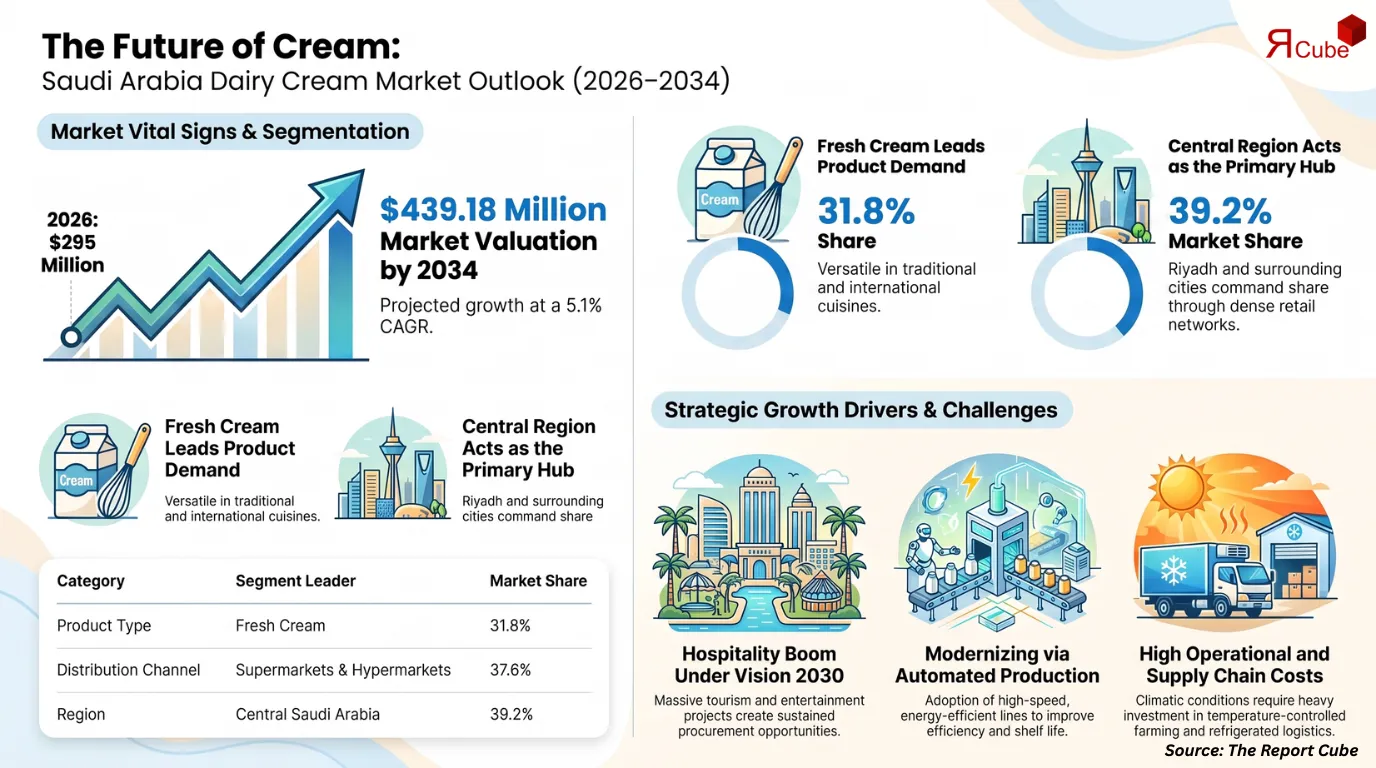
Fresh Cream segment leads the market with approximately 31.8% share.
By Distribution Channel:
Supermarkets and Hypermarkets segment dominates the market with nearly 37.6% of total revenue.
Regional Outlook:
Central Saudi Arabia dominates the Saudi Arabia Dairy Cream Market with around 39.2% market share.
Saudi Arabia Dairy Cream Market Insights & Analysis
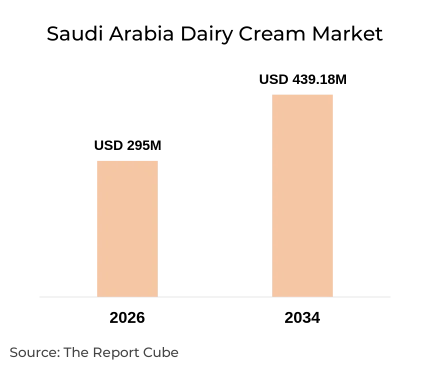
The Saudi Arabia Dairy Cream Market is anticipated to register a CAGR of around 5.1% during the forecast period of 2026-2034. The market size is valued at USD 295 million in 2026 and is projected to reach USD 439.18 million by 2034. Demand for dairy cream in Saudi Arabia continues to advance as premium dairy ingredients become an essential component across household kitchens and commercial food preparation. Hotels, cafés, bakeries, confectionery manufacturers, and quick-service restaurants are expanding their use of fresh cream, whipping cream, and heavy cream to satisfy changing dining preferences and the growing popularity of international cuisines. Retail shelves have also witnessed a broader assortment of locally produced and imported cream products, giving consumers greater access to premium offerings through supermarkets, hypermarkets, and digital grocery platforms. This combination of commercial demand and wider retail availability continues to strengthen the market's long-term outlook.
Investment activity across the KSA dairy cream industry reflects the Kingdom's broader strategy of strengthening domestic food manufacturing while improving production efficiency. Leading dairy companies are expanding processing capacity through automation, energy-efficient equipment, and modern filling technologies that improve product consistency and extend shelf life. Product development has shifted toward premium cooking creams, whipping creams, and value-added dairy solutions designed for both retail and institutional customers. The rapid growth of Saudi Arabia's hospitality, tourism, and entertainment sectors is creating sustained procurement opportunities for dairy processors, while improvements in refrigerated logistics and nationwide retail distribution are allowing manufacturers to serve a wider customer base. These structural developments continue to reinforce the growth potential of the Saudi Arabia Dairy Cream Market throughout the forecast period.
Saudi Arabia Dairy Cream Market Impact Analysis
| Factor | Type | Specific Impact on Market | Magnitude | Business Implication |
|---|---|---|---|---|
| Growth in Bakery and Desserts | Market | Higher use of cream in cakes, pastries and premium ice creams | High | Supports volume growth in whipping and pouring cream lines |
| Rising Health Conscious Consumers | Consumer | Shift toward lower fat and cleaner label dairy cream options | Medium | Requires development of light cream and fortified variants |
| Dependence on Dairy Raw Material Imports | Environmental | Exposure to global price swings for milk and related inputs | High | Necessitates sourcing diversification and cost risk hedging |
| Strong Retail and Foodservice Channels | Market | Large supermarkets and horeca demand stabilize cream offtake | High | Encourages tailored pack sizes for retail and bulk foodservice |
| Competition from Local Dairy Leaders | Competitive | Major players use scale to defend share in cream products | Medium | Smaller brands must compete via niches and recipe innovation |
| Emergence of Plant Based Alternatives | Technological | Non dairy creams draw share from traditional high fat creams | Medium | Pushes dairies to offer hybrid ranges and clearer positioning |
| Food Safety and Import Regulations | Regulatory | Quality standards govern cream composition and shelf stability | Medium | Demands strict compliance and investment in processing control |
Saudi Arabia Dairy Cream Market Dynamics
Key Driver: Expanding Premium Foodservice Industry Accelerating Dairy Cream Consumption
Rising investments in Saudi Arabia's foodservice industry are creating sustained demand for premium dairy ingredients, particularly dairy cream. The expansion of upscale restaurants, international café brands, artisan bakeries, luxury hotels, and dessert chains has increased the requirement for high-quality fresh cream and whipping cream across commercial kitchens. Large hospitality projects under Vision 2030, combined with higher tourist arrivals and growing domestic leisure spending, have encouraged foodservice operators to diversify menus featuring premium bakery items, specialty beverages, gourmet desserts, and international cuisine. These developments continue to strengthen commercial procurement of dairy cream across the Kingdom.
Household purchasing patterns are also evolving as consumers increasingly prepare café-style beverages, baked products, and restaurant-inspired meals at home. Dairy manufacturers have responded by introducing convenient packaging sizes and premium formulations that meet both retail and professional requirements. The availability of locally manufactured products alongside established international brands has improved market competitiveness while supporting broader adoption across residential and commercial applications. These factors collectively reinforce the steady expansion of the Saudi Arabia Dairy Cream Market.
Industry Trends: Premium Product Innovation and Modern Dairy Processing Reshaping the Market
Product innovation has become a defining characteristic of the Dairy Cream in Saudi Arabia industry as manufacturers focus on premium quality, functionality, and convenience. Companies are expanding their portfolios with cooking cream, whipping cream, lactose-free variants, and specialty cream products designed for cafés, bakeries, and food processors. Packaging innovation is also gaining momentum through resealable cartons, recyclable materials, and portion-controlled formats that improve product usability while reducing food waste. Premium dairy categories continue to gain shelf space as retailers respond to changing purchasing preferences among urban consumers.
Manufacturing facilities across Saudi Arabia are increasingly adopting automated production systems, advanced sterilization technologies, and intelligent quality monitoring solutions to improve efficiency and maintain product consistency. Modern processing equipment enables higher production volumes while reducing operational losses and supporting sustainability objectives. These investments are strengthening the competitiveness of domestic dairy companies and enabling them to expand their presence across both traditional retail channels and rapidly growing e-commerce grocery platforms, supporting long-term development of the KSA Dairy Cream industry.
Book your FREE 30-minute expert consultation today
Contact UsMajor Challenge: Cost Pressures Across Dairy Production and Supply Chain Operations
Maintaining competitive pricing remains challenging as dairy processors continue to manage rising operating expenses throughout the production chain. Feed costs, energy prices, refrigerated transportation, packaging materials, and labor expenditures directly influence manufacturing costs for dairy cream. Saudi Arabia's climatic conditions also require significant investment in temperature-controlled dairy farming and cold-chain infrastructure to preserve milk quality, increasing the overall cost of production. These operational realities place continuous pressure on profitability, particularly for manufacturers operating within highly competitive retail segments.
Supply chain volatility can further affect production planning when fluctuations occur in raw milk availability or imported packaging materials. Producers must balance efficiency improvements with investments in advanced processing technologies to maintain product quality while controlling manufacturing costs. Companies are therefore strengthening supplier relationships, expanding local sourcing where feasible, and improving operational productivity to preserve margins without compromising product standards or consumer confidence.
Opportunity: Growing Hospitality Investments Creating Long-Term Commercial Demand
Large-scale investments in tourism, entertainment, and hospitality are opening new opportunities for the Saudi Arabia Dairy Cream Market. Newly developed hotels, integrated tourism destinations, fine dining restaurants, cafés, and international food franchises require consistent supplies of premium dairy ingredients for daily operations. As the Kingdom continues expanding its hospitality infrastructure, commercial demand for fresh cream, heavy cream, and whipping cream is expected to increase steadily across multiple foodservice applications. Growth in premium bakery products, artisanal desserts, and specialty beverages further strengthens this opportunity.
Additional growth opportunities are emerging through product diversification and wider retail accessibility. Dairy companies are introducing healthier formulations, premium cream blends, and convenient packaging formats that address changing consumer preferences without compromising quality. Expansion of refrigerated distribution networks and online grocery platforms has improved product availability across major cities and secondary urban centers, enabling manufacturers to reach new customer segments while strengthening the long-term outlook of the KSA Dairy Cream industry.
Saudi Arabia Dairy Cream Market Segment-wise Analysis
By Product Type:
- Thickened Cream/Heavy Cream
- Fresh Cream
- Sour Cream
- Whipping Cream
- Others
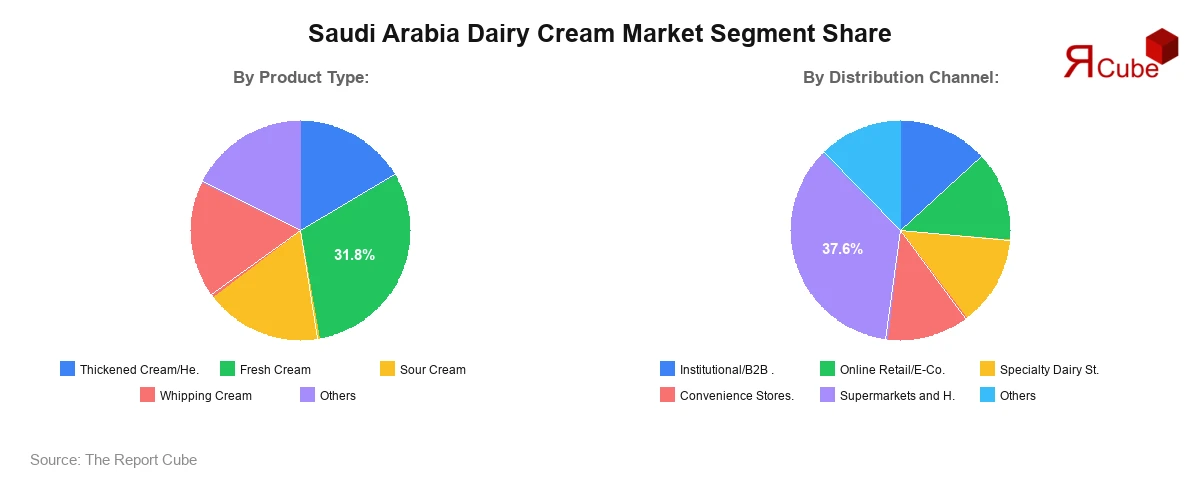
The Fresh Cream segment accounted for the largest share of nearly 31.8% in the Saudi Arabia Dairy Cream Market in 2026. Its leadership is supported by broad usage across households and commercial food establishments, where fresh cream serves as a key ingredient in desserts, pastries, sauces, soups, and specialty beverages. Unlike processed cream varieties designed for specific culinary applications, fresh cream offers greater versatility, making it suitable for both traditional Middle Eastern recipes and international cuisine. Rising consumption of premium bakery products, café beverages, and ready-to-cook meals has further strengthened demand for fresh cream across the Kingdom. Local dairy processors continue expanding production to meet the growing preference for high-quality dairy ingredients with consistent taste and texture.
Retail availability has also played a significant role in the segment's expansion. Major dairy brands now offer fresh cream in multiple packaging sizes, enabling greater accessibility for residential consumers as well as small foodservice businesses. Product improvements focusing on extended shelf life, better pouring convenience, and enhanced freshness have increased consumer confidence in locally manufactured dairy products. As Saudi Arabia's hospitality and food processing sectors continue to expand under Vision 2030, fresh cream is expected to maintain its leading position due to its widespread application across commercial kitchens and industrial food manufacturing.
By Distribution Channel:
- Institutional/B2B Sales
- Online Retail/E-Commerce
- Specialty Dairy Stores
- Convenience Stores
- Supermarkets and Hypermarkets
- Others
Supermarkets and Hypermarkets represented the largest distribution channel, capturing approximately 37.6% of the Saudi Arabia Dairy Cream Market. Organized retail continues to dominate dairy cream sales because consumers prefer purchasing refrigerated dairy products from outlets that offer reliable cold-chain facilities, extensive product selections, and trusted quality standards. Leading retail chains provide both domestic and imported dairy cream brands, allowing shoppers to compare fat content, packaging formats, and pricing within a single location. Frequent promotional campaigns and loyalty programs have further strengthened purchasing volumes across urban centers including Riyadh, Jeddah, and Dammam.
The continued expansion of modern retail infrastructure across Saudi Arabia is supporting higher dairy cream sales by improving product availability in both metropolitan and developing cities. Many supermarket operators have integrated digital ordering platforms and home delivery services, creating a seamless shopping experience for consumers seeking fresh dairy products. Improved refrigerated logistics and efficient inventory management have reduced stock shortages while ensuring consistent product freshness. These advantages continue to reinforce supermarkets and hypermarkets as the preferred distribution channel for dairy cream throughout the forecast period.
Regional Projection of Saudi Arabia Dairy Cream Industry
- East
- West
- South
- Central
Central Saudi Arabia accounted for the largest regional share of approximately 39.2% in the Saudi Arabia Dairy Cream Market. The region benefits from its large urban population, higher disposable incomes, and concentration of leading dairy manufacturers and distribution hubs. Riyadh serves as the country's largest consumer market for premium dairy products, supported by a dense network of supermarkets, hypermarkets, cafés, hotels, restaurants, and institutional foodservice operators. Continuous commercial development and population growth have contributed to rising consumption of fresh cream, whipping cream, and heavy cream across both residential and commercial applications.
Central Saudi Arabia also attracts substantial investments in food manufacturing, cold-chain infrastructure, and logistics, enabling dairy companies to distribute products efficiently across the Kingdom. The presence of major processing facilities allows manufacturers to maintain product freshness while reducing transportation costs and improving supply reliability. Growth in hospitality projects, international restaurant chains, premium bakeries, and entertainment destinations continues to generate stable commercial demand for dairy cream. These structural advantages are expected to preserve the region's leadership in the KSA Dairy Cream industry throughout the forecast period.
Need insights for a specific region within this market?
Request Regional DataSaudi Arabia Dairy Cream Market Regional Analysis
The Saudi Arabia dairy cream market shows regional variation driven by income, urbanization, imports, and foodservice activity.
| Cluster | Demand Level | Key Areas | System Dominance | Core Demand Logic | Growth Nature |
|---|---|---|---|---|---|
| Eastern Region | Very High | Dammam, Khobar, Jubail | Imported cream & value-added | Higher incomes and strong retail presence | Premiumization and product mix upgrade |
| Western Region | High | Jeddah, Mecca, Medina | Foodservice and hospitality cream | Pilgrim tourism and hotel catering demand | Seasonal peak growth around pilgrimage |
| Central Region | Very High | Riyadh and surrounding cities | Retail packs and bakery cream | Dense population and modern trade outlets | Stable volume with steady value growth |
| Southern Region | Medium | Abha, Jazan, Najran | Affordable cream and traditional use | Rising urbanization and new supermarkets | Emerging growth with distribution push |
Government Initiatives & Policies
- Ministry of Environment, Water and Agriculture (MEWA) Dairy Food Security Initiative: In 2025, MEWA reaffirmed Saudi Arabia's commitment to strengthening domestic dairy production under Vision 2030, highlighting annual dairy output exceeding 2.6 million tons and encouraging consumers to purchase locally produced dairy products, including cream. The initiative supports food security, domestic manufacturing, and sustainable dairy sector development.
- National Transformation Program (Vision 2030) Food Security Initiatives: The National Transformation Program continued expanding food security and agricultural sustainability initiatives by supporting local food manufacturing, private-sector investment, agricultural productivity, and supply chain resilience. These measures strengthen Saudi Arabia's dairy industry by encouraging modern production facilities and sustainable food processing investments.
Saudi Arabia Dairy Cream Industry Recent Developments
- 2025: Almarai Company launched Trofos, an authentic Greek Feta cheese brand carrying Protected Designation of Origin (PDO) certification across Saudi Arabia and GCC markets. The launch expands Almarai's premium dairy portfolio while addressing rising consumer demand for specialty and value-added dairy products. This strategic expansion strengthens the company's premium dairy positioning and supports innovation across complementary dairy categories, including cream and specialty dairy ingredients.
- 2025: Saudia Dairy & Foodstuff Company (SADAFCO) commissioned Saudi Arabia's first Tetra Pak E3 Speed Hyper Line to enhance production capacity, operational efficiency, and sustainability. The advanced processing technology significantly reduces water and energy consumption while increasing manufacturing throughput. The investment reflects the industry's growing focus on modern dairy processing infrastructure, higher productivity, and sustainable manufacturing practices that will benefit value-added dairy products, including dairy cream.
Why Choose This Report?
- Provides a comprehensive overview of the overall market analysis, encompassing key trends, consumer behavior analysis, and risk assessment to support strategic decision-making.
- Provides accurate, up-to-date insights into market size, segmentation, and emerging opportunities, helping to minimize risk while capitalizing on future growth opportunities.
- Gives deep understanding of target audience preferences, purchasing behavior, consumption patterns, and communication channels for enhanced product development and marketing effectiveness.
- Delivers competitive analysis and benchmarking, uncovering the strengths, market positioning, and strategic developments of leading industry participants.
- Consolidates comprehensive market intelligence, reducing research time while providing actionable business insights for investors and stakeholders.
- Facilitates customized market segmentation and risk mitigation strategies that align with business objectives, expansion plans, and investment priorities.
- Helps identify market challenges, growth drivers, investment opportunities, and untapped business potential across Saudi Arabia's dairy cream industry.
- Provides valuable insights based on industry developments, consumer demand trends, distribution channel analysis, and evolving market dynamics.
Table of Contents
- Introduction
- Objective of the Study
- Product and Category Definition
- Market Segmentation
- Study Variables
- Research Methodology
- Secondary Data Points
- Breakdown of Secondary Sources
- Primary Data Points
- Breakdown of Primary Interviews
- Secondary Data Points
- Executive Summary
- Market Dynamics
- Emerging Opportunities
- Adoption Trends
- Demand Drivers
- Disruption Analysis (Challenges)
- Industry Analysis and Strategic Insights
- Supply and Value Chain Analysis
- Pricing Analysis
- Go-To-Market Strategy
- BCG Matrix
- Recent Trends and Developments
- Import and Export Analysis
- Regulatory and Policy Landscape
- Region-wise Policies
- Government Initiatives
- Saudi Arabia Dairy Cream Market Overview and Forecast Analysis (2021-2034)
- Market Size, By Value, By Growth Rate (CAGR/USD Million)
- Market Share, By Product Type
- Thickened Cream/Heavy Cream
- Fresh Cream
- Sour Cream
- Whipping Cream
- Others
- Market Share, By Fat Content
- High-Fat/Full-Fat Cream
- Medium-Fat Cream
- Low-Fat Cream
- Market Share, By Source
- Buffalo Milk Cream
- Mixed Milk Cream
- Cow Milk Cream
- Others
- Market Share, By Distribution Channel
- Institutional/B2B Sales
- Online Retail/E-Commerce
- Specialty Dairy Stores
- Convenience Stores
- Supermarkets and Hypermarkets
- Others
- Market Share, By End User
- Commercial
- Ice Cream Manufacturers
- Food Processors
- Bakeries
- HoReCa
- Others
- Residential
- Commercial
- Market Share, By Packaging Type
- Bulk Packaging
- Cans
- Tubs
- Bottles
- Cartons
- Pouches
- Market Share, By Region
- East
- West
- South
- Central
- Market Share, By Company
- Revenue Shares and Analysis
- Competitive Landscape
- East Region Dairy Cream Market Overview and Forecast Analysis (2021-2034)
- Market Size, By Value, By Growth Rate (CAGR/USD Million)
- Market Share, By Product Type
- Market Share, By Fat Content
- Market Share, By Source
- Market Share, By Distribution Channel
- Market Share, By End User
- Market Share, By Packaging Type
- West Region Dairy Cream Market Overview and Forecast Analysis (2021-2034)
- Market Size, By Value, By Growth Rate (CAGR/USD Million)
- Market Share, By Product Type
- Market Share, By Fat Content
- Market Share, By Source
- Market Share, By Distribution Channel
- Market Share, By End User
- Market Share, By Packaging Type
- South Region Dairy Cream Market Overview and Forecast Analysis (2021-2034)
- Market Size, By Value, By Growth Rate (CAGR/USD Million)
- Market Share, By Product Type
- Market Share, By Fat Content
- Market Share, By Source
- Market Share, By Distribution Channel
- Market Share, By End User
- Market Share, By Packaging Type
- Central Region Dairy Cream Market Overview and Forecast Analysis (2021-2034)
- Market Size, By Value, By Growth Rate (CAGR/USD Million)
- Market Share, By Product Type
- Market Share, By Fat Content
- Market Share, By Source
- Market Share, By Distribution Channel
- Market Share, By End User
- Market Share, By Packaging Type
- Competitive Analysis, 2026
- Market Share of Key Players
- Competitive Mapping for Each Product Type and Companies Operating Regionally
- East Region Dairy Cream Companies Share and Competitive Analysis, 2026
- West Region Dairy Cream Companies Share and Competitive Analysis, 2026
- South Region Dairy Cream Companies Share and Competitive Analysis, 2026
- Central Region Dairy Cream Companies Share and Competitive Analysis, 2026
- Company Profile (Partial List)
- Royal FrieslandCampina N.V.
- Company Overview
- Product Portfolio
- Strategic Alliances/Partnerships
- Recent Developments
- Al Safi Danone Company Limited
- Company Overview
- Product Portfolio
- Strategic Alliances/Partnerships
- Recent Developments
- Groupe Lactalis S.A.
- Company Overview
- Product Portfolio
- Strategic Alliances/Partnerships
- Recent Developments
- National Agricultural Development Company (NADEC)
- Company Overview
- Product Portfolio
- Strategic Alliances/Partnerships
- Recent Developments
- Arla Foods amba
- Company Overview
- Product Portfolio
- Strategic Alliances/Partnerships
- Recent Developments
- Saudia Dairy and Foodstuff Company (SADAFCO)
- Company Overview
- Product Portfolio
- Strategic Alliances/Partnerships
- Recent Developments
- Savencia Fromage and Dairy S.A.
- Company Overview
- Product Portfolio
- Strategic Alliances/Partnerships
- Recent Developments
- Fonterra Co-operative Group Limited
- Company Overview
- Product Portfolio
- Strategic Alliances/Partnerships
- Recent Developments
- Almarai Company
- Company Overview
- Product Portfolio
- Strategic Alliances/Partnerships
- Recent Developments
- Nestlé S.A.
- Company Overview
- Product Portfolio
- Strategic Alliances/Partnerships
- Recent Developments
- Others (Partial List)
- Royal FrieslandCampina N.V.
- Contact Us and Disclaimer
Top Key Players & Market Share Outlook
- Royal FrieslandCampina N.V.
- Al Safi Danone Company Limited
- Groupe Lactalis S.A.
- National Agricultural Development Company (NADEC)
- Arla Foods amba
- Saudia Dairy & Foodstuff Company (SADAFCO)
- Savencia Fromage & Dairy S.A.
- Fonterra Co-operative Group Limited
- Almarai Company
- Nestlé S.A.
- Others
Frequently Asked Questions






