



Build Your Custom Market Intelligence Report
Customize Your ReportGlobal Data Center Fabric Market Insights & Analysis
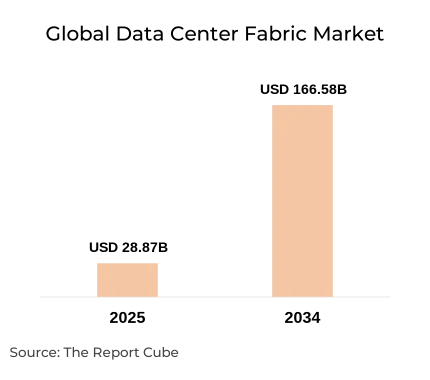
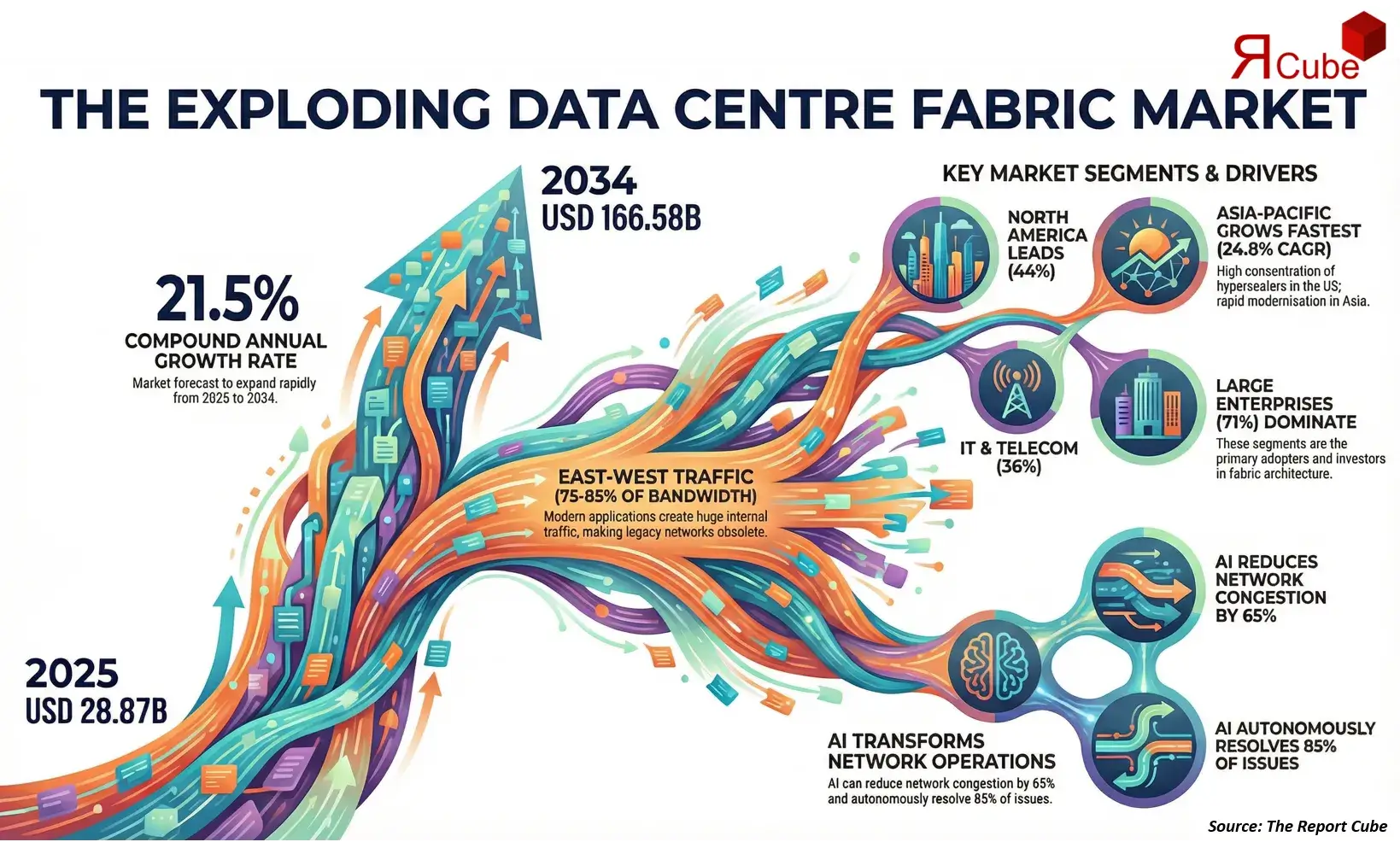
The Global Data Center Fabric Market is anticipated to register a CAGR of 21.50% during 2026-2034. The market size was valued at USD 28.87 billion in 2025 and is projected to reach USD 166.58 billion by 2034. The market is undergoing rapid transformation as enterprises and cloud service providers increasingly modernize data center architectures to handle exponential data growth, high-performance computing workloads, and latency-sensitive applications.
This accelerated expansion is closely linked to the global rise in cloud computing, artificial intelligence, and edge data centers. Traditional network architectures are struggling to support east-west traffic and dynamic workloads, prompting widespread adoption of data center fabric solutions that deliver scalable, low-latency, and highly automated connectivity. Organizations are prioritizing flexible and programmable fabrics to support hybrid and multi-cloud strategies, driving consistent investment across hyperscale and enterprise data centers.
Moreover, the market is benefiting from strong demand for network virtualization and software-defined infrastructure. Data center fabric solutions simplify network management while improving reliability and utilization, which is critical as operational efficiency becomes a top priority. As digital transformation initiatives accelerate across industries, the Global Data Center Fabric Market is expected to maintain robust momentum throughout the forecast period.
Global Data Center Fabric Market Recent Developments
- 2025: Cisco introduced Unified Fabric Experience on Nexus Dashboard, converging ACI and VXLAN EVPN data center fabrics.
- 2025: Arista Networks launched 800G AI data center networking platforms delivering petabit-scale, low-latency Ethernet fabric performance.
Government Initiatives & Policies
- U.S. National Digital Infrastructure Strategy: Supports resilient and scalable data center networks nationwide.
- EU Digital Decade Policy Program: Promotes high-capacity digital infrastructure and secure data ecosystems.
Global Data Center Fabric Market Dynamics
Key Driver: Rapid Growth of Cloud Computing and Hyperscale Data Centers
The rapid expansion of cloud computing and hyperscale data centers is the primary driver of the Global Data Center Fabric Market. Cloud service providers are continuously scaling infrastructure to support AI, machine learning, and big data workloads, which demand ultra-low latency and high bandwidth connectivity. Data center fabric architectures enable seamless east-west traffic flow, reducing bottlenecks common in legacy networks. Over 70% of new hyperscale data centers now deploy some form of fabric-based networking, highlighting its critical role. As enterprises migrate workloads to the cloud, demand for agile, scalable fabric solutions continues to rise, directly fueling market growth.
Book your FREE 30-minute expert consultation today
Contact UsIndustry Trends: Shift Toward Software-Defined and Automated Networking
A major trend shaping the market is the shift toward software-defined networking and automation within data center fabrics. Organizations are adopting intelligent management software to improve visibility, reduce manual configuration errors, and accelerate deployment timelines. Automation-driven fabrics can reduce network provisioning time by nearly 60%, improving operational efficiency. Additionally, integration with AI-driven analytics enables predictive maintenance and performance optimization. This trend aligns with enterprise goals to lower operational costs while supporting increasingly complex application environments, reinforcing long-term adoption of fabric solutions.
Major Challenge: High Initial Deployment and Integration Complexity
Despite strong growth prospects, high initial investment and integration complexity remain significant challenges. Deploying data center fabric solutions often requires upgrading existing infrastructure, retraining IT staff, and ensuring compatibility with legacy systems. For small and mid-sized enterprises, upfront costs can be prohibitive, slowing adoption rates. Additionally, managing multi-vendor environments adds complexity, as interoperability issues can impact performance. These factors may delay decision-making and extend deployment cycles, particularly in cost-sensitive markets.
Opportunity: Expansion of Edge Computing and AI Workloads
The rapid rise of edge computing and AI workloads presents a substantial opportunity for the Global Data Center Fabric Market. Edge data centers require compact, high-performance fabrics capable of supporting real-time processing and low-latency connectivity. As industries such as manufacturing, healthcare, and autonomous mobility deploy edge infrastructure, demand for scalable fabric solutions will increase. Furthermore, AI workloads require massive bandwidth and deterministic performance, making advanced fabric architectures essential. Vendors offering flexible, energy-efficient, and AI-optimized fabrics are well-positioned to capture emerging opportunities.
Global Data Center Fabric Market Segment-wise Analysis
By Solution Type:
- Switching
- Routers
- SAN
- Controllers
- Network Security
- Management Software
Switching solutions dominate the market by solution type, accounting for approximately 34% of total revenue in 2025. High-performance switches form the backbone of data center fabrics, enabling low-latency, high-throughput connectivity across servers and storage systems. Increasing adoption of leaf-spine architectures further strengthens demand for advanced switching solutions. Network security and management software are also gaining traction as enterprises prioritize secure, automated, and centrally managed fabric environments.
By Technology:
- Fibre Channel Switching
- InfiniBand Switching
- RoCE Switching
- Ethernet Switching
Ethernet switching leads the market by technology, holding nearly 48% market share in 2025. Its cost-effectiveness, scalability, and widespread compatibility make it the preferred choice for cloud and enterprise data centers. InfiniBand and RoCE switching are gaining momentum in high-performance computing and AI workloads due to superior latency and throughput. Fibre Channel remains relevant in storage-focused environments, supporting stable demand within specific use cases.
Regional Projection of Global Data Center Fabric Industry
- North America
- Europe
- Asia Pacific
- South America
- Middle East and Africa
North America leads the Global Data Center Fabric Market, contributing approximately 39% of total revenue in 2025. The region benefits from a high concentration of hyperscale cloud providers, advanced digital infrastructure, and strong investment in AI and cloud technologies. Europe follows with steady adoption driven by data sovereignty regulations and cloud expansion. Asia Pacific is emerging as the fastest-growing region, supported by rapid digitalization, rising internet penetration, and expanding data center capacity across major economies.
Need insights for a specific region within this market?
Request Regional DataWhy Choose This Report?
- Provides a comprehensive overview of the overall market analysis, encompassing key trends, consumer behavior analysis, and risk assessment to support strategic decision-making.
- Provides accurate, up-to-date insights into market size, segmentation, and emerging opportunities, helping to minimize risk & capitalizing on growth.
- Gives deep understanding of target audience preferences, investment habits, and communication channels for enhanced product development & marketing effectiveness.
- Delivers competitive analysis & benchmarking, uncovering the strengths & weaknesses of market competitors to guide strategies.
- Consolidate comprehensive market intelligence, reducing reasoning & streamlining research efforts.
- Facilitates customized market segmentation & risk mitigation strategies, fine-tuned to the business objectives.
- Aids in identifying both market challenges & untapped opportunities within the industry to drive long-term business growth.
- Provides valuable information based on actual customer data & search trends.
Table of Contents
- Introduction
- Objective of the Study
- Product and Category Definition
- Market Segmentation
- Study Variables
- Research Methodology
- Secondary Data Points
- Breakdown of Secondary Sources
- Primary Data Points
- Breakdown of Primary Interviews
- Secondary Data Points
- Executive Summary
- Market Dynamics
- Drivers
- Challenges
- Opportunity Assessment
- Recent Trends and Developments
- Regulatory and Policy Landscape
- Global Data Center Fabric Market Overview (2020-2034)
- Market Size, By Value (USD Billion)
- Market Share, By Solution Type
- Switching
- Routers
- SAN
- Controllers
- Network Security
- Management Software
- Market Share, By Technology
- Fibre Channel Switching
- InfiniBand Switching
- RoCE Switching
- Ethernet Switching
- Market Share, By Deployment Type
- End-of-Row
- Top-of-Rack
- Middle-of-Row
- Market Share, By Speed
- 100G
- 10G
- 400G
- 200G
- 40G
- Market Share, By Port Configuration
- 100G QSFP28
- 10G SFP+
- 400G QSFP-DD
- 200G QSFP56
- 40G QSFP+
- Market Share, By Functionality
- Network Virtualization
- Layer 2 Switching
- Storage Area Networking
- Layer 3 Routing
- Market Share, By Application
- Cloud Services
- Enterprise Apps
- AI and ML
- Big Data Analytics
- Other Applications
- Market Share, By End User
- Cloud Providers
- Telecom Providers
- Enterprises
- Government
- Other End Users
- Market Share, By Vertical
- BFSI
- IT and Telecom
- Healthcare
- Retail
- Media and Entertainment
- Education
- Other Verticals
- Market Share, By Region
- North America
- Europe
- Asia Pacific
- South America
- Middle East and Africa
- Market Share, By Company
- Competition Characteristics
- Revenue Shares & Analysis
- North America Data Center Fabric Market
- Market Size, By Value (USD Billion)
- Market Share, By Solution Type
- Market Share, By Technology
- Market Share, By Deployment Type
- Market Share, By Speed
- Market Share, By Port Configuration
- Market Share, By Functionality
- Market Share, By Application
- Market Share, By End User
- Market Share, By Vertical
- Market Share, By Country
- United States
- Canada
- Mexico
- Europe Data Center Fabric Market
- Market Size, By Value (USD Billion)
- Market Share, By Solution Type
- Market Share, By Technology
- Market Share, By Deployment Type
- Market Share, By Speed
- Market Share, By Port Configuration
- Market Share, By Functionality
- Market Share, By Application
- Market Share, By End User
- Market Share, By Vertical
- Market Share, By Country
- Germany
- United Kingdom
- France
- Italy
- Spain
- Rest of Europe
- Asia Pacific Data Center Fabric Market
- Market Size, By Value (USD Billion)
- Market Share, By Solution Type
- Market Share, By Technology
- Market Share, By Deployment Type
- Market Share, By Speed
- Market Share, By Port Configuration
- Market Share, By Functionality
- Market Share, By Application
- Market Share, By End User
- Market Share, By Vertical
- Market Share, By Country
- China
- India
- Japan
- South Korea
- Australia
- Rest of Asia Pacific
- South America Data Center Fabric Market
- Market Size, By Value (USD Billion)
- Market Share, By Solution Type
- Market Share, By Technology
- Market Share, By Deployment Type
- Market Share, By Speed
- Market Share, By Port Configuration
- Market Share, By Functionality
- Market Share, By Application
- Market Share, By End User
- Market Share, By Vertical
- Market Share, By Country
- Argentina
- Brazil
- Mexico
- Rest of South America
- Middle East and Africa Data Center Fabric Market
- Market Size, By Value (USD Billion)
- Market Share, By Solution Type
- Market Share, By Technology
- Market Share, By Deployment Type
- Market Share, By Speed
- Market Share, By Port Configuration
- Market Share, By Functionality
- Market Share, By Application
- Market Share, By End User
- Market Share, By Vertical
- Market Share, By Country
- Saudi Arabia
- United Arab Emirates
- South Africa
- Rest of Middle East and Africa
- Competitive Outlook and Company Profiles
- Cisco Systems, Inc.
- Company Overview
- Product Portfolio
- Strategic Alliances Partnerships
- Recent Developments
- Arista Networks, Inc.
- Company Overview
- Product Portfolio
- Strategic Alliances Partnerships
- Recent Developments
- Juniper Networks, Inc.
- Company Overview
- Product Portfolio
- Strategic Alliances Partnerships
- Recent Developments
- Dell Technologies
- Company Overview
- Product Portfolio
- Strategic Alliances Partnerships
- Recent Developments
- Hewlett Packard Enterprise
- Company Overview
- Product Portfolio
- Strategic Alliances Partnerships
- Recent Developments
- Huawei Technologies Co., Ltd.
- Company Overview
- Product Portfolio
- Strategic Alliances Partnerships
- Recent Developments
- Extreme Networks
- Company Overview
- Product Portfolio
- Strategic Alliances Partnerships
- Recent Developments
- IBM Corporation
- Company Overview
- Product Portfolio
- Strategic Alliances Partnerships
- Recent Developments
- VMware, Inc.
- Company Overview
- Product Portfolio
- Strategic Alliances Partnerships
- Recent Developments
- Brocade (Broadcom)
- Company Overview
- Product Portfolio
- Strategic Alliances Partnerships
- Recent Developments
- Others
- Cisco Systems, Inc.
- Contact Us and Disclaimer
Top Key Players & Market Share Outlook
- Cisco Systems, Inc.
- Arista Networks, Inc.
- Juniper Networks, Inc.
- Dell Technologies
- Hewlett Packard Enterprise
- Huawei Technologies Co., Ltd.
- Extreme Networks
- IBM Corporation
- VMware, Inc.
- Brocade (Broadcom)
- Others
Frequently Asked Questions






