



Build Your Custom Market Intelligence Report
Customize Your ReportUAE Edible Oil Market Insights & Analysis
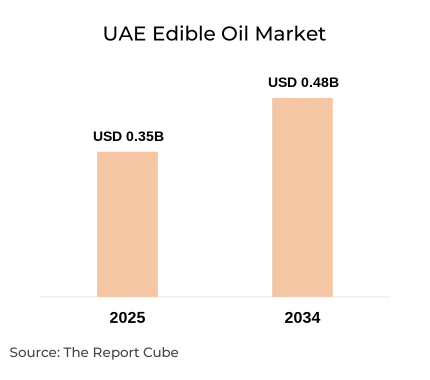
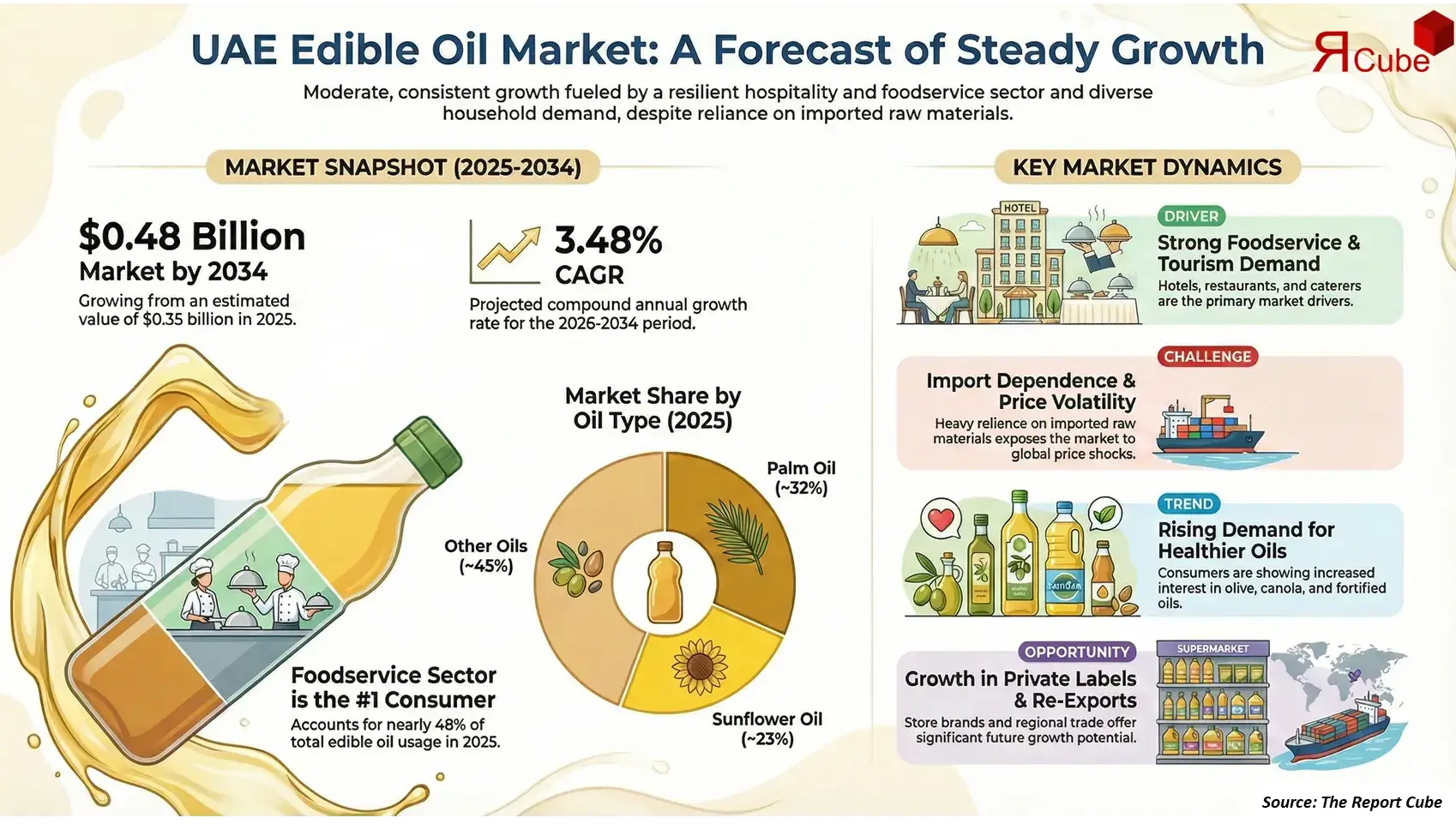
The UAE Edible Oil Market is anticipated to register a CAGR of 3.48% during 2026-2034. The market size was valued at USD 0.35 billion in 2025 and is projected to reach USD 0.48 billion by 2034. the market plays a critical role within the country’s food and beverage ecosystem, supported by high per capita consumption, a strong hospitality sector, and a large expatriate population with diverse dietary preferences. As the UAE imports a substantial portion of its food requirements, edible oils remain a strategically important commodity due to their extensive use in household cooking, food processing, quick-service restaurants, and large-scale catering operations. In 2025, palm oil and sunflower oil collectively accounted for over 55% of total edible oil consumption, reflecting their affordability, functional versatility, and wide acceptance across regional cuisines. Rising health awareness is gradually influencing purchasing behavior, with consumers showing increased interest in oils perceived as healthier, such as olive and canola oils. At the same time, stable population growth, strong retail penetration, and consistent tourism inflows continue to sustain baseline demand. These structural factors ensure steady market expansion despite moderate overall growth rates.UAE Edible Oil Market Recent Developments
- 2025: IFFCO Group expanded fortified edible oil variants targeting health-conscious consumers.
- 2025: Al Ghurair Foods increased sunflower oil refining capacity to support domestic demand.
Government Initiatives & Policies
- UAE National Food Security Strategy 2051: Framework strengthening food supply resilience, processing capacity, and nutritional standards.
- UAE Food Safety Law: Regulatory framework governing edible oil quality, labeling, and import standards.
Market performance is further shaped by the UAE’s role as a regional trade and re-export hub, allowing edible oil processors and distributors to serve not only domestic demand but also neighboring Gulf and African markets. Major players operate advanced refining, blending, and packaging facilities that support consistent supply and competitive pricing. Foodservice demand remains a key growth pillar, accounting for nearly 48% of total edible oil usage in 2025, driven by hotels, restaurants, and institutional catering. Meanwhile, retail demand benefits from expanding private-label offerings and promotional strategies across hypermarkets and supermarkets. Over the forecast period, incremental growth is expected from premiumization trends, clean-label positioning, and gradual shifts toward oils with improved nutritional profiles, reinforcing the market’s stable and resilient outlook.
UAE Edible Oil Market Dynamics
Key Driver: Strong Foodservice Demand and Consumption Stability
The primary driver of the UAE edible oil market is consistent demand from the foodservice sector combined with stable household consumption patterns. The UAE hosts one of the most developed hospitality industries in the Middle East, with restaurants, hotels, and catering services consuming large volumes of palm, sunflower, and soybean oils for frying and food preparation. In 2025, foodservice operations accounted for nearly half of total edible oil demand, supported by tourism activity exceeding 16 million international visitors annually. Additionally, the multicultural population sustains diverse cooking styles that rely heavily on edible oils, ensuring consistent retail demand. These consumption fundamentals provide a reliable growth base, even during periods of global commodity price volatility.
Major Challenge: Import Dependence and Raw Material Price Volatility
A key challenge for the UAE edible oil market is its heavy reliance on imported raw materials, particularly crude palm oil and oilseeds. Fluctuations in global commodity prices, influenced by weather patterns, geopolitical developments, and trade policies, directly impact procurement costs for refiners and packers. In 2024–2025, international palm oil price movements of over 15% year-on-year highlighted the sector’s exposure to external supply shocks. Managing these cost variations while maintaining competitive retail pricing pressures margins, especially in value-driven segments. Companies must rely on efficient sourcing strategies, long-term supplier relationships, and inventory management to mitigate these risks.
Industry Trends: Health Positioning and Product Differentiation
An important trend shaping the market is the gradual shift toward health-oriented positioning and product differentiation. Consumers are increasingly attentive to fat composition, cholesterol impact, and perceived health benefits, driving higher demand for olive oil, canola oil, and blended oils with reduced saturated fat content. In 2025, premium and health-positioned oils accounted for approximately 18% of retail value sales, up from 14% in 2021. Manufacturers are responding by offering fortified oils with added vitamins and clearer nutritional labeling. While price sensitivity remains high, especially for staple oils, this trend supports value growth and margin enhancement.
Opportunity Ahead: Private Labels and Regional Re-Export Potential
Future opportunities lie in the expansion of private-label edible oils and leveraging the UAE’s re-export capabilities. Retailers are increasingly promoting private-label oils priced 8–12% below branded alternatives, appealing to cost-conscious consumers while improving retailer margins. Additionally, the UAE’s advanced logistics infrastructure positions it as a strategic hub for exporting refined and packaged oils to GCC and African markets. Companies that align product specifications with regional preferences and regulatory standards can unlock incremental revenue streams beyond domestic consumption.
UAE Edible Oil Market Segment-wise Analysis
By Oil Type:
- Palm Oil
- Sunflower Oil
- Soybean Oil
- Olive Oil
- Canola Oil
- Others
Palm oil remains the leading oil type in the UAE, accounting for approximately 32% of total consumption in 2025 due to its cost efficiency, long shelf life, and widespread use in foodservice applications. Sunflower oil follows closely with around 23% share, favored for household cooking and perceived health benefits. Olive oil continues to grow in value terms, particularly within premium retail segments, though its volume share remains lower due to higher pricing.
By Nature:
- Refined
- Unrefined / Virgin
Refined edible oils dominate the market with nearly 74% share in 2025, reflecting strong demand from foodservice operators and mass retail consumers seeking consistency, neutral taste, and extended usability. Unrefined and virgin oils, including extra virgin olive oil, represent a smaller but growing segment driven by health-conscious and premium consumers. This segment is expanding at a faster rate than refined oils, supporting incremental value growth.
Regional Projection of UAE Edible Oil Industry
- Dubai
- Abu Dhabi
- Sharjah
- Northern Emirates
Dubai leads the UAE edible oil market, accounting for approximately 38% of total market value in 2025, supported by its dense population, high tourism activity, and concentration of foodservice establishments. Abu Dhabi follows with around 27% share, driven by steady household demand and institutional catering. Sharjah and the Northern Emirates collectively contribute the remaining share, supported by growing retail penetration and population expansion. Regional demand patterns closely mirror population density and hospitality activity.
Why Choose This Report?
- Provides a comprehensive overview of the overall market analysis, encompassing key trends, consumer behavior analysis, and risk assessment to support strategic decision-making.
- Provides accurate, up-to-date insights into market size, segmentation, and emerging opportunities, helping to minimize risk & capitalizing on growth.
- Gives deep understanding of target audience preferences, investment habits, and communication channels for enhanced product development & marketing effectiveness.
- Delivers competitive analysis & benchmarking, uncovering the strengths & weaknesses of market competitors to guide strategies.
- Consolidate comprehensive market intelligence, reducing reasoning & streamlining research efforts.
- Facilitates customized market segmentation & risk mitigation strategies, fine-tuned to the business objectives.
- Aids in identifying both market challenges & untapped opportunities within the industry to drive long-term business growth.
- Provides valuable information based on actual customer data & search trends.
Table of Contents
- Introduction
- Objective of the Study
- Product/Category Definition
- Market Segmentation
- Study Variables
- Research Methodology
- Secondary Data Points
- Breakdown of Secondary Sources
- Primary Data Points
- Breakdown of Primary Interviews
- Secondary Data Points
- Executive Summary
- Market Dynamics
- Drivers
- Challenges
- Opportunity Assessment
- Recent Trends and Developments
- Policy and Regulatory Landscape
- UAE Edible Oil Market Overview (2020-2034)
- Market Size, By Volume (Thousand Tonnes) & Value (AED Million / USD Million)
- Market Share, By Oil Type
- Palm Oil
- Sunflower Oil
- Soybean Oil
- Olive Oil
- Canola Oil
- Others
- Market Share, By Nature
- Refined
- Unrefined / Virgin
- Market Share, By End Use
- Household Consumption
- Foodservice & HoReCa
- Food Processing Industry
- Market Share, By Distribution Channel
- Supermarkets & Hypermarkets
- Convenience Stores
- Online Retail
- Wholesale & Cash & Carry
- Market Share, By Region
- Dubai
- Abu Dhabi
- Sharjah
- Northern Emirates
- Market Share, By Company
- Revenue Shares
- Competitive Landscape
- Segment-wise & Industry-wise Market Forecast (2026-2034)
- By Oil Type
- By Nature
- By End Use
- By Distribution Channel
- By Region
- Dubai Edible Oil Market
- Market Size, By Volume & Value (AED Million)
- Market Share, By Oil Type
- Market Share, By End Use
- Market Share, By Distribution Channel
- Market Share, By Key Brands
- Abu Dhabi Edible Oil Market
- Market Size, By Volume & Value (AED Million)
- Market Share, By Oil Type
- Market Share, By End Use
- Market Share, By Distribution Channel
- Market Share, By Key Brands
- Competitive Outlook & Company Profiles
- IFFCO Group
- Company Overview
- Product Portfolio
- Strategic Alliances/Partnerships
- Recent Developments
- Al Ghurair Foods
- Company Overview
- Product Portfolio
- Strategic Alliances/Partnerships
- Recent Developments
- Wilmar International (UAE Ops)
- Company Overview
- Product Portfolio
- Strategic Alliances/Partnerships
- Recent Developments
- Cargill Middle East
- Company Overview
- Product Portfolio
- Strategic Alliances/Partnerships
- Recent Developments
- Savola Group (UAE)
- Company Overview
- Product Portfolio
- Strategic Alliances/Partnerships
- Recent Developments
- Others
- IFFCO Group
- Contact Us / Disclaimer
Top Key Players & Market Share Outlook
- IFFCO Group
- Al Ghurair Foods
- Wilmar International (UAE Ops)
- Cargill Middle East
- Savola Group (UAE)
- Others
Frequently Asked Questions






