



Build Your Custom Market Intelligence Report
Customize Your ReportVietnam Electric Two-Wheeler Market Key Highlights
By Vehicle Type:
Electric Scooters segment leads the market, with around 62% share.
By Battery Type:
Lithium-Ion Battery segment dominates the market, accounting for nearly 58% of total revenue.
Regional Outlook:
Southern region dominates the Vietnam electric two-wheeler market, with around 45% share.
Government Initiatives & Policies
- Vietnam National Strategy on Green Growth (2021-2030, vision to 2050): The government accelerates electric vehicle adoption through tax incentives, infrastructure investment, and emission reduction targets aligned with net-zero commitments.
- Decision No. 876/QĐ-TTg on Transport Electrification (Updated 2026 Action Plan): Roadmap to increase electric two-wheeler penetration in urban centers and phase down fossil-fuel motorcycles by 2035.
Vietnam Electric Two-Wheeler Market Insights & Analysis
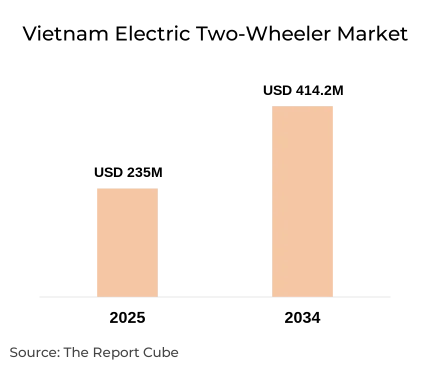
The Vietnam Electric Two-Wheeler Market is anticipated to register a CAGR 6.5% during 2026-2034. The market size was valued at USD 235 million in 2025 and is projected to reach USD 414.20 million by 2034. Vietnam stands among Southeast Asia’s most dynamic two-wheeler economies, with over 65 million motorcycles currently in circulation. Electric mobility is gaining measurable traction as urban air pollution, fuel price volatility, and government decarbonization commitments reshape consumer behavior.
Market expansion is driven by urban congestion in Ho Chi Minh City and Hanoi, where motorcycles account for nearly 85% of daily commuter trips. Electric two-wheelers (E2Ws) offer 30-40% lower operating costs compared to gasoline models. Lithium battery prices declined by approximately 18% between 2023 and 2025, improving affordability. Local manufacturing strength, led by domestic brands, enhances supply chain resilience. Increasing delivery activity from e-commerce platforms has also expanded fleet demand, with last-mile electric motorcycles growing at double-digit rates. Infrastructure development, including battery-swapping pilots and fast-charging corridors, is accelerating adoption. As a result, Vietnam is transitioning from early adoption toward structured mass-market electrification.
Vietnam Electric Two-Wheeler Market Dynamics
Key Driver: Urban Mobility Electrification and Cost Efficiency
Vietnam’s dense urban mobility ecosystem is the strongest catalyst for electric two-wheeler growth. Fuel prices fluctuated between 2023 and 2025, raising commuter sensitivity to running costs. An electric scooter costs nearly 70% less per kilometer compared to petrol alternatives when considering electricity tariffs and maintenance savings. Delivery riders operating 80-100 km daily can reduce annual fuel expenses by nearly USD 400. Government air-quality monitoring reports show particulate concentration in major cities exceeding recommended thresholds, encouraging green commuting incentives. In addition, corporate ESG targets are prompting logistics and ride-hailing operators to electrify fleets. Domestic players are localizing component production to reduce price barriers. These combined factors position electrification as an economic and environmental necessity rather than a premium lifestyle choice.
Book your FREE 30-minute expert consultation today
Contact UsIndustry Trends: Lithium Dominance, Smart Connectivity, and Battery Swapping
Lithium-ion batteries are rapidly replacing lead-acid variants due to higher energy density and longer lifecycle performance. Average lithium battery lifespan now exceeds 1,000 charging cycles, nearly triple traditional lead-acid units. Smart connectivity features, including GPS tracking, theft alerts, and mobile app diagnostics, are becoming standard in mid-range models. Battery-swapping pilots in Ho Chi Minh City reduced downtime to under three minutes per exchange, improving commercial viability. High-speed electric motorcycles capable of exceeding 80 km/h are also gaining traction among younger riders. Manufacturers are integrating regenerative braking and IoT-enabled dashboards. The combination of performance upgrades and digital integration is reshaping consumer expectations across price tiers.
Major Challenge: Charging Infrastructure Gaps and Price Sensitivity
Charging infrastructure density remains uneven outside major cities. While urban districts are witnessing rapid deployment, rural regions face limited public charging availability. Approximately 72% of charging points are concentrated in Hanoi and Ho Chi Minh City. Upfront purchase costs remain 15-25% higher than gasoline equivalents for lithium-based models. Financing penetration for electric motorcycles is still developing compared to conventional bikes. Consumer perception regarding battery degradation and resale value also impacts purchase decisions. Local producers must balance affordability with technological advancement to maintain mass-market appeal.
Opportunity: Fleet Electrification and Export Expansion
Vietnam’s fast-growing e-commerce ecosystem presents strong commercial demand. Delivery and ride-hailing fleets account for nearly 18% of new electric motorcycle sales in 2025. Fleet operators prioritize models with 100+ km range and swappable batteries to optimize uptime. Furthermore, Vietnam’s “Make in Vietnam” strategy supports export expansion into ASEAN markets. Domestic manufacturers are improving quality standards to meet regional homologation requirements. Export-oriented production can strengthen economies of scale and reduce domestic pricing pressure. Green financing and carbon credit mechanisms may further accelerate electrification across urban logistics networks.
Vietnam Electric Two-Wheeler Market Segment-wise Analysis
By Vehicle Type:
- Electric Scooters
- Electric Motorcycles
- Electric Mopeds
Electric scooters dominate with approximately 62% market share in 2025 due to urban commuting suitability. Lightweight design, automatic transmission, and compact structure align with Vietnam’s dense traffic conditions. Average scooter range improved to 90 km per charge in mid-tier lithium models. Urban female commuters and students represent key buyer segments. Manufacturers are introducing customizable color variants and digital dashboards to enhance appeal. Price points range between USD 900 and USD 1,600, enabling mass affordability. Increased charging convenience in residential buildings further supports scooter penetration. As infrastructure expands, electric scooters are expected to maintain leadership throughout the forecast period.
By Battery Type:
- Lithium-Ion Battery
- Lead-Acid Battery
- Others
Lithium-ion batteries account for nearly 58% of total revenue, reflecting rapid technological transition. Energy density improvements enable higher speed and extended range models. Lithium systems reduce weight by nearly 40% compared to lead-acid alternatives. Falling import costs and local battery assembly initiatives have narrowed price gaps. Consumers increasingly prioritize durability and lifecycle savings over initial cost. Fleet operators especially prefer lithium variants due to lower downtime and better efficiency. As battery prices decline further, lithium penetration is projected to exceed 70% by 2030.
Regional Projection of Vietnam Electric Two-Wheeler Industry
- Northern
- Central
- Southern
- Others
The Southern region leads with approximately 45% share, supported by Ho Chi Minh City’s dense commuting patterns and strong commercial delivery demand. The city’s population exceeds 9 million, with motorcycles forming the backbone of daily transport. Charging pilot zones and battery-swapping networks are concentrated in this region. High disposable income levels and strong startup presence further accelerate innovation. Meanwhile, Northern Vietnam, led by Hanoi, shows strong policy-driven adoption. Central provinces are gradually expanding infrastructure, presenting long-term growth potential.
Vietnam Electric Two-Wheeler Market Recent Developments
- 2025: Honda Vietnam unveiled the ICON e:, its first domestically produced electric scooter, strengthening its competitive positioning and intensifying rivalry within Vietnam’s fast-growing electric two-wheeler landscape.
- 2025: Dat Bike secured a US$22 million Series B funding round, expanding production capacity and accelerating regional distribution expansion plans across Vietnam and ASEAN markets.
- 2025: VinFast delivered 406,453 electric scooters in 2025, capturing the leading market position and reinforcing its strategy to expand internationally across five foreign markets.
Need insights for a specific region within this market?
Request Regional DataWhy Choose This Report?
- Provides a comprehensive overview of the overall market analysis, encompassing key trends, consumer behavior analysis, and risk assessment to support strategic decision-making.
- Provides accurate, up-to-date insights into market size, segmentation, and emerging opportunities, helping to minimize risk & capitalizing on growth.
- Gives deep understanding of target audience preferences, investment habits, and communication channels for enhanced product development & marketing effectiveness.
- Delivers competitive analysis & benchmarking, uncovering the strengths & weaknesses of market competitors to guide strategies.
- Consolidate comprehensive market intelligence, reducing reasoning & streamlining research efforts.
- Facilitates customized market segmentation & risk mitigation strategies, fine-tuned to the business objectives.
- Aids in identifying both market challenges & untapped opportunities within the industry to drive long-term business growth.
- Provides valuable information based on actual customer data & search trends.
Table of Contents
- Introduction
- Objective of the Study
- Product and Category Definition
- Market Segmentation
- Study Variables
- Research Methodology
- Secondary Data Points
- Breakdown of Secondary Sources
- Primary Data Points
- Breakdown of Primary Interviews
- Secondary Data Points
- Executive Summary
- Market Dynamics
- Drivers
- Challenges
- Opportunity Assessment
- Recent Trends and Developments
- Regulatory and Policy Landscape
- Vietnam Electric Two-Wheeler Market Overview (2021-2034)
- Market Size, By Value (USD Million)
- Market Share, By Vehicle Type
- Electric Scooters
- Electric Motorcycles
- Electric Mopeds
- Market Share, By Battery Type
- Lithium-Ion Battery
- Lead-Acid Battery
- Others
- Market Share, By Battery Technology
- Removable Battery
- Fixed Battery
- Battery Swapping Enabled
- Market Share, By Battery Voltage
- <36V
- 36-48V
- 48-72V
- 72-96V
- >96V
- Market Share, By Power Output
- Less than 1 kW
- 1 kW to 3 kW
- Above 3 kW
- Market Share, By Speed
- Low-Speed Electric Two-Wheelers
- High-Speed Electric Two-Wheelers
- Market Share, By Range
- Below 50 km
- 50 km to 100 km
- Above 100 km
- Market Share, By End User
- Individual Consumers
- Commercial and Fleet Users
- Ride-Hailing and Delivery Services
- Market Share, By Distribution Channel
- Online Sales
- Offline Sales
- Company-Owned Showrooms
- Multi-Brand Dealerships
- Others
- Market Share, By Motor Placement
- Hub Type
- Chassis Mounted
- Market Share, By Region
- Northern
- Central
- Southern
- Others
- Market Share, By Company
- Revenue Shares & Analysis
- Competitive Landscape
- Northern Vietnam Electric Two-Wheeler Market
- Market Size, By Value (USD Million)
- Market Share, By Vehicle Type
- Market Share, By Battery Voltage
- Market Share, By Motor Placement
- Market Share, By Battery Type
- Market Share, By Battery Technology
- Market Share, By Power Output
- Market Share, By Speed
- Market Share, By Range
- Market Share, By End User
- Market Share, By Distribution Channel
- Central Vietnam Electric Two-Wheeler Market
- Market Size, By Value (USD Million)
- Market Share, By Vehicle Type
- Market Share, By Battery Voltage
- Market Share, By Motor Placement
- Market Share, By Battery Type
- Market Share, By Battery Technology
- Market Share, By Power Output
- Market Share, By Speed
- Market Share, By Range
- Market Share, By End User
- Market Share, By Distribution Channel
- Southern Vietnam Electric Two-Wheeler Market
- Market Size, By Value (USD Million)
- Market Share, By Vehicle Type
- Market Share, By Battery Voltage
- Market Share, By Motor Placement
- Market Share, By Battery Type
- Market Share, By Battery Technology
- Market Share, By Power Output
- Market Share, By Speed
- Market Share, By Range
- Market Share, By End User
- Market Share, By Distribution Channel
- Other Regions Vietnam Electric Two-Wheeler Market
- Market Size, By Value (USD Million)
- Market Share, By Vehicle Type
- Market Share, By Battery Voltage
- Market Share, By Motor Placement
- Market Share, By Battery Type
- Market Share, By Battery Technology
- Market Share, By Power Output
- Market Share, By Speed
- Market Share, By Range
- Market Share, By End User
- Market Share, By Distribution Channel
- Competitive Outlook and Company Profiles
- VinFast
- Company Overview
- Product Portfolio
- Strategic Alliances/Partnerships
- Recent Developments
- Pega (formerly HKBike)
- Company Overview
- Product Portfolio
- Strategic Alliances/Partnerships
- Recent Developments
- Dat Bike
- Company Overview
- Product Portfolio
- Strategic Alliances/Partnerships
- Recent Developments
- Yadea Vietnam
- Company Overview
- Product Portfolio
- Strategic Alliances/Partnerships
- Recent Developments
- Selex Motors
- Company Overview
- Product Portfolio
- Strategic Alliances/Partnerships
- Recent Developments
- Dibao Vietnam
- Company Overview
- Product Portfolio
- Strategic Alliances/Partnerships
- Recent Developments
- Honda Vietnam
- Company Overview
- Product Portfolio
- Strategic Alliances/Partnerships
- Recent Developments
- Yamaha Motor Vietnam
- Company Overview
- Product Portfolio
- Strategic Alliances/Partnerships
- Recent Developments
- DK Bike
- Company Overview
- Product Portfolio
- Strategic Alliances/Partnerships
- Recent Developments
- Anbico
- Company Overview
- Product Portfolio
- Strategic Alliances/Partnerships
- Recent Developments
- Osakar
- Company Overview
- Product Portfolio
- Strategic Alliances/Partnerships
- Recent Developments
- Son Ha (EVGO)
- Company Overview
- Product Portfolio
- Strategic Alliances/Partnerships
- Recent Developments
- Before All
- Company Overview
- Product Portfolio
- Strategic Alliances/Partnerships
- Recent Developments
- Kazuki (DTP)
- Company Overview
- Product Portfolio
- Strategic Alliances/Partnerships
- Recent Developments
- Nijia Vietnam
- Company Overview
- Product Portfolio
- Strategic Alliances/Partnerships
- Recent Developments
- Sym Vietnam
- Company Overview
- Product Portfolio
- Strategic Alliances/Partnerships
- Recent Developments
- Kymco Vietnam
- Company Overview
- Product Portfolio
- Strategic Alliances/Partnerships
- Recent Developments
- Others
- VinFast
- Contact Us and Disclaimer
Top Key Players & Market Share Outlook
- VinFast
- Pega (formerly HKBike)
- Dat Bike
- Yadea Vietnam
- Selex Motors
- Dibao Vietnam
- Honda Vietnam
- Yamaha Motor Vietnam
- DK Bike
- Anbico
- Osakar
- Son Ha (EVGO)
- Before All
- Kazuki (DTP)
- Nijia Vietnam
- Sym Vietnam
- Kymco Vietnam
Frequently Asked Questions






