



Build Your Custom Market Intelligence Report
Customize Your ReportVietnam Fleet Electrification for Ride-Hailing Market Key Highlights
By Vehicle Type:
Electric Motorbikes segment leads the market, with around 52% share.
By Service Type:
Ride-Hailing Passenger segment dominates the market, accounting for nearly 48% of total revenue.
Regional Outlook:
Southern region dominates the vietnam fleet electrification for ride-hailing market, with around 46% share.
Government Initiatives & Policies
- Vietnam National Green Growth Strategy 2021-2030 (Updated 2025 Implementation Plan): Promotes electrification of public transport and ride-hailing fleets, targeting reduced urban transport emissions by 30% by 2030.
- Decision No. 876/QD-TTg on Action Program for Energy Transition in Transport (2022, updated 2025 guidance): Encourages EV adoption, charging infrastructure expansion, and tax incentives for electric vehicles and fleet operators.
Vietnam Fleet Electrification for Ride-Hailing Market Insights & Analysis
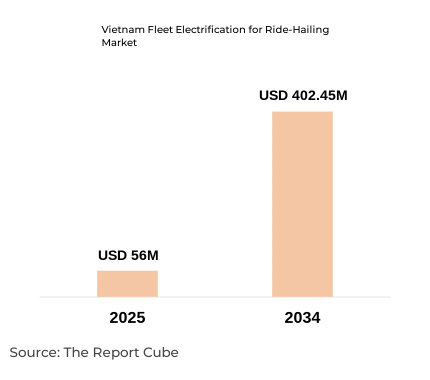
The Vietnam Fleet Electrification for Ride-Hailing Market is anticipated to register a 24.5% during 2026-34. The market size was valued at USD 56 million in 2025 and is projected to reach USD 402.45 million by 2034. Vietnam’s rapid urbanization, rising fuel costs, and strong domestic EV manufacturing ecosystem are reshaping the ride-hailing mobility landscape toward electrified fleets.
Vietnam has one of Southeast Asia’s highest two-wheeler penetration rates, with over 70 million registered motorbikes nationwide. This creates a natural foundation for electric motorbike deployment in ride-hailing and last-mile delivery services. By 2025, electric vehicles represented an estimated 12-15% of new ride-hailing vehicle registrations in major cities such as Ho Chi Minh City and Hanoi. Platforms are accelerating electrification to reduce fuel expenses, which typically account for 25-35% of driver operating costs. Electric motorbikes reduce per-kilometer costs by up to 40% compared to gasoline models, making them financially attractive for driver-partners.
The presence of vertically integrated domestic players such as VinFast and Xanh SM (GSM) has strengthened the local EV supply chain. Unlike markets dependent on imports, Vietnam benefits from localized vehicle manufacturing and expanding charging networks. Fleet-focused charging depots, battery-swapping solutions, and app-integrated charging discovery features are increasing operational convenience. Strategic partnerships between ride-hailing platforms and charging providers are also addressing range anxiety and downtime challenges.
Investor confidence remains strong. Private capital inflows into electric two-wheeler startups and charging infrastructure providers have increased notably in 2025. Fleet operators are shifting toward platform-owned and leased models to accelerate transition speed while maintaining service quality. As regulatory clarity improves and urban emission standards tighten, electrification is moving from pilot initiatives to structured fleet transformation programs across northern and southern metropolitan clusters.
Vietnam Fleet Electrification for Ride-Hailing Market Dynamics
Key Driver: Cost Efficiency and Emission Reduction Mandates
Fuel price volatility has significantly influenced fleet economics. With gasoline prices fluctuating between VND 22,000-25,000 per liter in recent years, ride-hailing drivers face rising operational burdens. Electric vehicles reduce fuel expenses by 30-50% annually depending on utilization rates. Additionally, Vietnam’s commitment to achieving net-zero emissions by 2050 has accelerated city-level emission control initiatives. Major urban centers are introducing low-emission transport planning frameworks, encouraging EV adoption in commercial mobility services. Corporate ESG targets are also influencing logistics and mobility firms to electrify fleets. These combined financial and environmental incentives are strengthening adoption momentum and supporting sustained double-digit growth.
Book your FREE 30-minute expert consultation today
Contact UsIndustry Trends: Integrated Charging Ecosystems and Battery Swapping Expansion
The market is witnessing rapid expansion of integrated charging ecosystems. Ride-hailing apps now provide real-time charging station mapping, tariff comparisons, and battery-swapping availability. Battery swapping is gaining traction in two-wheeler fleets, reducing downtime to under five minutes compared to 2-4 hours for conventional charging. Charging networks exceeding 300 public stations in major cities are now integrated into ride-hailing platforms. Depot charging hubs dedicated to fleet vehicles are also expanding, particularly for electric cars and vans. These infrastructure improvements are improving fleet uptime ratios and supporting scalability in high-demand corridors such as airport and intercity routes.
Major Challenge: Infrastructure Gaps and Upfront Vehicle Costs
While infrastructure is expanding, charging density remains uneven in central and secondary cities. High upfront acquisition costs of electric cars, which can be 15-25% higher than internal combustion equivalents, limit rapid mass conversion. Financing accessibility for driver-owned fleets also varies across income segments. Battery degradation concerns and resale value uncertainties further influence adoption decisions. Grid capacity upgrades are required to support large-scale depot charging, particularly during peak demand hours. Addressing these challenges requires coordinated policy incentives, financing innovation, and infrastructure investment.
Opportunity: Platform-Owned Fleet Models and Corporate Mobility Contracts
Platform-owned fleets allow faster electrification by centralizing capital investment and vehicle management. Corporate mobility contracts for employee transport and airport shuttle services are increasingly favoring electric vehicles due to ESG alignment. Delivery-focused ride-hailing segments are also transitioning to electric vans and motorbikes to reduce operational costs. By 2030, platform-owned EV fleets could represent nearly 40% of total electrified ride-hailing vehicles. Battery leasing and subscription-based mobility models are further expanding affordability and accelerating transition rates.
Vietnam Fleet Electrification for Ride-Hailing Market Segment-wise Analysis
By Vehicle Type:
- Electric Cars
- Electric Motorbikes
- Electric Vans
- Electric Buses
Electric motorbikes account for approximately 52% of the total electrified ride-hailing fleet in 2025. Their dominance stems from Vietnam’s two-wheeler-centric urban mobility structure. Delivery services, short-distance passenger trips, and dense urban traffic conditions favor agile two-wheelers. Operating costs are significantly lower compared to gasoline models, with electricity expenses averaging 60-70% lower per kilometer. Domestic manufacturers such as Dat Bike and Selex Motors are expanding production capacity to meet demand. Battery-swapping infrastructure specifically designed for motorbikes is accelerating adoption, ensuring high utilization rates for ride-hailing drivers operating 8-10 hours daily.
By Service Type:
- Ride-Hailing Passenger
- Ride-Hailing Delivery
- Corporate Mobility
- Airport & Intercity
Ride-hailing passenger services represent nearly 48% of market revenue. Urban commuters increasingly prefer EV-based services due to smoother rides and lower emissions. Passenger-focused EV fleets in Ho Chi Minh City and Hanoi report customer satisfaction improvements exceeding 20% compared to traditional vehicles. Airport and intercity services are gradually integrating electric cars and buses to meet sustainability benchmarks. Delivery services remain a strong secondary growth driver, particularly in e-commerce-driven logistics networks. Passenger mobility dominance is expected to continue as urban emission standards evolve and consumer awareness increases.
Regional Projection of Vietnam Fleet Electrification for Ride-Hailing Industry
- Southern
- Northern
- Central
- Others
The Southern region leads with around 46% market share, driven by Ho Chi Minh City’s dense ride-hailing penetration and established charging infrastructure. Northern Vietnam, particularly Hanoi, follows with strong adoption among electric taxis and corporate fleets. Central provinces are gradually expanding charging infrastructure but remain in early-stage adoption. Industrial zones in the south provide logistical advantages for depot charging and fleet management. Urban population density and higher disposable income levels further support electrification in southern metropolitan clusters.
Vietnam Fleet Electrification for Ride-Hailing Market Recent Developments
- 2025: Grab Vietnam partnered with Charge+ to expand EV charging and battery-swapping infrastructure nationwide, integrating charging locations into the Grab app and offering preferential tariffs to driver-partners to accelerate large-scale fleet electrification.
- 2025: Grab Vietnam signed a cooperation agreement with EBOOST to provide access to over 300 charging stations, co-develop new sites, and integrate battery-swapping information directly within its digital platform.
- 2025: Dat Bike secured US$22 million in funding to scale local electric motorbike manufacturing and strengthen partnerships with ride-hailing and delivery platforms, supporting rapid two-wheeler fleet electrification.
Need insights for a specific region within this market?
Request Regional DataWhy Choose This Report?
- Provides a comprehensive overview of the overall market analysis, encompassing key trends, consumer behavior analysis, and risk assessment to support strategic decision-making.
- Provides accurate, up-to-date insights into market size, segmentation, and emerging opportunities, helping to minimize risk & capitalizing on growth.
- Gives deep understanding of target audience preferences, investment habits, and communication channels for enhanced product development & marketing effectiveness.
- Delivers competitive analysis & benchmarking, uncovering the strengths & weaknesses of market competitors to guide strategies.
- Consolidate comprehensive market intelligence, reducing reasoning & streamlining research efforts.
- Facilitates customized market segmentation & risk mitigation strategies, fine-tuned to the business objectives.
- Aids in identifying both market challenges & untapped opportunities within the industry to drive long-term business growth.
- Provides valuable information based on actual customer data & search trends.
Table of Contents
- Introduction
- Objective of the Study
- Product and Category Definition
- Market Segmentation
- Study Variables
- Research Methodology
- Secondary Data Points
- Breakdown of Secondary Sources
- Primary Data Points
- Breakdown of Primary Interviews
- Secondary Data Points
- Executive Summary
- Market Dynamics
- Drivers
- Challenges
- Opportunity Assessment
- Recent Trends and Developments
- Regulatory and Policy Landscape
- Vietnam Fleet Electrification for Ride-Hailing Market Overview (2021-2034)
- Market Size, By Value (USD Million)
- Market Share, By Vehicle Type
- Electric Cars
- Electric Motorbikes
- Electric Vans
- Electric Buses
- Market Share, By Service Type
- Ride-Hailing Passenger
- Ride-Hailing Delivery
- Corporate Mobility
- Airport & Intercity
- Market Share, By Ownership
- Platform-Owned Fleet
- Leased Fleet
- Driver-Owned Fleet
- Market Share, By Charging Type
- Depot Charging
- Public Charging
- Battery Swapping
- Home & Workplace
- Market Share, By Region
- Northern
- Central
- Southern
- Others
- Market Share, By Company
- Revenue Shares & Analysis
- Competitive Landscape
- Northern Vietnam Fleet Electrification for Ride-Hailing Market
- Market Size, By Value (USD Million)
- Market Share, By Vehicle Type
- Market Share, By Service Type
- Market Share, By Ownership
- Market Share, By Charging Type
- Central Vietnam Fleet Electrification for Ride-Hailing Market
- Market Size, By Value (USD Million)
- Market Share, By Vehicle Type
- Market Share, By Service Type
- Market Share, By Ownership
- Market Share, By Charging Type
- Southern Vietnam Fleet Electrification for Ride-Hailing Market
- Market Size, By Value (USD Million)
- Market Share, By Vehicle Type
- Market Share, By Service Type
- Market Share, By Ownership
- Market Share, By Charging Type
- Competitive Outlook and Company Profiles
- Xanh SM (GSM)
- Company Overview
- Product Portfolio
- Strategic Alliances/Partnerships
- Recent Developments
- VinFast
- Company Overview
- Product Portfolio
- Strategic Alliances/Partnerships
- Recent Developments
- Grab Vietnam
- Company Overview
- Product Portfolio
- Strategic Alliances/Partnerships
- Recent Developments
- Be Group
- Company Overview
- Product Portfolio
- Strategic Alliances/Partnerships
- Recent Developments
- Dat Bike
- Company Overview
- Product Portfolio
- Strategic Alliances/Partnerships
- Recent Developments
- Selex Motors
- Company Overview
- Product Portfolio
- Strategic Alliances/Partnerships
- Recent Developments
- Mai Linh Group
- Company Overview
- Product Portfolio
- Strategic Alliances/Partnerships
- Recent Developments
- Vinasun Corp
- Company Overview
- Product Portfolio
- Strategic Alliances/Partnerships
- Recent Developments
- Gojek Vietnam
- Company Overview
- Product Portfolio
- Strategic Alliances/Partnerships
- Recent Developments
- Lazada Logistics
- Company Overview
- Product Portfolio
- Strategic Alliances/Partnerships
- Recent Developments
- Ahamove
- Company Overview
- Product Portfolio
- Strategic Alliances/Partnerships
- Recent Developments
- EBOOST
- Company Overview
- Product Portfolio
- Strategic Alliances/Partnerships
- Recent Developments
- Charge+ Vietnam
- Company Overview
- Product Portfolio
- Strategic Alliances/Partnerships
- Recent Developments
- VinBus
- Company Overview
- Product Portfolio
- Strategic Alliances/Partnerships
- Recent Developments
- Son Ha Group
- Company Overview
- Product Portfolio
- Strategic Alliances/Partnerships
- Recent Developments
- Pega Vietnam
- Company Overview
- Product Portfolio
- Strategic Alliances/Partnerships
- Recent Developments
- Others
- Xanh SM (GSM)
- Contact Us and Disclaimer
Top Key Players & Market Share Outlook
- Xanh SM (GSM)
- VinFast
- Grab Vietnam
- Be Group
- Dat Bike
- Selex Motors
- Mai Linh Group
- Vinasun Corp
- Gojek Vietnam
- Lazada Logistics
- Ahamove
- EBOOST
- Charge+ Vietnam
- VinBus
- Son Ha Group
- Pega Vietnam
- Others
Frequently Asked Questions






