



Build Your Custom Market Intelligence Report
Customize Your ReportVietnam Electric Vehicle Market Insights & Analysis
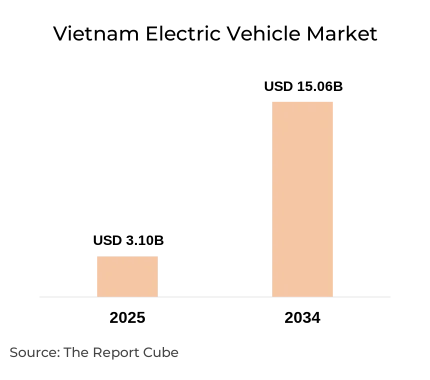
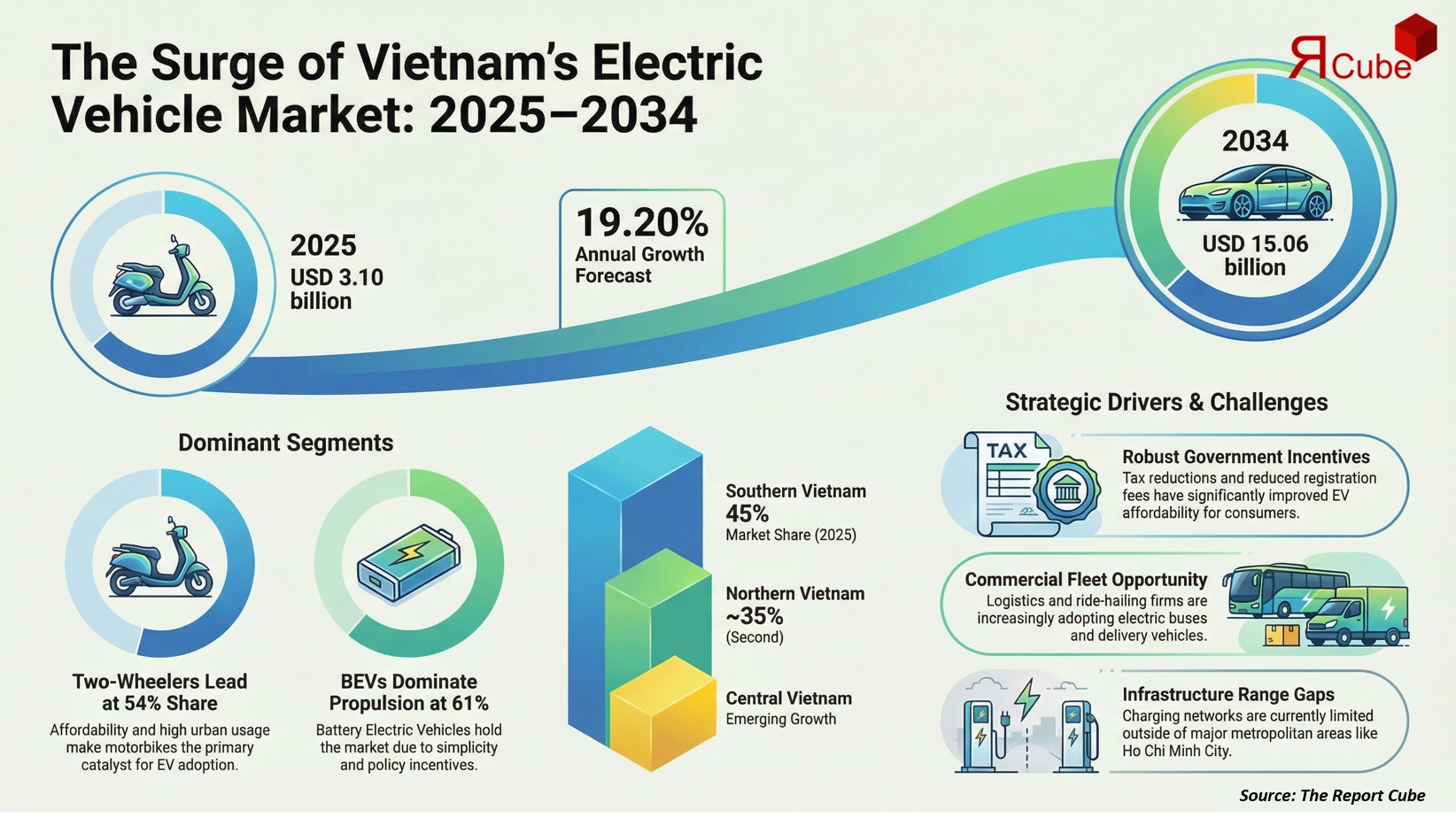
The Vietnam Electric Vehicle Market is anticipated to register a CAGR of 19.20% during the forecast period 2026-2034. The market size was valued at USD 3.10 billion in 2025 and is projected to reach USD 15.06 billion by 2034. This exceptional growth trajectory reflects Vietnam’s rapid urbanization, rising fuel costs, and strong government push toward sustainable mobility solutions.
Vietnam’s transportation sector is undergoing a major transformation as consumers increasingly shift from internal combustion engine vehicles to electric alternatives. Rising environmental awareness, combined with supportive policies such as tax incentives and reduced registration fees, has significantly improved EV affordability. Domestic manufacturers and international automakers are expanding product portfolios to cater to diverse income groups, ranging from affordable electric two-wheelers to premium electric passenger cars.
Furthermore, the rapid expansion of charging infrastructure across major cities has eased range anxiety among consumers. Southern and Northern Vietnam, in particular, are witnessing strong adoption due to higher disposable incomes and dense urban traffic conditions. As battery costs continue to decline and technology improves, the Vietnam Electric Vehicle Market is expected to move from early adoption toward mass-market penetration during the forecast period.
Vietnam Electric Vehicle Market Recent Developments
- 2025: VinFast expanded its domestic EV lineup with new affordable models targeting mass urban commuters.
- 2025: BYD strengthened its Vietnam market entry through partnerships focused on electric passenger vehicles.
Government Initiatives & Policies
- National Green Growth Strategy: Promotes EV adoption through tax reductions and sustainable transport incentives.
- Vietnam Transport Electrification Program: Supports EV infrastructure and charging station deployment nationwide.
Vietnam Electric Vehicle Market Dynamics
Key Driver: Strong Government Support for Clean Mobility
The most significant driver of the Vietnam Electric Vehicle Market is robust government support for clean and sustainable mobility. Authorities have introduced preferential policies such as reduced import duties on EV components, lower registration fees, and favorable excise tax structures. These measures have directly improved the cost competitiveness of electric vehicles compared to conventional gasoline-powered alternatives. In addition, Vietnam’s commitment to reducing carbon emissions under international climate agreements has accelerated public investment in green transportation. Government-backed pilot projects for electric buses and urban EV fleets further enhance market visibility. As these initiatives gain momentum, both consumers and fleet operators are increasingly confident in transitioning to electric mobility, driving sustained market growth.
Book your FREE 30-minute expert consultation today
Contact UsIndustry Trends: Rapid Adoption of Electric Two-Wheelers
A key trend shaping the market is the rapid adoption of electric two-wheelers, which align well with Vietnam’s existing mobility patterns. Motorbikes dominate personal transportation, and electric variants offer lower operating costs, reduced noise, and minimal maintenance. Urban consumers are particularly drawn to electric scooters for daily commuting, supported by improving battery performance and shorter charging times. Manufacturers are focusing on localized production to keep prices affordable while enhancing design and durability. This trend is gradually extending beyond urban centers into semi-urban areas, creating a strong foundation for broader EV ecosystem development across vehicle categories.
Major Challenge: Limited Charging Infrastructure Outside Major Cities
Despite strong growth potential, limited charging infrastructure remains a critical challenge for the Vietnam Electric Vehicle Market. While major cities have seen steady deployment of public charging stations, rural and remote regions still lack adequate coverage. This uneven infrastructure development restricts long-distance travel and slows adoption among consumers outside metropolitan areas. Additionally, high initial investment costs for fast-charging stations can deter private players. Addressing these gaps through public-private partnerships and grid upgrades will be essential to unlock nationwide EV adoption and ensure balanced market growth.
Opportunity: Electrification of Commercial and Public Transport Fleets
The electrification of commercial vehicles and public transport fleets presents a major growth opportunity. Logistics companies, ride-hailing platforms, and municipal authorities are increasingly evaluating electric buses and delivery vehicles to reduce fuel expenses and emissions. Fleet electrification offers predictable charging patterns and faster return on investment compared to private ownership. As battery prices decline and vehicle range improves, electric commercial vehicles are expected to gain traction, significantly expanding the addressable market and supporting long-term revenue growth.
Vietnam Electric Vehicle Market Segment-wise Analysis
By Vehicle Type:
- Passenger Cars
- Commercial Vehicles
- Two-Wheelers
- Buses
- Others
Two-Wheelers dominate the Vietnam Electric Vehicle Market, accounting for approximately 54% of total market share in 2025. This dominance is driven by affordability, high urban usage, and strong replacement demand for conventional motorbikes. Passenger Cars follow, supported by rising middle-class incomes and growing availability of locally manufactured models. Electric buses and commercial vehicles, while smaller in share, are gaining attention through government-backed pilot projects. The segment-wise growth reflects Vietnam’s unique mobility structure, where two-wheelers act as the primary catalyst for overall EV adoption.
By Propulsion:
- Battery EV
- Plug-in Hybrid
- Hybrid EV
- Fuel Cell EV
Battery Electric Vehicles (BEVs) lead the propulsion segment, holding nearly 61% market share due to simplicity, lower maintenance costs, and strong policy incentives. Plug-in Hybrid EVs account for around 21%, appealing to consumers seeking range flexibility amid infrastructure constraints. Hybrid EVs maintain steady demand, particularly in premium passenger cars, while Fuel Cell EVs remain at a nascent stage due to high costs and lack of hydrogen infrastructure. The propulsion mix highlights Vietnam’s clear transition toward full electrification over transitional technologies.
Regional Projection of Vietnam Electric Vehicle Industry
- Northern Vietnam
- Central Vietnam
- Southern Vietnam
Southern Vietnam leads the Vietnam Electric Vehicle Market, contributing approximately 45% of total demand. The region benefits from higher urbanization, stronger purchasing power, and advanced charging infrastructure in cities such as Ho Chi Minh City. Northern Vietnam follows, supported by government initiatives and growing adoption in Hanoi. Central Vietnam currently holds a smaller share but presents long-term potential as infrastructure investment expands. Southern Vietnam’s leadership is expected to continue throughout the forecast period, driven by sustained consumer demand and fleet electrification initiatives.
Need insights for a specific region within this market?
Request Regional DataWhy Choose This Report?
- Provides a comprehensive overview of the overall market analysis, encompassing key trends, consumer behavior analysis, and risk assessment to support strategic decision-making.
- Provides accurate, up-to-date insights into market size, segmentation, and emerging opportunities, helping to minimize risk & capitalizing on growth.
- Gives deep understanding of target audience preferences, investment habits, and communication channels for enhanced product development & marketing effectiveness.
- Delivers competitive analysis & benchmarking, uncovering the strengths & weaknesses of market competitors to guide strategies.
- Consolidate comprehensive market intelligence, reducing reasoning & streamlining research efforts.
- Facilitates customized market segmentation & risk mitigation strategies, fine-tuned to the business objectives.
- Aids in identifying both market challenges & untapped opportunities within the industry to drive long-term business growth.
- Provides valuable information based on actual customer data & search trends.
Table of Contents
- Introduction
- Objective of the Study
- Product and Category Definition
- Market Segmentation
- Study Variables
- Research Methodology
- Secondary Data Points
- Breakdown of Secondary Sources
- Primary Data Points
- Breakdown of Primary Interviews
- Secondary Data Points
- Executive Summary
- Market Dynamics
- Drivers
- Challenges
- Opportunity Assessment
- Recent Trends and Developments
- Regulatory and Policy Landscape
- Vietnam Electric Vehicle Market Overview (2020-2034)
- Market Size, By Value (USD Billion)
- Market Share, By Vehicle Type
- Passenger Cars
- Commercial Vehicles
- Two-Wheelers
- Buses
- Others
- Market Share, By Propulsion
- Battery EV
- Plug-in Hybrid
- Hybrid EV
- Fuel Cell EV
- Market Share, By Battery Type
- Lithium-ion
- Nickel-metal Hydride
- Other Batteries
- Market Share, By End-User
- Private/Individual
- Corporate Fleets
- Public Transport
- Other End-Users
- Market Share, By Distribution
- Dealerships
- Direct Sales
- Online Channels
- Market Share, By Region
- Northern Vietnam
- Central Vietnam
- Southern Vietnam
- Market Share, By Company
- Competition Characteristics
- Revenue Shares & Analysis
- Northern Vietnam EV Market
- Market Size, By Value (USD Billion)
- Market Share, By Vehicle Type
- Market Share, By Propulsion
- Market Share, By Battery Type
- Market Share, By End-User
- Market Share, By Distribution
- Central Vietnam EV Market
- Market Size, By Value (USD Billion)
- Market Share, By Vehicle Type
- Market Share, By Propulsion
- Market Share, By Battery Type
- Market Share, By End-User
- Market Share, By Distribution
- Southern Vietnam EV Market
- Market Size, By Value (USD Billion)
- Market Share, By Vehicle Type
- Market Share, By Propulsion
- Market Share, By Battery Type
- Market Share, By End-User
- Market Share, By Distribution
- Competitive Outlook and Company Profiles
- VinFast Auto Ltd.
- Company Overview
- Product Portfolio
- Charging & Services Ecosystem
- Recent Developments
- Tesla Inc.
- Company Overview
- Product Portfolio
- Import & Sales Strategy
- Recent Developments
- Hyundai Motor Company
- Company Overview
- Product Portfolio
- Local Partnerships
- Recent Developments
- Toyota Motor Corporation
- Company Overview
- Product Portfolio
- Electrification Roadmap
- Recent Developments
- BYD Company Ltd.
- Company Overview
- Product Portfolio
- Market Entry Strategy
- Recent Developments
- Honda Vietnam Co., Ltd.
- Company Overview
- Two-wheeler Focus
- EV Launch Plans
- Recent Developments
- Dat Bike Vietnam Co. Ltd.
- Company Overview
- Product Portfolio
- Manufacturing Footprint
- Recent Developments
- Selex Motors
- Company Overview
- Battery-swapping Model
- Logistics Partnerships
- Recent Developments
- PEGA Vietnam
- Company Overview
- Product Portfolio
- Distribution Network
- Recent Developments
- Mercedes-Benz Vietnam Ltd.
- Company Overview
- Premium EV Lineup
- Dealer Network
- Recent Developments
- Others
- VinFast Auto Ltd.
- Contact Us and Disclaimer
Top Key Players & Market Share Outlook
- VinFast Auto Ltd.
- Tesla Inc.
- Hyundai Motor Company
- Toyota Motor Corporation
- BYD Company Ltd.
- Honda Vietnam Co., Ltd.
- Dat Bike Vietnam Co. Ltd.
- Selex Motors
- PEGA Vietnam
- Mercedes-Benz Vietnam Ltd.
- Others
Frequently Asked Questions






