



Build Your Custom Market Intelligence Report
Customize Your ReportUnited States Electronic Design Automation AI Market Key Highlights
By Offering:
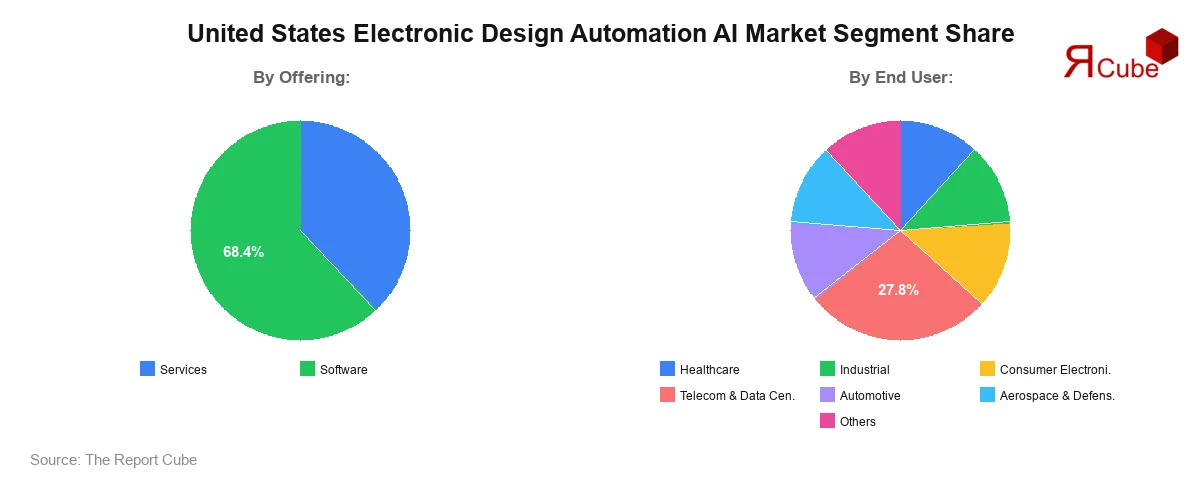
Software segment leads the market with approximately 68.4% share.
By End User:
Telecom & Data Centers segment dominates the market with nearly 27.8% of revenue.
Regional Outlook:
South West region dominates the US Electronic Design Automation AI market with around 39.6% share.
United States Electronic Design Automation AI Market Insights & Analysis
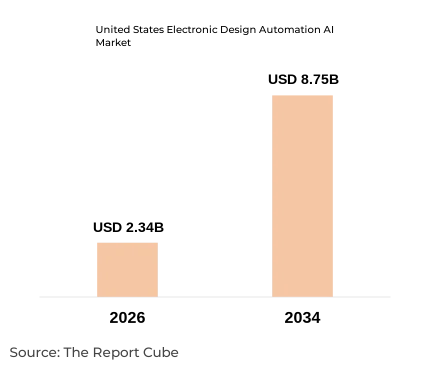
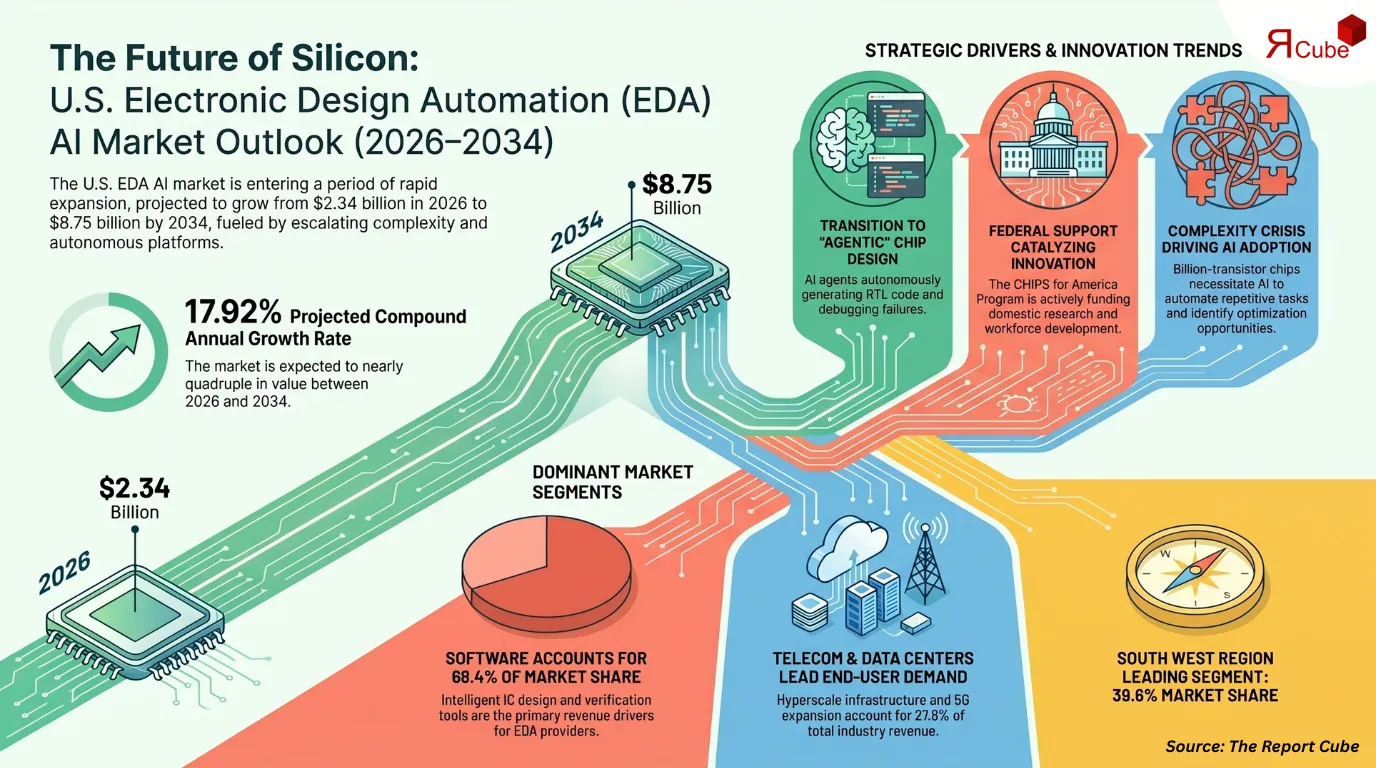
The United States Electronic Design Automation AI Market is anticipated to register a CAGR of around 17.92% during the forecast period 2026-2034. The market size is valued at USD 2.34 billion in 2026 and is projected to reach USD 8.75 billion by 2034. Growth is being supported by the rapid evolution of semiconductor technologies, increasing adoption of advanced-node manufacturing, and the rising complexity of integrated circuit architectures. Semiconductor companies are under continuous pressure to shorten development timelines while improving performance, power efficiency, and design reliability. As a result, AI-enabled Electronic Design Automation solutions are becoming critical tools for automating design optimization, verification, simulation, and validation processes across the semiconductor value chain.
Industry investment patterns indicate a growing shift toward intelligent engineering environments capable of handling large-scale chip development programs. The expansion of high-performance computing, AI accelerators, cloud infrastructure processors, automotive electronics, and defense-grade semiconductors has significantly increased the demand for advanced EDA platforms. Leading software vendors are embedding machine learning, generative design capabilities, and autonomous workflow orchestration into their product portfolios to improve engineering productivity. In addition, federal initiatives supporting domestic semiconductor innovation and manufacturing are strengthening long-term opportunities for EDA providers. These developments are expected to accelerate adoption of AI-integrated design tools across both established semiconductor firms and emerging chip developers throughout the United States.
US Electronic Design Automation AI Market Impact Analysis
| Factor | Type | Specific Impact on Market | Magnitude | Business Implication |
|---|---|---|---|---|
| Rising Chip Complexity & Nodes | Market | Advanced nodes and 3D designs increase AI EDA tool reliance | High | Drives sustained demand for AI enabled verification workflows |
| AI Driven Design Automation | Technological | Machine learning reduces design and validation cycle times | High | Improves competitiveness through faster tape outs and launches |
| Cloud Based EDA Adoption | Technological | Scalable cloud tools support distributed AI centric design teams | Medium | Enables flexible pricing and access for diverse US customers |
| US Semiconductor Investment Plans | Market | Public and private funding increases design activity and tooling | High | Expands customer base across fabless firms and foundries |
| Talent & Skill Gap in AI EDA | Competitive | Shortage of experts slows full adoption of advanced AI flows | Medium | Creates opening for training, services, and guided platforms |
| Data Security & IP Protection Needs | Regulatory | Sensitive design data demands secure AI and cloud solutions | High | Necessitates robust compliance features and trusted hosting |
| Competition from Open Source Tools | Competitive | Low cost AI capable EDA options attract startups and academia | Medium | Pressures pricing and pushes vendors to add differentiated value |
United States Electronic Design Automation AI Market Dynamics
Key Driver: Growing Complexity of Advanced Semiconductor Design
The increasing sophistication of semiconductor devices is creating strong demand for AI-powered Electronic Design Automation platforms across the United States. Modern chips designed for artificial intelligence, cloud computing, automotive systems, and advanced communications contain billions of transistors and highly integrated functional blocks. Managing these complex architectures through traditional design approaches often leads to extended development cycles and increased engineering costs. AI-enhanced EDA solutions help design teams automate repetitive tasks, identify optimization opportunities, and improve verification efficiency throughout the product lifecycle.
Growing investments in AI processors, custom silicon, advanced ASICs, and data center infrastructure are further reinforcing market expansion. Semiconductor manufacturers are increasingly deploying AI-driven simulation, verification, and physical design tools to achieve faster design closure and higher first-pass success rates. These capabilities allow organizations to improve productivity while addressing challenges associated with shrinking process nodes and escalating design complexity. As semiconductor innovation remains a strategic priority for the United States, demand for intelligent EDA platforms is expected to remain strong throughout the forecast period.
Industry Trends: Emergence of Agentic AI and Autonomous Engineering Platforms
A notable transformation within the United States Electronic Design Automation AI Market is the emergence of autonomous engineering environments capable of executing complex design activities with minimal manual intervention. Software vendors are increasingly integrating agent-based automation, generative design engines, and intelligent verification frameworks into their EDA ecosystems. These technologies enable engineers to accelerate tasks such as RTL development, simulation management, debugging, and design optimization while improving consistency across projects.
Recent product launches from major EDA providers demonstrate the industry's movement beyond conventional AI-assisted workflows toward fully orchestrated engineering systems. The integration of large language models, retrieval-augmented intelligence, and multimodal data processing is enabling more sophisticated decision-making throughout semiconductor development. As organizations seek to improve productivity and address engineering talent shortages, autonomous design platforms are becoming an important component of next-generation semiconductor innovation strategies.
Book your FREE 30-minute expert consultation today
Contact UsMajor Challenge: High Implementation Costs and Data Security Concerns
The implementation of advanced AI-powered EDA platforms often requires substantial financial and operational commitments. Organizations must invest in software licensing, computational infrastructure, cloud resources, employee training, and workflow integration activities. While large semiconductor companies typically possess the resources necessary to support these investments, smaller design firms may face budgetary constraints that limit adoption. Integration with legacy engineering environments can also require significant customization efforts, increasing deployment timelines and implementation costs.
Protection of proprietary semiconductor designs remains another critical concern. Chip architectures, verification data, and design libraries represent valuable intellectual property that requires strict security controls. Many organizations continue to evaluate the implications of deploying sensitive engineering workloads within AI-enabled environments. Regulatory requirements, cybersecurity risks, and the need for reliable model outputs create additional considerations for technology adoption. Addressing these challenges will be essential for ensuring broader market penetration and long-term industry confidence.
Opportunity: Expansion of AI Chip Development and Domestic Semiconductor Manufacturing
Significant opportunities are emerging from the continued expansion of semiconductor manufacturing capacity and AI-focused infrastructure investments across the United States. Growing demand for advanced processors, AI accelerators, networking chips, and high-performance computing solutions is increasing the need for sophisticated design automation capabilities. Semiconductor developers are seeking technologies that can accelerate innovation while maintaining design accuracy and production readiness, creating favorable conditions for EDA AI adoption.
Federal support programs aimed at strengthening domestic semiconductor competitiveness are also contributing to market opportunities. New fabrication facilities, advanced packaging initiatives, and collaborative research programs require efficient design ecosystems capable of supporting increasingly complex product development requirements. AI-powered Electronic Design Automation platforms can help organizations reduce engineering bottlenecks, improve design quality, and accelerate commercialization timelines. These advantages position EDA AI technologies as a critical enabler of future semiconductor growth in the United States.
United States Electronic Design Automation AI Market Segment-wise Analysis
By Offering:
- Services
- Support & Maintenance
- Consulting Services
- Integration & Deployment
- Software
- Generative Design & Optimization Tools
- Circuit Simulation Software
- AI-Based Verification Software
- PCB Design Software
- Timing & Power Analysis Software
- Physical Design & Layout Software
- AI-Driven IC Design Software
Software represents the largest revenue-generating offering segment within the United States Electronic Design Automation AI Market, accounting for approximately 68.4% of total market share. The segment's leadership is supported by strong adoption of AI-driven verification software, circuit simulation platforms, timing analysis tools, and intelligent IC design solutions. Semiconductor organizations increasingly prioritize software investments that enhance engineering efficiency, reduce development risks, and support advanced-node chip design. As device complexity continues to increase, software platforms capable of automating critical design workflows have become indispensable across commercial and defense-related semiconductor programs.
Continuous innovation from leading EDA providers is further strengthening the competitive position of the software segment. New product releases increasingly incorporate generative design capabilities, machine learning algorithms, and autonomous engineering features that improve productivity and design quality. The growing adoption of cloud-enabled engineering environments and AI-native design ecosystems is expected to sustain software demand over the coming years. Consequently, software solutions are likely to remain the primary revenue contributor within the market throughout the forecast period.
By End User:
- Healthcare
- Industrial
- Consumer Electronics
- Telecom & Data Centers
- Automotive
- Aerospace & Defense
- Others
Telecom & Data Centers hold the largest share of the United States Electronic Design Automation AI Market, representing nearly 27.8% of total revenue. This leadership position reflects the substantial semiconductor requirements associated with cloud computing infrastructure, hyperscale data centers, advanced networking equipment, and next-generation communication technologies. Operators within this sector require highly specialized processors, AI accelerators, networking chips, and custom silicon solutions capable of supporting increasingly demanding workloads.
EDA AI platforms play an important role in enabling faster development and optimization of these advanced semiconductor products. Intelligent design automation tools help engineering teams improve verification accuracy, reduce development cycles, and enhance overall chip performance. Continued investments in AI infrastructure, edge computing environments, and 5G network expansion are expected to sustain semiconductor innovation across the telecom and data center ecosystem. These factors are anticipated to support long-term demand for sophisticated EDA technologies throughout the forecast horizon.
Regional Projection of United States Electronic Design Automation AI Industry
- North East
- North West
- South East
- South West
- Others
The South West region maintains a leading position in the United States Electronic Design Automation AI Market with an estimated share of 39.6%. Regional leadership is supported by a highly developed semiconductor ecosystem, strong concentration of technology companies, extensive venture capital activity, and access to world-class engineering talent. The region serves as a strategic hub for semiconductor research, integrated circuit development, software innovation, and AI technology advancement, creating favorable conditions for widespread EDA AI adoption.
Numerous semiconductor manufacturers, design firms, and software developers operate major facilities across the South West, contributing to sustained technology investment and product innovation. The region also benefits from strong collaboration among research institutions, private enterprises, and government-supported initiatives focused on semiconductor competitiveness. Rising investments in AI infrastructure, advanced computing technologies, and next-generation chip development continue to strengthen demand for intelligent design automation solutions. These advantages are expected to support the region's market leadership throughout the forecast period.
Need insights for a specific region within this market?
Request Regional DataUS Electronic Design Automation AI Market – Regional Analysis
The US EDA AI market shows uneven growth by region, driven by chip R&D hubs, cloud adoption, and AI-intensive design flows.
| Cluster | Demand Level | Key Areas | System Dominance | Core Demand Logic | Growth Nature |
|---|---|---|---|---|---|
| North East | High | Boston, NYC, New Jersey | Cloud EDA & AI co-design | Fabless IC, finance and AI startups | Steady, R&D-led expansion |
| North West | Very High | Seattle, Portland | Cloud-native EDA AI tools | Hyperscale cloud and chip teams | Platform-driven rapid growth |
| South East | High | Raleigh, Atlanta, Miami | EDA AI for SoC and RF | Auto, telecom and ARM ecosystem | Design center densification |
| South West | Extremely High | Bay Area, Austin, Phoenix | Full-stack AI EDA suites | Leading-edge nodes and 3nm flows | Fastest value and spend growth |
| Others | Medium | Midwest, Rockies, Texas fabs | Mixed on-prem and cloud EDA | CHIPS-backed fab and OSAT sites | Catch-up, fab-centric growth |
Government Initiatives & Policies
- CHIPS for America Program (2025-2026): Supports domestic semiconductor research, manufacturing expansion, and workforce development through federal funding and incentives, strengthening demand for advanced EDA and AI-driven chip design technologies.
- National Semiconductor Technology Center (NSTC) Initiative (2025-2026): Accelerates semiconductor innovation through collaborative R&D, prototyping, and design ecosystem development, fostering broader adoption of AI-powered Electronic Design Automation solutions.
United States Electronic Design Automation AI Industry Recent Developments
- 2026: Siemens EDA launched the Fuse EDA AI Agent, an autonomous engineering platform integrating retrieval-augmented generation, multimodal EDA intelligence, and NVIDIA AI infrastructure. The solution automates verification, RTL development, debugging, and manufacturing sign-off activities, enabling more efficient semiconductor and PCB design workflows.
- February 2026: Cadence Design Systems introduced the Chip Stack AI Super Agent for agentic chip design automation. The platform autonomously generates RTL code, develops testbenches, executes simulations, and debugs failures, with early deployments reporting productivity improvements of up to ten times across semiconductor engineering workflows.
- 2025: Synopsys expanded its Synopsys.ai Copilot capabilities by introducing generative AI-powered workflow assistants and advanced engineering automation features. The enhancements improved documentation search efficiency, automated script generation, accelerated formal verification processes, and supported faster onboarding of semiconductor design engineers.
Why Choose This Report?
- Provides a comprehensive overview of the overall market analysis, encompassing key trends, consumer behavior analysis, and risk assessment to support strategic decision-making.
- Provides accurate, up-to-date insights into market size, segmentation, and emerging opportunities, helping to minimize risk & capitalizing on growth.
- Gives deep understanding of target audience preferences, investment habits, and communication channels for enhanced product development & marketing effectiveness.
- Delivers competitive analysis & benchmarking, uncovering the strengths & weaknesses of market competitors to guide strategies.
- Consolidate comprehensive market intelligence, reducing reasoning & streamlining research efforts.
- Facilitates customized market segmentation & risk mitigation strategies, fine-tuned to the business objectives.
- Aids in identifying both market challenges & untapped opportunities within the industry to drive long-term business growth.
- Provides valuable information based on actual customer data & search trends.
Table of Contents
- Introduction
- Objective of the Study
- Product and Category Definition
- Market Segmentation
- Study Variables
- Research Methodology
- Secondary Data Points
- Breakdown of Secondary Sources
- Primary Data Points
- Breakdown of Primary Interviews
- Secondary Data Points
- Executive Summary
- Market Dynamics
- Emerging Opportunities
- Adoption Trends
- Demand Drivers
- Disruption Analysis (Challenges)
- Industry Analysis & Strategic Insights
- Supply/Value Chain Analysis
- Pricing Analysis
- Go-To-Market (GTM) Strategy
- BCG Matrix
- Recent Trends and Developments
- Regulatory and Policy Landscape
- Region-wise policies
- Government Initiatives
- United States Electronic Design Automation AI Market Overview and Forecast Analysis (2021-2034)
- Market Size, By Value, By Growth Rate (CAGR/USD Billion)
- Market Share, By Offering
- Services
- Support & Maintenance
- Consulting Services
- Integration & Deployment
- Software
- Generative Design & Optimization Tools
- Circuit Simulation Software
- AI-Based Verification Software
- PCB Design Software
- Timing & Power Analysis Software
- Physical Design & Layout Software
- AI-Driven IC Design Software
- Services
- Market Share, By AI Integration Level
- AI-Native
- AI-Augmented
- AI-Automated
- AI-Accelerated
- Market Share, By Deployment Mode
- Hybrid
- On-Premises
- Cloud-Based
- Market Share, By Enterprise Size
- Small & Medium Enterprises (SMEs)
- Large Enterprises
- Market Share, By Technology
- Generative AI
- Machine Learning (ML)
- Natural Language Processing (NLP)
- Reinforcement Learning
- Deep Learning (DL)
- Market Share, By Design Stage
- Verification & Validation
- Front-End Design
- System-Level Design
- Back-End Design
- Market Share, By Tool Type
- Simulation & Analysis Tools
- Computer-Aided Engineering (CAE)
- PCB & Multi-Chip Module (MCM) Design
- IC Physical Design & Verification
- Market Share, By Application
- ASICs & SoCs
- RF & Communication ICs
- Memory Management Units
- AI Accelerators & HPC Chips
- Microprocessors & Controllers
- Market Share, By End User
- Healthcare
- Industrial
- Consumer Electronics
- Telecom & Data Centers
- Automotive
- Aerospace & Defense
- Others
- Market Share, By Region
- North East
- North West
- South East
- South West
- Others
- Market Share, By Company
- Revenue Shares & Analysis
- Competitive Landscape
- North East United States Electronic Design Automation AI Market Overview and Forecast Analysis (2021-2034)
- Market Size, By Value, By Growth Rate (CAGR/USD Billion/Million)
- Market Share, By Offering
- Market Share, By AI Integration Level
- Market Share, By Deployment Mode
- Market Share, By Enterprise Size
- Market Share, By Technology
- Market Share, By Design Stage
- Market Share, By Tool Type
- Market Share, By Application
- Market Share, By End User
- North West United States Electronic Design Automation AI Market Overview and Forecast Analysis (2021-2034)
- Market Size, By Value, By Growth Rate (CAGR/USD Billion/Million)
- Market Share, By Offering
- Market Share, By AI Integration Level
- Market Share, By Deployment Mode
- Market Share, By Enterprise Size
- Market Share, By Technology
- Market Share, By Design Stage
- Market Share, By Tool Type
- Market Share, By Application
- Market Share, By End User
- South East United States Electronic Design Automation AI Market Overview and Forecast Analysis (2021-2034)
- Market Size, By Value, By Growth Rate (CAGR/USD Billion/Million)
- Market Share, By Offering
- Market Share, By AI Integration Level
- Market Share, By Deployment Mode
- Market Share, By Enterprise Size
- Market Share, By Technology
- Market Share, By Design Stage
- Market Share, By Tool Type
- Market Share, By Application
- Market Share, By End User
- South West United States Electronic Design Automation AI Market Overview and Forecast Analysis (2021-2034)
- Market Size, By Value, By Growth Rate (CAGR/USD Billion/Million)
- Market Share, By Offering
- Market Share, By AI Integration Level
- Market Share, By Deployment Mode
- Market Share, By Enterprise Size
- Market Share, By Technology
- Market Share, By Design Stage
- Market Share, By Tool Type
- Market Share, By Application
- Market Share, By End User
- Competitive Analysis, 2026
- Market Share of Key Players
- Competitive Mapping for Each Segment and Companies Operating Regionally
- North East United States Electronic Design Automation AI Companies/Providers Share & Competitive Analysis, 2026
- North West United States Electronic Design Automation AI Companies/Providers Share & Competitive Analysis, 2026
- South East United States Electronic Design Automation AI Companies/Providers Share & Competitive Analysis, 2026
- South West United States Electronic Design Automation AI Companies/Providers Share & Competitive Analysis, 2026
- Company Profile (Partial List)
- Agnisys
- Company Overview
- Product Portfolio
- Strategic Alliances/Partnerships
- Recent Developments
- Cadence Design Systems
- Company Overview
- Product Portfolio
- Strategic Alliances/Partnerships
- Recent Developments
- Altium Limited
- Company Overview
- Product Portfolio
- Strategic Alliances/Partnerships
- Recent Developments
- Keysight Technologies
- Company Overview
- Product Portfolio
- Strategic Alliances/Partnerships
- Recent Developments
- Siemens EDA
- Company Overview
- Product Portfolio
- Strategic Alliances/Partnerships
- Recent Developments
- Synopsys
- Company Overview
- Product Portfolio
- Strategic Alliances/Partnerships
- Recent Developments
- Silvaco
- Company Overview
- Product Portfolio
- Strategic Alliances/Partnerships
- Recent Developments
- Zuken
- Company Overview
- Product Portfolio
- Strategic Alliances/Partnerships
- Recent Developments
- Altair Engineering
- Company Overview
- Product Portfolio
- Strategic Alliances/Partnerships
- Recent Developments
- Ansys
- Company Overview
- Product Portfolio
- Strategic Alliances/Partnerships
- Recent Developments
- Others (Partial List)
- Agnisys
- Contact Us and Disclaimer
Top Key Players & Market Share Outlook
- Agnisys
- Cadence Design Systems
- Altium Limited
- Keysight Technologies
- Siemens EDA
- Synopsys
- Silvaco
- Zuken
- Altair Engineering
- Ansys
Frequently Asked Questions






