



Build Your Custom Market Intelligence Report
Customize Your ReportGlobal Endpoint Security Market Key Highlights
By Component:
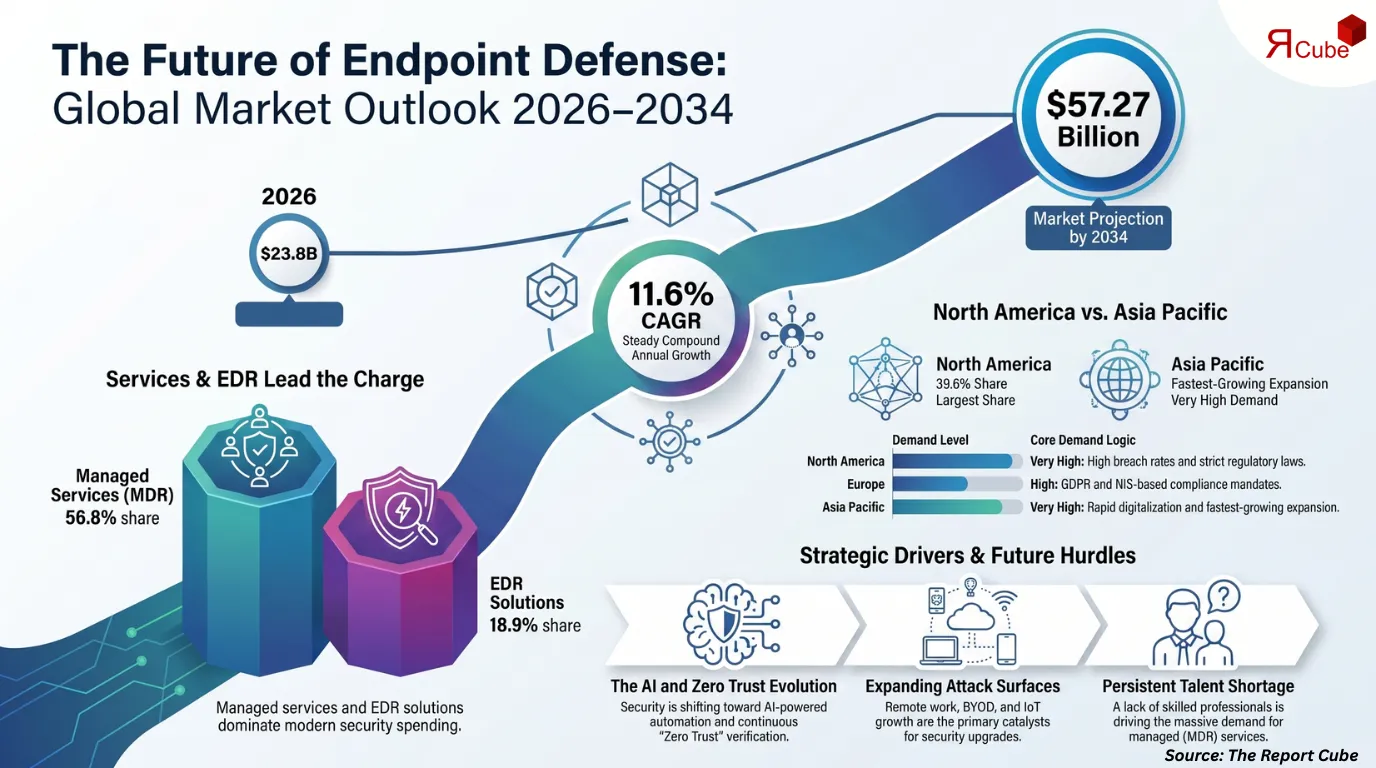
Services segment leads the market with nearly 56.8% share.
By Solution Type:
EDR (Endpoint Detection and Response) dominates the market with around 18.9% of total revenue.
Regional Outlook:
North America dominates the Global Endpoint Security Market with approximately 39.6% market share.
Global Endpoint Security Market Insights & Analysis
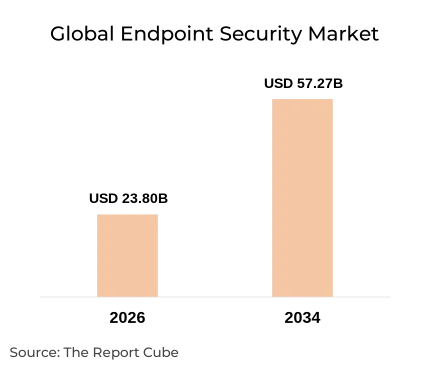
The Global Endpoint Security Market is anticipated to register a CAGR of around 11.6% during the forecast period 2026-2034. The market size is valued at USD 23.8 billion in 2026 and is projected to reach USD 57.27 billion by 2034. The market continues to gain momentum as organizations strengthen cyber resilience against ransomware, phishing, insider threats, and advanced persistent attacks. Increasing digital transformation, hybrid work environments, cloud migration, and widespread deployment of connected devices have significantly expanded enterprise attack surfaces. Organizations are shifting from traditional antivirus software toward integrated endpoint protection platforms that combine endpoint detection and response, extended detection and response, behavioral analytics, threat intelligence, and AI-powered automation. Rising compliance requirements across banking, healthcare, government, and critical infrastructure sectors are also encouraging enterprises to invest in comprehensive endpoint security solutions.
Technology providers continue to expand their cybersecurity portfolios through acquisitions, cloud-native innovations, and AI-driven threat intelligence. Investments in managed detection and response services are increasing because many organizations face shortages of skilled cybersecurity professionals. Governments worldwide are strengthening national cybersecurity strategies, encouraging zero-trust architecture, and promoting stronger protection for critical infrastructure. At the same time, the rapid growth of IoT devices, operational technology, remote endpoints, and SaaS applications creates new opportunities for endpoint security vendors. Vendors are also integrating generative AI for faster threat hunting, automated incident investigation, predictive analytics, and real-time response, helping enterprises reduce security operation costs while improving detection accuracy and regulatory compliance.
Global Endpoint Security Market Impact Analysis
| Factor | Type | Specific Impact on Market | Magnitude | Business Implication |
|---|---|---|---|---|
| Escalating Ransomware and Malware Threats | Market | Breaches on corporate endpoints push rapid security adoption worldwide | High | Drives spending growth on advanced endpoint platforms and services |
| BYOD, Remote Work and Mobile Workforce | Consumer | More unmanaged devices accessing networks expand attack surface globally | High | Creates demand for unified policies across laptops, mobiles and tablets |
| Cloud Delivered and SaaS Security Models | Technological | Shift from on premise tools to scalable cloud managed protection stacks | High | Vendors must invest in multi tenant cloud based architectures and billing |
| Integration of AI, EDR and XDR Capabilities | Technological | Analytics driven detection replaces signature only antivirus solutions | High | Encourages portfolio upgrades toward AI native, behavior centric offerings |
| Regulatory Focus on Data Protection and Privacy | Regulatory | Compliance needs in BFSI, healthcare and government raise security spend | Medium | Favors vendors with compliance reporting, encryption and audit features |
| Preference for Free or Low Cost Tools | Competitive | Small firms rely on basic or bundled endpoint tools limiting paid uptake | Medium | Requires clear ROI messaging and tiered pricing for SMB customers |
| Regional Expansion in Asia Pacific Enterprises | Market | Digitalization and IoT growth in Asia Pacific accelerate solution demand | High | Supports focused go to market investments in key Asia Pacific economies |
Global Endpoint Security Market Dynamics
Key Driver: Escalating Ransomware Activity and Expanding Digital Work Environments Accelerate Endpoint Security Investments
Cybersecurity has become a board-level priority as ransomware groups, state-sponsored attackers, and organized cybercriminals increasingly target enterprise endpoints to gain unauthorized access to sensitive information. Business operations now rely heavily on remote employees, cloud applications, mobile devices, and distributed networks, making endpoint protection an essential component of enterprise risk management. Organizations are replacing conventional antivirus solutions with intelligent endpoint security platforms capable of identifying suspicious behavior, detecting zero-day exploits, and containing attacks before they disrupt business continuity. This shift is strengthening demand for advanced endpoint security solutions across enterprises of every size.
Financial institutions, healthcare providers, manufacturers, public sector organizations, and technology companies continue increasing cybersecurity investments to reduce financial losses, maintain regulatory compliance, and protect critical digital assets. Security leaders are also prioritizing continuous endpoint visibility, automated threat intelligence, and rapid incident response as cyberattacks become faster and more sophisticated. These evolving enterprise security requirements are expected to remain the primary catalyst supporting long-term Endpoint Security Market growth throughout the forecast period.
Industry Trends: Unified Security Platforms and AI-Driven Threat Intelligence Reshape Endpoint Protection Strategies
Enterprise cybersecurity strategies are steadily moving toward platform-based security architectures that integrate endpoint protection, cloud security, identity security, network detection, and security analytics within a single operational framework. Organizations increasingly recognize that isolated security tools create operational inefficiencies and visibility gaps, encouraging greater adoption of unified cybersecurity platforms. Vendors are responding by embedding artificial intelligence, machine learning, behavioral analytics, and automated remediation capabilities into endpoint security solutions to improve detection accuracy while reducing manual investigation workloads.
Cloud-native endpoint security continues to experience strong adoption as enterprises modernize IT infrastructure and support geographically distributed workforces. Browser isolation, identity-aware access controls, adaptive authentication, vulnerability prioritization, and autonomous response capabilities are becoming standard features across next-generation endpoint security platforms. The growing implementation of XDR and MDR services also enables organizations to correlate security events across endpoints, networks, cloud environments, and identities, significantly improving threat visibility and operational efficiency for security operations centers.
Book your FREE 30-minute expert consultation today
Contact UsMajor Challenge: Complex Hybrid Infrastructure and Persistent Cybersecurity Talent Shortages Limit Security Effectiveness
Modern enterprises manage thousands of endpoints across cloud environments, corporate offices, remote work locations, industrial facilities, and mobile networks. Maintaining consistent security policies across diverse operating systems, connected devices, and cloud workloads remains a significant operational challenge. Legacy infrastructure often limits integration with modern endpoint protection platforms, creating security blind spots that sophisticated attackers can exploit. As organizations accelerate digital transformation initiatives, endpoint visibility and centralized security management become increasingly difficult to maintain.
The shortage of experienced cybersecurity professionals further complicates enterprise security operations. Many organizations struggle to recruit and retain skilled analysts capable of managing advanced detection platforms, investigating incidents, and responding to evolving threats around the clock. Budget constraints among small and medium-sized enterprises also slow technology adoption despite increasing cybersecurity risks. Consequently, demand for managed endpoint security services, automated investigation capabilities, and AI-assisted threat detection continues to rise as organizations seek practical solutions to overcome operational resource limitations.
Opportunity: Zero Trust Adoption and Protection of Connected Enterprise Devices Create Long-Term Market Potential
Organizations are redesigning cybersecurity strategies around Zero Trust principles that require continuous verification of users, devices, applications, and network activity before granting access to enterprise resources. This architectural shift is expanding opportunities for endpoint security vendors capable of delivering integrated identity verification, behavioral monitoring, endpoint risk assessment, and automated policy enforcement through unified security platforms. As enterprises modernize cybersecurity frameworks, endpoint protection is becoming a foundational layer supporting secure digital transformation initiatives.
Rapid deployment of Internet of Things devices, industrial control systems, smart healthcare equipment, connected retail infrastructure, and operational technology is opening additional revenue opportunities across the Endpoint Security Market. These environments require specialized endpoint protection solutions that secure mission-critical assets without disrupting operational performance. Vendors investing in AI-powered analytics, cloud-delivered security services, real-time telemetry, and predictive threat intelligence are expected to strengthen their competitive position as enterprise demand for intelligent endpoint protection continues expanding through 2034.
Global Endpoint Security Market Segment-wise Analysis
By Component:
- Services
- Solution
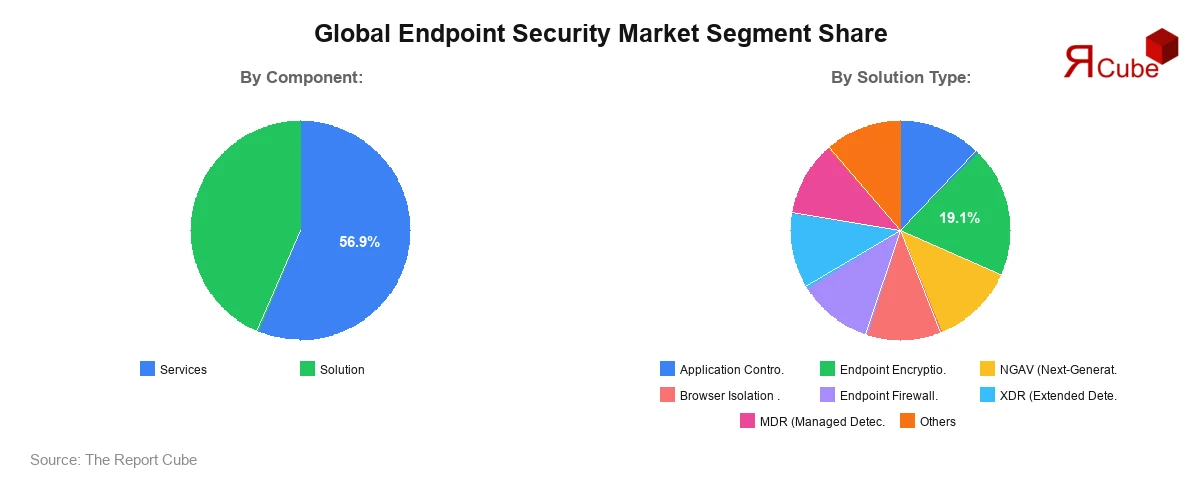
The Services segment accounted for approximately 56.9% of the Global Endpoint Security Market in 2026 and continues to lead the industry as organizations increasingly outsource cybersecurity operations to specialized service providers. Growing cyber threats, expanding digital infrastructures, and limited availability of skilled cybersecurity professionals have encouraged enterprises to adopt managed detection and response (MDR), incident response, threat hunting, vulnerability assessment, and security consulting services. These offerings enable businesses to strengthen endpoint visibility, improve incident response times, and maintain compliance with evolving cybersecurity regulations while reducing operational complexity.
Demand for endpoint security services is particularly strong among banking, healthcare, government, manufacturing, and critical infrastructure organizations that require around-the-clock monitoring of distributed endpoints. Service providers are integrating artificial intelligence, threat intelligence platforms, and security automation to deliver proactive protection against ransomware, phishing campaigns, zero-day attacks, and insider threats. As hybrid work environments and cloud adoption continue expanding, enterprises are expected to increase investments in managed endpoint security services that improve operational resilience while lowering the total cost of cybersecurity management.
By Solution Type:
- Application Control
- Endpoint Encryption
- NGAV (Next-Generation Antivirus)
- Browser Isolation and Browser Security
- Endpoint Firewall
- XDR (Extended Detection and Response)
- MDR (Managed Detection and Response)
- EPP (Endpoint Protection Platform)
- Device Control
- Patch and Vulnerability Management
- EDR (Endpoint Detection and Response)
- Mobile Threat Defense
- Others
Endpoint Detection and Response (EDR) held the largest share of nearly 19.1% in the Global Endpoint Security Market due to its ability to provide continuous endpoint monitoring, behavioral analytics, real-time threat detection, and automated incident response. Unlike traditional antivirus software, EDR platforms identify sophisticated attack techniques such as fileless malware, credential theft, ransomware, and advanced persistent threats by analyzing endpoint behavior rather than relying solely on known malware signatures. This capability has made EDR a critical component of modern enterprise cybersecurity strategies.
Large enterprises across financial services, healthcare, retail, manufacturing, and information technology sectors are increasingly integrating EDR solutions with Security Information and Event Management (SIEM), Extended Detection and Response (XDR), and Security Orchestration, Automation, and Response (SOAR) platforms to improve security operations. Vendors are also enhancing EDR capabilities with AI-powered analytics, cloud-native deployment models, and automated threat investigation to reduce response times and improve security efficiency. These advancements continue to strengthen the demand for EDR solutions as organizations seek comprehensive endpoint protection against evolving cyber risks.
Regional Projection of Global Endpoint Security Industry
- North America
- Europe
- Asia Pacific
- Middle East and Africa
- South America
North America accounted for approximately 39.7% of the Global Endpoint Security Market, maintaining its leadership position due to advanced digital infrastructure, high enterprise cybersecurity spending, and the presence of several leading cybersecurity technology providers. Organizations across the United States and Canada continue investing in endpoint protection platforms, endpoint detection and response, extended detection and response, and managed security services to defend against increasingly sophisticated ransomware attacks, supply chain threats, and identity-based cyber risks. Strong regulatory frameworks governing data privacy and critical infrastructure protection further support sustained market growth across the region.
Technology innovation remains a defining characteristic of the North American market, with enterprises rapidly adopting Zero Trust architecture, cloud-native security platforms, artificial intelligence, and automated threat intelligence solutions. Financial institutions, healthcare providers, government agencies, and technology companies are among the largest investors in advanced endpoint security technologies as they modernize security operations and protect expanding hybrid work environments. Continued investment in digital transformation, cloud migration, and cybersecurity resilience is expected to reinforce North America's dominant position throughout the forecast period.
Need insights for a specific region within this market?
Request Regional DataGlobal Endpoint Security Market Regional Analysis
The endpoint security market shows varied growth patterns across regions, driven by threat exposure, regulation, and digitalization.
| Region | Demand Level | Key Areas | System Dominance | Core Demand Logic | Growth Nature |
|---|---|---|---|---|---|
| North America | Very High | U.S., Canada tech hubs | EDR, XDR, MDR platforms | High breach rates & strict laws | Mature, upgrade‑driven growth |
| Europe | High | UK, Germany, France | EDR with compliance tooling | GDPR and NIS‑based mandates | Regulation‑led steady growth |
| Asia Pacific | Very High | China, India, ASEAN cities | Cloud‑native EDR & suites | Rapid digitalization & BYOD | Fastest‑growing expansion |
| Middle East & Africa | Medium | GCC capitals, South Africa | Managed endpoint services | Critical infrastructure focus | Emerging, project‑led growth |
| South America | Medium | Brazil, Mexico, Chile | SMB‑centric endpoint suites | Ransomware & cloud adoption | Cost‑sensitive incremental growth |
Government Initiatives & Policies
- United States Cyber Trust Mark Program (2025): The U.S. government continued expanding the Cyber Trust Mark initiative to improve the cybersecurity of connected devices through standardized security requirements, encouraging stronger endpoint protection across enterprise and consumer IoT ecosystems.
- European Union Cyber Solidarity Act Implementation (2025): The European Union advanced the implementation of the Cyber Solidarity Act to strengthen cyber threat detection, coordinated incident response, and security preparedness across member states, driving higher investments in endpoint security technologies for critical infrastructure.
Global Endpoint Security Industry Recent Developments
- 2026: CrowdStrike Holdings, Inc. agreed to acquire Seraphic Security, expanding its browser runtime security capabilities. The acquisition strengthens protection for SaaS applications, enterprise browsers, and remote workforces while enhancing unified endpoint security across hybrid IT environments.
- 2025: SentinelOne, Inc. announced an agreement to acquire Prompt Security to strengthen generative AI security, AI agent protection, and data leakage prevention. The acquisition expands the company's AI-native cybersecurity platform and addresses emerging enterprise security risks.
- 2025: SentinelOne, Inc. also announced an agreement to acquire Observo AI, enhancing its real-time telemetry pipeline capabilities. The integration improves large-scale security data collection, AI-powered analytics, and faster threat investigation across enterprise security operations.
- 2025: Palo Alto Networks, Inc. announced a US$25 billion agreement to acquire CyberArk. The acquisition significantly strengthens identity security capabilities while expanding the company's integrated cybersecurity platform across endpoint, cloud, network, and identity protection.
Why Choose This Report?
- Provides a comprehensive overview of the overall market analysis, encompassing key trends, consumer behavior analysis, and risk assessment to support strategic decision-making.
- Provides accurate, up-to-date insights into market size, segmentation, and emerging opportunities, helping to minimize risk while capitalizing on growth.
- Gives deep understanding of target audience preferences, investment habits, and communication channels for enhanced product development and marketing effectiveness.
- Delivers competitive analysis and benchmarking, uncovering the strengths and weaknesses of market competitors to guide strategic planning.
- Consolidates comprehensive market intelligence, reducing research time and streamlining business planning efforts.
- Facilitates customized market segmentation and risk mitigation strategies that align with business objectives.
- Aids in identifying both market challenges and untapped opportunities within the industry to drive long-term business growth.
- Provides valuable information based on actual customer demand patterns, technology adoption trends, and industry developments.
Table of Contents
- Introduction
- Objective of the Study
- Product and Category Definition
- Market Segmentation
- Study Variables
- Research Methodology
- Secondary Data Points
- Breakdown of Secondary Sources
- Primary Data Points
- Breakdown of Primary Interviews
- Secondary Data Points
- Executive Summary
- Market Dynamics
- Emerging Opportunities
- Adoption Trends
- Demand Drivers
- Disruption Analysis (Challenges)
- Industry Analysis & Strategic Insights
- Supply/Value Chain Analysis
- Pricing Analysis
- Go-To-Market (GTM) Strategy
- BCG Matrix
- Recent Trends and Developments
- Import and Export Analysis
- Regulatory and Policy Landscape
- Region-wise Policies
- Government Initiatives
- Global Endpoint Security Market Overview and Forecast Analysis (2021-2034)
- Market Size, By Value, By Growth Rate (CAGR/USD Billion)
- Market Share, By Component
- Services
- Solution
- Market Share, By Solution Type
- Application Control
- Endpoint Encryption
- NGAV (Next-Generation Antivirus)
- Browser Isolation and Browser Security
- Endpoint Firewall
- XDR (Extended Detection and Response)
- MDR (Managed Detection and Response)
- EPP (Endpoint Protection Platform)
- Device Control
- Patch and Vulnerability Management
- EDR (Endpoint Detection and Response)
- Mobile Threat Defense
- Others
- Market Share, By Deployment Mode
- Hybrid
- Cloud
- On Premises
- Market Share, By Endpoint Type
- Servers
- IoT Endpoints
- Workstations and Laptops
- POS Terminals
- Virtual Desktops
- Mobile Devices
- OT Endpoints
- Others
- Market Share, By End-User
- Government and Public Sector
- Manufacturing
- Transportation and Logistics
- Healthcare and Life Sciences
- Retail and E-Commerce
- IT and Telecom
- Energy and Utilities
- BFSI
- Education
- Others
- Market Share, By Region
- North America
- Europe
- Asia Pacific
- Middle East and Africa
- South America
- Market Share, By Company
- Revenue Shares and Analysis
- Competitive Landscape
- North America Endpoint Security Market Overview and Forecast Analysis (2021-2034)
- Market Size, By Value, By Growth Rate (CAGR/USD Billion/Million)
- Market Share, By Component
- Market Share, By Solution Type
- Market Share, By Deployment Mode
- Market Share, By Endpoint Type
- Market Share, By End-User
- Market Share, By Country
- United States
- Canada
- Mexico
- Rest of North America
- Europe Endpoint Security Market Overview and Forecast Analysis (2021-2034)
- Market Size, By Value, By Growth Rate (CAGR/USD Billion/Million)
- Market Share, By Component
- Market Share, By Solution Type
- Market Share, By Deployment Mode
- Market Share, By Endpoint Type
- Market Share, By End-User
- Market Share, By Country
- Germany
- United Kingdom
- France
- Italy
- Spain
- Netherlands
- Russia
- Poland
- Belgium
- Sweden
- Rest of Europe
- Asia Pacific Endpoint Security Market Overview and Forecast Analysis (2021-2034)
- Market Size, By Value, By Growth Rate (CAGR/USD Billion/Million)
- Market Share, By Component
- Market Share, By Solution Type
- Market Share, By Deployment Mode
- Market Share, By Endpoint Type
- Market Share, By End-User
- Market Share, By Country
- China
- India
- Japan
- South Korea
- Australia
- Indonesia
- Thailand
- Malaysia
- Vietnam
- Philippines
- Singapore
- New Zealand
- Rest of Asia Pacific
- Middle East and Africa Endpoint Security Market Overview and Forecast Analysis (2021-2034)
- Market Size, By Value, By Growth Rate (CAGR/USD Billion/Million)
- Market Share, By Component
- Market Share, By Solution Type
- Market Share, By Deployment Mode
- Market Share, By Endpoint Type
- Market Share, By End-User
- Market Share, By Country
- Saudi Arabia
- United Arab Emirates
- South Africa
- Egypt
- Nigeria
- Morocco
- Turkey
- Rest of Middle East and Africa
- South America Endpoint Security Market Overview and Forecast Analysis (2021-2034)
- Market Size, By Value, By Growth Rate (CAGR/USD Billion/Million)
- Market Share, By Component
- Market Share, By Solution Type
- Market Share, By Deployment Mode
- Market Share, By Endpoint Type
- Market Share, By End-User
- Market Share, By Country
- Brazil
- Argentina
- Chile
- Colombia
- Peru
- Rest of South America
- Competitive Analysis, 2026
- Market Share of Key Players
- Competitive Mapping for Each Component and Solution Type, and Companies Operating Regionally
- North America Endpoint Security Companies Share and Competitive Analysis, 2026
- Europe Endpoint Security Companies Share and Competitive Analysis, 2026
- Asia Pacific Endpoint Security Companies Share and Competitive Analysis, 2026
- Middle East and Africa Endpoint Security Companies Share and Competitive Analysis, 2026
- South America Endpoint Security Companies Share and Competitive Analysis, 2026
- Company Profile (Partial List)
- Trend Micro Incorporated
- Company Overview
- Product Portfolio
- Strategic Alliances/Partnerships
- Recent Developments
- Bitdefender SRL
- Company Overview
- Product Portfolio
- Strategic Alliances/Partnerships
- Recent Developments
- Trellix
- Company Overview
- Product Portfolio
- Strategic Alliances/Partnerships
- Recent Developments
- CrowdStrike Holdings, Inc.
- Company Overview
- Product Portfolio
- Strategic Alliances/Partnerships
- Recent Developments
- Microsoft Corporation
- Company Overview
- Product Portfolio
- Strategic Alliances/Partnerships
- Recent Developments
- VMware LLC
- Company Overview
- Product Portfolio
- Strategic Alliances/Partnerships
- Recent Developments
- Cisco Systems, Inc.
- Company Overview
- Product Portfolio
- Strategic Alliances/Partnerships
- Recent Developments
- Fortinet, Inc.
- Company Overview
- Product Portfolio
- Strategic Alliances/Partnerships
- Recent Developments
- Kaspersky Lab
- Company Overview
- Product Portfolio
- Strategic Alliances/Partnerships
- Recent Developments
- ESET, spol. s r.o.
- Company Overview
- Product Portfolio
- Strategic Alliances/Partnerships
- Recent Developments
- BlackBerry Limited
- Company Overview
- Product Portfolio
- Strategic Alliances/Partnerships
- Recent Developments
- WatchGuard Technologies, Inc.
- Company Overview
- Product Portfolio
- Strategic Alliances/Partnerships
- Recent Developments
- SentinelOne, Inc.
- Company Overview
- Product Portfolio
- Strategic Alliances/Partnerships
- Recent Developments
- Malwarebytes Inc.
- Company Overview
- Product Portfolio
- Strategic Alliances/Partnerships
- Recent Developments
- Broadcom Inc.
- Company Overview
- Product Portfolio
- Strategic Alliances/Partnerships
- Recent Developments
- Check Point Software Technologies Ltd.
- Company Overview
- Product Portfolio
- Strategic Alliances/Partnerships
- Recent Developments
- Sophos Limited
- Company Overview
- Product Portfolio
- Strategic Alliances/Partnerships
- Recent Developments
- Palo Alto Networks, Inc.
- Company Overview
- Product Portfolio
- Strategic Alliances/Partnerships
- Recent Developments
- Tanium Inc.
- Company Overview
- Product Portfolio
- Strategic Alliances/Partnerships
- Recent Developments
- WithSecure Corporation
- Company Overview
- Product Portfolio
- Strategic Alliances/Partnerships
- Recent Developments
- Others (Partial List)
- Trend Micro Incorporated
- Contact Us and Disclaimer
Top Key Players & Market Share Outlook
- Trend Micro Incorporated
- Bitdefender SRL
- Trellix
- CrowdStrike Holdings, Inc.
- Microsoft Corporation
- VMware LLC
- Cisco Systems, Inc.
- Fortinet, Inc.
- Kaspersky Lab
- ESET, spol. s r.o.
- BlackBerry Limited
- WatchGuard Technologies, Inc.
- SentinelOne, Inc.
- Malwarebytes Inc.
- Broadcom Inc.
- Check Point Software Technologies Ltd.
- Sophos Limited
- Palo Alto Networks, Inc.
- Tanium Inc.
- WithSecure Corporation
Frequently Asked Questions






