




Build Your Custom Market Intelligence Report
Customize Your ReportGlobal Network Security Market Key Highlights
By Component:
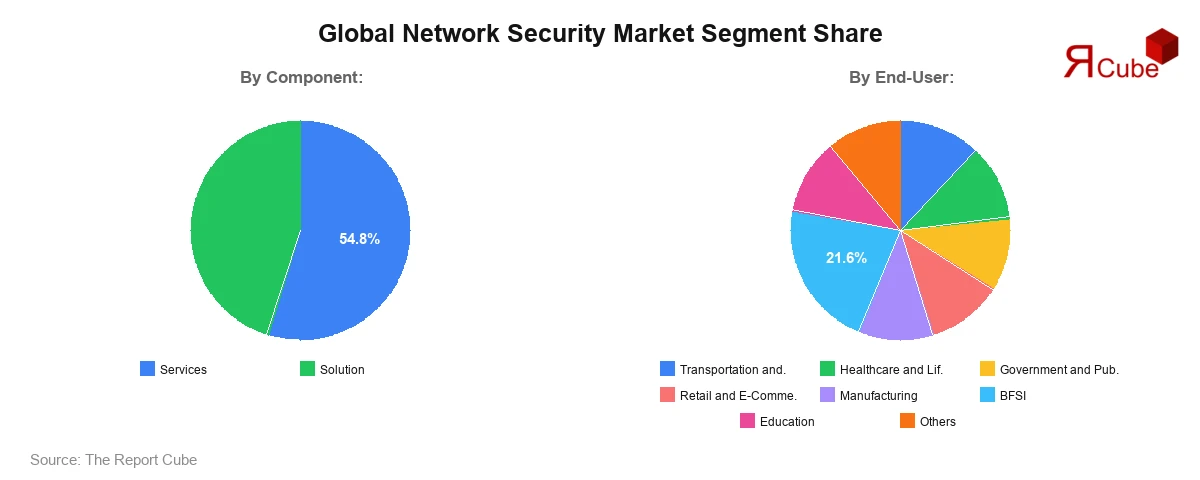
Services segment leads the market with approximately 54.8% share.
By End-User:
BFSI segment dominates the market with nearly 21.6% of total revenue.
Regional Outlook:
North America dominates the Global Network Security Market with an estimated 38.7% market share.
Global Network Security Market Insights & Analysis
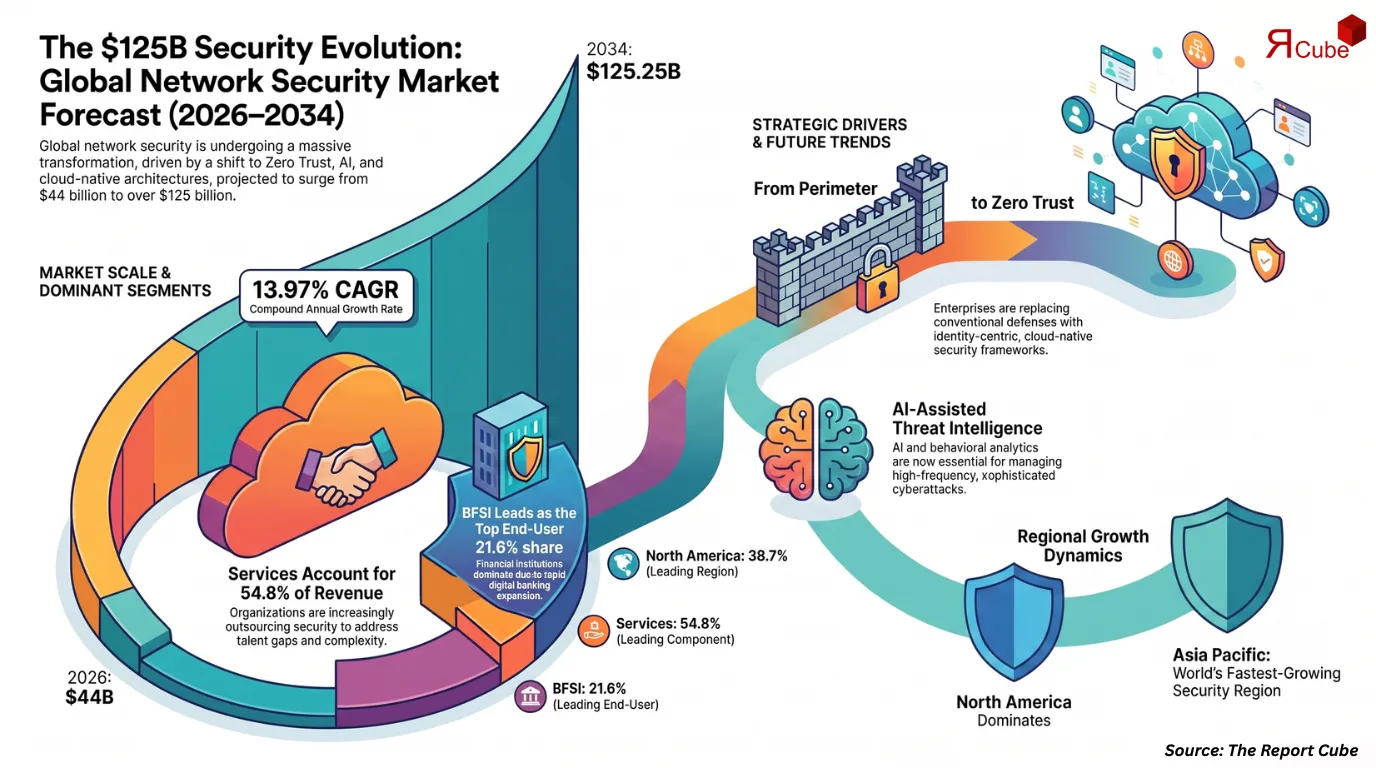
The Global Network Security Market is anticipated to register a CAGR of around 13.97% during the forecast period 2026-2034. The market size is valued at USD 44.0 billion in 2026 and is projected to reach USD 125.25 billion by 2034. Growth is being shaped by the rapid modernization of enterprise IT environments, where organizations are securing hybrid cloud infrastructure, remote work ecosystems, and increasingly connected operational networks. Cyberattacks targeting critical infrastructure, financial institutions, healthcare systems, and manufacturing facilities continue to rise in both frequency and sophistication, prompting enterprises to replace conventional perimeter-based defenses with integrated security architectures. Investments are increasingly directed toward Zero Trust Network Access (ZTNA), Secure Access Service Edge (SASE), Next-Generation Firewalls (NGFW), Network Detection and Response (NDR), and AI-assisted threat intelligence platforms that improve visibility across distributed enterprise environments while reducing incident response time.
Industry investment remains robust as organizations prioritize cyber resilience alongside digital transformation initiatives. Large enterprises are consolidating multiple security products into unified platforms capable of protecting cloud workloads, branch networks, industrial systems, and remote users through centralized policy management. Governments across North America, Europe, and Asia Pacific continue strengthening cybersecurity regulations and critical infrastructure protection programs, encouraging public and private organizations to increase security spending. Technology vendors are responding with cloud-delivered security services, automated threat hunting, behavioral analytics, and real-time network monitoring capabilities that simplify security operations while addressing the shortage of cybersecurity professionals. As enterprises continue expanding AI-enabled business operations, 5G connectivity, Internet of Things deployments, and multi-cloud environments, demand for scalable and intelligent network security services is expected to accelerate steadily throughout the forecast period.
Global Network Security Market Impact Analysis
| Factor | Type | Specific Impact on Market | Magnitude | Business Implication |
|---|---|---|---|---|
| Surge in Sophisticated Cyberattacks | Market | Escalating breach frequency drives rapid uptake of advanced defenses | High | Supports premium pricing for next gen firewalls, IDS and SASE suites |
| Enterprise Cloud and Remote Work Adoption | Technological | Cloud migration and hybrid work expand attack surface across networks | High | Boosts demand for cloud native security, ZTNA and secure access tools |
| Stringent Data Protection Regulations | Regulatory | Privacy laws force continuous upgrades to compliance ready security | High | Creates recurring projects for audits, policy automation and reporting tools |
| Integration of AI and Analytics | Technological | AI based detection improves speed and accuracy of threat response | Medium | Enables differentiated offerings in behavior analytics and automated SOC |
| Complexity of Security Stacks | Environmental | Fragmented tools increase integration effort and management burden | Medium | Drives interest in consolidated platforms and managed security services |
| Shortage of Skilled Cyber Professionals | Competitive | Talent gaps limit enterprises’ ability to operate solutions effectively | Medium | Supports growth of MSSPs, automation and outcome based service models |
| Macroeconomic and Budget Constraints | Market | Economic uncertainty delays hardware refresh and large projects | Medium | Accelerates shift to subscription models and scalable cloud delivery |
Global Network Security Market Dynamics
Key Driver: Escalating Cyber Threats Are Accelerating Enterprise Security Modernization
Organizations are experiencing an unprecedented increase in ransomware attacks, credential theft, supply chain compromises, distributed denial-of-service attacks, and advanced persistent threats that target increasingly interconnected business environments. Digital transformation has expanded enterprise attack surfaces through cloud computing, remote work, Internet of Things devices, and third-party integrations, making traditional network security models insufficient for modern risk management. As a result, enterprises across banking, healthcare, manufacturing, government, and telecommunications are strengthening investments in advanced firewall technologies, network detection and response platforms, intrusion prevention systems, secure web gateways, and Zero Trust security frameworks to improve threat visibility and minimize operational disruption.
Board-level attention toward cybersecurity has also increased as cyber incidents create financial losses, regulatory penalties, reputational damage, and operational downtime. Regulatory requirements governing financial data, healthcare information, and critical infrastructure continue to encourage organizations to adopt continuous network monitoring, automated threat intelligence, identity-centric access controls, and comprehensive incident response capabilities. These factors are creating sustained demand for both network security solutions and managed network security services across organizations of all sizes.
Industry Trend: Cloud-Native Security and Zero Trust Frameworks Are Becoming Enterprise Standards
Enterprise security strategies are rapidly evolving from perimeter-focused protection toward identity-driven and cloud-native security architectures capable of securing users, applications, devices, and workloads regardless of their physical location. Organizations migrating business applications to public and private cloud platforms increasingly require integrated security models that combine Secure Access Service Edge (SASE), Security Service Edge (SSE), Zero Trust Network Access, DNS security, and secure web gateways into unified platforms. This architectural shift enables organizations to simplify policy enforcement while maintaining consistent protection across hybrid environments.
Technology providers are continuously enhancing network security platforms through artificial intelligence, machine learning, behavioral analytics, and automated orchestration capabilities that improve detection accuracy while reducing manual intervention. Security operations centers increasingly rely on AI-assisted threat prioritization, automated investigation workflows, and predictive risk analysis to manage growing alert volumes. Subscription-based security platforms and managed detection services are also becoming preferred deployment models because they enable enterprises to strengthen cybersecurity without significantly increasing infrastructure complexity or operational overhead.
Book your FREE 30-minute expert consultation today
Contact UsMajor Challenge: Security Skill Gaps and Multi-Vendor Infrastructure Increase Operational Complexity
Although cybersecurity investment continues to increase worldwide, many organizations face persistent challenges in effectively managing increasingly sophisticated security environments. Modern enterprise networks often combine legacy infrastructure, cloud workloads, operational technology, remote work environments, SaaS applications, and Internet of Things devices, creating highly complex ecosystems that require continuous monitoring. Limited availability of experienced cybersecurity professionals makes it difficult for many organizations to maintain round-the-clock threat detection, vulnerability management, and incident response capabilities.
Operational complexity also increases when enterprises deploy security products from multiple vendors that operate through separate management interfaces and inconsistent policy frameworks. Integration challenges frequently reduce visibility across the network while increasing administrative workloads and overall ownership costs. Small and medium-sized businesses are particularly affected because budget limitations restrict investments in advanced security technologies and highly skilled personnel. These operational constraints continue to influence purchasing decisions and encourage greater adoption of unified network security platforms and managed security services.
Opportunity: Managed Network Security Services and Intelligent Threat Detection Continue to Gain Momentum
Growing demand for outsourced cybersecurity operations presents significant long-term opportunities for network security service providers. Organizations across mid-sized and large enterprises are increasingly partnering with managed security service providers (MSSPs) to strengthen cyber resilience without expanding internal security teams. Services including continuous security monitoring, managed detection and response, digital forensics, vulnerability assessments, compliance management, and incident remediation have become critical components of enterprise cybersecurity strategies as threat activity continues to evolve.
Continuous advances in artificial intelligence, predictive analytics, and automation are further expanding commercial opportunities across the Global Network Security Market. AI-enabled security platforms can identify anomalous network behavior, prioritize high-risk threats, automate investigation workflows, and accelerate response times with greater operational efficiency. Rapid deployment of 5G infrastructure, industrial automation, connected healthcare systems, smart cities, and cloud-native enterprise applications will continue creating sustained demand for intelligent network security services capable of protecting highly distributed digital environments throughout the forecast period.
Global Network Security Market Segment-wise Analysis
By Component:
- Services
- Solution
The Services segment held the largest share of the Global Network Security Market, accounting for approximately 54.8% of total revenue in 2026. Organizations across industries are increasingly outsourcing cybersecurity functions to specialized service providers to strengthen network visibility, accelerate incident response, and ensure regulatory compliance. Growing cyber risks, combined with the shortage of experienced cybersecurity professionals, have significantly increased demand for managed security services, consulting, vulnerability assessments, penetration testing, and security operations center (SOC) services. Enterprises are also seeking continuous monitoring capabilities that enable early threat detection and faster remediation across hybrid IT environments.
Demand for network security services continues to expand as businesses modernize digital infrastructure through cloud migration, hybrid workplaces, and connected enterprise networks. Financial institutions, healthcare providers, manufacturers, government agencies, and telecom operators increasingly rely on managed detection and response (MDR), threat intelligence, and compliance management services to minimize operational disruptions caused by sophisticated cyberattacks. Service providers are also integrating artificial intelligence, automation, and real-time analytics into their offerings, enabling organizations to improve operational efficiency while reducing overall cybersecurity management costs. These factors are expected to support the continued leadership of the Services segment throughout the forecast period.
By End-User:
- Transportation and Logistics
- Healthcare and Life Sciences
- Government and Public Sector
- Retail and E-Commerce
- Manufacturing
- BFSI
- Education
- IT and Telecom
- Energy and Utilities
- Others
The BFSI segment accounted for nearly 21.6% of the Global Network Security Market revenue in 2026 and remains the largest end-user owing to the rapid expansion of digital banking, online payment platforms, and fintech services. Financial institutions process millions of sensitive transactions daily, making them frequent targets for ransomware, phishing campaigns, credential theft, and advanced fraud schemes. As cyber risks continue to evolve, banks and insurance companies are investing heavily in Zero Trust Network Access (ZTNA), next-generation firewalls, secure web gateways, identity and access management, and AI-powered threat detection platforms to strengthen their security posture.
Regulatory frameworks covering financial data protection, operational resilience, anti-money laundering, and customer privacy are further driving long-term cybersecurity investments within the BFSI sector. The increasing adoption of open banking, API-based financial services, mobile banking applications, and cloud-native financial platforms has expanded network complexity, requiring continuous monitoring and advanced security controls. Leading financial institutions are also partnering with managed security service providers to improve cyber resilience, enhance incident response capabilities, and maintain uninterrupted digital banking operations, ensuring the BFSI segment continues to generate substantial market demand.
Regional Projection of Global Network Security Industry
- North America
- Europe
- Asia Pacific
- Middle East and Africa
- South America
North America dominated the Global Network Security Market with an estimated 38.7% revenue share in 2026, supported by advanced digital infrastructure, widespread cloud adoption, and one of the world's highest enterprise cybersecurity spending levels. The United States remains the primary contributor due to continuous investments in cybersecurity modernization across financial services, healthcare, defense, manufacturing, and critical infrastructure sectors. The region is home to several leading cybersecurity companies that continuously introduce advanced network protection technologies, accelerating enterprise adoption of Zero Trust architectures, SASE platforms, Network Detection and Response (NDR), and AI-driven security analytics.
Market expansion across North America is further supported by stringent cybersecurity regulations, increasing ransomware incidents, and ongoing government initiatives to strengthen national cyber resilience. Organizations continue replacing legacy security infrastructure with integrated cloud-native security platforms capable of protecting hybrid workforces, distributed enterprise networks, and multi-cloud environments. Growing investments in 5G infrastructure, industrial automation, Internet of Things ecosystems, and digital public services are creating additional opportunities for network security vendors. These long-term technology investments, combined with strong public-private cybersecurity collaboration, are expected to help North America maintain its leadership position throughout the forecast period.
Need insights for a specific region within this market?
Request Regional DataRegional Analysis of Global Network Security Market
The global network security market shows varied growth patterns across regions driven by threat intensity, regulation, and digitalization.
| Region | Demand Level | Key Areas | System Dominance | Core Demand Logic | Growth Nature |
|---|---|---|---|---|---|
| North America | Very High | US, Canada | Next‑gen firewalls, Zero Trust | APTs, AI‑driven attacks, cloud traffic | Mature, upgrade‑led growth |
| Europe | High | Germany, UK, France | Secure gateways, IDS/IPS | GDPR, NIS2, tight compliance needs | Regulation‑driven expansion |
| Asia Pacific | Very High | China, India, Japan | Cloud security, SD‑WAN, SOC‑as‑a‑service | Rapid digitization, smart cities, IoT | Fastest‑growing region |
| Middle East & Africa | Medium | GCC, South Africa | Managed security, perimeter defense | National projects, oil & gas protection | Project‑led, stepwise growth |
| South America | Medium | Brazil, Mexico, Chile | Unified threat management, VPN | Banking fraud, cloud adoption, SMEs | Gradual, catch‑up growth |
Government Initiatives & Policies
- U.S. National Cybersecurity Strategy Implementation (2025): The U.S. government continued implementing the National Cybersecurity Strategy through expanded cybersecurity investments, stronger critical infrastructure protection, secure-by-design software initiatives, and enhanced public-private collaboration to improve national cyber resilience.
- European Union NIS2 Directive Implementation (2025-2026): European Union member states continued implementing the NIS2 Directive, requiring essential and important entities to strengthen network security, incident reporting, cyber risk management, and supply chain security across critical sectors.
Global Network Security Industry Recent Developments
- 2026: Palo Alto Networks, Inc. released security updates addressing a PAN-OS vulnerability affecting GlobalProtect Gateway and Portal configurations. The update highlighted the growing importance of rapid vulnerability remediation, proactive patch management, and continuous protection of enterprise network edge infrastructure against emerging cyber threats.
- 2026: Fortinet, Inc. issued security patches following reports of active exploitation targeting FortiGate firewall vulnerabilities. The development increased enterprise focus on timely firmware updates, credential rotation, firewall configuration reviews, and stronger network edge security practices to reduce organizational cyber risk.
Why Choose This Report?
- Provides a comprehensive overview of the overall market analysis, encompassing key trends, consumer behavior analysis, and risk assessment to support strategic decision-making.
- Provides accurate, up-to-date insights into market size, segmentation, and emerging opportunities, helping to minimize risk while capitalizing on growth.
- Gives deep understanding of target audience preferences, investment habits, and communication channels for enhanced product development and marketing effectiveness.
- Delivers competitive analysis and benchmarking, uncovering the strengths and weaknesses of market competitors to guide business strategies.
- Consolidates comprehensive market intelligence, reducing research efforts and streamlining strategic planning.
- Facilitates customized market segmentation and risk mitigation strategies that align with organizational business objectives.
- Aids in identifying both market challenges and untapped opportunities within the industry to drive long-term business growth.
- Provides valuable information based on actual customer data, industry developments, and evolving search trends.
Table of Contents
- Introduction
- Objective of the Study
- Product and Category Definition
- Market Segmentation
- Study Variables
- Research Methodology
- Secondary Data Points
- Breakdown of Secondary Sources
- Primary Data Points
- Breakdown of Primary Interviews
- Secondary Data Points
- Executive Summary
- Market Dynamics
- Emerging Opportunities
- Adoption Trends
- Demand Drivers
- Disruption Analysis (Challenges)
- Industry Analysis & Strategic Insights
- Supply/Value Chain Analysis
- Pricing Analysis
- Go-To-Market (GTM) Strategy
- BCG Matrix
- Recent Trends and Developments
- Import and Export Analysis
- Regulatory and Policy Landscape
- Region-wise Policies
- Government Initiatives
- Global Network Security Market Overview and Forecast Analysis (2021-2034)
- Market Size, By Value, By Growth Rate (CAGR/USD Billion)
- Market Share, By Component
- Services
- Solution
- Market Share, By Solution Type
- NDR (Network Detection and Response)
- Firewall
- DNS Security
- ZTNA (Zero Trust Network Access)
- SD-WAN Security
- VPN (Virtual Private Network)
- NGFW (Next-Generation Firewall)
- DDoS Protection
- SASE (Secure Access Service Edge)
- Secure Web Gateway
- Network Sandbox
- IPS (Intrusion Prevention System)
- SSE (Security Service Edge)
- NAC (Network Access Control)
- IDS (Intrusion Detection System)
- Others
- Market Share, By Deployment Mode
- Hybrid
- On Premises
- Cloud
- Market Share, By Network Type
- Industrial Network
- Cloud Network
- Enterprise Network
- Remote Access Network
- Telecom Network
- Branch Network
- Data Center Network
- Others
- Market Share, By End-User
- Transportation and Logistics
- Healthcare and Life Sciences
- Government and Public Sector
- Retail and E-Commerce
- Manufacturing
- BFSI
- Education
- IT and Telecom
- Energy and Utilities
- Others
- Market Share, By Region
- North America
- Europe
- Asia Pacific
- Middle East and Africa
- South America
- Market Share, By Company
- Revenue Shares and Analysis
- Competitive Landscape
- North America Network Security Market Overview and Forecast Analysis (2021-2034)
- Market Size, By Value, By Growth Rate (CAGR/USD Billion/Million)
- Market Share, By Component
- Market Share, By Solution Type
- Market Share, By Deployment Mode
- Market Share, By Network Type
- Market Share, By End-User
- Market Share, By Country
- United States
- Canada
- Mexico
- Rest of North America
- Europe Network Security Market Overview and Forecast Analysis (2021-2034)
- Market Size, By Value, By Growth Rate (CAGR/USD Billion/Million)
- Market Share, By Component
- Market Share, By Solution Type
- Market Share, By Deployment Mode
- Market Share, By Network Type
- Market Share, By End-User
- Market Share, By Country
- Germany
- United Kingdom
- France
- Italy
- Spain
- Netherlands
- Russia
- Poland
- Belgium
- Sweden
- Rest of Europe
- Asia Pacific Network Security Market Overview and Forecast Analysis (2021-2034)
- Market Size, By Value, By Growth Rate (CAGR/USD Billion/Million)
- Market Share, By Component
- Market Share, By Solution Type
- Market Share, By Deployment Mode
- Market Share, By Network Type
- Market Share, By End-User
- Market Share, By Country
- China
- India
- Japan
- South Korea
- Australia
- Indonesia
- Thailand
- Malaysia
- Vietnam
- Philippines
- Singapore
- New Zealand
- Rest of Asia Pacific
- Middle East and Africa Network Security Market Overview and Forecast Analysis (2021-2034)
- Market Size, By Value, By Growth Rate (CAGR/USD Billion/Million)
- Market Share, By Component
- Market Share, By Solution Type
- Market Share, By Deployment Mode
- Market Share, By Network Type
- Market Share, By End-User
- Market Share, By Country
- Saudi Arabia
- United Arab Emirates
- South Africa
- Egypt
- Nigeria
- Morocco
- Turkey
- Rest of Middle East and Africa
- South America Network Security Market Overview and Forecast Analysis (2021-2034)
- Market Size, By Value, By Growth Rate (CAGR/USD Billion/Million)
- Market Share, By Component
- Market Share, By Solution Type
- Market Share, By Deployment Mode
- Market Share, By Network Type
- Market Share, By End-User
- Market Share, By Country
- Brazil
- Argentina
- Chile
- Colombia
- Peru
- Rest of South America
- Competitive Analysis, 2026
- Market Share of Key Players
- Competitive Mapping for Each Segment and Companies Operating Regionally
- North America Network Security Companies Share and Competitive Analysis, 2026
- Europe Network Security Companies Share and Competitive Analysis, 2026
- Asia Pacific Network Security Companies Share and Competitive Analysis, 2026
- Middle East and Africa Network Security Companies Share and Competitive Analysis, 2026
- South America Network Security Companies Share and Competitive Analysis, 2026
- Company Profile (Partial List)
- Arista Networks, Inc.
- Company Overview
- Product Portfolio
- Strategic Alliances/Partnerships
- Recent Developments
- Juniper Networks, Inc.
- Company Overview
- Product Portfolio
- Strategic Alliances/Partnerships
- Recent Developments
- Trend Micro Incorporated
- Company Overview
- Product Portfolio
- Strategic Alliances/Partnerships
- Recent Developments
- Zscaler, Inc.
- Company Overview
- Product Portfolio
- Strategic Alliances/Partnerships
- Recent Developments
- Broadcom Inc.
- Company Overview
- Product Portfolio
- Strategic Alliances/Partnerships
- Recent Developments
- Cloudflare, Inc.
- Company Overview
- Product Portfolio
- Strategic Alliances/Partnerships
- Recent Developments
- Palo Alto Networks, Inc.
- Company Overview
- Product Portfolio
- Strategic Alliances/Partnerships
- Recent Developments
- Fortinet, Inc.
- Company Overview
- Product Portfolio
- Strategic Alliances/Partnerships
- Recent Developments
- F5, Inc.
- Company Overview
- Product Portfolio
- Strategic Alliances/Partnerships
- Recent Developments
- Cisco Systems, Inc.
- Company Overview
- Product Portfolio
- Strategic Alliances/Partnerships
- Recent Developments
- Hillstone Networks Co., Ltd.
- Company Overview
- Product Portfolio
- Strategic Alliances/Partnerships
- Recent Developments
- WatchGuard Technologies, Inc.
- Company Overview
- Product Portfolio
- Strategic Alliances/Partnerships
- Recent Developments
- Check Point Software Technologies Ltd.
- Company Overview
- Product Portfolio
- Strategic Alliances/Partnerships
- Recent Developments
- Trellix
- Company Overview
- Product Portfolio
- Strategic Alliances/Partnerships
- Recent Developments
- Huawei Technologies Co., Ltd.
- Company Overview
- Product Portfolio
- Strategic Alliances/Partnerships
- Recent Developments
- SonicWall Inc.
- Company Overview
- Product Portfolio
- Strategic Alliances/Partnerships
- Recent Developments
- Netskope, Inc.
- Company Overview
- Product Portfolio
- Strategic Alliances/Partnerships
- Recent Developments
- HPE Aruba Networking
- Company Overview
- Product Portfolio
- Strategic Alliances/Partnerships
- Recent Developments
- Akamai Technologies, Inc.
- Company Overview
- Product Portfolio
- Strategic Alliances/Partnerships
- Recent Developments
- Forcepoint LLC
- Company Overview
- Product Portfolio
- Strategic Alliances/Partnerships
- Recent Developments
- Others (Partial List)
- Arista Networks, Inc.
- Contact Us and Disclaimer
Top Key Players & Market Share Outlook
- Arista Networks, Inc.
- Juniper Networks, Inc.
- Trend Micro Incorporated
- Zscaler, Inc.
- Broadcom Inc.
- Cloudflare, Inc.
- Palo Alto Networks, Inc.
- Fortinet, Inc.
- F5, Inc.
- Cisco Systems, Inc.
- Hillstone Networks Co., Ltd.
- WatchGuard Technologies, Inc.
- Check Point Software Technologies Ltd.
- Trellix
- Huawei Technologies Co., Ltd.
- SonicWall Inc.
- Netskope, Inc.
- HPE Aruba Networking
- Akamai Technologies, Inc.
- Forcepoint LLC
Frequently Asked Questions