



Build Your Custom Market Intelligence Report
Customize Your ReportNorth America Environmental Control Systems Market Key Highlights
By System:
Air conditioning systems segment lead the market, accounting for nearly 34% of total revenue.
By Platform:
Commercial buildings segment dominate the market, contributing close to 39% share.
Regional Outlook:
The United States dominates the regional landscape with approximately 72% market share.
Government Initiatives & Policies
- U.S. Department of Energy Building Technologies Office: Promotes high-efficiency HVAC systems and smart building integration.
- Canada Green Buildings Strategy: Supports low-carbon building systems and advanced environmental controls.
North America Environmental Control Systems Market Insights & Analysis
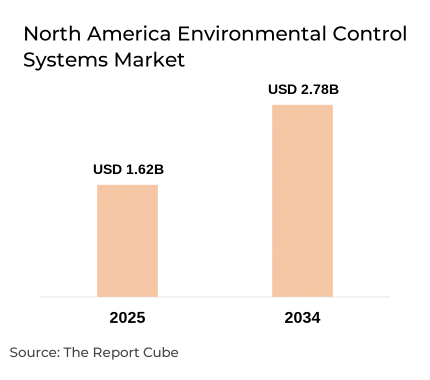
The North America Environmental Control Systems Market is anticipated to register a CAGR of 6.20% during 2026-2034. The market size was valued at USD 1.62 billion in 2025 and is projected to reach USD 2.78 billion by 2034. Environmental control systems play a central role in maintaining indoor air quality, thermal comfort, and energy efficiency across residential, commercial, and industrial environments.
Growth across North America is closely linked to rising energy efficiency standards, urbanization, and climate volatility. Buildings account for nearly 40% of regional energy consumption, pushing governments and property owners to invest in advanced HVAC, air filtration, and humidity control technologies. Investments in smart building infrastructure exceeded USD 18 billion in 2024 across the United States and Canada, reflecting strong demand for integrated environmental control platforms. Technological innovation is accelerating adoption, particularly through sensor-driven automation, AI-based building management systems, and green HVAC solutions that reduce carbon emissions. As sustainability becomes a core operational priority, environmental control systems are transitioning from mechanical utilities into digitally optimized infrastructure assets.
North America Environmental Control Systems Market Dynamics
Key Driver: Rising Focus on Energy Efficiency and Building Decarbonization
Growing emphasis on energy efficiency and carbon reduction is a primary driver shaping the North America Environmental Control Systems Market. Governments across the region are implementing stricter building energy codes, compelling both new construction and retrofit projects to adopt advanced environmental controls. In the United States, updated ASHRAE standards are estimated to reduce building energy consumption by nearly 10% when modern HVAC and control systems are deployed. Property owners are responding by investing in variable-speed HVAC units, demand-controlled ventilation, and intelligent control platforms. Commercial buildings, in particular, are prioritizing energy optimization as electricity costs rise and sustainability reporting becomes mandatory. Environmental control systems enable real-time monitoring and adaptive operation, delivering measurable reductions in energy waste while supporting regulatory compliance.
Book your FREE 30-minute expert consultation today
Contact UsIndustry Trends: Rapid Adoption of Smart and Integrated Building Systems
A major trend reshaping the market is the rapid adoption of smart environmental control systems that integrate HVAC, air quality, lighting, and energy management into unified platforms. Building owners increasingly favor centralized software-driven solutions that provide predictive maintenance, automated fault detection, and energy analytics. Smart systems can lower operational energy use by up to 25% through optimized scheduling and load balancing. Integration with IoT sensors allows real-time monitoring of temperature, humidity, and particulate matter, improving occupant comfort and health outcomes. The market is also seeing rising interest in AI-enabled controls that learn usage patterns and adapt environmental settings dynamically, supporting long-term efficiency gains.
Major Challenge: High Installation Costs and Retrofit Complexity
High upfront costs associated with advanced environmental control systems present a significant challenge, particularly for retrofit projects. Upgrading legacy buildings often requires infrastructure modifications, system integration, and skilled labor, increasing total project costs by 20-30%. Small and mid-sized property owners may delay adoption due to budget constraints and uncertain payback timelines. Additionally, interoperability issues between old mechanical equipment and modern digital platforms complicate system deployment. These technical and financial barriers slow adoption in older residential and commercial structures, especially outside major metropolitan areas.
Opportunity: Expansion of Green and Hybrid Environmental Control Technologies
The transition toward green and hybrid environmental control systems presents a strong growth opportunity. Demand for low-emission HVAC, renewable-powered heating systems, and advanced air purification is accelerating as organizations pursue sustainability targets. Hybrid systems that combine conventional HVAC with renewable energy sources can reduce building emissions by nearly 40%. Healthcare facilities and data centers are emerging as high-growth segments, driven by strict air quality and temperature requirements. Government incentives for green construction and retrofits further strengthen the commercial case for advanced environmental control investments across North America.
North America Environmental Control Systems Market Segment-wise Analysis
By System:
- Ventilation Systems
- Air Conditioning Systems
- Heating Systems
- Air Filtration Systems
- Humidity Control Systems
- Integrated Building Systems
Air conditioning systems lead the market with approximately 34% share in 2025, driven by rising cooling demand and extended heatwave periods across North America. Increased adoption of energy-efficient chillers and variable refrigerant flow systems is strengthening this segment. Integration with smart thermostats and building management platforms further enhances performance and user control.
By Platform:
- Residential Buildings
- Commercial Buildings
- Industrial Facilities
- Healthcare Facilities
- Transportation Infrastructure
Commercial buildings dominate the platform segment, accounting for nearly 39% market share. Offices, retail centers, and mixed-use developments require large-scale environmental control solutions to meet comfort, safety, and regulatory standards. Continuous retrofitting of aging commercial infrastructure further supports sustained demand.
Regional Projection of North America Environmental Control Systems Industry
- United States
- Canada
- Mexico
The United States holds the dominant position in the regional market, contributing roughly 72% of total revenue. High construction activity, stringent energy regulations, and strong adoption of smart building technologies drive market leadership. Canada follows with steady growth supported by green building initiatives and public sector investments. Mexico is emerging as a growth market, fueled by industrial expansion and rising urban infrastructure development.
North America Environmental Control Systems Market Recent Developments
- November 2025: Johnson Controls announced it would showcase next-generation sustainable HVAC and integrated building technologies at HVACR World 2025, highlighting high-efficiency systems and smart controls designed to accelerate building decarbonization across North America.
- September 2025: Carrier launched field trials in North America for next-generation HVAC systems that integrate variable-speed heat pumps with home battery storage, improving grid resilience and reducing peak energy demand.
- September 2025: Trane Technologies introduced AI Control and the ARIA AI agent for commercial buildings, using advanced analytics to reduce energy waste and modernize aging building infrastructure.
- 2025: Honeywell emphasized its integrated smart building management platforms that connect HVAC, energy, and safety systems, enabling real-time optimization and improved occupant comfort across commercial properties.
Need insights for a specific region within this market?
Request Regional DataWhy Choose This Report?
- Provides a comprehensive overview of the overall market analysis, encompassing key trends, consumer behavior analysis, and risk assessment to support strategic decision-making.
- Provides accurate, up-to-date insights into market size, segmentation, and emerging opportunities, helping to minimize risk & capitalizing on growth.
- Gives deep understanding of target audience preferences, investment habits, and communication channels for enhanced product development & marketing effectiveness.
- Delivers competitive analysis & benchmarking, uncovering the strengths & weaknesses of market competitors to guide strategies.
- Consolidate comprehensive market intelligence, reducing reasoning & streamlining research efforts.
- Facilitates customized market segmentation & risk mitigation strategies, fine-tuned to the business objectives.
- Aids in identifying both market challenges & untapped opportunities within the industry to drive long-term business growth.
- Provides valuable information based on actual customer data & search trends.
Table of Contents
- Introduction
- Objective of the Study
- Product and Category Definition
- Market Segmentation
- Study Variables
- Research Methodology
- Secondary Data Points
- Breakdown of Secondary Sources
- Primary Data Points
- Breakdown of Primary Interviews
- Secondary Data Points
- Executive Summary
- Market Dynamics
- Drivers
- Challenges
- Opportunity Assessment
- Recent Trends and Developments
- Regulatory and Policy Landscape
- North America Environmental Control Systems Market Overview (2021-2034)
- Market Size, By Value (USD Billion)
- Market Share, By System
- Ventilation Systems
- Air Conditioning Systems
- Heating Systems
- Air Filtration Systems
- Humidity Control Systems
- Integrated Building Systems
- Market Share, By Platform
- Residential Buildings
- Commercial Buildings
- Industrial Facilities
- Healthcare Facilities
- Transportation Infrastructure
- Market Share, By Component
- Sensors
- Controllers
- Actuators
- Air Handling Units
- Filters
- Fans and Blowers
- Heat Exchangers
- Software Platforms
- Market Share, By End User
- Residential Users
- Commercial Users
- Industrial Users
- Healthcare Users
- Government and Public
- Others
- Market Share, By Product Type
- Heating Equipment
- Ventilation Equipment
- Air Conditioning Equipment
- Air Purification Equipment
- Water Treatment Equipment
- Noise Control Equipment
- Market Share, By Technology
- Conventional Systems
- Green Systems
- Smart Systems
- Hybrid Systems
- Market Share, By Application
- Indoor Air Quality
- Thermal Comfort
- Process Environment
- Cleanroom Environment
- Data Center Cooling
- Others
- Market Share, By Country
- United States
- Canada
- Mexico
- Market Share, By Company
- Revenue Shares and Analysis
- Competitive Landscape
- United States Environmental Control Systems Market
- Market Size, By Value (USD Billion/Million)
- Market Share, By System
- Market Share, By Platform
- Market Share, By Component
- Market Share, By End User
- Market Share, By Product Type
- Market Share, By Technology
- Market Share, By Application
- Canada Environmental Control Systems Market
- Market Size, By Value (USD Billion/Million)
- Market Share, By System
- Market Share, By Platform
- Market Share, By Component
- Market Share, By End User
- Market Share, By Product Type
- Market Share, By Technology
- Market Share, By Application
- Mexico Environmental Control Systems Market
- Market Size, By Value (USD Billion/Million)
- Market Share, By System
- Market Share, By Platform
- Market Share, By Component
- Market Share, By End User
- Market Share, By Product Type
- Market Share, By Technology
- Market Share, By Application
- Competitive Outlook and Company Profiles
- Johnson Controls
- Company Overview
- Product Portfolio
- Strategic Alliances/Partnerships
- Recent Developments
- Honeywell
- Company Overview
- Product Portfolio
- Strategic Alliances/Partnerships
- Recent Developments
- Carrier Global
- Company Overview
- Product Portfolio
- Strategic Alliances/Partnerships
- Recent Developments
- Trane Technologies
- Company Overview
- Product Portfolio
- Strategic Alliances/Partnerships
- Recent Developments
- Emerson Electric
- Company Overview
- Product Portfolio
- Strategic Alliances/Partnerships
- Recent Developments
- Lennox International
- Company Overview
- Product Portfolio
- Strategic Alliances/Partnerships
- Recent Developments
- Schneider Electric
- Company Overview
- Product Portfolio
- Strategic Alliances/Partnerships
- Recent Developments
- Daikin Applied
- Company Overview
- Product Portfolio
- Strategic Alliances/Partnerships
- Recent Developments
- Rheem Manufacturing
- Company Overview
- Product Portfolio
- Strategic Alliances/Partnerships
- Recent Developments
- Automated Logic
- Company Overview
- Product Portfolio
- Strategic Alliances/Partnerships
- Recent Developments
- Siemens Smart Infrastructure
- Company Overview
- Product Portfolio
- Strategic Alliances/Partnerships
- Recent Developments
- AAON, Inc.
- Company Overview
- Product Portfolio
- Strategic Alliances/Partnerships
- Recent Developments
- Delta Controls
- Company Overview
- Product Portfolio
- Strategic Alliances/Partnerships
- Recent Developments
- Munters
- Company Overview
- Product Portfolio
- Strategic Alliances/Partnerships
- Recent Developments
- Nortek Air Solutions
- Company Overview
- Product Portfolio
- Strategic Alliances/Partnerships
- Recent Developments
- Mitsubishi Electric Trane
- Company Overview
- Product Portfolio
- Strategic Alliances/Partnerships
- Recent Developments
- Others
- Johnson Controls
- Contact Us and Disclaimer
Top Key Players & Market Share Outlook
- Johnson Controls
- Honeywell
- Carrier Global
- Trane Technologies
- Emerson Electric
- Lennox International
- Schneider Electric
- Daikin Applied
- Rheem Manufacturing
- Automated Logic
- Siemens Smart Infrastructure
- AAON, Inc.
- Delta Controls
- Munters
- Nortek Air Solutions
- Mitsubishi Electric Trane
- Others
Frequently Asked Questions






