



Build Your Custom Market Intelligence Report
Customize Your ReportMalaysia EV Public Fleet Conversion Market Key Highlights
By Fleet Type:
Logistics Fleet segment leads the market, with around 31% share.
By Powertrain:
Battery Electric segment dominates the market, accounting for nearly 72% of total revenue.
Regional Outlook:
Central region dominates the malaysia ev public fleet conversion market, with around 48% share.
Government Initiatives & Policies
- Malaysia Low Carbon Mobility Blueprint (LCMB) 2021-2030, updated 2025 implementation roadmap: Targets large-scale EV adoption for public transport and commercial fleets, with fiscal incentives and infrastructure expansion.
- National Energy Transition Roadmap (NETR) 2025 Update: Expands green transport financing schemes and tax incentives for EV fleet operators and charging infrastructure deployment.
Malaysia EV Public Fleet Conversion Market Insights & Analysis
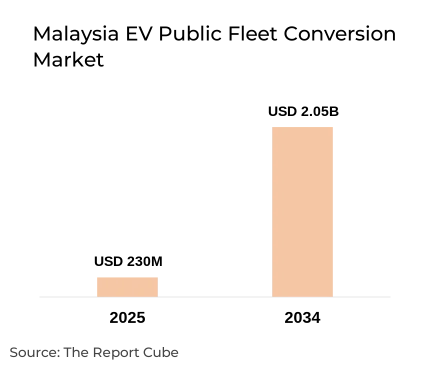
The Malaysia EV Public Fleet Conversion Market is anticipated to register a 27.5% during 2026-34. The market size was valued at USD 230 million in 2025 and is projected to reach USD 2,047.95 million by 2034. Accelerated decarbonization commitments, urban air quality targets, and cost optimization strategies among logistics and mobility operators are reshaping Malaysia’s commercial transport ecosystem.
Malaysia’s transport sector contributes nearly 25% of national greenhouse gas emissions, with commercial fleets accounting for a substantial share of diesel consumption. As fuel price volatility and carbon reduction targets intensify, fleet operators are transitioning toward battery electric vehicles (BEVs) to achieve lower total cost of ownership (TCO). Industry estimates indicate that electric buses and trucks can reduce operating costs by 20-30% over a 10-year lifecycle compared to diesel alternatives, driven by lower fuel and maintenance expenses. These economics are particularly compelling for high-utilization segments such as logistics fleets and ride-hailing platforms.
Infrastructure development is progressing in parallel. High-powered DC charging installations across the North-South Expressway and urban hubs are expanding route feasibility for public fleets. By mid-2025, Malaysia surpassed 2,500 public charging points nationwide, with over 25% classified as DC fast chargers. Strategic collaborations between utilities, oil & gas majors, and mobility platforms are enabling depot charging models tailored to bus and logistics operators. The integration of renewable energy, including solar-ready charging hubs, strengthens the sustainability profile of fleet electrification initiatives.
Government-backed incentives such as import duty exemptions for EV components, green financing schemes, and tax deductions for charging infrastructure are improving investment viability. Public agencies are also piloting electric bus programs in Kuala Lumpur and Putrajaya, signaling long-term procurement pipelines. As fleet operators prioritize ESG alignment and operational efficiency, Malaysia’s EV public fleet conversion landscape is transitioning from pilot-scale deployments to structured, scalable adoption frameworks.
Malaysia EV Public Fleet Conversion Market Dynamics
Key Driver: Cost Efficiency and Carbon Reduction Mandates
Fleet electrification is increasingly driven by cost rationalization and environmental compliance. Diesel prices and maintenance overheads represent major operational expenditures for logistics and bus operators. Electric drivetrains offer fewer moving parts, lowering maintenance costs by up to 40% annually. Carbon reporting obligations under ESG frameworks are also influencing procurement decisions, particularly among publicly listed companies. Government procurement guidelines now favor low-emission vehicles for municipal fleets, accelerating adoption. Financial institutions are offering green loans with preferential rates for EV fleet investments, further enhancing affordability. These combined drivers are creating a strong economic and regulatory foundation for sustained market growth.
Book your FREE 30-minute expert consultation today
Contact UsIndustry Trends: Expansion of High-Powered Charging and Depot Electrification
Charging infrastructure is evolving toward high-capacity solutions suitable for commercial fleets. Deployment of 150kW-200kW DC chargers along expressways reduces downtime for long-haul logistics vehicles. Depot charging systems integrated with smart energy management software are gaining traction among bus and ride-hail operators. Solar-integrated charging hubs are being introduced to offset grid demand and stabilize electricity costs. Digital fleet management platforms now incorporate real-time battery monitoring and predictive maintenance analytics, optimizing route planning and charging schedules. This ecosystem approach enhances reliability and supports scaling from pilot fleets to large commercial operations.
Major Challenge: High Upfront Capital and Grid Capacity Constraints
Initial acquisition costs for electric buses and heavy-duty trucks remain higher than conventional vehicles, with premiums ranging from 25-40%. Charging infrastructure installation requires significant capital investment, especially for high-capacity depot systems. Grid capacity limitations in certain industrial zones may necessitate transformer upgrades, adding project complexity. Battery replacement costs and residual value uncertainties also influence financial modeling. Smaller fleet operators may face financing challenges without structured subsidy support. Addressing these barriers requires coordinated infrastructure planning and expanded access to green financing instruments.
Opportunity: Public-Private Partnerships and Integrated Mobility Platforms
Public-private partnership (PPP) models are emerging as a scalable pathway for fleet electrification. Utilities, charging operators, and fleet companies are co-investing in infrastructure to share capital risks. Integrated digital platforms enabling charging payment interoperability enhance utilization rates and customer convenience. Ride-hailing platforms are incentivizing drivers to adopt EVs through leasing schemes and charging discounts. Electrification of government fleets offers predictable procurement pipelines, creating stable demand for OEMs and infrastructure providers. As PPP frameworks mature, they are expected to accelerate deployment across multiple fleet categories.
Malaysia EV Public Fleet Conversion Market Segment-wise Analysis
By Fleet Type:
- Bus Fleet
- Taxi Fleet
- Ride-Hail Fleet
- Logistics Fleet
- Government Fleet
- Others
Logistics fleets account for approximately 31% of total market revenue in 2025, driven by Malaysia’s role as a regional trade and distribution hub. High daily mileage and predictable routes make delivery trucks ideal for electrification. Operators report fuel cost reductions of up to 35% after transitioning to electric light- and medium-duty trucks. Large logistics companies are piloting electric prime movers for port and warehouse operations, demonstrating commercial feasibility. Government incentives for commercial EV imports further support this segment’s leadership, positioning logistics fleets as the primary growth engine within the market.
By Powertrain:
- Battery Electric
- Plug-in Hybrid
- Fuel Cell Electric
Battery electric vehicles dominate with nearly 72% market share due to falling battery costs and expanding charging infrastructure. Lithium-ion battery pack prices declined below USD 110 per kWh in 2025, improving affordability for fleet buyers. BEVs offer zero tailpipe emissions and lower operating costs, aligning with national carbon reduction goals. Plug-in hybrids maintain niche adoption in transitional fleet applications, while fuel cell electric vehicles remain at pilot stage. Strong policy alignment and infrastructure readiness continue to reinforce BEV dominance across bus, logistics, and government fleets.
Regional Projection of Malaysia EV Public Fleet Conversion Industry
- Northern
- Central
- Southern
- East
- Others
The Central region leads with around 48% market share, anchored by Kuala Lumpur, Selangor, and Putrajaya. Dense urban mobility demand, higher income levels, and concentration of charging infrastructure drive adoption. Public bus electrification pilots and corporate fleet headquarters are primarily located in this region. Northern and Southern corridors are expanding through highway charging hubs supporting intercity logistics. East Malaysia remains in early development stages but is expected to benefit from government-backed infrastructure expansion. Regional deployment patterns closely follow industrial density and charging accessibility.
Malaysia EV Public Fleet Conversion Market Recent Developments
- 2025: Yinson GreenTech and PLUS Malaysia announced Malaysia’s first highway-integrated EV charging hub featuring 20 DC fast chargers with solar-ready infrastructure, enhancing long-distance fleet charging coverage along a major expressway corridor.
- 2025: TNB Electron (Tenaga Nasional) launched a 200kW DC fast charger at BHPetrol Jalan Genting Klang and announced additional high-powered sites, strengthening its network across Peninsular Malaysia for fleet accessibility.
- 2025: Shell Recharge Malaysia partnered with PRO-NET to integrate charging location and payment services into PROTON e.MAS and Hello smart apps, improving accessibility and utilization for private and commercial EV fleets.
- 2025: Swift Haulage Berhad deployed a five-tonne electric truck and planned additional electric prime movers, demonstrating early large-scale logistics fleet electrification and operational cost efficiency.
- 2025: TNB Electron expanded high-speed DC charging deployment along the North-South Expressway, supporting long-distance EV travel and strengthening infrastructure readiness for public and logistics fleets.
Need insights for a specific region within this market?
Request Regional DataWhy Choose This Report?
- Provides a comprehensive overview of the overall market analysis, encompassing key trends, consumer behavior analysis, and risk assessment to support strategic decision-making.
- Provides accurate, up-to-date insights into market size, segmentation, and emerging opportunities, helping to minimize risk & capitalizing on growth.
- Gives deep understanding of target audience preferences, investment habits, and communication channels for enhanced product development & marketing effectiveness.
- Delivers competitive analysis & benchmarking, uncovering the strengths & weaknesses of market competitors to guide strategies.
- Consolidate comprehensive market intelligence, reducing reasoning & streamlining research efforts.
- Facilitates customized market segmentation & risk mitigation strategies, fine-tuned to the business objectives.
- Aids in identifying both market challenges & untapped opportunities within the industry to drive long-term business growth.
- Provides valuable information based on actual customer data & search trends.
Table of Contents
- Introduction
- Objective of the Study
- Product and Category Definition
- Market Segmentation
- Study Variables
- Research Methodology
- Secondary Data Points
- Breakdown of Secondary Sources
- Primary Data Points
- Breakdown of Primary Interviews
- Secondary Data Points
- Executive Summary
- Market Dynamics
- Drivers
- Challenges
- Opportunity Assessment
- Recent Trends and Developments
- Regulatory and Policy Landscape
- Malaysia EV Public Fleet Conversion Market Overview (2021-2034)
- Market Size, By Value (USD Million)
- Market Share, By Fleet Type
- Bus Fleet
- Taxi Fleet
- Ride-Hail Fleet
- Logistics Fleet
- Government Fleet
- Others
- Market Share, By Powertrain
- Battery Electric
- Plug-in Hybrid
- Fuel Cell Electric
- Market Share, By Charging
- Depot Charging
- On-route Charging
- Public Fast Charging
- Destination Charging
- Market Share, By Ownership
- Public Agency
- Private Operator
- Public-Private Model
- Market Share, By Region
- Northern
- Central
- Southern
- East
- Others
- Market Share, By Company
- Revenue Shares & Analysis
- Competitive Landscape
- Northern Malaysia EV Public Fleet Conversion Market
- Market Size, By Value (USD Million)
- Market Share, By Fleet Type
- Market Share, By Powertrain
- Market Share, By Charging
- Market Share, By Ownership
- Central Malaysia EV Public Fleet Conversion Market
- Market Size, By Value (USD Million)
- Market Share, By Fleet Type
- Market Share, By Powertrain
- Market Share, By Charging
- Market Share, By Ownership
- Southern Malaysia EV Public Fleet Conversion Market
- Market Size, By Value (USD Million)
- Market Share, By Fleet Type
- Market Share, By Powertrain
- Market Share, By Charging
- Market Share, By Ownership
- East Malaysia EV Public Fleet Conversion Market
- Market Size, By Value (USD Million)
- Market Share, By Fleet Type
- Market Share, By Powertrain
- Market Share, By Charging
- Market Share, By Ownership
- Competitive Outlook and Company Profiles
- Gentari (Petronas)
- Company Overview
- Product Portfolio
- Strategic Alliances/Partnerships
- Recent Developments
- Yinson GreenTech
- Company Overview
- Product Portfolio
- Strategic Alliances/Partnerships
- Recent Developments
- TNB Electron
- Company Overview
- Product Portfolio
- Strategic Alliances/Partnerships
- Recent Developments
- Sime Darby Motors
- Company Overview
- Product Portfolio
- Strategic Alliances/Partnerships
- Recent Developments
- EV Connection (JomCharge)
- Company Overview
- Product Portfolio
- Strategic Alliances/Partnerships
- Recent Developments
- Solarvest Holdings
- Company Overview
- Product Portfolio
- Strategic Alliances/Partnerships
- Recent Developments
- ChargeSini
- Company Overview
- Product Portfolio
- Strategic Alliances/Partnerships
- Recent Developments
- Swift Haulage Berhad
- Company Overview
- Product Portfolio
- Strategic Alliances/Partnerships
- Recent Developments
- Treeletrik
- Company Overview
- Product Portfolio
- Strategic Alliances/Partnerships
- Recent Developments
- Blueshark Malaysia
- Company Overview
- Product Portfolio
- Strategic Alliances/Partnerships
- Recent Developments
- EP Manufacturing (EPMB)
- Company Overview
- Product Portfolio
- Strategic Alliances/Partnerships
- Recent Developments
- Kumpool (Causeway Link)
- Company Overview
- Product Portfolio
- Strategic Alliances/Partnerships
- Recent Developments
- Mercedes-Benz Malaysia
- Company Overview
- Product Portfolio
- Strategic Alliances/Partnerships
- Recent Developments
- BMW Group Malaysia
- Company Overview
- Product Portfolio
- Strategic Alliances/Partnerships
- Recent Developments
- Volvo Car Malaysia
- Company Overview
- Product Portfolio
- Strategic Alliances/Partnerships
- Recent Developments
- Shell Recharge
- Company Overview
- Product Portfolio
- Strategic Alliances/Partnerships
- Recent Developments
- myChargepoint (Infra Tenaga)
- Company Overview
- Product Portfolio
- Strategic Alliances/Partnerships
- Recent Developments
- Others
- Gentari (Petronas)
- Contact Us and Disclaimer
Top Key Players & Market Share Outlook
- Gentari (Petronas)
- Yinson GreenTech
- TNB Electron
- Sime Darby Motors
- EV Connection (JomCharge)
- Solarvest Holdings
- ChargeSini
- Swift Haulage Berhad
- Treeletrik
- Blueshark Malaysia
- EP Manufacturing (EPMB)
- Kumpool (Causeway Link)
- Mercedes-Benz Malaysia
- BMW Group Malaysia
- Volvo Car Malaysia
- Shell Recharge
- myChargepoint (Infra Tenaga)
- Others
Frequently Asked Questions






