



Build Your Custom Market Intelligence Report
Customize Your ReportMalaysia EV Battery Supply Chain Market Key Highlights
By Stage:
Cell Manufacturing segment leads the market, with around 31% share.
By Battery Type:
Li-ion Cells segment dominates the market, accounting for nearly 44% of total revenue.
Regional Outlook:
Northern region dominates the malaysia ev battery supply chain market, with around 36% share.
Government Initiatives & Policies
- National Automotive Policy (NAP 2020): Framework promoting Energy Efficient Vehicles (EEVs), EV localization, and advanced battery manufacturing incentives.
- Low Carbon Mobility Blueprint 2021-2030: National strategy accelerating EV adoption, battery ecosystem growth, and charging infrastructure expansion.
Malaysia EV Battery Supply Chain Market Insights & Analysis
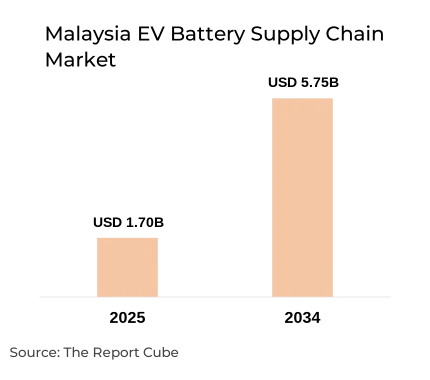
The Malaysia EV Battery Supply Chain Market is anticipated to register a 14.5% during 2026-34. The market size was valued at USD 1.7 billion in 2025 and is projected to reach USD 5.75 billion by 2034. Malaysia is steadily advancing its position as a regional hub for EV battery manufacturing and energy storage systems, supported by strong electronics manufacturing expertise and established semiconductor ecosystems.
Over the past three years, Malaysia has attracted more than USD 4 billion in announced investments across battery cell production, pack assembly, EV assembly, and recycling infrastructure. Kulim, Kedah, and Perak have emerged as strategic battery corridors, benefiting from industrial parks, export-friendly logistics, and skilled labor pools. The country’s strong track record in electrical and electronics exports, which accounts for nearly 40% of total manufacturing exports, provides a foundation for high-quality battery component manufacturing. Tax incentives under NAP 2020 and green investment tax allowances have encouraged global players to establish regional bases. In parallel, EV registrations in Malaysia grew by more than 80% year-on-year in 2024, increasing demand for locally assembled battery packs. Public-private partnerships are also supporting charging infrastructure rollout, integrating battery energy storage systems to overcome grid constraints. Malaysia’s diversified industrial base and stable regulatory framework are positioning it as a competitive Southeast Asian supply chain partner.
Malaysia EV Battery Supply Chain Market Dynamics
Key Driver: Strong Electronics Manufacturing Ecosystem and Export Orientation
Malaysia’s well-developed electrical and electronics sector serves as a key growth engine for the EV battery supply chain. The country contributes nearly 7% of global semiconductor trade, offering advanced automation capabilities, precision engineering, and quality control standards essential for lithium-ion cell production. Existing expertise in PCB assembly, power electronics, and thermal management supports pack assembly and system integration activities. Export-oriented industrial zones enable efficient access to ASEAN, China, and European markets. Furthermore, Malaysia’s free trade agreements reduce tariff barriers, making locally manufactured battery systems cost competitive. Skilled technical talent and established supplier networks shorten lead times for new plant commissioning, strengthening Malaysia’s position as a preferred investment destination.
Book your FREE 30-minute expert consultation today
Contact UsIndustry Trends: Expansion of Energy Storage Systems and LFP Localization
A key trend shaping the Malaysia EV Battery Supply Chain Market is the rapid expansion of battery energy storage systems (BESS) to support EV charging networks. Grid capacity constraints in urban centers have accelerated demand for modular storage systems integrated with fast chargers. Locally assembled BESS solutions are increasingly incorporating second-life EV batteries, improving cost efficiency. Another significant trend is the growing adoption of LFP chemistry for both EV and stationary storage applications. LFP batteries offer improved thermal stability and lower material costs, aligning with Southeast Asia’s tropical climate conditions. Investment in localized cathode supply agreements ensures long-term production security. This shift supports Malaysia’s ambition to become a manufacturing base for both automotive and energy storage markets.
Major Challenge: Limited Upstream Raw Material Resources
Malaysia lacks significant domestic lithium and nickel reserves, increasing reliance on imported raw materials. This dependency exposes manufacturers to global commodity price fluctuations and supply chain disruptions. Logistics costs for imported battery-grade materials can account for 10-15% of production expenses. While recycling initiatives are emerging, feedstock volumes remain limited due to the early stage of EV penetration. Competition from neighboring countries with larger mineral reserves may also constrain upstream integration opportunities. Addressing these limitations will require strategic partnerships and long-term supply contracts.
Opportunity: Regional EV Assembly Growth and Recycling Capacity Expansion
Malaysia’s growing EV assembly ecosystem presents strong downstream opportunities. CKD and locally assembled EV programs are expected to expand steadily through 2030, increasing domestic battery pack demand. The recycling segment is also gaining traction, with processing capacities projected to exceed 25,000 tonnes annually by 2027. Establishing closed-loop battery material recovery systems can reduce import dependency and enhance sustainability credentials. Government-backed green financing and ESG-driven investments further strengthen growth prospects. Malaysia’s strategic location and logistics connectivity position it to serve as an export platform for ASEAN EV markets.
Malaysia EV Battery Supply Chain Market Segment-wise Analysis
By Stage:
- Raw Materials
- Cell Manufacturing
- Pack Assembly
- System Integration
- Recycling & Reuse
Cell Manufacturing leads the market with approximately 31% revenue share in 2025. Malaysia’s advanced electronics infrastructure supports high-volume lithium-ion cell production with strong quality benchmarks. Industrial zones in Kedah and Penang host automated cell production lines capable of exceeding 12 GWh annual capacity. Investments in precision coating, electrolyte filling, and formation processes have improved energy density and cycle life performance. Export contracts for stationary storage and EV battery cells contribute significantly to revenue concentration in this stage.
By Battery Type:
- Li-ion Cells
- LFP Cells
- NMC Cells
- Lead-acid Packs
- Others
Li-ion Cells dominate the market with nearly 44% share due to their versatility across passenger EVs, commercial vehicles, and stationary storage. Their higher energy density and established supply chain ecosystem make them preferred for long-range EV models. Malaysia’s established battery brands and international partnerships ensure consistent quality standards. Although LFP adoption is rising, Li-ion cells continue to generate higher revenue contributions due to diversified application coverage.
Regional Projection of Malaysia EV Battery Supply Chain Industry
- Northern
- Central
- Southern
- East
- Others
The Northern region dominates with around 36% share, driven by industrial hubs in Kedah and Penang. Kulim Industrial Park has become a focal point for battery manufacturing investments exceeding USD 1.5 billion since 2023. The region benefits from strong logistics connectivity to Penang Port and Thailand borders, supporting export growth. Skilled labor availability and integrated supplier ecosystems accelerate production scale-up. Central and Southern regions are emerging as pack assembly and EV integration centers, supporting balanced geographic expansion.
Malaysia EV Battery Supply Chain Market Recent Developments
- 2025: EVE Energy Malaysia approved an investment of up to RMB 8.65 billion (around USD 1.2 billion) to develop a second-phase energy storage battery plant in Kulim, expanding capacity by 10-15 GWh annually and strengthening Malaysia’s export-oriented battery production base.
- 2025: BYD Malaysia confirmed plans to establish a CKD EV assembly plant in Tanjong Malim, Perak, targeting construction commencement by end-August 2025 to leverage local EV incentives and stimulate broader supply chain development.
- 2025: NexV Manufacturing signed an MoU with Global NEV Technology to explore CKD commercial EV assembly, with its Negeri Sembilan facility set to commence operations in Q2 2025, enhancing regional EV component demand.
- 2025: Econili announced progress in establishing Malaysia’s largest EV battery recycling facility in Perak, targeting up to 24,000 tonnes annual processing capacity and reinforcing sustainable material recovery initiatives.
Need insights for a specific region within this market?
Request Regional DataWhy Choose This Report?
- Provides a comprehensive overview of the overall market analysis, encompassing key trends, consumer behavior analysis, and risk assessment to support strategic decision-making.
- Provides accurate, up-to-date insights into market size, segmentation, and emerging opportunities, helping to minimize risk & capitalizing on growth.
- Gives deep understanding of target audience preferences, investment habits, and communication channels for enhanced product development & marketing effectiveness.
- Delivers competitive analysis & benchmarking, uncovering the strengths & weaknesses of market competitors to guide strategies.
- Consolidate comprehensive market intelligence, reducing reasoning & streamlining research efforts.
- Facilitates customized market segmentation & risk mitigation strategies, fine-tuned to the business objectives.
- Aids in identifying both market challenges & untapped opportunities within the industry to drive long-term business growth.
- Provides valuable information based on actual customer data & search trends.
Table of Contents
- Introduction
- Objective of the Study
- Product and Category Definition
- Market Segmentation
- Study Variables
- Research Methodology
- Secondary Data Points
- Breakdown of Secondary Sources
- Primary Data Points
- Breakdown of Primary Interviews
- Secondary Data Points
- Executive Summary
- Market Dynamics
- Drivers
- Challenges
- Opportunity Assessment
- Recent Trends and Developments
- Regulatory and Policy Landscape
- Malaysia EV Battery Supply Chain Market Overview (2021-2034)
- Market Size, By Value (USD Billion)
- Market Share, By Stage
- Raw Materials
- Cell Manufacturing
- Pack Assembly
- System Integration
- Recycling & Reuse
- Market Share, By Battery Type
- Li-ion Cells
- LFP Cells
- NMC Cells
- Lead-acid Packs
- Others
- Market Share, By Application
- Passenger EV
- Commercial EV
- Two/Three Wheeler
- Off-Highway EV
- Stationary Storage
- Market Share, By End User
- Automakers
- Tier-1 Suppliers
- Energy Utilities
- Fleet Operators
- Others
- Market Share, By Region
- Northern
- Central
- Southern
- East
- Others
- Market Share, By Company
- Revenue Shares & Analysis
- Competitive Landscape
- Northern Malaysia EV Battery Supply Chain Market
- Market Size, By Value (USD Billion/Million)
- Market Share, By Stage
- Market Share, By Battery Type
- Market Share, By Application
- Market Share, By End User
- Central Malaysia EV Battery Supply Chain Market
- Market Size, By Value (USD Billion/Million)
- Market Share, By Stage
- Market Share, By Battery Type
- Market Share, By Application
- Market Share, By End User
- Southern Malaysia EV Battery Supply Chain Market
- Market Size, By Value (USD Billion/Million)
- Market Share, By Stage
- Market Share, By Battery Type
- Market Share, By Application
- Market Share, By End User
- East Malaysia EV Battery Supply Chain Market
- Market Size, By Value (USD Billion/Million)
- Market Share, By Stage
- Market Share, By Battery Type
- Market Share, By Application
- Market Share, By End User
- Competitive Outlook and Company Profiles
- EVE Energy Malaysia
- Company Overview
- Product Portfolio
- Strategic Alliances/Partnerships
- Recent Developments
- Samsung SDI Energy
- Company Overview
- Product Portfolio
- Strategic Alliances/Partnerships
- Recent Developments
- Panasonic Energy
- Company Overview
- Product Portfolio
- Strategic Alliances/Partnerships
- Recent Developments
- BYD Malaysia
- Company Overview
- Product Portfolio
- Strategic Alliances/Partnerships
- Recent Developments
- AESC (Envision)
- Company Overview
- Product Portfolio
- Strategic Alliances/Partnerships
- Recent Developments
- NexV Manufacturing
- Company Overview
- Product Portfolio
- Strategic Alliances/Partnerships
- Recent Developments
- EP Manufacturing
- Company Overview
- Product Portfolio
- Strategic Alliances/Partnerships
- Recent Developments
- TDK (Malaysia)
- Company Overview
- Product Portfolio
- Strategic Alliances/Partnerships
- Recent Developments
- Century Battery
- Company Overview
- Product Portfolio
- Strategic Alliances/Partnerships
- Recent Developments
- Econili (Recycling)
- Company Overview
- Product Portfolio
- Strategic Alliances/Partnerships
- Recent Developments
- JYC Battery
- Company Overview
- Product Portfolio
- Strategic Alliances/Partnerships
- Recent Developments
- GP Batteries
- Company Overview
- Product Portfolio
- Strategic Alliances/Partnerships
- Recent Developments
- ABM Fujiya
- Company Overview
- Product Portfolio
- Strategic Alliances/Partnerships
- Recent Developments
- EnerSys Malaysia
- Company Overview
- Product Portfolio
- Strategic Alliances/Partnerships
- Recent Developments
- International Battery Center
- Company Overview
- Product Portfolio
- Strategic Alliances/Partnerships
- Recent Developments
- Yinson GreenTech
- Company Overview
- Product Portfolio
- Strategic Alliances/Partnerships
- Recent Developments
- Gentari (Petronas)
- Company Overview
- Product Portfolio
- Strategic Alliances/Partnerships
- Recent Developments
- Others
- EVE Energy Malaysia
- Contact Us and Disclaimer
Top Key Players & Market Share Outlook
- EVE Energy Malaysia
- Samsung SDI Energy
- Panasonic Energy
- BYD Malaysia
- AESC (Envision)
- NexV Manufacturing
- EP Manufacturing
- TDK (Malaysia)
- Century Battery
- Econili (Recycling)
- JYC Battery
- GP Batteries
- ABM Fujiya
- EnerSys Malaysia
- International Battery Center
- Yinson GreenTech
- Gentari (Petronas)
- Others
Frequently Asked Questions






