



Build Your Custom Market Intelligence Report
Customize Your ReportJapan Genomic Medicine Market Key Highlights
By Product Type:
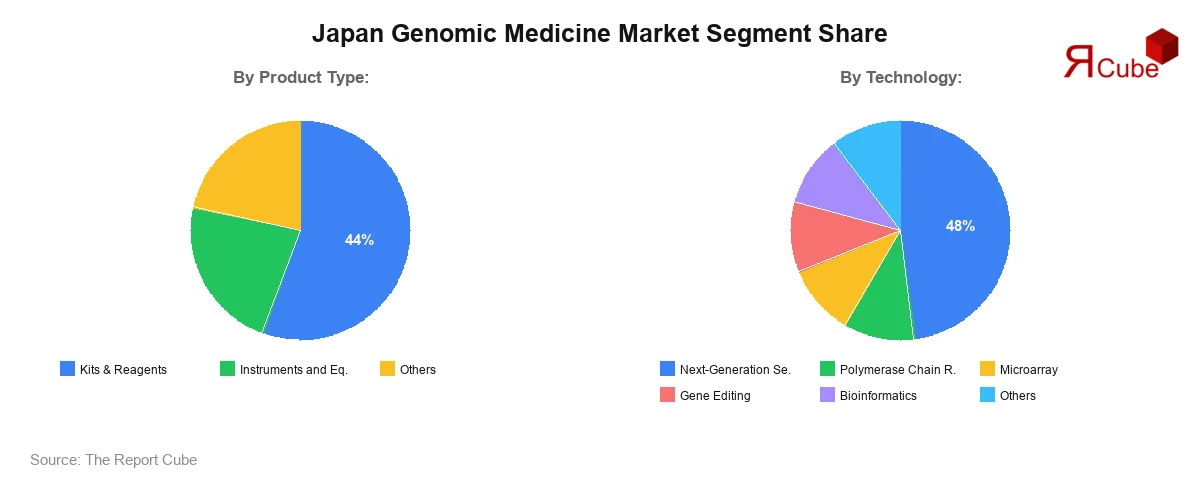
Kits & Reagents segment leads the market with nearly 44% market share.
By Application:
Oncology segment dominates the market with around 41% of revenue.
Regional Outlook:
Honshu region dominates the Japan Genomic Medicine market with approximately 68% share.
Japan Genomic Medicine Market Insights & Analysis
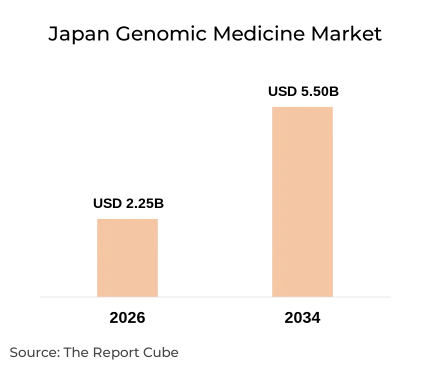
The Japan Genomic Medicine Market is anticipated to register a CAGR of around 11.8% during the forecast period 2026-2034. The market size is valued at USD 2.25 billion in 2026 and is projected to reach USD 5.50 billion by 2034. The Japan genomic medicine market growth is strongly supported by the country’s advanced healthcare infrastructure and consistent investments in precision medicine programs. National initiatives such as genome sequencing projects and cancer profiling programs have expanded access to genomic diagnostics across hospitals and research institutions. In recent years, more than 70% of tertiary hospitals in Japan have adopted next-generation sequencing platforms, improving early disease detection and targeted therapy selection.
In addition, collaborations between biotechnology firms and academic institutions are accelerating innovation in sequencing technologies and bioinformatics tools. Companies are investing in high-throughput sequencing platforms and AI-based genomic interpretation, which enhances diagnostic accuracy and reduces turnaround time by nearly 30%. The rising burden of cancer, accounting for over 28% of total deaths in Japan, continues to fuel demand for genomic-based diagnostics. This evolving ecosystem is significantly strengthening Japan genomic medicine market size, revenue expansion, and long-term clinical adoption.
Japan Genomic Medicine Market Dynamics
Key Driver: Rising Demand for Precision Oncology and Targeted Therapies
The increasing prevalence of cancer and chronic diseases in Japan is a major driver shaping the Japan genomic medicine market trends. Oncology alone contributes to a significant portion of healthcare expenditure, encouraging the adoption of genomic profiling tools for personalized treatment strategies. Studies indicate that over 60% of oncologists in Japan now rely on genomic testing to guide therapy decisions, especially for rare and complex tumor types. This shift toward precision oncology ensures improved patient outcomes and reduced trial-and-error treatments.
Furthermore, advancements in sequencing technologies such as next-generation sequencing have significantly lowered the cost per genome, making genomic diagnostics more accessible. The cost of sequencing has declined by nearly 40% over the past five years, enabling broader integration into clinical workflows. As healthcare providers focus on outcome-based care models, genomic medicine continues to gain traction as a reliable and cost-efficient solution.
Book your FREE 30-minute expert consultation today
Contact UsIndustry Trends: Integration of AI and Bioinformatics in Genomic Analysis
A key trend influencing the Japan genomic medicine market growth is the integration of artificial intelligence with genomic data analysis. AI-powered platforms are enhancing the interpretation of complex genetic datasets, enabling faster and more accurate diagnosis. In Japan, the adoption of AI in genomics has increased by approximately 35% since 2023, reflecting growing reliance on automated data interpretation systems.
Additionally, bioinformatics tools are evolving rapidly, supporting large-scale genomic data storage and analysis. Research institutions are leveraging cloud-based genomic databases to improve collaboration and accelerate discoveries. This trend is also helping pharmaceutical companies develop targeted therapies with higher success rates, further boosting the Japan genomic medicine market value and technological advancement.
Major Challenge: High Cost and Data Management Complexity
The Japan genomic medicine market faces challenges related to the high cost of advanced genomic technologies and infrastructure requirements. Establishing genomic laboratories requires significant investment in sequencing instruments, reagents, and skilled professionals. For smaller healthcare facilities, these costs can be a barrier to adoption, limiting market penetration in certain regions.
Another major concern is the management of large-scale genomic data. Handling sensitive patient data requires robust cybersecurity frameworks and compliance with strict regulatory standards. Data storage, processing, and interpretation add operational complexity, which can slow down implementation in clinical settings. These factors collectively restrain the overall Japan genomic medicine market growth to some extent.
Opportunity: Expansion of Personalized Healthcare and Preventive Genomics
The shift toward preventive healthcare presents significant opportunities for the Japan genomic medicine market. Genetic screening programs are increasingly being used to identify disease risks at an early stage, allowing timely intervention and reducing long-term healthcare costs. Preventive genomics is gaining popularity among younger populations, contributing to expanding market demand.
Moreover, partnerships between pharmaceutical companies and genomic research firms are creating new opportunities for drug development. Personalized medicine approaches are expected to improve treatment efficacy by nearly 50% compared to traditional therapies. As awareness about genomic healthcare increases, the market is likely to witness strong adoption across both clinical and consumer segments.
Japan Genomic Medicine Market Segment-wise Analysis
By Product Type:
- Kits & Reagents
- NGS Library Preparation Kits
- PCR Assay Kits
- DNA/RNA Extraction Reagents
- Target Enrichment Kits
- Quality Control Reagents
- Instruments and Equipment
- Next-Generation Sequencers
- Real-Time PCR Systems
- Microarray Scanners
- Automated Sample Prep Systems
- Capillary Electrophoresis Systems
- Others
- Consumables
- Accessories
- Ancillary Lab Equipment
The kits & reagents segment dominates the Japan genomic medicine market share, accounting for nearly 44% in 2026. This dominance is linked to the recurring demand for consumables in genomic workflows, particularly in sequencing and PCR-based applications. Laboratories require continuous replenishment of reagents for sample preparation, amplification, and analysis, ensuring steady revenue generation.
The increasing number of diagnostic tests performed annually, estimated to exceed 15 million genomic tests by 2027 in Japan, further supports segment growth. Additionally, advancements in reagent chemistry are improving test accuracy and efficiency, strengthening their adoption across hospitals and research labs.
By Technology:
- Next-Generation Sequencing (NGS)
- Polymerase Chain Reaction (PCR)
- Microarray
- Gene Editing
- Bioinformatics
- Others
Next-generation sequencing (NGS) leads the technology segment with approximately 48% market share, driven by its ability to deliver high-throughput and cost-effective genomic analysis. NGS enables simultaneous sequencing of multiple genes, making it highly suitable for oncology and rare disease diagnostics.
In Japan, the adoption of NGS has increased significantly due to government-supported genome projects and clinical research initiatives. The technology also supports precision medicine by enabling detailed genetic profiling, which is essential for targeted therapies. Continuous improvements in sequencing speed and data accuracy further reinforce its leadership in the Japan genomic medicine market.
Regional Projection of Japan Genomic Medicine Industry
- Hokkaido
- Honshu
- Shikoku
- Kyushu
Honshu holds the largest share in the Japan genomic medicine market, contributing around 68% of total revenue. This dominance is attributed to the concentration of advanced healthcare facilities, research institutions, and biotechnology companies in major cities such as Tokyo and Osaka. Honshu is home to leading genomic research centers and accounts for over 70% of clinical genomic trials conducted in Japan. The region also benefits from strong government funding and public-private partnerships that support innovation in precision medicine. High patient awareness and access to advanced diagnostics further accelerate market growth in this region.
Government Initiatives & Policies
- Japan Genome Project Initiative: Government-backed program expanding nationwide genomic sequencing and personalized medicine research.
- AMED Precision Medicine Program: Supports genomic data integration and clinical applications through funding and research collaboration.
Japan Genomic Medicine Industry Recent Developments
- 2025: Illumina, Inc. launched an AI-powered genome analysis platform in collaboration with Japanese institutions, improving sequencing accuracy and enabling faster real-time genomic data interpretation.
- 2025: Chugai Pharmaceutical Co., Ltd. received regulatory approval for FoundationOne CDx as a companion diagnostic for targeted cancer therapy, strengthening genomic testing adoption in oncology.
Need insights for a specific region within this market?
Request Regional DataWhy Choose This Report?
- Provides a comprehensive overview of the overall market analysis, encompassing key trends, consumer behavior analysis, and risk assessment to support strategic decision-making.
- Provides accurate, up-to-date insights into market size, segmentation, and emerging opportunities, helping to minimize risk & capitalizing on growth.
- Gives deep understanding of target audience preferences, investment habits, and communication channels for enhanced product development & marketing effectiveness.
- Delivers competitive analysis & benchmarking, uncovering the strengths & weaknesses of market competitors to guide strategies.
- Consolidate comprehensive market intelligence, reducing reasoning & streamlining research efforts.
- Facilitates customized market segmentation & risk mitigation strategies, fine-tuned to the business objectives.
- Aids in identifying both market challenges & untapped opportunities within the industry to drive long-term business growth.
- Provides valuable information based on actual customer data & search trends.
Table of Contents
- Introduction
- Objective of the Study
- Product and Category Definition
- Market Segmentation
- Study Variables
- Research Methodology
- Secondary Data Points
- Breakdown of Secondary Sources
- Primary Data Points
- Breakdown of Primary Interviews
- Secondary Data Points
- Executive Summary
- Market Dynamics
- Drivers
- Challenges
- Opportunity Assessment
- Recent Trends and Developments
- Regulatory and Policy Landscape
- Japan Genomic Medicine Market Overview (2021-2034)
- Market Size, By Value (USD Billion)
- Market Share, By Product Type
- Kits & Reagents
- NGS Library Preparation Kits
- PCR Assay Kits
- DNA/RNA Extraction Reagents
- Target Enrichment Kits
- Quality Control Reagents
- Instruments and Equipment
- Next-Generation Sequencers
- Real-Time PCR Systems
- Microarray Scanners
- Automated Sample Prep Systems
- Capillary Electrophoresis Systems
- Others
- Consumables
- Accessories
- Ancillary Lab Equipment
- Kits & Reagents
- Market Share, By Technology
- Next-Generation Sequencing (NGS)
- Polymerase Chain Reaction (PCR)
- Microarray
- Gene Editing
- Bioinformatics
- Others
- Market Share, By Application
- Oncology
- Cardiology
- Pediatrics
- Endocrinology
- Infectious Diseases
- Others
- Market Share, By End User
- Hospitals & Clinics
- Academic Institutions
- Research Institutions
- Market Share, By Region
- Hokkaido
- Honshu
- Shikoku
- Kyushu
- Market Share, By Company
- Revenue Shares & Analysis
- Competitive Landscape
- Hokkaido Genomic Medicine Market
- Market Size, By Value (USD Billion/Million)
- Market Share, By Product Type
- Market Share, By Technology
- Market Share, By Application
- Market Share, By End User
- Honshu Genomic Medicine Market
- Market Size, By Value (USD Billion/Million)
- Market Share, By Product Type
- Market Share, By Technology
- Market Share, By Application
- Market Share, By End User
- Shikoku Genomic Medicine Market
- Market Size, By Value (USD Billion/Million)
- Market Share, By Product Type
- Market Share, By Technology
- Market Share, By Application
- Market Share, By End User
- Kyushu Genomic Medicine Market
- Market Size, By Value (USD Billion/Million)
- Market Share, By Product Type
- Market Share, By Technology
- Market Share, By Application
- Market Share, By End User
- Competitive Outlook and Company Profiles
- QIAGEN
- Company Overview
- Product Portfolio
- Strategic Alliances/Partnerships
- Recent Developments
- Eurofins Scientific
- Company Overview
- Product Portfolio
- Strategic Alliances/Partnerships
- Recent Developments
- Illumina, Inc.
- Company Overview
- Product Portfolio
- Strategic Alliances/Partnerships
- Recent Developments
- Thermo Fisher Scientific Inc.
- Company Overview
- Product Portfolio
- Strategic Alliances/Partnerships
- Recent Developments
- Agilent Technologies, Inc.
- Company Overview
- Product Portfolio
- Strategic Alliances/Partnerships
- Recent Developments
- Oxford Nanopore Technologies plc.
- Company Overview
- Product Portfolio
- Strategic Alliances/Partnerships
- Recent Developments
- Takara Bio Inc
- Company Overview
- Product Portfolio
- Strategic Alliances/Partnerships
- Recent Developments
- Chugai Pharmaceutical Co., Ltd.
- Company Overview
- Product Portfolio
- Strategic Alliances/Partnerships
- Recent Developments
- RIKEN GENESIS CO., LTD.
- Company Overview
- Product Portfolio
- Strategic Alliances/Partnerships
- Recent Developments
- Others
- QIAGEN
- Contact Us and Disclaimer
Top Key Players & Market Share Outlook
- QIAGEN
- Eurofins Scientific
- Illumina, Inc.
- Thermo Fisher Scientific Inc.
- Agilent Technologies, Inc.
- Oxford Nanopore Technologies plc.
- Takara Bio Inc
- Chugai Pharmaceutical Co., Ltd.
- RIKEN GENESIS CO., LTD.
Frequently Asked Questions






